






























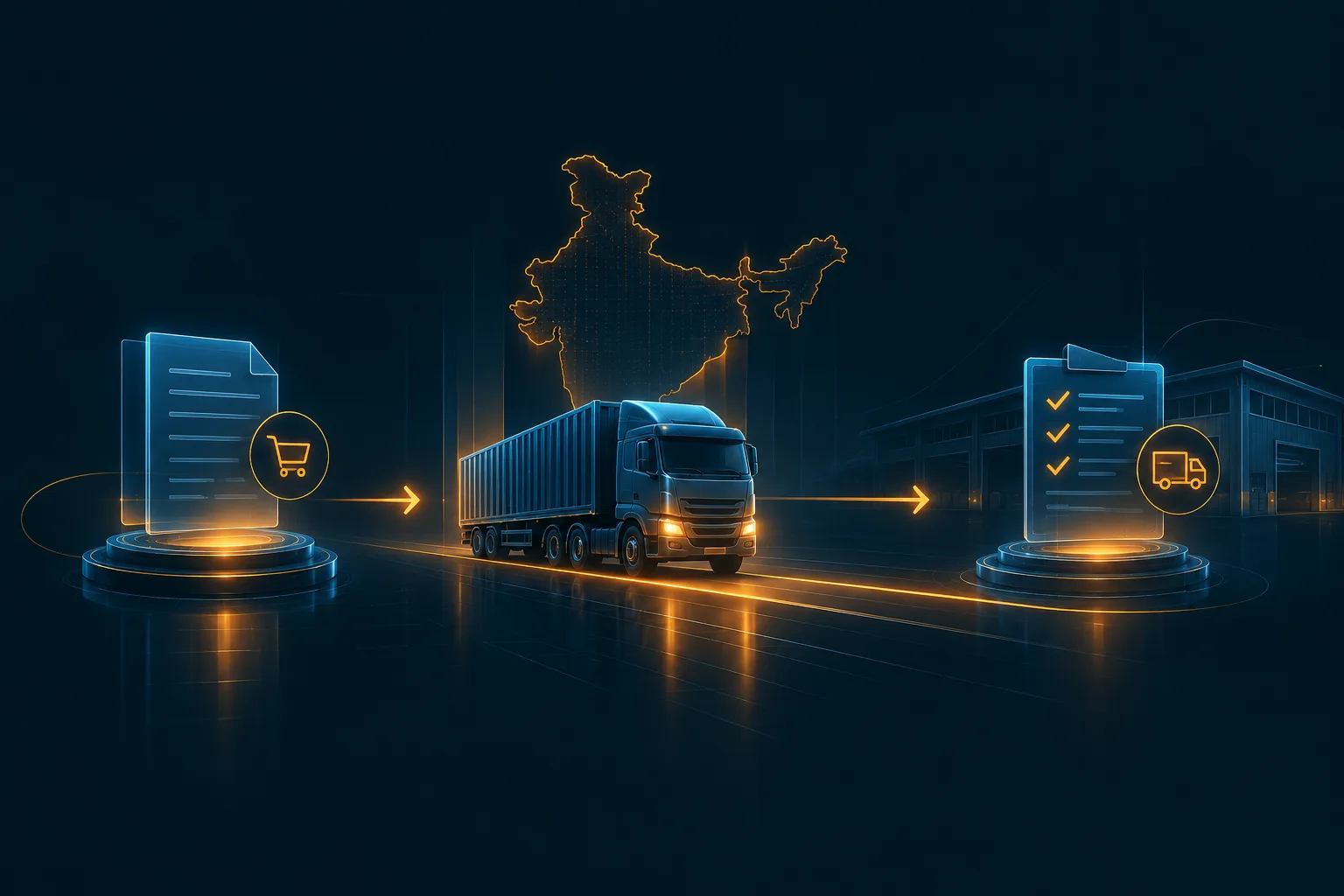
A purchase order says one thing and the truck does another. Your customer in Ahmedabad places the order, but asks you to deliver straight to their own customer in Indore. One invoice, one movement of goods, three parties, and two states in the middle of it.
This is the everyday reality of a bill to ship to e way bill, and it is where a lot of avoidable GST errors start. The wrong party in the wrong field can mean the wrong tax type, a mismatch at reconciliation, or a vehicle held at a check post.
There is also a 2026 twist. GSTN has set a Mandatory Ship-to GSTIN Validation for this transaction, pushed its date back once, and now has postponed it indefinitely. This article deals with the details of the transaction process, capturing details of the transaction, and handling this change without any speculation.
When Bill-to/Ship-to E-Way Bill Applies
This refers to a situation where the bill goes to one person while the products go to someone else based on instructions from the buyer. GSTN’s FAQ explains it as: A Ltd. issues an invoice to B Ltd., but it delivers the product to C Ltd. based on the instructions of B Ltd.
It is better to distinguish it from its neighbors because the portal has four transaction types, and they get confused:
- Regular: Billing and movement take place between the same two parties.
- Bill-to/Ship-to: The supplier invoices the buyer, and the products are shipped to a third party chosen by the buyer.
- Bill-from/Dispatch-from: The supplier invoices the buyer but dispatches the products from a third party’s premises.
- Combination: Both happen simultaneously. The products are dispatched from one third party and received by another.
One trap deserves a mention early. In the case when your client simply requires delivery of goods to his warehouse or extra office, it doesn’t represent a Bill-to/Ship-to situation. GSTIN is the same on both sides, so it is a regular supply with a different delivery address. GSTN’s FAQs say this directly, and ERP teams that default every “deliver to” address into the Ship-to block end up generating the wrong transaction type.
Parties, Data and Documents
Three parties, and each one has a role the system cares about.
The supplier raises the invoice and is the Bill-from party. The buyer is the Bill-to party, the one who placed the order and who is billed. The consignee is the Ship-to party, the one who receives the goods. Where goods start from a different place than the supplier’s billing address, a Dispatch-from address comes into play as well.
For the e-Way Bill, a few data points matter more than the rest:
- GSTIN and legal or trade name of the Bill-from and Bill-to parties
- Dispatch-from address, if different from Bill-from
- Ship-to address and PIN code
- Ship-to GSTIN, or “URP” where applicable (more on the status of this below)
- HSN, value and tax breakup, which must agree with the invoice
- Document number and date
Who generates the e-Way Bill matters too. The Press Information Bureau clarified back in April 2018 that only one e-Way Bill is needed for the movement, and that either the supplier or the buyer can generate it. The fields in Part A change depending on who does. When the supplier generates it, the supplier sits in Bill-from, the buyer in Bill-to, and the consignee’s address in Ship-to. When the buyer generates it, the field mapping shifts, and the portal treats it as an inward transaction.
That second route has a practical use. GSTN’s July 2026 FAQs note that a buyer who does not want to share the consignee’s GSTIN with the supplier can generate the e-Way Bill themselves and enter it directly.
Transaction Flow
It will be easy to understand using an example.
A supplier based in Pune supplies his goods to a distributor located in Ahmedabad. The distributor has already sold them on to a retailer in Indore and wants the goods delivered there directly. The supplier raises the invoice on the distributor and sends the goods to Indore.
Invoice 1: Pune supplier to Ahmedabad distributor. This is the invoice the supplier reports. Movement: Pune to Indore, in one go. Invoice 2: Ahmedabad distributor to Indore retailer, raised separately by the distributor.
System Actions and Status Changes
The process would be similar to the following when using an e-Way Bill solution, portal or API:
- The generator picks the type of transaction as “Bill to/Ship To” (or sends the same via the API/e-Invoice route).
- Part A is filled with the parties, addresses, document details and goods.
- Part B, the vehicle or transport details, is added when the goods are ready to move.
- The system issues the e-Way Bill number and the validity clock starts once Part B is in.
If the e-Way Bill is created based on the e-Invoice, then the type of transaction is determined by the addresses available in the IRN payload. When there are addresses like Bill-from, Bill-to, and Ship-to, then there will be Bill-to/Ship-to. Add a Dispatch-from address and you get the combination type.
Checks Before Submission or Dispatch
Short list that your dispatch or billing desk can really use:
- Is the Ship-to party really a separate individual from the Bill-to party? In case the GSTIN is identical, it is a normal supply..
- Is the Ship-to Address & PIN Code that of the state that you have talked about?
- Does the e-Way Bill value and tax breakup match the invoice?
- Has HSN been validated at the required digit level? Our note on HSN validation for e-Way Bills covers what the portal checks.
- Is the same eway bill validation logic applied whether the document is raised in the ERP, on the portal, or through an API?
Corrections, Cancellations and Edge Cases
This is where Bill to Ship to transactions get problematic since an alteration in one affects the other.
Wrong Ship-to address. Part A cannot be edited once generated. In case there is a change in the consignee, the normal process is to cancel and make a new booking during the allowed time limit or make a change of destination using Part B for those changes which involve only transport or vehicle change. Do check with the rules currently present on the portal before doing this.
Consignee changes mid-transit. The buyer diverts the shipment to a different consignee. The e-Way Bill no longer matches reality. This one needs a fresh document and a tax review of the invoice trail, not just a data fix.
Exports. This is the one that surprises people. In an export where goods are billed to an overseas buyer but move domestically to a port, airport, ICD, CFS or other export-linked location, Bill-to/Ship-to can still arise. GSTN’s FAQs propose “URP” as the Ship-to GSTIN where there is no domestic registered Ship-to, and they are clear that URP in this context is a system-level entry and does not turn the supply into a domestic sale to an unregistered person. The nature of the export is decided by the export invoice, shipping bill and customs records.
Merchant exporters. If goods are billed to a registered merchant exporter and move directly to an export-linked location, the merchant exporter’s GSTIN is the Bill-to GSTIN, and the Ship-to GSTIN is captured where that location is registered.
How is GST Determined When the Billing State and Delivery State are Different?
This is the question most teams get wrong, so it deserves a straight answer.
Under Section 10(1)(b) of the IGST Act, where goods are delivered on the direction of a third person, that person is treated as having received them. The place of supply of the first invoice is the principal place of business of that third person, the buyer. It is not where the truck unloads.
So in our example, the Pune supplier looks at Pune against Ahmedabad. Those are different states, so the first invoice carries IGST, even though the goods end up in Indore. If the buyer had also been in Maharashtra and the consignee in Madhya Pradesh, the first invoice would still be CGST and SGST, because the buyer’s location governs.
The second invoice, from the distributor to the retailer, is tested separately against the distributor’s location and the retailer’s location. Each invoice stands on its own.
On input tax credit, the explanation to Section 16 of the CGST Act deems goods to be received by the buyer where they are delivered to another person on the buyer’s direction. That is why the buyer can claim credit on the first invoice even though the goods never reached their premises, subject to the usual conditions. (Pending source validation against the Acts on the India Code portal before external publication.)
ERP and Workflow Controls
Most Bill-to/Ship-to problems are master data problems. The e-Way Bill is just where they show up.
A few controls that tend to pay for themselves:
- A separate ship-to master. Maintain the consignee places separately as records with GSTIN, state code, and PIN code tied up with the customer. Don’t depend on any free text for delivery addresses.
- A transaction-type rule in the ERP. In case the value of Bill to GSTIN is same as that of Ship to GSTIN, the process should be a normal one rather than letting the user choose Bill to/Ship to out of habit.
- State and PIN consistency checks. GSTN’s API FAQs list validations that tie the Ship-to state code to the GSTIN and the PIN code to the state. Running the same check in your ERP means errors are caught at the invoice desk and not at the dispatch gate.
- A named owner for exceptions. When an e-Way Bill fails, someone in logistics or tax should be the one who sees it the same day.
Cygnet.One teams working on GST filing workflows see the same pattern repeatedly. The compliance risk is rarely in the rule. It sits in a customer record that was set up once and never reviewed. If you are mapping the wider picture, the GST Compliance India 2025 overview and our GST compliance challenges guide cover the surrounding obligations.
The 2026 Ship-to GSTIN change: where it stands
This is the part to be careful with, because the status moved several times.
- 20 May 2026: GSTN announced two e-Way Bill enhancements, mandatory capture of Ship-to GSTIN in Bill-to/Ship-to transactions and a voluntary closure facility, for 15 June 2026.
- 9 June 2026 (Advisory 663): GSTN moved both to 1 August 2026, asking taxpayers, GSPs and ERP providers to complete changes and testing before that date.
- 17 June and 1 July 2026: a further advisory on the API changes, and a set of GSTN FAQs, set out the proposed validations and error codes.
- 29 July 2026: GSTN issued an advisory titled “Advisory on Keeping on Hold the Proposed e-Way Bill Enhancements”. The 1 August rollout did not go ahead.
As of 9 October 2026, I could not find a revised implementation date. So the honest position is: the Ship-to GSTIN validation is proposed, not currently in force, and GSTN has not said when it will return. Please check the GST portal’s News and Updates section before you act on this, because it can change at short notice.
A lot of articles published between June and July still describe the 1 August date as firm. They are out of date.
What the proposal contained is still useful to know, because the sandbox work and the FAQs tell you where the validation is heading:
- Ship-to GSTIN mandatory in Bill-to/Ship-to and combination transactions, with “URP” where the consignee has no GSTIN
- Bill-to GSTIN and Ship-to GSTIN not allowed to be the same
- Ship-to GSTIN not to be sent for regular or Bill-from/Dispatch-from transactions
- Ship-to GSTIN not printed on the e-Way Bill, not returned by the GET e-Way Bill APIs, and visible only to authorised officers
- Proposed API error codes, such as 608, 616, 618 and 864 for the standalone e-Way Bill API, and 5002, 2323, 2325 and 3039 in the IRN plus e-Way Bill flow
Treat the error codes as proposed. They come from GSTN’s FAQ document, and they can change before a go-live.
Records for Reconciliation and Audit
Three documents have to tell the same story: the invoice, the e-Way Bill, and the return. This alignment is also important across the wider GST filing process.
Keep the following together for each Bill-to/Ship-to movement:
- The tax invoice and the e-Invoice IRN, where applicable
- The e-Way Bill, with the Ship-to address as entered
- The buyer’s written instruction to deliver to the consignee (an email is enough, but it must exist)
- The proof of delivery from the consignee’s location
- The buyer’s own invoice to the consignee, if you have access to it
The instruction and the proof of delivery are the two most commonly missing items. These are the first things that a police officer or auditor would ask for if an invoice has been raised with IGST, and the truck has unloaded the goods at a new location.
Conclusion
Bill-to/Ship-to e-Way Bill transactions require more than accurate invoice and delivery details. Businesses must ensure that the buyer, consignee, place of supply and tax treatment are correctly mapped across invoices, e-Way Bills and ERP records. While GSTN’s proposed mandatory Ship-to GSTIN validation remains on hold, businesses should use this time to strengthen master data, review transaction workflows and prepare for the eventual changes. Consistent documentation and reconciliation will help reduce compliance errors and ensure smoother goods movement.
FAQ's
You select the Bill-to/Ship-to transaction type, fill the Bill-from and Bill-to party details, enter the consignee’s address under Ship-to, and complete the goods and transport details. If you generate from an e-Invoice, the type is derived from the addresses in the IRN. An e-Way Bill is sufficient for the transportation process.
Bill-to sections have the name of the person billed, that is, the Buyer. The Ship-to fields carry the actual consignee’s address and PIN code. The two should be different persons. If they share a GSTIN, the transaction should be entered as a regular supply with the delivery address noted.
By the Bill-to party’s location, read with the supplier’s location, under Section 10(1)(b) of the IGST Act. Same state for supplier and buyer means CGST and SGST. Different states means IGST. The place where the goods are delivered does not decide the tax type on the first invoice.
No. It was originally set by GSTN for 15 June 2026, but later rescheduled to 1 August 2026, before being postponed to an indefinite period via an advisory of 29 July 2026. As of 9 October 2026, no new date has been identified yet. Check the GST portal before changing production validations.
Watch the GST portal’s News and Updates for a fresh advisory, and the e-Way Bill and e-Invoice sandbox documentation for changes to payload fields and error codes. In the meantime, clean consignee master data, build the Bill-to versus Ship-to GSTIN check, and test state and PIN consistency, so the switch is a configuration task when the date returns.
Author


Kesha Shah
General Manager - Products Marketing
Kesha Kumar leads the global products marketing team at Cygnet.One, where she turns the complexity of tax and finance transformation into stories that resonate with the people who matter most. She’s the strategic force behind the brand’s presence across India, the GCC, Southeast Asia, and Europe, translating dense subjects like e-Invoicing mandates, digital engineering, and enterprise AI into narratives that inform and drive action. With expertise spanning tax and finance transformation, quality, enterprise applications, and data and AI, Kesha blends sharp strategic thinking with a marketer’s instinct for what truly connects. At Cygnet.One, she does more than build campaigns and content; she shapes the conversations that help enterprises navigate compliance with clarity and confidence, propelling the brand to the forefront of the industry along the way.