

































Enterprises need data access governance that gives teams access to the right data at the right time, often supported by data engineering services. At the same time, they need to stay in control of how that data is used. This balance comes from building enterprise data access models that match how people actually work with data.
As Sundar Pichai once said, “A lot of companies are trying to turn themselves into data-driven organizations, but not all are succeeding.” In many cases, the problem is not the lack of data. It comes down to how access to that data is set up and managed across teams.
As organizations scale, more teams begin to rely on shared datasets. This increases the number of users and access points. Without structure, access becomes inconsistent, especially in complex data analytics services environments. Some teams face delays, while others gain access without clear controls. This is where data access governance becomes a foundational part of the data platform.
This becomes clearer when organizations start looking at the access challenges that appear as data usage grows.
What are the data access challenges?
Data access challenges often develop gradually. They are rarely visible in the early stages of a data platform. As usage grows, these issues begin to affect how teams interact with data.
Limited visibility into access patterns
Teams often do not have a clear view of who is accessing specific datasets. This creates uncertainty and makes it harder to monitor usage across systems.
Inconsistent controls across platforms
Different tools apply permissions in different ways. This leads to situations where access rules do not align across environments.
Delays caused by approval workflows
Access requests often depend on manual approvals. This slows down teams that rely on data for operational decisions.
Security concerns affecting usability
Organizations need to maintain data security for analytics, although strict controls can limit how easily data is accessed.
Unstructured data permissions frameworks
Without defined data permissions frameworks, access decisions become inconsistent. This creates confusion across teams.
As these challenges continue, they begin to affect productivity. Teams spend more time managing access instead of using data. This creates a need for structured access models.
How to design data access models that balance governance and business agility?
Designing effective enterprise data access models starts with defining how access decisions are made across the organization. This is not a single step. It is a sequence where each layer builds on the previous one, so that data access governance becomes part of how data is used every day.
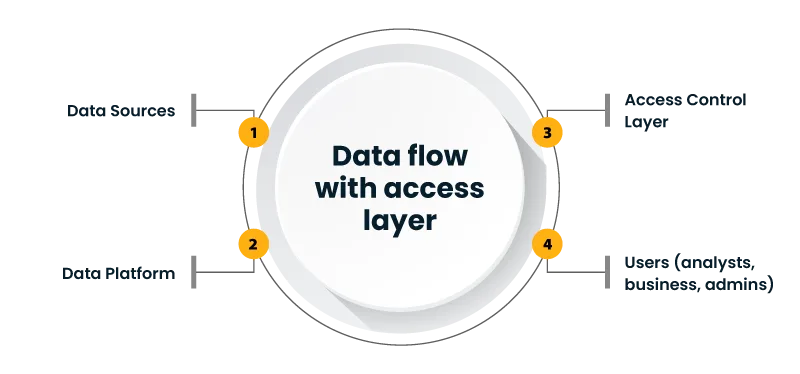
The process begins with mapping how data is actually consumed. Teams across analytics, operations, and leadership interact with data in different ways, and access models need to reflect those patterns. When usage is clearly understood, it becomes easier to design access that supports real workflows.
Step 1: Classify data based on risk and usage
Data needs to be grouped into categories that reflect both sensitivity and business relevance. This classification becomes the base layer of data access governance.
Sensitive data requires controlled access, while operational datasets can allow broader access within defined boundaries. This step ensures that governance decisions are tied to actual risk rather than applied uniformly.
Step 2: Define access personas and usage contexts
Instead of assigning access directly to users, it is more effective to define personas based on roles and responsibilities. Each persona reflects how a group interacts with data.
For example, analysts may need exploratory access, while operational users may require restricted views. This step connects access with real usage.
How personas translate into access design
| Persona | Access Type | Control Level |
| Analyst | Broad dataset access | Medium control |
| Business user | Curated datasets | High control |
| Admin | Full access | Strict monitoring |
Step 3: Design layered access controls
Access should be defined in layers rather than through a single rule. This allows flexibility without losing structure.
- Role-based access defines baseline permissions
- Attribute-based conditions refine access further
- Policy rules enforce governance across systems
This layered model becomes the foundation of data permissions frameworks, ensuring that access remains consistent while adapting to context in data transformation testing environments.
Step 4: Embed access policies into data pipelines
Access rules should travel with the data rather than being applied separately, particularly in modern data engineering pipelines. When policies are embedded into pipelines, they remain consistent across environments.
This ensures that as data moves from ingestion to analytics layers, permissions remain intact. It also reduces manual intervention.
Step 5: Introduce dynamic access controls
Static permissions often fail when business needs to change. Access should be adjusted based on context, such as user behavior or usage patterns.
This approach allows organizations to maintain data security for analytics while supporting flexibility in how data is accessed.
Step 6: Centralize policy enforcement
A central enforcement layer ensures that access rules are applied consistently across all platforms. Without this layer, fragmentation begins to appear.
This layer becomes a core part of data permissions frameworks, ensuring that governance remains uniform across systems.
Step 7: Enable audit and monitoring mechanisms
Every access interaction should be traceable. This provides visibility into how data is being used.
When monitoring is in place:
- Access patterns become visible
- Unusual behavior can be detected
- Compliance reporting becomes easier
This strengthens data access governance without slowing down workflows.
Step 8: Align access with analytics workflows
Access models should reflect how teams actually use data. When permissions align with workflows, teams spend less time requesting access.
This ensures that governance supports productivity rather than creating friction.
As these steps come together, access models begin to stabilize. Each layer supports the next, and governance becomes part of the system rather than an external control.
When designed this way, enterprise data access models allow organizations to scale data usage while maintaining control.
Governance vs accessibility: what’s the difference?
As access models become more structured, organizations begin to understand how governance and accessibility interact. Both are part of the same system, although they focus on different aspects.
Governance defines control. Accessibility defines usability. When these two are not aligned, friction begins to appear in workflows.
How governance and accessibility differ
| Aspect | Governance | Accessibility |
| Purpose | Control how data is used | Enable access to data |
| Focus | Policies and compliance | Usability and speed |
| Ownership | Central teams | Distributed users |
| Outcome | Risk control | Faster execution |
This distinction helps organizations design access models that support both control and usability. When governance is aligned with accessibility, data becomes easier to use without increasing risk.
Build access models that support both control and speed
Designing access models requires a shift in how organizations think about data access governance. It is not only about defining restrictions. It is about enabling access in a structured way.
As organizations scale, the importance of enterprise data access models becomes more visible. Teams depend on data for both operational and strategic decisions. Delays in access begin to affect productivity.
This is where structured data permissions frameworks become essential. They ensure that access rules remain consistent across systems.
When access models are designed properly, teams move faster. At the same time, governance remains intact. This creates an environment where data is both secure and usable.
Design access that moves at the speed of your business
If your organization is facing delays in data access or inconsistencies in permissions, the issue often lies in how access models are structured.
This is where Cygnet.One supports enterprises in building scalable data environments. By aligning governance with workflows, Cygnet helps organizations design access models that support both control and agility.
When access is structured clearly, teams spend less time managing permissions. They spend more time working with data.
FAQs
What is data access governance?
Data access governance defines how data is accessed and controlled across systems.
What are enterprise data access models?
These are frameworks that define how users interact with data.
Why is data security for analytics important?
It makes sure that sensitive data remains protected while still being usable.
What are data permissions frameworks?
They define how access rules are applied across systems.
How can organizations balance governance and agility?
By designing access models that align policies with real workflows.
Author


Yogita Jain
Content Lead
Yogita Jain leads with storytelling and Insightful content that connects with the audiences. She’s the voice behind the brand’s digital presence, translating complex tech like cloud modernization and enterprise AI into narratives that spark interest and drive action. With a diverse of experience across IT and digital transformation, Yogita blends strategic thinking with editorial craft, shaping content that’s sharp, relevant, and grounded in real business outcomes. At Cygnet, she’s not just building content pipelines; she’s building conversations that matter to clients, partners, and decision-makers alike.