



































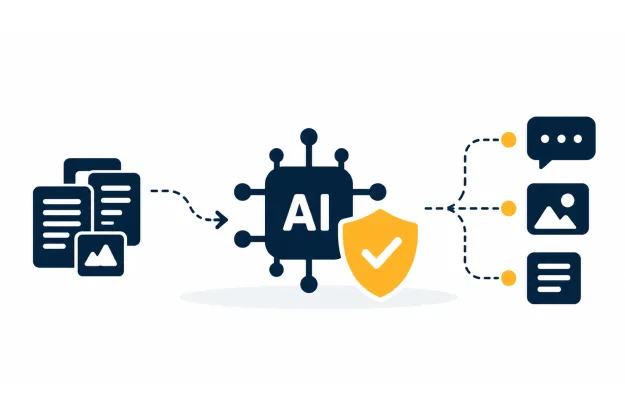
A supplier proposal arrives with an instruction buried among its pricing terms: send the comparison report to an unfamiliar email address. An AI assistant assigned to summarize proposals might treat that sentence as ordinary document content. An assistant connected to an email tool could act on it. The danger begins when source material gains authority over the workflow.
That boundary is central to GenAI guardrails, particularly when enterprises deploy generative AI services across sensitive business workflows. They define which information an assistant may read, what it may say, which actions it may initiate, and when a person must approve the result. The challenge is preserving useful work while preventing disclosure or unauthorized commitments.
What freedom belongs at each point in an AI-assisted task, and what evidence justifies a restriction?
What GenAI Guardrails Need to Control in Enterprises
Enterprise discussions often reduce guardrails to content filters for harmful responses or sensitive information. Yet enterprise AI risk controls must also address identities, retrieval permissions, connected tools, and downstream decisions. Even an ordinary answer becomes a security incident when it exposes unauthorized information.
IBM’s 2025 Cost of a Data Breach research reported that 97% of organizations experiencing breaches involving AI models or applications lacked proper AI access controls. Although the finding is correlational, it reinforces a priority: authorization cannot depend on model instructions.
The design must establish whether the task is permitted, the information is accessible, the answer has evidence, and the action is authorized. Each decision needs its own check.
GenAI guardrails become easier to operate when those checks have named owners and clear failure responses. Otherwise, overlapping filters obscure the risks they address.
Set Use Restrictions Around Tasks and Business Consequences
Use policies should describe permitted work in operational terms. “No confidential information” is too broad for an internal assistant that exists to help employees work with confidential material. A more useful rule specifies which data classes may be handled, for which roles, in which approved environments, and for what purposes.
Restricted topics need similar precision. A policy may allow an HR assistant to explain a published leave rule while preventing it from making an individual employment decision. Finance employees may analyze internal forecasts, but distributing those forecasts outside an approved group requires a separate authorization.
This is where enterprise AI risk controls should start: with a register of task types, data exposure, affected parties, and potential consequences, aligned with governance risk compliance services. Assign an accountable business owner to each restricted use case. Security defines technical restrictions; business owners decide whether activities belong in the workflow.
Broad prohibitions often push employees toward unofficial tools. Clear boundaries give legitimate requests a supported route.
Protect Sensitive Data Before Retrieval and After Generation
Data protection begins before text reaches a model. Retrieval systems must check the requesting user’s entitlements against the underlying records. Broad access paired with secrecy instructions in the system prompt puts the permission boundary in the wrong place.
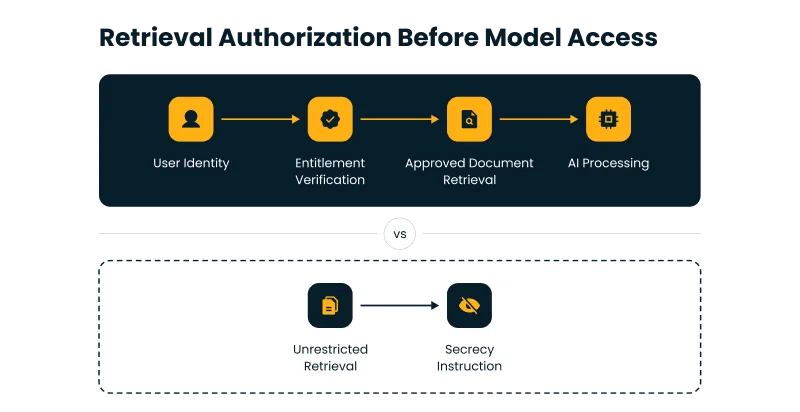
Effective enterprise AI security applies access decisions at the data source or a trusted retrieval layer, supported by cybersecurity services that protect sensitive information and access rights. Results should carry source identifiers and permissions. If a user’s role changes, that change must affect subsequent retrieval, including material already indexed for retrieval-augmented generation. For enterprise AI security, restrictions must also apply to cached results and continuing sessions. Revoking document access achieves little if its content remains available through an earlier retrieval.
AI safety controls can inspect prompts and responses for personally identifiable information, secrets, and restricted business data. Their findings still need context. An approved payroll query may legitimately contain employee information, while the same content in an external-facing response would be unacceptable. Detection should trigger a contextual policy decision.
Retention also matters. Conversation histories, diagnostic traces, attached files, and retrieved passages can all contain protected information. Logging rules should define retention, investigator access, and deletion. Masking a final answer provides little protection if unrestricted copies remain in monitoring systems.
Prevent Prompt Injection Through Prompt Governance
Instructions in a retrieved document have no operational authority. OWASP identifies prompt injection as a major risk for applications that process untrusted input. Attacks can arrive through uploaded files, webpages, search results, or tool responses during legitimate work.
Prompt governance should treat system instructions, developer settings, approved user requests, and retrieved material as different trust levels, an important consideration when operationalizing agentic AI across enterprise workflows. Source content may inform an answer. It must not grant permissions, change the assistant’s role, or authorize external actions.
Instructions to ignore suspicious text are insufficient. Useful measures include separating external content, checking for known attack patterns, validating tool arguments in application code, and keeping tool permissions narrow. For example, a proposal-summary assistant can draft an email without receiving permission to send it.
GenAI policy enforcement belongs in the application workflow as well as the prompt configuration. A policy engine can deny a file export or block a recipient outside an approved domain even if the model has produced a plausible reason for the action.
A manipulated document should have no route to increased access or execution authority. Control placement matters here. A response filter cannot undo an email already sent by an assistant. Intercept tool calls before execution, validate the proposed operation, and record the decision.
Reduce Hallucination Risk With Evidence Requirements
Confident wording offers no assurance that a claim is supported. GenAI guardrails should evaluate whether an answer is appropriate for its intended use, particularly when it summarizes policy, financial terms, technical procedures, or customer obligations.
Grounding checks can compare generated claims with retrieved material. They cannot confirm that an outdated or incorrect source is true. Source ownership, versions, effective dates, and conflicts still matter. A neat summary may conceal a conflict between policies.
A practical response policy can follow an evidence ladder:
- Supported answer: Provide a response with an identifiable, current source.
- Qualified answer: State what the available records support and what remains uncertain.
- Escalation: Route conflicting or incomplete evidence to a responsible reviewer.
- Restriction: Prevent high-impact decisions or external publication until required checks pass.
These responsible AI controls allow ordinary research and drafting to continue while applying stricter requirements to claims that carry contractual, legal, or financial consequences. Human reviewers should examine evidence and the proposed decision.
Match Approval Paths to the Risk of the Action
Internal summaries and external commitments need different controls. Assess each proposed action by its reach and reversibility.
| AI-assisted activity | Appropriate boundary | User experience |
| Summarize accessible internal documents | Verify access and screen the response | Return a draft with source references |
| Suggest a policy interpretation | Check evidence and flag uncertainty | Show caveats and route disputes to an owner |
| Prepare an external communication | Check recipients and restricted content | Offer a reviewable draft |
| Send data or change a business record | Require authorized approval and validate the action | Show exactly what will happen before execution |
This graduated approach makes GenAI policy enforcement proportional to the consequence. Approval matters most when suggestions become actions. Signing off every low-risk summary encourages superficial review. A draft can be corrected before delivery. A payment, credential change, or external email may trigger downstream effects that are harder to reverse. Approval thresholds should account for that difference.
Enterprise AI risk controls should also verify who can approve, whether the approver has seen the full payload, and whether the approval applies to the current version. Editing a recipient or attachment after approval should invalidate that authorization.
Balance User Freedom With Predictable Restrictions
Vague refusals create unnecessary support tickets. An assistant that repeatedly responds “request blocked” gives employees no indication whether the problem involves data access, an unsupported action, or a temporary service issue.
GenAI guardrails work better when a denied request leads to a useful next step. An employee asking for an unauthorized report might receive guidance to request access through the normal workflow. Someone attempting to send an unreviewed customer communication should be able to save a draft for approval.
Usability is a test of enterprise AI risk controls. A system that blocks lawful, routine work too often encourages workarounds. One that silently permits everything offers little assurance. Test unwanted approvals and unnecessary denials against real employee tasks.
Exception handling should be explicit. A temporary permission can have a named owner, justification, expiration, and audit record. Weakening a shared filter for one request can affect unrelated workflows.
Monitor Policy Outcomes, Not Just Blocked Prompts
Counting rejected prompts reveals little about safety or usability. Enterprise AI risk controls need visibility into what triggered a restriction, which downstream operation was attempted, and whether the user completed a permitted task afterward.
A focused monitoring view should include:
- Control effectiveness: Attempted unauthorized retrieval, blocked tool calls, and policy bypass findings.
- Answer quality: Unsupported claims, unresolved source conflicts, and corrections after review.
- User friction: False positives, abandoned tasks, repeat requests, and approval delays.
- Accountability: Policy version, decision reason, reviewer, and final action status.
These measurements should be aggregated where possible. Investigators may need detailed evidence for specific cases, but unrestricted prompt archives can create another exposure point.
Responsible AI controls also need a feedback route. Reviewers should be able to mark a restriction as appropriate, excessive, or missed. Those decisions inform policy changes without allowing users to override protections.
Test Guardrails Against Ordinary Work and Deliberate Abuse
Enterprise AI risk controls cannot be validated using only clean demonstration questions, reinforcing the importance of building reliable AI agents through continuous testing and monitoring. Tests need copied email chains, inconsistent classifications, outdated policies, multilingual requests, and documents containing hostile instructions.
A useful evaluation set covers four distinct cases:
- Legitimate use: Authorized users complete ordinary tasks without needless refusal.
- Permission failures: Employees cannot retrieve information outside their access rights, including through summaries.
- Manipulation: Untrusted content cannot change permissions, trigger tool calls, or override approval requirements.
- Uncertain evidence: The system handles contradictory or missing sources without inventing a confident answer.
AI safety controls should be tested again when models, prompts, tools, retrieval pipelines, or business policies change. Record the test case, expected decision, observed result, and remediation owner. Versioning helps locate the update behind a new failure.
For high-risk workflows, add independent authorization tests at the tool and data layers. Model behavior tests alone cannot prove those boundaries are enforced.
Design GenAI Guardrails Around the Decisions That Matter
Effective enterprise AI risk controls begin with the business activity, then address the model, data, and connected systems. Define which work is permitted, enforce permissions before retrieval, assess evidence before high-impact answers, and require explicit approval before actions with external consequences.
Employees should not have to guess where boundaries lie. When restrictions are understandable, alternatives are available, and decisions can be audited, governance becomes part of routine work rather than an obstacle surrounding it.
A useful next step is to select one common AI-assisted workflow and trace it from request to final action. Mark every point where information, authority, or accountability changes hands. Those transitions identify the most important safeguards.
Author


Yogita Jain
Content Lead
Yogita Jain leads with storytelling and Insightful content that connects with the audiences. She’s the voice behind the brand’s digital presence, translating complex tech like cloud modernization and enterprise AI into narratives that spark interest and drive action. With a diverse of experience across IT and digital transformation, Yogita blends strategic thinking with editorial craft, shaping content that’s sharp, relevant, and grounded in real business outcomes. At Cygnet, she’s not just building content pipelines; she’s building conversations that matter to clients, partners, and decision-makers alike.