





























Introduction
For many Philippine enterprises, connecting finance systems to the EIS is less about buying another module and more about whether invoice data can move from source systems into structured electronic form. Existing ERP, billing, and accounting platforms may already contain the required transaction data. However, that information is often distributed across customer masters, tax configurations, product records, and finance workflows.
Under the applicable BIR e-Invoicing requirements in Revenue Regulations (RR) No. 11-2025, covered taxpayers must issue electronic invoices using structured invoice data that can be extracted electronically. Electronic sales reporting is addressed separately and may introduce additional technical processes depending on scope. RR No. 26-2025 gives specified covered taxpayers until 31 December 2026 for electronic invoice issuance. This article explains how to assess readiness, choose an architecture, map invoice data, and complete ERP integration without disrupting day-to-day billing.
Is Your ERP Ready for BIR Electronic Invoicing?
An ERP alone does not prove readiness. Philippines e-invoicing readiness depends on whether invoice data can be extracted consistently, validated accurately, and issued in accordance with applicable BIR requirements without manual intervention.
Many programmes discover too late that the accounting system can print invoices well but cannot support structured electronic invoice output across all entities and channels.
Where Invoice Data Lives Across Your Business
Invoice data rarely resides in a single system. The ERP often holds the general ledger, customer accounts, tax codes, and core sales invoices, but it may not be the only source of truth. Billing platforms may generate commercial invoices independently of the core finance system.
POS systems create high-volume branch invoices with different numbering series. CRM systems may own customer onboarding data that never fully synchronises into finance. Customer master data often determines whether an electronic invoice can be issued successfully.
Start with a source-system map covering commercial events, tax treatment, invoice numbering, and structured data supply for issuance or later sales reporting.
Common ERP Readiness Gaps
During ERP readiness assessments, the following gaps commonly affect Philippine e-Invoicing implementations:
- Incomplete customer master data. Missing Taxpayer Identification Numbers (TINs), incomplete legal names, and inconsistent customer addresses often result in validation failures before any integration goes live.
- Poor tax configuration. Incorrect VAT treatment, outdated exemption flags, and goods-and-services tax logic that has not been revalidated after the EOPT changes can lead to compliance issues.
- Inconsistent branch processes. Head offices may use one invoice template, while branches continue to operate with local tools or legacy CAS environments, creating inconsistencies across the organization.
- Manual invoice generation. Adjustments, exceptions, or special customer invoices are often created manually, preventing these documents from entering the structured invoice data workflow and increasing compliance risks.
Choosing the Right ERP Integration Strategy
Selecting an integration strategy is an architectural decision rather than a technology procurement exercise. The right design depends on invoice volume, number of source systems, internal IT capability, and the BIR processes that apply to the taxpayer. The objective of ERP integration is to enable controlled, auditable data movement rather than simply achieving a successful test transmission.
Direct Connection from the ERP
A direct build places extraction, transformation, validation, and connectivity inside the organisation’s ERP or internal integration layer. It is usually the best fit when one core ERP dominates invoice generation, master data is relatively centralised, and IT can own ongoing change management.
This approach provides tighter control over data logic, reduces external hand-offs, and aligns more closely with existing ERP security and transport processes.
However, limitations become evident in multi-ERP environments: every bolt-on system still needs a path into the design, custom code can become expensive to maintain, and BIR-related changes may require repeated regression testing.
How ERP Data Moves Through an e-Invoicing System
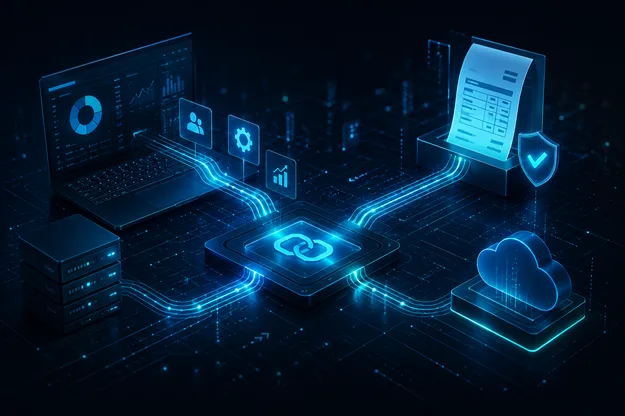
A reliable integration should define each step between invoice creation and the final accounting record.
- Source transaction: The ERP, billing platform, POS, or other source system creates the transaction.
- Data extraction: The integration layer retrieves the invoice fields, customer information, tax treatment, branch details, and document identifiers.
- Transformation and validation: The data is mapped into the required structured format and checked for missing fields, inconsistent tax values, and invalid identifiers.
- Applicable compliance processing: The Philippines e-Invoicing solution performs the issuance, validation, or transmission steps required for the taxpayer’s applicable BIR process.
- Status and exception handling: The system records processing outcomes, identifies failures, and routes exceptions to named owners.
- Reconciliation and retention: Finance teams reconcile invoice activity with accounting records and retain the relevant invoice data, processing history, responses, and correction links.
The exact technical flow depends on the applicable BIR requirements and the organisation’s architecture. Teams should confirm which steps apply to electronic invoice issuance, and which apply to any separate electronic sales-reporting obligation before finalising the design.
Middleware or Compliance Platform
A middleware or compliance platform sits between source systems and the downstream e-Invoicing or reporting process. Its primary value lies in centralized validation, providing a single point to enforce field rules, tax validations, exception management, and monitoring across multiple invoice sources. It is particularly useful in multi-ERP environments, where forcing every entity onto one native build would delay compliance. It can also support faster implementation when the platform already contains mapping accelerators and reusable connectors. Define data ownership, service levels, update responsibility, and evidence retention.
Manual or File-Based Processing
Manual encoding or file-based upload may be possible where the applicable BIR process supports it. It is suitable only for low transaction volumes and simple invoice scenarios. Operational risks include keying errors, delayed processing, weak segregation of duties, and poor linkage between corrections and original invoices.
Scalability limitations become obvious with branches, high daily volume, or complex tax scenarios. For most covered enterprises heading toward December 2026, manual processing is a contingency, not a primary architecture.
| Approach | Best fit | Main risk |
| Direct ERP build | One dominant ERP, strong internal IT | Customisation and multi-system blind spots |
| Middleware / compliance platform | Multiple sources, need central controls | Provider and data-ownership dependency |
| Manual / file-based | Low volume, simple scenarios | Errors, delays, poor scale |
ERP Considerations by Platform
Readers often need platform-specific framing even when the regulatory obligation is the same. The BIR EIS framework requires structured invoice data and controlled processes; the platform question is how that requirement is met inside each technology stack supporting BIR e-Invoicing.
Global Enterprise ERPs
For SAP, Oracle NetSuite, and Microsoft Dynamics 365, the core integration considerations are largely the same. Businesses should evaluate how invoice data is managed, how tax is determined, and how the ERP can support Philippine-specific e-Invoicing requirements.
When assessing your ERP, consider the following:
- Review where invoice data is stored. Understand how invoice information is captured and retrieved across your ERP landscape.
- Assess tax determination logic. Verify that tax calculations align with Philippine regulatory requirements.
- Evaluate your extension strategy. Determine what should be configured using standard ERP capabilities, what requires approved extensions, and what should be handled through middleware.
- Consider localization requirements. Ensure the ERP supports Philippine-specific invoice fields, TIN handling, document types, and branch scenarios, as these may not be fully covered by standard country packs.
Local CAS Platforms and Custom Applications
Many Philippine businesses rely on Computerized Accounting Systems (CAS), proprietary billing platforms, or legacy applications that were developed before modern API-based integration became common. While these systems may support daily accounting operations, they often require additional assessment before meeting structured e-Invoicing requirements.
Key evaluation areas include:
Verify structured data extraction. Confirm that the system can consistently generate structured invoice data rather than only producing PDF documents.
- Review invoice identification. Ensure invoice numbers remain unique, consistent, and traceable across transactions.
- Assess validation capabilities. Check whether mandatory invoice fields can be exported accurately and validated before submission.
- Test document handling. Verify that credit notes, cancellations, and other document types are supported as independent transaction documents.
- Evaluate branch consolidation. Confirm that invoice data from multiple branches can be consolidated without relying on manual spreadsheets.
- Plan remediation where required. If native capabilities are limited, consider supplementing the system with middleware or replacing only the invoice-generation layer instead of rebuilding the entire application.
Building a Reliable Integration Architecture
Connectivity is only one layer. Reliable architecture makes invoice data complete, exceptions visible, and outcomes explainable to finance, tax, and audit stakeholders. In practice, ERP integration succeeds when mapping, validation, and monitoring are designed together rather than added after go-live.
Data Mapping and Validation
Invoice mapping translates each required and conditional electronic invoice element to a source field, derivation rule, or enrichment step. Master data quality determines whether mapping works in production: customer TIN, legal name, address, and tax profile must be complete before volume testing. Tax rules need explicit design for standard-rated, exempt, zero-rated, mixed, and adjustment scenarios. Validate before issuance or reporting hand-off, catching missing TINs, unbalanced headers and lines, and branch coding errors early.
Exception Management and Monitoring
Error handling needs named business ownership as interface logs are not an operating model. Audit trails should show what failed, who corrected it, what changed, and which invoice was finally issued or reported. Retry mechanisms must distinguish technical retries from business corrections. Monitor failure rates by entity, branch, document type, and error code; backlog ageing; and interface availability.
Managing ERP Integration Without Business Disruption
The title promise is operational continuity. Disruption usually comes from big-bang cutovers, under-tested edge cases, and unclear ownership during exceptions, not from the existence of an interface.
A Phased Migration Strategy
A phased approach reduces billing risk. Pilot implementation should use one entity, channel, or invoice type with production-like data and full finance sign-off. Parallel runs compare existing invoice outputs and accounting postings against structured electronic invoice results before the old path is switched off. Branch-wise rollout is often necessary where local systems or numbering series differ. Each wave needs exit criteria: validation pass rates, exception turnaround time, reconciliation sign-off, and user readiness.
Testing Beyond Standard Invoices
Standard sales invoices are the easy path. Production breaks on the rest. Test credit notes, returns, discounts, zero-rated transactions, and VAT-exempt scenarios, plus cancellations, multi-branch series, and corrected invoices. Include volume and failure-injection tests. UAT should involve AR, Tax, and IT together.
Questions to Ask Before Choosing an e-Invoicing Partner
Whether the partner is an implementer, middleware provider, or compliance platform vendor, evaluation should cover compliance stewardship and technology fit for BIR e-invoicing. A polished demo is not a substitute for Philippine-scope clarity.
Questions About Compliance
When evaluating a compliance partner, ask the following questions:
- How do you monitor regulatory updates? Understand how the partner tracks changes under Revenue Regulation (RR) No. 11-2025 and Revenue Regulation (RR) No. 26-2025, as well as other relevant BIR issuances.
- How do you interpret BIR compliance requirements? Ask how the partner distinguishes between electronic invoice issuance and electronic sales reporting, and where their implementation responsibilities begin and end.
- What certification support do you provide? Confirm whether the partner assists with EIS-related enrolment, testing, and Permit to Transmit (PTT) processes where applicable.
- How are regulatory changes managed? Clarify who monitors new rules, how mapping updates are maintained, and how quickly regulatory changes are reflected in the solution.
Questions About Technology
When evaluating a technology solution, ask the following questions:
- Is the ERP compatible with your existing technology landscape? Assess compatibility based on your actual environment rather than a generic platform list.
- Does the solution support your integration requirements? Review APIs, file handling capabilities, and operating hours against your billing calendar.
- Are security controls comprehensive? Examine authentication, access management, encryption, and environment segregation measures.
- Who owns and manages critical data? Confirm responsibility for invoice payloads, transaction logs, and security credentials.
- Is disaster recovery well defined? Verify Recovery Point Objective (RPO), Recovery Time Objective (RTO), and service continuity commitments during BIR or platform outages.
ERP Integration Readiness Checklist
Use the following BIR e-Invoicing readiness checklist, not a post-implementation decoration. Complete these checks before connectivity is treated as done.
Before You Begin Integration
- Have all invoice sources been identified, including ERP, billing, POS, e-commerce, and spreadsheets?
- Is customer and branch master data completing enough for electronic invoices, especially TINs?
- Are ERP customisations and output routines documented?
- Are tax rules validated for standard, exempt, zero-rated, mixed, and adjustment scenarios?
- Is electronic invoice issuance scoped separately from electronic sales reporting?
- Has an integration approach been selected with clear ownership and support model?
- Are credit note, cancellation, and discount processes defined as system documents, not side journals?
- Can every relevant accounting system feed the design without hidden manual steps?
Before Go-Live
- Has end-to-end testing been completed beyond standard invoices?
- Are exception workflows documented with named owners and turnaround targets?
- Are users in AR, Tax, and branch operations trained?
- Are monitoring dashboards and alert thresholds active?
- Are retry, reconciliation, and downtime procedures approved by Finance and IT?
- Is evidence retention configured for invoice data, validation results, and corrections?
- Is there a controlled rollout plan with pilot exit criteria and rollback conditions?
Conclusion
BIR electronic invoicing makes invoice data quality and system design visible. Revenue Regulation (RR) No. 11-2025 requires structured, extractable electronic invoice data for covered taxpayers, and Revenue Regulation (RR) No. 26-2025 sets a 31 December 2026 issuance window for specified categories. Successful ERP integration depends less on a single connector and more on source-system mapping, master data, tax configuration, exception handling, and phased testing.
Direct ERP integrations, middleware platforms, and limited file-based approaches can all be valid when matched to volume, landscape complexity, and governance capacity. Finance, Tax, and IT teams should approach ERP integration as an operating model transformation: technical integration becomes significantly easier when the underlying data and business processes are already well governed.
Cygnet.One supports enterprises assessing e-Invoicing data, system connectivity, validation, and operational workflow requirements across complex environments. For Philippine organisations preparing for EIS-related obligations, a structured readiness assessment is usually the fastest way to identify integration risk before it reaches billing.
FAQ's
Sometimes. Legacy systems can support electronic invoicing if they can generate or export the required structured invoice data and participate in validation, correction, and retention. Many need remediation, middleware, or selective replacement of the invoice-generation layer.
Choose direct integration when one ERP dominates and internal teams can own the build. Choose middleware when multiple systems need centralised validation and monitoring. Hybrid models are common.
Timelines vary with system complexity, invoice-data quality, entities and branches, transaction scenarios, custom development, and applicable BIR technical processes. Demand a plan based on your architecture, not a generic estimate.
Enterprises commonly implement around SAP, Oracle NetSuite, Microsoft Dynamics 365, local CAS products, and proprietary billing applications. The regulatory test is whether the landscape can produce structured invoice data and sustain controlled processes under the organisation’s BIR scope.
Author


Kesha Shah
General Manager - Products Marketing
Kesha Kumar leads the global products marketing team at Cygnet.One, where she turns the complexity of tax and finance transformation into stories that resonate with the people who matter most. She’s the strategic force behind the brand’s presence across India, the GCC, Southeast Asia, and Europe, translating dense subjects like e-Invoicing mandates, digital engineering, and enterprise AI into narratives that inform and drive action. With expertise spanning tax and finance transformation, quality, enterprise applications, and data and AI, Kesha blends sharp strategic thinking with a marketer’s instinct for what truly connects. At Cygnet.One, she does more than build campaigns and content; she shapes the conversations that help enterprises navigate compliance with clarity and confidence, propelling the brand to the forefront of the industry along the way.