



































The problems that make cloud environments expensive to operate rarely show up during migration. Architecture decisions that limit scalability, security gaps that widen as workloads multiply, and costs that compound without governance surface six to twelve months later, under production pressure, after the team that ran the migration has moved on to the next project.
AWS consulting services exist to prevent exactly that pattern. The gap between moving infrastructure to AWS and operating an environment that is secure, cost-efficient, and scalable is not closed by migration alone. It requires architecture expertise, security design, cost governance, and operational discipline applied before workloads go live, not after the
consequences surface.
The 2024 Gartner Forecast on Worldwide Public Cloud End-User Spending tracked global public cloud spending reaching $723.4 billion in 2025, a 21.5% increase from the prior year. At that scale of investment, the distance between a well-governed cloud environment and a poorly governed one carries real business consequences.
This guide covers what AWS consulting services include, how engagements work, how to evaluate partners against delivery capability rather than certifications, and what a well-structured engagement should produce.
What Are AWS Consulting Services?
AWS consulting services are professional services delivered by certified AWS Partner Network members to help organizations design, migrate, secure, optimize, and manage cloud environments on Amazon Web Services. Engagements cover cloud architecture design, migration planning, DevOps automation, security governance, cost optimization, and ongoing cloud operations support across every phase of cloud adoption.
The scope of an engagement depends on where an organization sits in its cloud journey. Businesses migrating for the first time need architecture design, workload migration planning, and initial security configuration.
Organizations already operating on AWS typically engage consultants for optimization, governance, application modernization, or managed operational support. Startups, mid-market companies, and enterprises all use AWS consulting services, with engagement complexity scaling alongside workload requirements and business objectives.
Why Do Businesses Use AWS Consulting Services?
Internal cloud teams rarely maintain comprehensive expertise across every domain that complex cloud environments require. Architecture risks emerge during migration, security posture gaps accumulate as workloads expand, and costs rise without active governance – leaving organizations with environments that run on AWS but not efficiently, securely, or at the cost level the business projected.
The most common reasons businesses engage AWS consulting partners span six operational areas:
- Accelerate cloud migration through structured planning and validated architecture design.
- Reduce infrastructure risk with cloud design patterns matched to specific workload requirements.
- Improve cloud security posture across identities, workloads, network boundaries, and compliance requirements.
- Optimize AWS spending through rightsizing, waste elimination, and FinOps governance practices.
- Modernize legacy applications for cloud-native performance, scalability, and deployment efficiency.
- Improve deployment consistency and release speed through DevOps automation and CI/CD implementation.
For enterprise teams, AWS consulting reduces adoption risk while compressing the time needed to reach stable, secure, and cost-efficient cloud operations at scale.
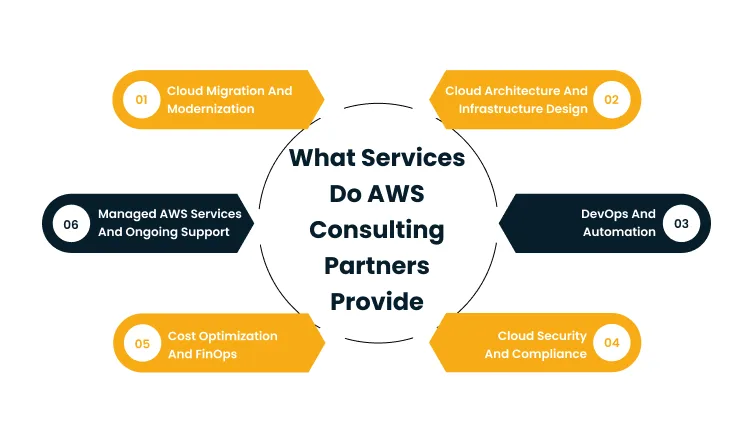
What Services Do AWS Consulting Partners Provide?
AWS consulting partners support multiple phases of cloud adoption, from initial strategy through migration, architecture design, automation, security, and ongoing managed operations. The strongest partners cover the full delivery lifecycle, combining architecture expertise, DevOps capability, compliance depth, and industry-specific knowledge.
Cloud Migration And Modernization
Migration consulting helps organizations move workloads, applications, and databases from on-premises or legacy environments into AWS while minimizing operational disruption. A structured approach addresses the following before cutover begins:
- Application dependency mapping to surface hidden connections that affect migration sequencing.
- Workload prioritization based on migration complexity, operational risk, and business criticality.
- Data transfer planning for large-scale database and object storage migrations.
- Parallel running periods and staged cutover to validate performance before go-live.
- Rollback procedures for each workload transferred before the on-premises decommission.
Modernization extends beyond basic migration to include containerization using ECS or EKS, serverless adoption, and cloud-native refactoring that eliminates technical debt from legacy infrastructure. Cygnet.One’s Cloud Migration and Modernization practice delivers structured engagements covering dependency mapping, modernization, and cutover execution as a coordinated delivery.
Cloud Architecture And Infrastructure Design
Cloud architecture consulting defines the foundation that every workload in the environment depends on. Decisions covering VPC design, network segmentation, multi-account strategy, storage architecture, high availability configuration, and IAM governance framework all carry scalability, resilience, and cost implications that are expensive to reverse after migration begins.
Consultants validate that the architecture supports the organization’s current requirements and the scale it expects within three to five years. Environments designed for ten workloads require significant redesign to support a hundred, and getting these decisions right before migration begins eliminates the rework costs that emerge when infrastructure cannot scale under operational pressure.
DevOps And Automation
DevOps consulting transforms manual deployment processes into automated, repeatable delivery pipelines. Engagements typically cover CI/CD pipeline implementation, infrastructure-as-code configuration using Terraform or CloudFormation, automated test gate integration, deployment governance, and monitoring setup aligned with deployment SLAs.
For organizations scaling engineering teams, DevOps automation reduces deployment risk and shortens release cycles by eliminating the manual handoffs that introduce inconsistency between development and production. Cygnet.One’s Cloud Native Development practice combines pipeline implementation with cloud-native application design, ensuring the delivery environment and the application architecture it supports are built to scale together.
Cloud Security And Compliance
Security controls designed into the architecture from the start are significantly less costly to implement than those retrofitted after deployment. The 2024 IBM Cost of a Data Breach Report found that 82% of data breaches involved cloud-stored data, with the average breach reaching a record $4.88 million globally.
AWS security consulting addresses the following areas:
- IAM policy design and least-privilege access governance across accounts and workloads.
- Encryption configuration for data at rest and in transit.
- Network security controls, zero trust implementation, and perimeter segmentation.
- Compliance framework alignment for HIPAA, PCI DSS, SOC 2, and regional data residency requirements.
- Threat monitoring, incident detection, and automated response configuration.
For regulated industries, these controls must be embedded in the architecture from initial deployment. Consulting partners with specific compliance framework experience help organizations meet audit requirements without engineering security into running environments under operational pressure.
Cost Optimization And FinOps
Cloud costs increase faster than projected for most organizations without active governance in place. The 2024 Flexera State of the Cloud Report found that enterprises estimate 27% of their cloud spending is waste, a figure that has remained consistent despite cost optimization ranking as the industry’s top cloud challenge year after year.
AWS consulting partners address this through the following:
- Rightsizing analysis to align instance types with actual workload consumption.
- Reserved instance and savings plan recommendations based on usage patterns.
- Tagging strategies and cost allocation frameworks for department-level spend visibility.
- FinOps governance policies that prevent unplanned resource provisioning.
- Usage dashboards and budget alerts are configured before the environment goes live.
The goal is to give engineering and finance teams the visibility to make informed infrastructure decisions from the first month of operations, rather than discovering cost inefficiencies through unexpectedly high AWS bills.
Managed AWS Services And Ongoing Support
Some AWS consulting partners provide managed cloud operations alongside project-based delivery. Managed services maintain the environment continuously after handover – covering infrastructure monitoring, security patching, incident management, backup management, and ongoing FinOps governance.
It is a distinct model from project-based consulting that transfers full operational responsibility to the client team at engagement close. Businesses without sufficient internal cloud operations capacity benefit most from consulting partners that offer both project delivery and ongoing managed support.
The risk of project-only delivery is that the environment is handed to a team that did not build it and may lack the operational context to sustain it at the required service level.
How Do AWS Consulting Services Typically Work?
Most AWS consulting engagements follow a phased progression from assessment through architecture design, implementation, and post-deployment optimization. Each phase produces working outputs before the next begins, reducing implementation risk while building toward long-term scalability and governance.
Assessment And Cloud Readiness
Assessment maps existing infrastructure, workloads, application dependencies, and compliance requirements before migration begins. The output is a prioritized inventory identifying what needs to move, in what sequence, and what operational risks each workload carries – including dependency conflicts, compliance gaps, performance baselines, and licensing considerations.
Organizations that skip formal assessment typically encounter dependency conflicts mid-migration, which delays delivery and increases cost. Structured assessment converts those surprises into known variables before they become operational blockers, and gives both teams a shared understanding of migration scope before commitment.
Architecture, Planning, And Roadmap Creation
The planning phase translates assessment findings into a migration roadmap and cloud architecture blueprint. This covers workload prioritization, environment design, governance structure, migration sequencing, and cloud operating model recommendations aligned with the organization’s technical requirements and delivery capacity.
The architecture decisions made here – VPC design, multi-account strategy, network segmentation, and identity architecture – determine what the environment can scale to without rework. Consulting partners who invest depth at the planning stage produce cloud environments that perform significantly better in three years than those designed under time pressure to meet a migration deadline.
AWS Well-Architected Reviews can also help teams identify migration gaps early, especially when architecture, security, reliability, and cost decisions need validation before workloads scale.
Migration And Implementation
Migration execution transfers workloads to the cloud environment following the architecture and sequencing defined in the planning phase. A well-managed migration minimizes operational disruption through parallel running periods, staged cutover, and documented rollback procedures for each workload transferred.
For organizations evaluating migration support in more detail, AWS migration services can help clarify what enterprises should expect across planning, execution, validation, and post-migration stabilization.
For applications requiring modernization alongside migration, this phase includes refactoring, containerization, or serverless conversion as part of the deployment process. Validation testing confirms that migrated workloads perform as expected before the on-premises counterpart is decommissioned, and documented cutover runbooks reduce the operational risk of the final transition.
Optimization And Ongoing Governance
Post-deployment optimization closes the performance, cost, and governance gaps that only become visible once the environment is running under real workload conditions. Infrastructure rightsizing, monitoring configuration, alert threshold tuning, governance policy enforcement, and security posture review are standard activities in this phase.
Without formal post-migration governance, costs rise, security posture weakens, and operational complexity accumulates as teams add resources without centralized oversight. The governance layer is what determines whether a cloud environment remains manageable, cost-efficient, and compliant as the business continues to scale.
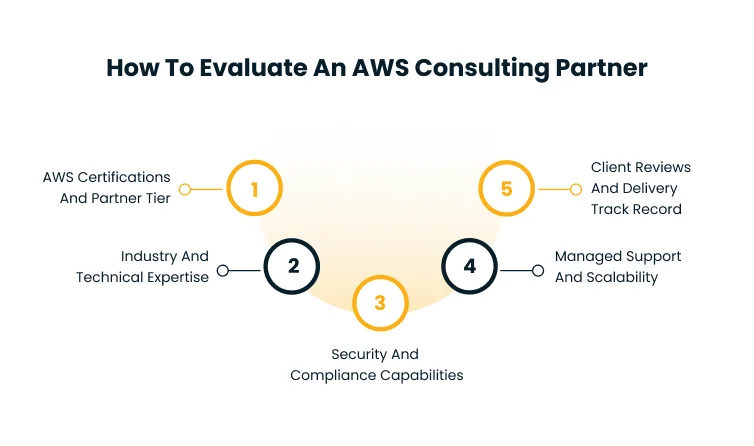
How To Evaluate An AWS Consulting Partner?
Choosing the right AWS consulting partner requires looking beyond certifications to evaluate delivery capability, governance maturity, security expertise, and long-term operational support. Certifications confirm a technical baseline but do not reveal how partners perform under delivery pressure. Delivery evidence at comparable scope and complexity is what differentiates strong partners from weaker ones.
AWS Certifications And Partner Tier
AWS Partner Network tier status reflects the level of technical validation, delivery experience, and certified expertise a partner has demonstrated.
- AWS Select Tier: Entry-level validation with foundational AWS delivery experience.
- AWS Advanced Tier: Validated competency across migration, architecture, and cloud operations.
- AWS Premier Tier: Highest tier with the broadest validated technical depth and delivery scale.
Partner tier provides meaningful differentiation from unvalidated vendors. It should be the starting point for evaluation rather than the deciding criterion – delivery evidence and governance maturity carry more weight than tier status alone.
Industry And Technical Expertise
Partners with experience in healthcare, fintech, SaaS, retail, or enterprise technology understand workload-specific compliance, security, and scalability requirements that generalist consultants address through generic frameworks. Industry experience accelerates architecture decisions that would otherwise require extensive discovery to validate.
Ask partners to describe deployments completed in your industry at comparable scale and complexity – not case study summaries, but the specific architecture decisions made under delivery pressure. The depth of the answer is a more reliable indicator of genuine industry expertise than the sector list on a partner website.
Security And Compliance Capabilities
Strong AWS consulting partners demonstrate security capability that extends from IAM governance design through compliance framework delivery. For regulated industries, ask the following during evaluation.
- Which compliance frameworks has the partner delivered against – HIPAA, PCI DSS, SOC 2, or others?
- What audit artifacts does the automated environment produce as part of normal operations?
- How does the partner approach IAM policy design, encryption, and network segmentation in practice?
- What is the process for identifying and remediating security gaps during architecture review?
- Partners who cannot answer these questions with specificity are unlikely to deliver a production-ready security posture for regulated workloads.
Managed Support And Scalability
Evaluate whether the consulting partner can support cloud operations after initial delivery. A partner without managed support capability transfers full operational responsibility to the client team at handover, regardless of whether that team has the capacity to manage the environment at the required service level.
Key questions to ask include the following:
- What SLA commitments does the partner’s managed services model provide?
- How is the managed services engagement structured relative to project-based delivery?
- What is the escalation process for critical incidents, and what are the response time commitments?
- How does managed support scale as the client’s infrastructure and team complexity grow?
Client Reviews And Delivery Track Record
Delivery consistency is best evaluated through the following evidence sources rather than through certification count alone.
- References from engagements at comparable scale and complexity – not generic testimonials.
- Specific outcome data: deployment timelines, migration success rates, and post-delivery cost improvement.
- AWS competency designations in migration, security, DevOps, or industry-specific workloads.
- Third-party review platform ratings that reveal patterns across multiple client engagements.
AWS competency designations indicate validated capability in specific domains through AWS review processes, providing external verification beyond what client references alone can confirm.
Mistakes To Avoid When Choosing An AWS Consulting Partner
Organizations frequently optimize for short-term cost when selecting AWS consulting partners, underweighting governance capability, security maturity, and long-term operational support. The compounding cost of a poorly governed cloud environment typically exceeds the initial savings from a lower-cost partner within the first twelve to eighteen months of operation.
Common selection mistakes that create operational and financial risk downstream include the following:
- Choosing partners without AWS certifications or verified AWS Partner Network tier status.
- Prioritizing migration speed over architecture quality and long-term infrastructure design decisions.
- Skipping security and compliance planning during initial cloud architecture design.
- Failing to establish clear cloud governance ownership at project handover.
- Underestimating post-migration optimization as a sustained operational requirement rather than a one-time task.
- Selecting consultants without a managed support offering for long-term operational continuity.
These gaps surface after delivery, when client teams inherit infrastructure they did not design, security controls that were not validated, and cloud costs that were not optimized. Evaluating partners against these criteria before engagement prevents the rework that follows from selection based on cost alone.
What Outcomes Should AWS Consulting Services Deliver?
A strong AWS consulting partner delivers measurable business outcomes beyond infrastructure deployment. The right partner improves cloud scalability, cost visibility, security posture, and operational efficiency while reducing the adoption risks that accumulate in poorly governed environments.
Faster And Lower-Risk Cloud Adoption
Structured migration planning and phased implementation reduce the downtime, deployment failures, and operational disruption that unstructured migrations produce. Strong consulting partners sequence workloads based on migration complexity and dependency risk, ensuring critical applications move only after simpler workloads have validated the migration process end-to-end.
Documented architecture decisions, runbooks, and handover materials allow the client team to operate the environment confidently after delivery. Partners that skip this documentation transfer migration risk from implementation to operations, where it accumulates as undocumented technical debt that surfaces under production pressure.
Better Cost Visibility And Optimization
Cloud costs increase quickly without active monitoring and resource governance. Strong AWS consulting partners establish cost visibility through tagging strategies, budget alerts, usage dashboards, and rightsizing analysis – configured before the environment goes live, not after the first unexpectedly high AWS bill.
FinOps practices implemented during the architecture phase are significantly less expensive than those retrofitted to a running environment. Partners who treat cost optimization as a standard delivery output produce environments where informed infrastructure decisions are possible from the first month of operations.
Stronger Security And Governance
Enterprise cloud environments require consistent security controls, identity governance, compliance monitoring, and policy enforcement across all workloads and user roles. Strong AWS consulting partners design security architecture that satisfies compliance requirements and operational needs simultaneously, rather than treating compliance as an audit exercise layered onto existing infrastructure.
For enterprises balancing security with delivery speed, AWS guardrails that support secure innovation can help teams enforce governance without slowing cloud adoption.
Governance frameworks delivered as part of the engagement give operations teams the policies, monitoring, and escalation processes needed to maintain security posture as environments grow and workloads are added. A governance layer designed to scale with infrastructure growth determines whether cloud environments remain secure and compliant over time.
Scalable Cloud Operations And Support
As cloud environments expand, operational complexity increases across infrastructure management, deployment pipelines, monitoring coverage, and incident response.
Strong consulting partners help organizations design cloud operations that scale with infrastructure growth rather than accumulating manual overhead alongside it – through deployment automation, standardized runbooks, monitoring frameworks, and managed support models that grow alongside the environment.
Organizations that receive this operational layer as part of their consulting engagement operate more efficiently at scale than those inheriting deployed infrastructure without it. Cygnet.One’s Cloud Operations and Optimization practice provides the managed operational layer – monitoring, optimization, governance, and incident management – that sustains cloud environments as workloads and team complexity grow.
Conclusion
Cloud environments that sustain business growth share one characteristic: they were built on deliberate architecture decisions rather than assembled under pressure to meet a migration deadline. The difference is not the tools used – it is the governance depth, security posture, and operational design embedded before workloads went live.
Selecting an AWS consulting partner is a delivery risk decision that shapes infrastructure cost, security posture, and operational capacity for years beyond the initial engagement. Delivery evidence at comparable scope and complexity is a more reliable predictor of that capability than tier status or certification count alone.
The next step for organizations moving through partner evaluation is getting past certifications to delivery depth. Book a demo with Cygnet.One to assess how our AWS consulting practice can help your organization migrate, secure, and operate on AWS with the architecture quality and governance maturity your environment requires at scale.
FAQs
AWS consulting services are professional services from certified AWS Partner Network members that help organizations design, migrate, secure, optimize, and manage cloud environments on Amazon Web Services. Engagements cover architecture design, migration planning, DevOps automation, security governance, cost optimization, and ongoing managed cloud operations support.
An AWS consulting partner supports cloud migration, infrastructure architecture design, DevOps automation, security implementation, cost optimization, and ongoing AWS management. Consulting partners deliver structured engagements across the full cloud adoption lifecycle, from initial assessment through migration, optimization, and long-term managed operations.
Evaluate AWS Partner Network tier, technical certifications, industry experience, security and compliance capability, and delivery track record at a comparable scope. Also, confirm whether the partner provides managed support beyond the initial engagement. References from comparable-scale projects are more reliable than certifications as a predictor of delivery quality.
AWS consulting focuses on cloud strategy, architecture design, migration, and optimization. Managed AWS services focus on ongoing cloud operations, including monitoring, incident response, patching, and infrastructure support. Some AWS consulting partners offer both, providing continuity between the delivery phase and ongoing cloud operations.
Strong AWS consulting partners hold AWS Advanced Tier or Premier Tier status within the AWS Partner Network, alongside certified AWS architects, security specialists, and DevOps engineers. AWS competency designations in specific domains such as migration, security, or DevOps indicate validated delivery capability in those areas.
No. Startups, mid-sized businesses, SaaS companies, and enterprises all use AWS consulting services based on migration complexity, scalability requirements, security needs, and the depth of internal cloud expertise available. Engagement scope and complexity scale with the organization’s infrastructure requirements and business objectives.
Author


Abhishek Nandan
AVP, Marketing
Abhishek Nandan is the AVP of Services Marketing at Cygnet.One, where he drives global marketing strategy and execution. With nearly a decade of experience across growth hacking, digital, and performance marketing, he has built high-impact teams, delivered measurable pipeline growth, and strengthened partner ecosystems. Abhishek is known for his data-driven approach, deep expertise in marketing automation, and passion for mentoring the next generation of marketers.