




































Every organization believes it has data, while only a few organizations have data that works. Reports conflict as the revenue figure in the finance dashboard differs from the one the sales team presents in the quarterly review.
The customer count in the CRM does not match the billing system. Analysts spend hours reconciling numbers before a single insight can be drawn, and by the time data is ready, the decision window has often closed.
Data siloes problems are behind most of these failures. They do not require a system breach or a technology failure to cause harm. They cause harm continuously, through the efficiency losses, decision delays, and missed opportunities that accumulate whenever organizational data cannot flow freely between the systems and teams that generate it.
The challenge is rarely a shortage of data. Most organizations are generating more data than they have ever had. The challenge is that data is trapped in isolated systems, owned by separate teams, and structured in incompatible formats that prevent it from being combined or acted on at scale.
Understanding data siloes problems, where they originate, what they cost, and how to eliminate them, is one of the most consequential investments a data-led organization can make.
What are data siloes?
Data siloes are isolated repositories of information stored within a single department, application, or system that are not accessible to the broader organization. Each silo captures data from one operational area and contains it there, preventing cross-team visibility and sharing.
Siloes typically form when technology systems lack integration capabilities, when departments build workflows around separate tools, or when no centralized governance is in place.
The result is a fragmented data landscape where marketing, finance, operations, and sales each hold distinct pieces of organizational intelligence that never converge into a unified view.
What are the top causes of data siloes in organizations?
Data siloes accumulate gradually as organizations grow, adopt new tools, and build workflows around the immediate needs of individual teams rather than the long-term needs of the business. Understanding where siloes originate is essential before attempting to address them.
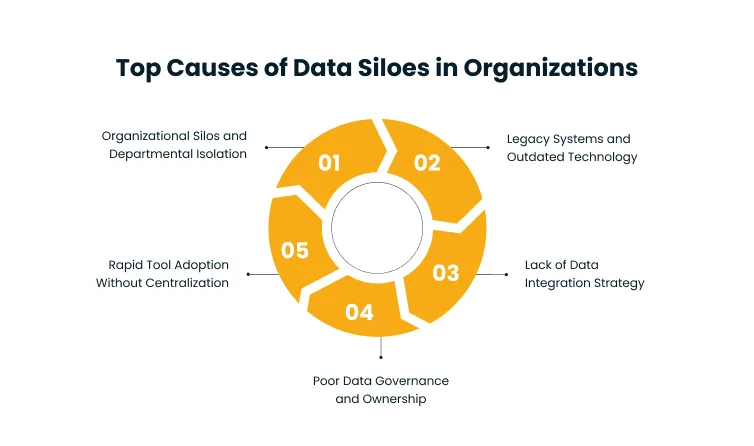
1. Organizational Silos and Departmental Isolation
When teams operate with independent priorities and their own toolsets, they build data practices that serve their workflows rather than the organization’s shared goals.
Marketing uses one CRM, sales uses another, and finance operates within its own ERP system. Each team generates and stores data in platforms chosen for departmental efficiency rather than organizational connectivity.
Over time, these separate data environments become entrenched and self-reinforcing, making cross-team data sharing the exception rather than the routine.
2. Legacy Systems and Outdated Technology
Older enterprise systems were built when integration was not a design priority. These platforms store data in proprietary formats, use closed architectures, and lack the APIs and connectors needed to communicate with modern tools.
When organizations continue to rely on legacy infrastructure alongside newer cloud platforms, the result is a patchwork of incompatible systems where data flows freely within each platform but cannot move between them.
Modernizing or replacing legacy technology is often a prerequisite for building a genuinely connected data environment.
3. Lack of Data Integration Strategy
Many organizations invest in individual tools without investing in the infrastructure that connects them. Without a defined data integration strategy, each tool acquisition solves a narrow problem while adding complexity to the broader data ecosystem.
Teams build workarounds, export data manually, and maintain spreadsheets to compensate for the absence of automated data flows. The lack of a strategic integration layer means data remains scattered, redundant, and difficult to reconcile across the organization.
Cygnet.One’s Enterprise Integration service provides the API management, middleware, and event-driven architecture needed to replace these manual workarounds with automated, real-time data flows across the enterprise.
4. Poor Data Governance and Ownership
When no one is clearly accountable for data quality, consistency, and access, standards deteriorate. Different teams define the same metrics differently, apply different naming conventions, and maintain records at varying levels of completeness.
Without formal data ownership and governance policies, there is no mechanism to enforce consistency, resolve conflicts, or ensure that data held in one system matches what is held in another.
The resulting inconsistency compounds over time, making trusted analysis increasingly difficult.
5. Rapid Tool Adoption Without Centralization
Fast-growing organizations often acquire tools quickly in response to immediate operational needs. A sales team adopts a new CRM, a marketing team launches a new automation platform, and a product team integrates a new analytics stack.
Each tool generates its own data, often without integration into a central repository. When tool adoption outpaces integration planning, the data ecosystem grows in all directions simultaneously, creating fragmentation that becomes harder to unwind with each new platform added.
What are the key data siloes problems and their impact?
Understanding where siloes come from is only half the picture. The more pressing question is what data siloes actually cost in practice.
Data integration issues ripple across reporting accuracy, operational speed, customer experience, and regulatory compliance, and the impact is never limited to one function.
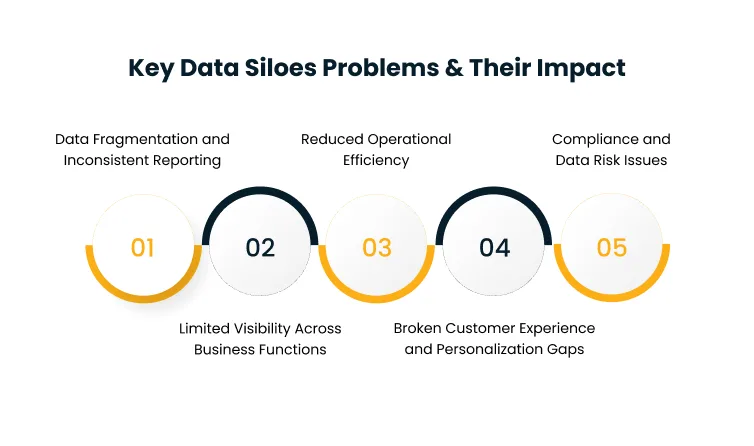
According to the 2025 IBM Study on Chief Data Officers, only 26% of CDOs are confident their data can support new AI-enabled revenue streams, a figure that reflects the cumulative cost of fragmented data environments across most enterprises. Each of the problems below represents a different dimension of that impact.
1. Data Fragmentation and Inconsistent Reporting
When the same business metric lives in multiple systems without a synchronization mechanism, different teams generate conflicting reports from the same underlying reality.
The finance team’s revenue figure does not match the sales team’s total closed deals. The customer count in the CRM differs from the number in the billing system. These discrepancies do not just create confusion. They undermine trust in data across the organization.
Decision-makers who cannot rely on data consistency either stop using data or spend disproportionate time reconciling figures before acting, and both outcomes carry high costs.
2. Limited Visibility Across Business Functions
A connected data environment enables leaders to see how one part of the business affects another. Data siloes remove that visibility entirely.
When sales performance data is not linked to marketing attribution data, it is impossible to understand which campaigns drove which revenue. When customer support data is not connected to product usage data, diagnosing accelerating churn becomes guesswork.
The strategic blind spots created by siloed data are competitive disadvantages that accumulate silently over time.
3. Reduced Operational Efficiency
One of the most immediate data siloes problems is the operational cost it imposes on daily work.
Employees who need data from multiple systems must access each system separately, export data, clean and reformat it, and manually combine it before performing any analysis.
This process is time-consuming, error-prone, and repeated constantly across the organization.
Time spent on manual data collection and reconciliation is time not spent on analysis, strategy, or execution. The cumulative cost of these manual workflows is significant even when it is never formally measured.
4. Broken Customer Experience and Personalization Gaps
A seamless customer experience depends on a unified view of the customer. When customer interaction data is distributed across marketing automation, sales CRM, support ticketing, and billing systems without integration, no single team has a complete picture of who the customer is or what they need.
The result is customers receiving conflicting communications, experiencing disjointed support interactions, and encountering offers that ignore their existing relationship with the business.
Personalization at scale becomes impossible when data fragmentation prevents any team from seeing the full customer journey.
5. Compliance and Data Risk Issues
Regulatory frameworks such as GDPR and CCPA require organizations to maintain accurate records of what personal data they hold, where it is stored, and who can access it.
When data is distributed across dozens of disconnected systems, meeting these requirements becomes significantly harder. Responding to subject access requests, enforcing data retention policies, and auditing access logs all depend on a mapped and governed data landscape.
Data integration issues create compliance exposure and security vulnerabilities simultaneously, with sensitive data sitting in systems that have inconsistent access controls.
How to identify data siloes in your organization?
Data siloes do not announce themselves and often develop gradually within normal business operations. Many organizations discover siloes only after they have caused a measurable problem, such as a failed reporting initiative, a customer complaint, or an audit finding.
Proactively diagnosing data fragmentation before it reaches that stage requires deliberate effort across both technical and organizational dimensions. The signals are usually present but they simply need a structured approach to surface them.
1. Common Warning Signs of Data Siloes
Several patterns consistently indicate the presence of data siloes in an organization:
- Teams maintain separate spreadsheets to track data that should come from a central system
- Reports generated by different departments show contradictory numbers for the same metric
- Accessing data from another team requires manual requests, email chains, or one-off extracts
- Onboarding a new analytics tool reveals that no consistent data schema exists across systems
- Business leaders cannot get a real-time performance view without waiting for manual reports
Each of these symptoms points to a breakdown in data connectivity. Any one of them warrants further investigation.
2. Questions to Diagnose Data Fragmentation
Structured diagnostic questions help teams assess the depth of data integration issues:
- Does each team rely on a different primary data source for the same business metrics?
- Is there a recognized single source of truth for customer, revenue, or operational data?
- Can teams access the data they need in real time, or is there always a lag?
- How often do cross-departmental reports require manual reconciliation before being trusted?
- Are there data definitions, such as the meaning of an active customer, that vary between teams?
If the answers reveal consistent inconsistency across these questions, data fragmentation is present and likely entrenched.
3. Identifying Gaps in Data Accessibility
Data accessibility gaps are a direct symptom of siloes. When employees need to request access from another team, navigate multiple login credentials across different systems, or wait for data exports from colleagues, the friction reveals something structural.
The degree of difficulty involved in accessing data across teams is a reliable proxy for the severity of siloes in the organization. If obtaining data from another function requires more than one step, a gap almost certainly exists.
4. Evaluating Cross-Team Data Sharing Practices
How data moves between teams reveals the health of the data ecosystem. If cross-team data sharing relies on scheduled email reports, manually exported CSV files, or informal verbal updates, the organization has no programmatic integration.
These workarounds are fragile, inconsistent, and impossible to audit. Evaluate whether your organization has automated pipelines that feed data from one function to another, or whether sharing depends entirely on individual effort. The absence of automation in cross-team data flows is a near-certain indicator of siloes.
5. Mapping Your Current Data Flow
A data flow map documents where data originates, how it moves between systems, and where it lands. Creating this map, even informally, typically surfaces siloed data environments immediately.
Systems that appear in the map with no inbound or outbound connections to other systems are siloes by definition.
A data flow map also identifies duplication, where the same data is stored in multiple systems without a mechanism to keep them synchronized. Organizations that cannot accurately draw their own data flow are, by definition, not in control of it.
Effective strategies to break down data siloes
Organizations that address siloes at the technical level without addressing the organizational conditions that created them typically find that siloes re-emerge in new forms.
Effective strategies operate at both layers simultaneously. The approaches below address the root causes identified earlier and work together to create a data environment where information flows freely, governance is enforced consistently, and teams collaborate around shared data.
1. Establishing Strong Data Governance Frameworks
Data governance is the foundation on which all other integration efforts rest. A governance framework defines who owns each data domain, who can access it, how it should be structured, and what quality standards apply.
Without this foundation, integration efforts connect systems that each contain inconsistent, incomplete, or contradictory data, producing a unified environment that surfaces problems more efficiently rather than eliminating them. Governance must precede or accompany integration.
Assigning clear data stewards, creating data dictionaries, and publishing access policies are practical starting points that most organizations can implement incrementally.
2. Standardizing Data Formats and Definitions
A significant portion of data integration issues stems from inconsistent definitions and formats rather than from technical incompatibility alone.
When marketing defines a lead differently from sales, integration between their systems produces data that is technically connected but analytically meaningless.
Establishing shared data definitions, common taxonomies, and uniform formatting conventions before and during integration ensures that connected data is also coherent.
This standardization work is often the difference between an integration project that succeeds and one that merely moves the problem downstream.
3. Encouraging Cross-Functional Collaboration
Data siloes are as much a cultural phenomenon as a technical one. Teams that have historically operated in isolation often resist integrating their data environments because doing so requires sharing control, relinquishing proprietary workflows, and accepting standards that may not perfectly suit individual processes.
Leadership must actively create incentives for cross-functional data collaboration, including shared performance metrics that depend on data from multiple functions and joint ownership of integration initiatives. Without organizational buy-in, even well-designed technical integrations tend to be undermined in practice.
4. Aligning Business Goals with Data Strategy
Data integration initiatives that are not tied to clear business outcomes tend to lose momentum and organizational support.
The strongest integration programs articulate specific business goals that unified data will enable, whether faster executive reporting, improved customer lifetime value analysis, or reduced time-to-insight for product decisions.
When leaders understand the value at stake, they are more likely to sponsor the organizational changes technical integration requires.
5. Migrating from Legacy Systems
Legacy systems are among the most persistent sources of data siloes because they cannot be resolved through configuration alone.
When a system lacks integration capabilities by design, the only sustainable path is migration to a modern platform that supports open APIs, standard data formats, and real-time connectivity.
Cygnet.One’s Data Migration and Modernization practice helps organizations plan and execute these migrations with minimal disruption, preserving historical data while rebuilding the architectural foundation needed for genuine integration.
Migration projects require careful planning, particularly when the legacy system holds years of data that must be preserved, transformed, and validated.
How to measure success after eliminating data siloes?
Organizations that do not define success metrics before beginning integration initiatives often lack the evidence needed to sustain momentum, secure continued investment, or demonstrate ROI to leadership.
The 2025 IBM Study of Chief Data Officers found that 82% of CDOs believe data is wasted without access, which underscores why data accessibility metrics are among the most important indicators of integration success. The following framework tracks impact across operational, strategic, and financial dimensions.
1. Key Metrics to Track Data Integration Success
The most relevant metrics for assessing data integration effectiveness include:
- Data accuracy rate: The percentage of records that are complete, consistent, and free of duplicates across connected systems
- System connectivity: The number of data sources integrated into a central platform versus the total number of data-producing systems in the organization
- Data refresh latency: The time between an event occurring and that data being available for analysis
- User adoption: The percentage of teams actively querying a centralized data source rather than maintaining shadow copies in separate spreadsheets
These metrics establish a direct connection between integration efforts and the data quality outcomes that drive business decisions.
2. Measuring Improvements in Data Accessibility
Data accessibility can be measured by tracking the time required for employees to obtain specific data sets and the number of steps involved in that process.
Before integration, this baseline is often measured in hours or days, with multiple system logins and manual handoffs.
After integration, the target state is self-service access with sub-minute retrieval. Organizations can also survey teams on perceived accessibility to capture qualitative improvements alongside technical metrics.
A reduction in data-related support tickets is another reliable indicator that accessibility has genuinely improved.
3. Evaluating Decision-Making Speed and Accuracy
Unified data environments accelerate decision-making by reducing the time between a business question and an actionable answer.
Measuring this improvement requires tracking the time from question to insight for specific recurring decisions, and the frequency of decisions revised or reversed after being made on incomplete data.
If leadership cycles are spending less time waiting for data and less time correcting decisions made on faulty data, the integration effort is producing measurable strategic value.
4. Tracking Operational Efficiency Gains
One of the most quantifiable outcomes of breaking down data siloes is the reduction in manual data handling across the organization. Track the hours per week that teams previously spent on manual data extraction, reformatting, and reconciliation, and compare those figures after integration.
Organizations that automate data flows between systems typically recover significant analyst and operations time that can be redirected toward higher-value work. This recovery is directly measurable and often provides the clearest ROI evidence available to support continued investment.
5. Monitoring Cost Reduction and ROI
Data siloes generate costs that are often invisible but measurable once organizations begin tracking them, including the cost of maintaining redundant systems, errors from inconsistent reporting, and compliance risks from ungoverned data.
Post-integration, monitor reductions in tool redundancy, licensing costs for systems consolidated or retired, and any reduction in compliance costs.
6. Before vs After Data Performance Benchmarking
Before beginning any data integration initiative, document the current state of key metrics across accuracy, accessibility, decision speed, and operational efficiency. This baseline documentation is what makes post-integration measurement meaningful.
Without a documented baseline, it is impossible to demonstrate improvement credibly. Ideally, benchmarking should include input from multiple teams, capturing how data fragmentation affects each function differently.
Post-integration benchmarks gathered at 30, 90, and 180 days provide a picture of both immediate and sustained improvement, which is important for demonstrating long-term ROI.
Conclusion
Data siloes do not appear or disappear overnight. They are the accumulated consequence of growth without integration planning, tool adoption without governance, and departmental autonomy without shared data standards. Every organization that has scaled beyond a handful of systems faces some version of this challenge.
What changes when organizations commit to addressing data siloes problems is the relationship between data and decision-making. Instead of analysts spending hours reconciling conflicting reports, insights arrive in time to influence the decisions they are meant to support.
Instead of customers encountering fragmented interactions because their data lives in four separate systems, they experience continuity. Instead of compliance teams scrambling to locate personal data across disconnected platforms, they maintain a mapped and governed data landscape.
The organizations that treat data integration as a continuous practice rather than a one-time project are the ones that build a genuine competitive advantage from their data. The distance between siloed and integrated data environments is exactly the distance between reactive and strategic operations.
Unified data environments transform how organizations make decisions, serve customers, and measure performance.
If your organization is navigating data integration issues or working to break down long-standing siloes, Cygnet.One’s Data Engineering and Management practice can help you build the integration architecture and governance layer your data strategy depends on.
Book a demo to explore what a connected data environment looks like for your organization.
FAQs
1. Why are data siloes a problem for businesses?
Data siloes lead to conflicting reports, operational inefficiencies, and broken customer experiences. When data cannot flow freely between systems, teams waste time on manual reconciliation, decisions are made on incomplete information, and compliance with data regulations becomes harder to maintain.
2. What causes data fragmentation?
Data fragmentation is caused by multiple disconnected tools, legacy systems that lack integration capabilities, poor data governance, and the absence of a centralized data strategy. When organizations adopt new platforms faster than they integrate them, data accumulates in separate environments with no mechanism to reconcile or synchronize it across the business.
3. How do data integration issues impact decision-making?
Data integration issues mean decision-makers cannot trust that the data they are looking at is complete or accurate. When different systems report different figures for the same metric, leaders must choose which source to believe or invest time in manual reconciliation before acting.
4. What tools help eliminate data siloes?
Data warehouses and data lakes centralize storage and make data accessible across the organization. Integration platforms and middleware connect disparate systems and automate data flows. APIs enable real-time data exchange between applications. Master data management tools enforce consistent definitions across systems. The right tool combination depends on the organization’s current infrastructure, data volumes, and integration requirements.
5. Can small businesses face data siloes too?
Yes. Small businesses using multiple disconnected tools, such as separate platforms for accounting, CRM, email marketing, and project management, face data siloes even without a large enterprise infrastructure.
6. How long does it take to fix data siloes?
Resolving data siloes requires a phased approach, and the timeline varies with organizational complexity. Simple integrations between a small number of systems can be completed in weeks. Comprehensive enterprise integration programs involving legacy migration, governance frameworks, and cross-functional alignment typically unfold over six to eighteen months. Ongoing governance is required afterward to prevent new siloes from forming as the business continues to evolve.
Author


Abhishek Nandan
AVP, Marketing
Abhishek Nandan is the AVP of Services Marketing at Cygnet.One, where he drives global marketing strategy and execution. With nearly a decade of experience across growth hacking, digital, and performance marketing, he has built high-impact teams, delivered measurable pipeline growth, and strengthened partner ecosystems. Abhishek is known for his data-driven approach, deep expertise in marketing automation, and passion for mentoring the next generation of marketers.