



































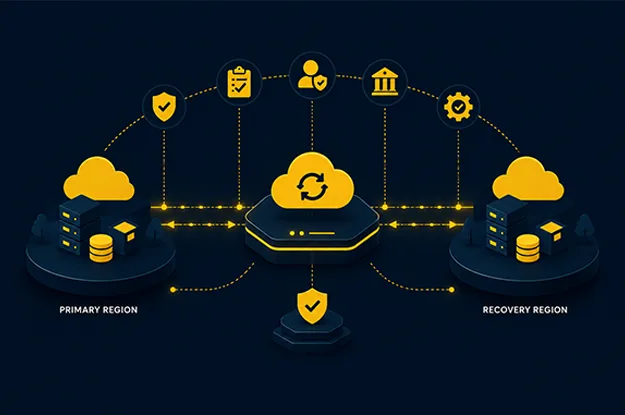
Disaster recovery stops being technical the moment a US enterprise has to explain an outage to customers, auditors, regulators, and the board on the same day. At that point, the question is no longer whether backups exist. The question is whether the business can recover the right systems, in the right order, with evidence that controls worked.
That question cuts through architecture diagrams. AWS disaster recovery US planning now sits at the intersection of uptime promises, regulated data, ransomware exposure, customer contracts, cyber insurance, and board risk reporting, especially when enterprises design multi-region cloud architectures for high availability and compliance. Restoring servers is useful. Restoring business operations with proof is what makes AWS business continuity credible.
Recovery targets often arrive as shorthand: RTO, RPO, region, snapshot, replication, failback. Those terms matter, yet they do not answer the business question: what must continue first, and what proof will satisfy compliance after the incident?
This is where cloud DR compliance with US requirements becomes practical: the recovery design must prove how data, access, systems, and controls are protected during disruption. It connects architecture, policy, evidence, and the actual recovery process. Strong plans remove debate during stress. Teams should not negotiate ownership, sequencing, or recovery priorities while customers are waiting. That is the real buyer test for an AWS disaster recovery US program: can the business recover critical services with control, timing, and proof?
What US Compliance Really Expects From DR
Compliance teams rarely ask for a perfect AWS diagram. They ask whether the organization can prove that critical systems, protected data, and contractual commitments remain controlled during disruption. That is the practical heart of AWS business continuity.
HIPAA is a useful example because its requirements are tied to practical recovery actions. The HIPAA Security Rule requires a data backup plan, a disaster recovery plan, an emergency mode operation plan, testing and revision procedures, and application and data criticality analysis. Healthcare and health-adjacent companies need retrievable copies, a restore method, critical-process continuity, and test proof.
SOC 2 pushes the same conversation through customer commitments. If the SOC 2 Availability category is in scope, auditors look at whether customer-facing uptime and service access promises are supported by monitoring, redundancy, incident handling, backup, recovery, and tested continuity procedures. Buyers comparing HIPAA SOC2 DR AWS requirements US guidance should look beyond backup frequency and ask how recovery testing, access control, encryption, retention, and evidence are handled. It should influence workload tiers, retention policy, access control, recovery automation, and evidence capture from day one.
| Compliance concern | DR design response | Evidence auditors expect |
| Protected data | Encrypted backup, replication, access control | Backup reports, KMS policy, access logs |
| Availability commitments | Defined RTO and RPO by workload tier | Test logs, incident records, runbooks |
| Critical process continuity | Recovery sequence mapped to business services | BIA, dependency map, approvals |
| Change control | Versioned runbooks and approved changes | Change tickets, approvals, test notes |
| Periodic validation | Scheduled recovery drills | Test results, gaps, remediation status |
This is where cloud DR compliance US becomes governance. Saying the data is backed up is too thin. The organization has to show who owns the workload, which tier it belongs to, how often recovery is tested, and whether the last test passed within target.
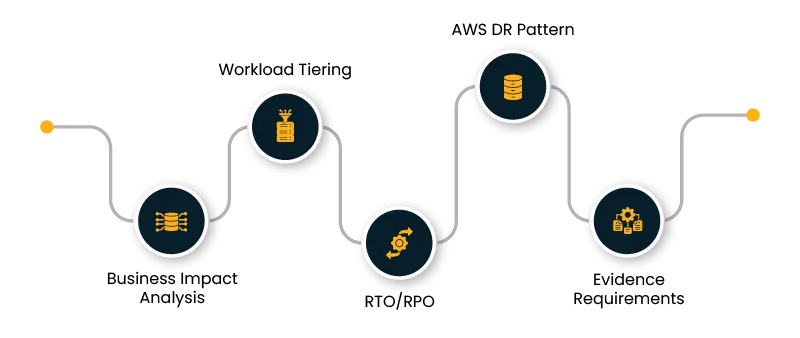
Start With Business Impact, Then Pick the AWS Pattern
The cleanest AWS disaster recovery strategies compliance programs start before service selection with aws cloud consulting services. They begin with a business impact analysis that names critical processes, supporting systems, dependent data stores, and the sequence needed to bring them back.
Many teams jump straight to multi-region design. That can be justified for certain systems. It can also add cost where a simpler pattern would meet the business need. AWS commonly frames disaster recovery options across backup and restore, pilot light, warm standby, and multi-site active/active. The right choice depends on recovery objective, failure scenario, data sensitivity, operating maturity, and cost tolerance.
| Workload tier | Common DR pattern | Best fit |
| Tier 1 | Warm standby or multi-site active/active | Revenue, care delivery, trading, customer access |
| Tier 2 | Pilot light or warm standby | Important internal systems with strict recovery windows |
| Tier 3 | Backup and restore | Lower urgency systems with acceptable downtime |
| Tier 4 | Archived recovery | Records, historical reporting, low-use workloads |
For regulated organizations, AWS disaster recovery US planning also needs legal and operating scrutiny around region choice. US-only data residency, customer contracts, latency needs, support coverage, and third-party dependencies can affect where recovery environments should sit. Multi-region alone does not solve those concerns. A recovery region must be approved, monitored, secured, and included in the same cloud DR compliance US control model as production, which makes cloud governance models that scale with enterprise growth essential.
A practical rule: build recovery around business service groups. A claims portal, payment workflow, patient scheduling system, or tax filing process usually depends on identity, DNS, databases, APIs, queues, file stores, observability, secrets, and external integrations. If one piece is missing in the recovery region, the workload may boot and still fail the business test.
Disaster Recovery Design That Stands Up During an Audit
A mature AWS business continuity design has five layers.
First, identity must remain available. Recovery plans often assume administrators can sign in, approve changes, and run automation. During a serious event, identity providers, federation paths, MFA devices, privileged access workflows, or network controls may be impaired. Runbooks should state how emergency access works and how those actions are logged.
Second, data protection must match data value. Amazon EBS snapshots, Amazon RDS automated backups, cross-region read replicas, Amazon S3 Versioning, S3 Object Lock, AWS Backup, and database-native replication all serve different purposes. The selection should tie back to RPO, immutability needs, and retention obligations.
Third, infrastructure should be reproducible. Recovery built through manual console steps ages badly. Infrastructure as code, approved AMIs, launch templates, parameterized network buildouts, and pre-approved security groups reduce delay when the recovery window is tight.
Fourth, observability must exist in the recovery path. Logs, metrics, traces, alarms, synthetic checks, and dashboards should work in the secondary region. A failover without monitoring creates another crisis because teams cannot tell whether recovery is stable.
Fifth, evidence should be produced as part of normal operation. For cloud DR compliance US programs, the weakest evidence is usually the evidence assembled manually after an incident. AWS Config, AWS CloudTrail, AWS Backup Audit Manager, Security Hub, IAM Access Analyzer, and ticketing integration can help create a steady control trail.
This is also where business continuity AWS enterprise US planning needs ownership outside IT. Legal, compliance, finance, operations, customer support, and executive leadership should know what the recovery order means. Technical restoration is only one part of AWS business continuity. Customer communication, manual workarounds, clinical safety, invoicing, and service credits may matter just as much.
AWS Tools That Matter in a Real DR Program
Tools should not drive the plan, but they can harden it. A mature AWS disaster recovery US design usually combines backup, replication, access control, automation, monitoring, and tested recovery procedures.
AWS Elastic Disaster Recovery is often used for block-level replication and orchestrated recovery for on-premises or cloud-based servers. AWS Backup centralizes backup policy across supported AWS services and can use backup vaults, retention rules, cross-account copy, cross-region copy, and audit reporting.
The tool layer should stay tied to the recovery objective. For some workloads, AWS Backup and cross-region copies may be enough. For others, AWS Elastic Disaster Recovery, database replication, automated failover, or a warm standby environment may be needed. The decision should come from RTO, RPO, data sensitivity, dependency depth, and evidence expectations, not from a preference for one AWS service.
For AWS disaster recovery strategies compliance, the tool choice should answer four questions:
- Can it meet the approved RTO and RPO?
- Can it produce evidence without manual reconstruction?
- Can it isolate recovery from the compromised environment?
- Can the team test it without risking production?
Those questions expose weak assumptions early and keep AWS disaster recovery US planning tied to recovery proof rather than tool preference.
Testing Is Where DR Plans Become Believable
A plan that has never been tested is a theory with a budget line. A serious DR testing AWS plan should be treated as a control activity, with defined scope, owners, recovery targets, evidence, and remediation tracking.
Testing needs levels. A tabletop review checks decision flow, contacts, authority, and communications. A component recovery test proves that a database, file store, or server can be restored inside the target window. An application recovery test checks whether the workload can run with its dependencies. A business recovery test validates whether the process works for real users, with customer support, reporting, security monitoring, and compliance evidence included.
For DR testing AWS, the useful measure is not only whether the test passed, but how far actual recovery performance was from the approved target. If the target RTO is four hours and the test took six, the question is what design, approval, dependency, or automation gap consumed those two hours.
Test evidence should include the date, scope, systems tested, recovery objective, actual recovery time, actual data loss window, issues found, screenshots or logs, approvals, and remediation plan. This level of detail helps support cloud DR compliance US claims during audits, customer reviews, and internal risk discussions.
In practical terms, HIPAA SOC2 DR AWS requirements US planning affects testing cadence, recovery records, access controls, backup retention, and the proof customers or auditors may request.
The Outcomes Buyers Should Expect
A strong AWS business continuity program should produce visible operational outcomes. If the investment only creates a larger runbook, the work has missed the point.
The first outcome is tighter recovery prioritization. Leaders should know which workloads recover first and why. This reduces argument during incidents and gives compliance teams a defensible record of criticality decisions.
The second outcome is cleaner audit readiness. In a mature cloud DR compliance US program, evidence should be available before the auditor asks. Backup compliance reports, recovery test results, access logs, configuration history, encryption policy, and change records should line up with the control narrative.
The third outcome is lower incident confusion. A well-designed AWS disaster recovery US program gives teams a known recovery path, not a heroic scramble. People still make judgment calls, yet they make them inside a tested model.
The fourth outcome is better customer trust. For US enterprises, customers increasingly ask direct questions about resilience, data protection, outage handling, and recovery testing. A clear explanation of business continuity AWS enterprise US controls, test cadence, recovery tiers, and evidence discipline helps commercial teams answer security questionnaires with substance.
The fifth outcome is better cost control. DR cost should track workload value. Warm standby for every internal system is rarely sensible. Backup and restore for a critical revenue workflow are risky. The art is in matching the recovery pattern to the business cost of downtime.
Conclusion: Recovery Has to Prove Itself Before the Incident
Disaster recovery work fails when it is treated as a backup project. Backups matter, yet AWS business continuity needs more than retrievable data. It needs a recovery order, tested dependencies, clear authority, secure access, clean evidence, and a design that reflects the business cost of downtime.
For US enterprises, AWS disaster recovery US planning should answer three questions without hesitation. What must recover first? How do we know that recovery works? What evidence proves the control operated?
When those answers are clear, cloud DR compliance US becomes less reactive. Audit conversations get easier. Customer reviews become more specific. Incident response becomes calmer. Most important, AWS business continuity moves from a policy phrase to an operating capability the business can trust.
Author


Yogita Jain
Content Lead
Yogita Jain leads with storytelling and Insightful content that connects with the audiences. She’s the voice behind the brand’s digital presence, translating complex tech like cloud modernization and enterprise AI into narratives that spark interest and drive action. With a diverse of experience across IT and digital transformation, Yogita blends strategic thinking with editorial craft, shaping content that’s sharp, relevant, and grounded in real business outcomes. At Cygnet, she’s not just building content pipelines; she’s building conversations that matter to clients, partners, and decision-makers alike.