



































A clean endpoint can be a compromised endpoint. Malware is no longer the only signal that matters. A risky login, a PowerShell command, lateral movement, or a suspicious attachment can create the same operational damage as a known virus file.
This is where EDR vs antivirus becomes practical. It is a question of how quickly an enterprise can see, contain, and learn from an attack before disruption begins.
Traditional antivirus was built for a simpler threat model. It checked files, matched signatures, blocked known malware, and gave IT teams a basic shield. That still has value. The problem is that modern attacks do not wait at the file layer. They move through email, identity, endpoints, and user behavior. Modern endpoint strategy should be built around that reality: email security, endpoint protection, user risk awareness, and managed response cannot sit in separate corners.
For enterprises, endpoint detection response has become the missing layer between “we blocked something” and “we understand what happened.” It gives security teams visibility after the first alert. This is why endpoint security solutions are now judged by detection depth, response speed, and operational fit, not by malware blocking alone.
Antivirus still has a job, but the job has changed
Traditional antivirus handles a defined purpose. If a known malicious file lands on a device, antivirus can stop it fast. It is familiar, easy to deploy, and useful for baseline protection.
The issue begins when executives assume that baseline protection equals endpoint resilience. That assumption is expensive.
Many attacks in 2026 avoid obvious malware signatures. Attackers use stolen credentials, built-in administrative tools, scripts, unpatched applications, and social engineering. A signature-based product may see a file. It may miss the sequence.
A user opens a phishing email. A script runs in memory. A process touches credential stores. The attacker checks privileges. Data starts moving. None of this may look like an old-school virus at first glance. This is the practical heart of why antivirus is not enough today.
What enterprise teams should understand first
When buyers compare tools, they often start with features. Start with the question each tool is designed to answer.
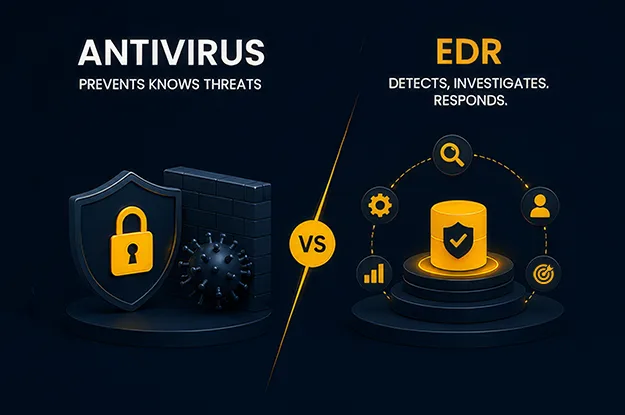
| Question | Traditional Antivirus | EDR |
| What is it mainly looking for? | Known malicious files and signatures | Suspicious behavior, attack patterns, and endpoint activity |
| What happens after detection? | Block or quarantine | Investigate, contain, isolate, and support response |
| What does IT see? | Alerts tied to files or known threats | Timelines, processes, users, devices, and attack paths |
| Where does it help most? | Basic prevention | Active threat detection and incident response |
These EDR vs antivirus differences enterprise teams care about affect how fast a team can answer core incident questions: Which endpoint was touched first? What process ran next? Which user account was involved? Did the attacker move to another system? What should be isolated now?
That context is the value of endpoint detection response.
What EDR adds that antivirus cannot carry alone
The strongest case for EDR vs antivirus is visibility. Prevention is still needed, yet prevention without investigation leaves too much unknown.
A mature EDR layer usually brings five capabilities:
- Behavioral detection: It looks for suspicious activity, not only known malware.
- Endpoint telemetry: It records process activity, command lines, file changes, network connections, and user actions.
- Threat hunting: It helps analysts search for indicators across the environment.
- Containment: It can isolate an endpoint before the incident spreads.
- Forensic context: It builds a timeline around the alert.
EDR becomes more useful when it is not treated as a standalone tool conversation. It works best when endpoint activity, email signals, and user risk data help security teams understand the full path of an attack. If email, endpoint, and user risk data are separated, the investigation starts with blind spots. If they are connected, the security team can understand the path from message to machine to response.
That is the lens enterprises should use when reviewing endpoint security solutions. A product should reduce guesswork. It should show the story behind the alert.
Threat detection is now about behavior
The old endpoint model asked, “Is this file bad?” The current model asks, “Is this activity normal for this user, device, process, and business context?”
Attackers often use trusted tools because trusted tools attract less attention. PowerShell, WMI, remote desktop utilities, browser sessions, and legitimate admin software can all be abused. Traditional antivirus may allow them because the tools themselves are clean. EDR looks at how they behave.
This is why the phrase endpoint detection response tools comparison should not be reduced to a feature checklist. The useful comparison is operational. Can the tool show attack progression? Can it reduce false positives? Can it connect alerts to user behavior? Can it support a lean IT team without demanding a full security operations center?
Where traditional antivirus breaks down in real enterprise use
Traditional antivirus starts to struggle when endpoints are scattered, users work from multiple locations, and business systems depend on modern cloud infrastructure management. The failure is usually practical, not technical.
Here are common cases where antivirus alone falls short:
- A finance user receives a convincing invoice email and opens a malicious attachment.
- A remote employee’s credentials are used from an unusual location.
- A script runs without dropping a known malicious file.
- An attacker uses approved admin tools to move across machines.
- A device shows suspicious network behavior after an email click.
This is the enterprise version of why antivirus is not enough today. It means antivirus cannot be the endpoint strategy by itself.
The practical answer is a layered model. Antivirus handles known threats. EDR watches behavior. Email security reduces the entry point. User training lowers risky action. Managed response supports teams that cannot watch alerts all day. EDR becomes more valuable when it works with email security, user awareness, and managed IT services.
EDR use cases that matter to enterprise teams
The best way to judge EDR vs antivirus is through real use cases. Abstract feature lists rarely help buyers. Incident pressure does.
| Enterprise use case | Why EDR matters |
| Ransomware containment | Isolates affected endpoints and helps trace the entry path |
| Phishing-led compromise | Connects endpoint activity with email and user behavior |
| Suspicious admin tool usage | Flags unusual use of legitimate tools |
| Remote workforce protection | Monitors endpoints outside the office network |
| Post-incident investigation | Shows process history, affected files, and lateral movement indicators |
For enterprises comparing endpoint detection response tools comparison criteria, the key question is simple: can the team act faster with this tool than without it? Speed matters, but so does accuracy. A fast wrong action can disrupt users. A slow right action can let an attacker continue.
Managed EDR and MDR support matter because many enterprises lack time, trained analysts, and clean workflows.
What enterprises need from security tools now
Modern buyers should stop asking whether they need antivirus or EDR. They need both, plus the operating model that makes them useful.
Strong modern endpoint security solutions should include:
- Prevention for known malware and risky files
- Behavioral detection for suspicious activity
- Endpoint isolation and guided remediation
- Integration with email defense
- User risk visibility
- Clear reporting for IT, risk, and leadership teams
- Managed support for investigation and response
This is a more realistic view of endpoint security solutions. It reflects how attacks actually unfold. A phishing email can trigger endpoint behavior. Endpoint behavior can expose credential misuse. Credential misuse can lead to data theft or ransomware. Each layer needs to inform the next.
A unified email and endpoint threat protection solution aligns with this need because it treats endpoint defense as part of a wider security posture. Enterprises do not need another disconnected dashboard. They need fewer blind spots and cleaner decisions.
How to evaluate EDR in an Enterprise Security Plan
EDR should be assessed through business risk, not only technical coverage. A good evaluation should ask:
- Which endpoints are most exposed?
- Which users are most likely to trigger risk?
- How quickly can IT isolate a device?
- Can email-originated threats be traced to endpoint activity?
- What alerts create the most wasted effort?
- Who responds after hours?
This also helps explain EDR vs antivirus differences enterprise leaders can understand without drowning them in product language. Antivirus is the lock on the door. EDR is the camera, motion sensor, incident log, and response workflow. One blocks known intrusion attempts. The other helps determine whether someone is already inside, what they touched, and how to stop them.

A practical enterprise endpoint model for 2026
A better endpoint strategy does not need to be complicated. It needs to be honest.
In this model, EDR vs antivirus becomes a readiness decision. Endpoint detection response provides context, while endpoint security solutions connect that context to action through cloud engineering services.
Start with antivirus for baseline protection. Add endpoint detection response for behavior, context, and response. Connect endpoint data with email security because the inbox remains a major entry point. Add user awareness because human action still drives many incidents. Use managed response where internal teams cannot cover alert review and investigation on their own.
This is the kind of model that makes modern endpoint security solutions useful in daily operations. It respects budget pressure, staff limits, and business continuity.
It also changes how teams measure success. The measure is not “How many threats did we block?” The better question is “How many incidents did we understand early enough to contain?”
That is the difference between security tooling and security readiness.
The endpoint is now an evidence source
The endpoint is no longer just a device to protect. It is an evidence source. It tells security teams what users did, what processes ran, what connections formed, and where risk moved next.
That is why EDR vs antivirus remains an important conversation in 2026. Traditional antivirus still belongs in the stack, but it cannot carry enterprise endpoint defense alone. Endpoint detection response gives teams the visibility and control needed when attacks avoid known signatures and move through normal business tools.
EDR matters in this shift because it gives endpoint activity the context security teams need. When connected with email defense, response workflows, and user risk awareness, it helps enterprises understand how an attack started, where it moved, and what needs to be contained.
For enterprises reviewing endpoint security solutions, the decision should be framed around readiness: can the organization see the threat, understand it, contain it, and keep the business moving?
That is what enterprises need today.
Author


Yogita Jain
Content Lead
Yogita Jain leads with storytelling and Insightful content that connects with the audiences. She’s the voice behind the brand’s digital presence, translating complex tech like cloud modernization and enterprise AI into narratives that spark interest and drive action. With a diverse of experience across IT and digital transformation, Yogita blends strategic thinking with editorial craft, shaping content that’s sharp, relevant, and grounded in real business outcomes. At Cygnet, she’s not just building content pipelines; she’s building conversations that matter to clients, partners, and decision-makers alike.