



































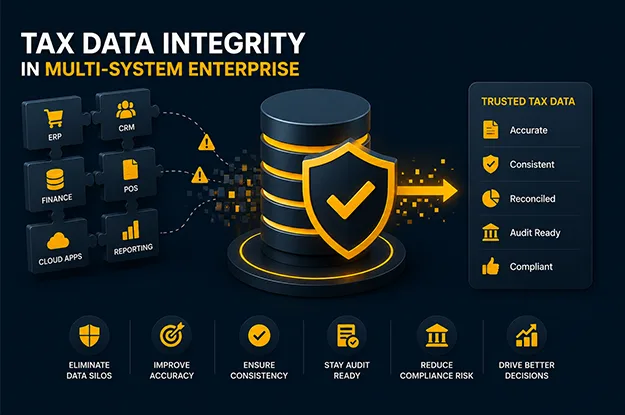
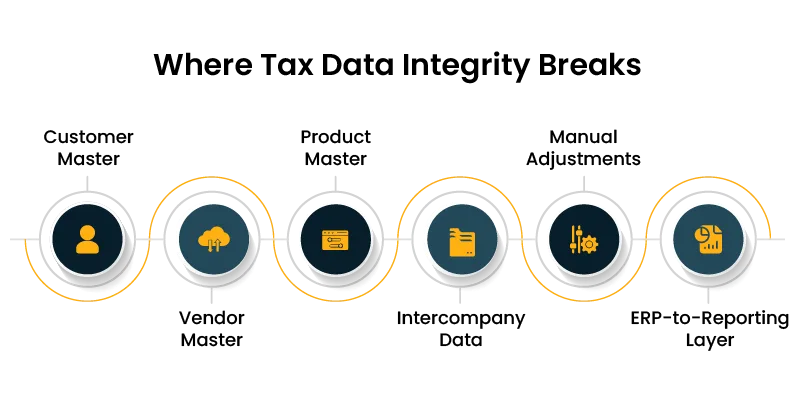
A tax return rarely fails at the return stage. It usually fails earlier, inside the customer master, vendor master, product code, invoice logic, exemption record, intercompany flow, or manual adjustment no one questioned in time.
That is why tax data integrity is a concern in multi-system enterprises. Tax teams work with ERP instances, procurement tools, billing engines, e-invoicing platforms, data warehouses, shared service workflows, and local statutory portals. The problem starts when those truths do not match.
Many enterprise tax data challenges look harmless at first. A missing ship-to field. A tax code copied from an old profile. A product classification that differs between the ERP and billing system. These are small breaks until they reach indirect tax, withholding, transfer pricing, audit defense, or statutory reporting.
Strong tax data governance means deciding which tax-sensitive fields matter, who owns them, and how exceptions are resolved through tax assurance services.
Why tax data breaks across connected systems
Multi-system enterprises often treat tax data as an output of finance. That view is too narrow. Tax data is created across the business before finance closes the period.
Sales creates customer records. Procurement sets vendor details. Supply chain defines movement of goods. Product teams maintain item attributes. IT configures integrations. Finance posts journals. Tax receives the result and is expected to certify it.
This creates a familiar pattern. Tax owns the liability, but it does not always own the inputs. That ownership gap is one of the most persistent enterprise tax data challenges.
| Tax-sensitive data area | Common break | Business impact |
| Customer master | Missing registration number or wrong jurisdiction | Incorrect tax treatment on sales |
| Vendor master | Outdated withholding status | Under-deduction or over-deduction |
| Product master | Wrong tax category or exemption flag | Incorrect indirect tax calculation |
| Intercompany data | Inconsistent entity mapping | Reconciliation breaks and audit issues |
| Manual adjustments | No reason code or approval trail | Weak audit defense |
| ERP to reporting layer | Field mapping changes without tax review | Return-level mismatch |
These enterprise tax data challenges rarely come from one bad field. It is the absence of a controlled path from data creation to tax reporting.
Integrity issues tax teams see too late
By the time a tax team sees a return file, the damage may already be embedded.
Common integrity issues include:
- Duplicate tax registrations for the same legal entity
- Tax codes assigned based on old rules
- Customer and vendor records created without mandatory tax fields
- Product categories maintained differently across regions
- Manual journal entries posted without tax logic
- ERP, sub-ledger, and return data mismatches
- Local statutory reports built from offline spreadsheets
This is where tax data integrity becomes more than data quality. Data quality checks whether a field is complete or formatted correctly. Integrity checks whether the field is fit for tax use, traceable to its source, and consistent across systems.
A registration number may pass a format check and still belong to the wrong entity. A product code may be active and still carry the wrong tax category.
What causes tax data inconsistency in enterprises?
The phrase tax data inconsistency causes enterprise teams to look for system defects. In practice, inconsistency often comes from design choices made outside tax.
The first cause is fragmented ownership. Master data may sit with shared services, process ownership may sit with finance, system control may sit with IT, and tax may only join when the return is due.
The second cause is local workarounds. A local mapping table, a spreadsheet adjustment, or a manual tax code override may solve the current filing. It also creates a second version of tax logic.
The third cause is poor change control. ERP updates, new billing rules, entity restructuring, tax rate changes, e-invoicing mandates, and new product lines all affect tax data. If tax is not part of change review, errors move quietly into live operations.
The fourth cause is weak metadata. Enterprises often know the value in a field but not its source, owner, last change, approval path, or downstream use. This is another reason tax data inconsistency causes enterprise reporting teams to spend more time explaining numbers than trusting them.
The risks are wider than penalties
Tax leaders often frame bad data as a compliance risk. That is correct, but it is incomplete.
Poor tax data integrity also affects cash flow, working capital, audit response, business continuity, and trust between tax and finance. Overpaid tax locks up cash. Underpaid tax attracts interest and scrutiny. Wrong exemptions slow customer billing. Weak documentation makes audits longer.
There is also a credibility cost. When tax repeatedly asks finance, IT, or operations for emergency corrections, tax becomes associated with friction. A better model is to make tax requirements visible at data creation.
OECD tax administration research shows a clear movement toward digital reporting, pre-filled data, e-services, analytics, and system-to-system exchange. In that environment, tax authorities receive more granular data sooner. Enterprises cannot treat tax accuracy as a final-stage cleanup activity.
What tax data governance should control
Good tax data governance starts with a small question: which fields can change the tax answer?
The answer differs by business, but it usually includes legal entity, tax registration, place of supply, customer location, ship-from and ship-to details, vendor status, product classification, exemption certificate, tax code, invoice type, intercompany relationship, and posting date.
Once these fields are identified, governance should define five controls.
| Control | What it means in practice |
| Ownership | A named business owner for each tax-sensitive field |
| Validation | Rules that check completeness, format, logic, and tax relevance |
| Change approval | Tax review for field changes that affect tax treatment |
| Exception routing | Clear paths for resolving mismatches before filing |
| Evidence | Audit trail showing source, change, approval, and correction |
This is where tax data governance frameworks help, but only when they are practical. A framework that sits in a policy file will not fix broken return data. The working version must be embedded into ERP design, master data workflows, integration rules, and reporting controls with data engineering services.
Solving tax data problems at the source
The strongest fix is to move tax checks closer to data creation. This is where ERP controls matter. Tax checks should be built into the workflows that create customer, vendor, product, invoice, and posting data.
Do not wait for the return file to reveal missing or inconsistent data. Build tax validation into customer onboarding, vendor setup, product creation, invoice generation, and journal posting.
A practical solution model looks like this:
- Identify tax-critical data fields by process, not only by system.
- Map each field from source to reporting output.
- Assign a business owner and a tax reviewer for each field group.
- Build validation rules into ERP and connected tools.
- Use exception dashboards that show owner, age, value, root cause, and status.
- Review recurring exceptions monthly and remove the process cause.
This makes error correction more sustainable because teams stop repairing the same tax data issues every reporting cycle. They start removing the condition that creates it.
A governance model tax teams can actually use
Many governance programs fail because they are written for committees, not for daily work. Operating rules need to fit how data moves.
A useful model has three layers.
The first layer is preventive control. This includes mandatory fields, approved tax code lists, address validation, product classification rules, and automated checks before posting.
The second layer is detective control. This includes ERP-to-return reconciliation, anomaly checks on tax rates, duplicate registration detection, and exception reports by entity and jurisdiction.
The third layer is corrective control. This includes owner-based workflows, root cause tagging, approved adjustment reasons, and evidence capture.
This is also where tax data governance frameworks should connect with technology. Governance should not depend on tax teams downloading files, filtering columns, and chasing updates by email. The workflow must show who owns the break and what decision is pending.
Best practices for ERP and tax data alignment
For many enterprises, ERP is the main tax data backbone. But ERP alone does not guarantee accuracy. The system must be configured around tax logic, not only finance posting logic.
For teams focused on ensuring tax data integrity, ERP systems must be treated as control environments, not just transaction systems. Start with these practices:
- Make tax fields mandatory where the tax result depends on them.
- Lock tax code changes behind approval rules.
- Separate master data corrections from return-period adjustments.
- Maintain a central tax logic register for rates, rules, exemptions, and mappings.
- Test tax scenarios when ERP, billing, procurement, or warehouse processes change.
- Reconcile transaction data before return preparation, not after filing.
- Track recurring exceptions by root cause and owner.
This is also where enterprise tax data challenges become easier to discuss with IT and finance. Instead of saying “tax data is bad,” tax can show the field, source system, failed rule, financial exposure, and owner.
How to build accountability without slowing the business
The fear around tax data governance is that it will slow operations. It can, if the design is heavy. The better approach is risk-based, especially when enterprise tax data challenges differ by value, jurisdiction, and filing impact.
Not every field needs tax approval. Not every exception needs leadership review. Not every mismatch deserves the same urgency.
A high-value customer with a missing registration number needs a fast review. A low-value calculation variance may need a tolerance rule and periodic monitoring. A repeated product classification error needs process correction. An unexplained manual override needs evidence before closing.
| Priority | Example | Response |
| High | Missing tax registration on high-value invoices | Stop, correct, approve |
| Medium | Repeated tax code mismatch in one region | Investigate and correct process |
| Low | Approved tolerance difference | Monitor and document |
The point is discipline. Tax data integrity improves when exceptions are classified, owned, and closed with evidence.
Final thoughts: Tax accuracy begins before tax reporting
Tax reporting is only as reliable as the data path behind it. Multi-system enterprises cannot solve tax accuracy by adding more review at the end. They need cleaner ownership, stronger controls, and earlier validation.
The real test of tax data governance is simple. Can the business explain where a tax number came from, who approved it, what rule shaped it, and why it is reliable?
For tax leaders, the priority is clear. Build tax data integrity into the operating model before the reporting calendar starts pressing. That is the difference between meeting a deadline and trusting the numbers behind it.
Many enterprise tax data challenges will remain complex because tax data depends on business activity. The practical win is not perfection. It is controlled data, clear ownership, and fewer surprises when the filing clock starts. This is also the real measure of fixing tax data errors enterprise teams face year after year: fewer repeat issues, clearer ownership, and stronger evidence before filing. The next wave of enterprise tax data challenges will reward teams that fix data where it starts, not where it is reported.
Author


Yogita Jain
Content Lead
Yogita Jain leads with storytelling and Insightful content that connects with the audiences. She’s the voice behind the brand’s digital presence, translating complex tech like cloud modernization and enterprise AI into narratives that spark interest and drive action. With a diverse of experience across IT and digital transformation, Yogita blends strategic thinking with editorial craft, shaping content that’s sharp, relevant, and grounded in real business outcomes. At Cygnet, she’s not just building content pipelines; she’s building conversations that matter to clients, partners, and decision-makers alike.