



































Introduction
Enterprise tax functions are absorbing more regulatory change in a year than they used to handle in five. New e-invoicing mandates land each quarter, ETR scrutiny tightens at the board level, and intercompany and cross-border transaction volumes keep climbing without proportional headcount growth.
What tax teams have to work with is rarely keeping up. Spreadsheets carry the load on direct tax provision, indirect tax determination relies on lookups stitched together quarter by quarter, and reconciliation between billing, ERP, and the tax engine swallows the close cycle.
The 2025 Deloitte Tax Transformation Trends Report found that 86% of organisations outsourced at least one tax process, and 68% did so to reduce operating costs. The shift signals where in-house tax functions are running out of capacity. External expertise has become a board-level conversation rather than a procurement exercise.
This guide explains what tax technology consulting covers and how it modernises the tax function. It also breaks down the signals that show your organisation needs it, the outcomes to expect, and how to choose the right partner for an enterprise mandate.
What Is Tax Technology Consulting?
Tax technology consulting is a specialised advisory practice that helps enterprises select, implement, and optimise the systems that run their tax obligations. The work sits between tax compliance, data engineering, and enterprise applications like SAP, Oracle, Vertex, Avalara, and Thomson Reuters ONESOURCE.
A consulting engagement typically spans current-state assessment, vendor selection, platform configuration, ERP-tax integration, data remediation, and post-go-live support. The output is a tax operating environment that absorbs higher transaction volume, more jurisdictions, and faster regulatory change without proportional headcount growth.
Tax technology consultants combine regulatory fluency with technical architecture skill, which is what separates the discipline from generic IT consulting and from pure tax advisory.
What Does A Tax Technology Consulting Engagement Typically Cover?
A consulting engagement is rarely just software deployment. The work runs across process re-engineering, data architecture, and platform configuration in parallel, because each one fails without the others.
The mix of work depends on the maturity of the tax function and the gaps surfaced during the initial assessment. Enterprises that arrive with a clear technology problem are scoped differently from those still figuring out where the bottleneck sits.
A well-scoped engagement typically moves through five phases:
- Current-state assessment of compliance, data, and systems
- Vendor selection and business case build
- Platform configuration and data remediation
- ERP-tax integration and regression testing
- Post-go-live support and continuous optimisation
Each phase builds on what the previous one validated, which keeps the program from drifting into a sequence of disconnected deliverables.
Indirect Tax Automation
Indirect tax (VAT, GST, sales and use tax) carries the highest transaction volume and the most frequent rule changes. Consultants implement engines like Vertex or Avalara, configure tax codes for each product-jurisdiction combination, and build determination logic that runs at the moment of invoicing.
The harder work is upstream. Most indirect tax automation projects stall because product master data, customer addresses, and exemption certificates are inconsistent across source systems. A data remediation workstream usually runs alongside the engine configuration, so determination has clean inputs from go-live, instead of from a frantic backfill six months later under audit pressure.
Direct Tax Compliance
For corporate income tax, consultants implement platforms that streamline provision calculations, return preparation, return-to-provision reconciliation, and statutory reporting across legal entities. The technology replaces the spreadsheet-driven consolidation that most multi-entity groups still rely on at quarter-end and year-end.
The depth lives in tax-sensitised chart of accounts mapping, deferred tax automation, and entity hierarchy modelling. A well-executed engagement collapses the close by two to four weeks and produces a defensible audit trail behind every figure that hits group reporting.
ERP-Tax Integration
Tax engines deliver value only when they receive accurate, complete transaction data from the systems where it originates. Consultants design the integrations between ERP platforms like SAP, Oracle, and Microsoft Dynamics and the tax engine.
The integration layer must handle several edge cases that determine whether the engine produces correct output:
- Intercompany transactions across legal entities
- Returns, credit notes, and rebates
- Drop-ship and triangulation flows
- Currency conversion and tax point timing
- Discount line allocation across multiple SKUs
This layer is usually where projects succeed or stall. A tax engine that is technically live but missing 15% of transaction context will quietly produce wrong determinations that surface months later under audit.
Good consultants treat integration as a first-class workstream, with field-level mapping, regression testing against historic transactions, and exception handling built before go-live.
How Does Tax Technology Consulting Modernize The Tax Function?
Modernisation runs deeper than digitisation. The work involves rebuilding how tax tasks flow, where data lives, and how decisions move from analyst to leader without losing context.
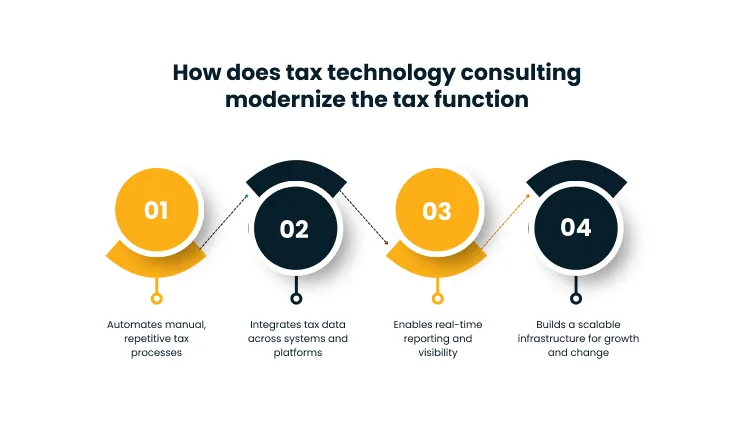
The 2025 Gartner CFO Survey on Technology Investment Plans found that 77% of CFOs planned to boost technology spending in 2025, and tax modernisation was a recurring line item in those budgets. The mechanics of the shift rest on four operating changes inside the tax function. A coherent governance framework holds the modernisation together under audit pressure.
Automates Manual, Repetitive Tax Processes
Manual tax calculation across thousands of transactions and dozens of jurisdictions is slow, expensive, and error-prone. Tax technology automates determination at the moment of transaction by running a rules engine over customer, product, location, and transaction type.
The engine produces the correct rate, tax code, and reverse-charge treatment in milliseconds. The stronger effect lands on audit defensibility.
Every automated determination is logged with the rule version, jurisdiction context, and inputs that produced it. When an auditor asks why a specific invoice was treated a specific way, the answer is a system record with an immutable timestamp rather than whatever the team remembers from that quarter.
Integrates Tax Data Across Systems And Platforms
Most tax errors trace back to fragmented data. Customer records differ between billing and ERP, product taxability flags go missing on new SKUs, and address fields fail jurisdictional lookup.
Consulting engagements unify these data flows so the tax function works from a single, reconciled source of truth. The mechanism is master data alignment, validation rules at the point of data entry, and exception workflows that route bad records back to the originating team for correction.
Cygnet.One’s unified tax data lake is one example of how this layer gets built at enterprise scale. Tax becomes a downstream consumer of data already validated at its source, with the cleanup work staying inside the teams that originate the records.
Enables Real-Time Reporting And Visibility
With connected systems and clean data, tax leaders see liability positions, filing status, and risk exposure as they accumulate. Real-time dashboards typically surface:
- Indirect tax position by jurisdiction
- Filing readiness by entity
- ETR rollforward across the quarter
- Audit-risk flags on outlier transactions
- Cash flow impact of pending refunds and assessments
The practical effect is that the Head of Tax can answer the CFO’s question on demand. There is no need to commission an analyst to prepare a two-day workbook every time leadership asks for a snapshot of exposure.
Builds A Scalable Infrastructure For Growth And Change
As enterprises expand into new markets, acquire entities, or absorb new e-invoicing mandates, a well-designed tax architecture handles the change rather than requiring a rebuild. The design choices that make this possible are deliberate:
- Cloud-hosted tax engines that scale elastically with transaction volume
- API-based integrations rather than point-to-point connectors that ossify over time
- Modular configuration that isolates jurisdiction-specific logic from core determination flows
A new country, a new e-invoicing requirement, or an acquired entity becomes a configuration project measured in weeks. The investment compounds as the business scales, instead of degrading under the weight of every new addition.
What Signals Show Your Tax Function Needs Technology Consulting?
Tax technology consulting earns its fee when symptoms are visible, but the root cause is unclear. The signals below point to an architectural gap in data, integration, or platform rather than a process gap. Manual tax determination is one common root cause once transaction volume and jurisdiction count cross a threshold.
- The close cycle is dominated by reconciling billing, ERP, and tax outputs that disagree on the same numbers.
- A new jurisdiction or e-invoicing mandate takes weeks of manual work to absorb each time it lands.
- Audit responses require pulling data from three or four disconnected systems and reformatting it.
- Tax errors surface during an external audit rather than during an internal review.
- The tax team is growing headcount just to maintain the same compliance scope without expanding it.
- Senior tax leaders cannot pull a real-time liability position without an analyst preparing it over two days.
- Spreadsheets remain the system of record for provision, ETR, or indirect tax reconciliations.
One signal in isolation may be manageable through better process discipline. Two or three together usually point to an architectural gap that no amount of additional headcount will solve. The economics of consulting shift from optional to obvious at that point.
What Outcomes Should You Expect From Tax Technology Consulting?
Engagements are judged on operational and financial impact rather than on deliverable count. The 2024 IBM CFO Study on Technology ROI Pressure found that 65% of finance leaders reported pressure to accelerate ROI from technology investments. Outcome-led tax engagements are the new norm because of that pressure.
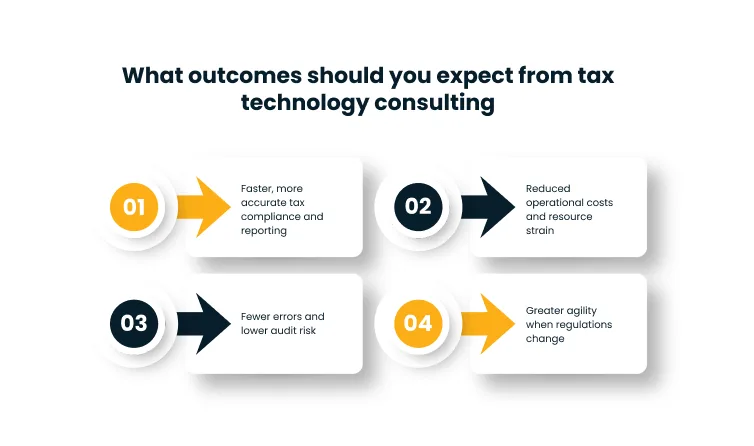
Returns show up across four areas that compound over time. The direct tax angle sees the sharpest gains, but the operational shift covers the full tax function.
Faster, More Accurate Tax Compliance And Reporting
Automated workflows and clean data integrations compress the time required to prepare and file returns, often by half. Review burden drops because exceptions surface earlier in the cycle, and the team spends a close week on judgment calls rather than reconciliation.
The compounding effect is that finance no longer waits for taxes to close the books. The tax number is available on the same cadence as the rest of the GL, which lets the broader finance close compress as well.
Reduced Operational Costs And Resource Strain
When technology handles routine determination, reconciliation, and reporting, the team’s capacity shifts to advisory work. Advisory time goes into planning, ETR optimisation, controversy support, and M&A tax due diligence.
Compliance hours per cycle drop substantially, and the team absorbs growth without proportional headcount. The practical saving comes from redirecting the existing team into higher-value work that the business has been asking for, which the team has never had bandwidth to deliver.
Fewer Errors And Lower Audit Risk
Rules-driven systems apply tax logic consistently across every transaction. Manual variation drops, exceptions are logged with a full audit trail, and the discrepancies that draw auditor attention become rare.
The visible improvements across an enterprise tax function typically include:
- Tax determination accuracy at the invoice line level
- Audit trail completeness for filed returns
- Time required to respond to auditor queries
- Audit reserve carried on the balance sheet
- Internal control test pass rate
Cygnet.One’s tax assurance practice anchors these improvements with controls testing and continuous monitoring. The result is durable defensibility that holds beyond the initial deployment, and a smaller audit reserve carried on the balance sheet over time.
Greater Agility When Regulations Change
Tax law does not stand still. A well-configured tax technology environment makes rate changes, new filing requirements, and cross-border rules deployable as configuration updates.
The function moves from being the slowest part of a regulatory response to being a credible partner for commercial and operations teams. They need quick answers on new markets, new product launches, and new entity structures.
What Types Of Tax Technology Consulting Partners Exist?
Not every consulting partner is built the same way. The right choice depends on four practical questions:
- How complex is the current environment, in jurisdictions covered and transaction volume processed?
- Has the platform decision already been made, or is vendor selection still open?
- How broad is the advisory mandate, covering pure tax tech or tax-plus-finance transformation?
- What budget envelope can leadership commit to, and over what delivery timeline?
Three partner types dominate the enterprise market today, each shaped by a different delivery model and engagement economics.
| Partner Type | Best For | Cost Vs Big 4 | Typical Timeline |
| Big 4 (Deloitte, PwC, EY, KPMG) | Multi-mandate transformation across tax, audit, and transfer pricing | Baseline (highest) | Months to mobilise; 12-24 months to deliver |
| Specialist tax tech consultancies | Mid-market and large enterprises with a focused tech problem | 30-50% lower | Weeks to mobilise; 4-12 months to deliver |
| Implementation partners (vendor-certified) | Clean deployment of an already-chosen platform | Lowest per project | Weeks to mobilise; 3-9 months to deliver |
What Do Big-4 Advisory Tax Practices Bring?
The Big 4 (Deloitte, PwC, EY, and KPMG) offer broad capabilities across tax advisory, technology, and regulatory matters from a single firm. They suit large, complex enterprises that need global reach, deep regulatory expertise across multiple jurisdictions, and the ability to absorb multi-country implementations alongside wider finance transformation programs.
The tradeoff is scale and price. Engagements often run into the millions, mobilisation can take months, and the on-the-ground delivery team is frequently more junior than the partners who sold the work.
Big 4 firms become the right call when the mandate genuinely spans tax, audit-adjacent advisory, and transfer pricing at once. They tend to be an over-investment when the brief is simply implementing a tax engine cleanly.
What Do Specialist Tax Technology Consultancies Offer?
Specialist firms focus exclusively on tax technology, covering strategy, vendor selection, implementation, integration, and post-go-live optimisation. They typically deliver faster time-to-value and deeper platform expertise because the consultants doing the work are the same consultants who scoped it.
Specialists suit mid-market enterprises and large enterprises with a clear technology problem rather than a broad advisory need. Pricing usually runs 30 to 50% lower than Big 4 equivalents for comparable scope, and engagement teams stay stable through go-live.
What Do Implementation Partners Do Differently?
Implementation partners are certified by specific vendors like Vertex, Avalara, and Thomson Reuters ONESOURCE. They focus on getting the chosen software deployed correctly through configuration, integration testing, data migration, and go-live support.
Implementation partners are the right choice when the platform decision is already made, and the priority is clean execution. Engagements run shorter and are more fixed-price than advisory work, with success criteria that are technical and observable rather than strategic.
How Cygnet.One Supports Tax Technology Transformation?
Most enterprise tax modernisation programs stall in the same place, somewhere between the vendor demo and the production integration. Tax engines get licensed, ERP teams get pulled in, and six months later, the team is still reconciling tax outputs against billing by hand.
Cygnet.One’s tax infrastructure practice is built around closing that gap. Engagements start with a current-state assessment of compliance, data flow, and system architecture. From there, the work moves into platform selection, ERP-tax integration, jurisdictional configuration, regression testing, and post-go-live support.
What separates the delivery model is that tax process expertise, data engineering, and platform configuration sit on the same team. Work does not move between an advisory firm, a separate systems integrator, and an internal IT group. The continuity is what prevents modernisation programs from stalling at the integration layer.
Conclusion
The tax function is being asked to do more, faster, with the same team. Technology is the only lever that scales sustainably, and only when the underlying data, processes, and integrations are designed with the same rigour as the platform itself. A tax engine without clean data is just a faster way to produce wrong determinations.
The decision worth taking seriously is the partner choice itself. Which firm has done this work before in environments comparable to yours, and which consultants will stay on the engagement through go-live and beyond? The platform decision follows naturally from that choice.
Map your tax technology gaps against a partner who has closed them before in comparable environments. Book a demo with Cygnet.One to walk through your current state, the platforms worth shortlisting for your scope, and the integration design that will hold up under audit and regulatory change.
FAQs
Tax technology consulting designs and implements the systems that run tax work, while tax compliance services execute the filing work itself. Consulting is project-based and builds internal capability. Compliance services are recurring operational delivery, and many enterprises engage with different providers.
A typical engagement runs three to twelve months, depending on scope. Indirect tax engine implementations average four to six months, while global multi-entity programs covering direct tax, indirect tax, and ERP integration usually run nine to eighteen months across phased waves.
Tax technology consulting is increasingly relevant for mid-market enterprises facing multi-jurisdiction compliance, e-invoicing mandates, or rapid growth. The investment scales with scope, with smaller engagements focused on a single tax type or ERP module rather than full-function transformation programs.
Tax technology consulting costs typically range from around $75K for a focused indirect tax engine implementation to several million for global multi-entity transformation programs. Pricing depends on jurisdictions covered, integrations required, platform licenses, and whether process redesign sits inside the engagement scope.
Tax technology consultants typically work with Vertex, Avalara, Thomson Reuters ONESOURCE, Sovos, and the native tax modules of SAP and Oracle ERP systems. Platform choice depends on tax type, transaction volume, geographic coverage, and ERP compatibility, with consultants running vendor selection when the decision is still open.
Yes, tax technology consulting is one of the fastest ways to absorb global e-invoicing mandates. Consultants configure compliant invoice formats, integrate with country-specific clearance platforms, and design rollout sequences across jurisdictions so the business meets each go-live without disrupting billing operations.
Author


Yogita Jain
Content Lead
Yogita Jain leads with storytelling and Insightful content that connects with the audiences. She’s the voice behind the brand’s digital presence, translating complex tech like cloud modernization and enterprise AI into narratives that spark interest and drive action. With a diverse of experience across IT and digital transformation, Yogita blends strategic thinking with editorial craft, shaping content that’s sharp, relevant, and grounded in real business outcomes. At Cygnet, she’s not just building content pipelines; she’s building conversations that matter to clients, partners, and decision-makers alike.