
































Introduction
Most of the enterprises face increasing complexity in managing tax and accounting operations. Legacy systems built on on-premise frameworks and batch-based processes often create fragmented data, slow reporting, and operational bottlenecks. If you have spent hours reconciling spreadsheets or managing multi-jurisdiction compliance, you understand how much manual work limits efficiency and decision-making.
Modern, cloud-enabled platforms consolidate financial data, automate repetitive tasks, and provide real-time insights. Month-end close cycles become faster, errors decrease, and finance teams can focus on analysis, forecasting, and planning instead of routine manual work.
This blog explains the challenges of legacy tax and accounting systems, describes the modernization services designed to address them, and presents a practical roadmap to help enterprises achieve efficient, scalable, and compliant financial operations.
Understanding Legacy Tax and Accounting
Legacy tax and accounting systems consist of monolithic, on-premise software platforms that handle financial operations through manual workflows and isolated modules. Enterprises relying on these systems frequently encounter fragmented data, delayed reporting, and limited operational visibility.
Manual reconciliations, batch-based processing, and siloed ERP integrations hinder real-time decision-making. Finance teams spend significant time consolidating spreadsheets, correcting errors, and updating compliance rules. These processes increase operational workload, reduce reporting accuracy, and restrict the ability to respond quickly to financial changes or regulatory updates.
Modernization transforms these legacy platforms into cloud-enabled, integrated solutions. These systems centralize data, automate repetitive workflows, and provide interactive dashboards that deliver actionable insights. Finance teams gain comprehensive visibility into financial operations, streamline compliance management, and scale their processes efficiently across multiple regions. Modern platforms also support secure, multi-jurisdiction tax processing, enabling enterprises to maintain consistency and responsiveness in a dynamic regulatory environment.
Why Legacy Tax and Accounting Systems Are Becoming Unsustainable?
Legacy tax and accounting platforms were built for simpler workflows. They create operational bottlenecks, reduce visibility across departments, and increase the workload of finance teams. Modern platforms solve these challenges by introducing automation, integration, and real-time insights for more effective financial operations.
Rising regulatory and compliance complexity
Frequent updates to tax laws require timely adjustments in reporting. Modern platforms apply regulatory changes automatically, allowing finance teams to process filings accurately and quickly.
Real-time monitoring dashboards display deadlines, filings, and audit status across departments. Leadership gains clear visibility into compliance activity and progress.
The 2023 Forrester Digital Business Survey found that 68% of digital leaders globally plan to increase investment in tech maintenance and updates, even as they adopt new technologies, highlighting that legacy systems remain a major operational focus.
Multi-jurisdiction tax obligations
Enterprises operating in multiple countries face varying corporate, VAT, and GST rules. Modern systems unify these obligations into consistent workflows, allowing finance teams to process transactions across regions efficiently.
Centralized reporting provides leadership with a clear view of tax liabilities and deadlines. Teams can analyze obligations quickly and adjust operational planning accordingly.
Automated application of tax rules reduces human error while maintaining consistency across departments, supporting timely reporting and operational control.
E-invoicing and real-time reporting mandates
Government regulations increasingly require electronic invoicing and instantaneous reporting. Modern platforms automate invoice validation, submission, and reporting across jurisdictions.
Dashboards show pending invoices, tax obligations, and reporting status, giving finance teams clear visibility to prioritize critical tasks.
Integration with financial systems allows accurate reporting across departments. Teams gain reliable insights and complete tasks faster, maintaining smooth operational flows.
Manual reconciliation and delayed financial close
Manual reconciliations and spreadsheet-based workflows extend month-end and year-end closings. Cloud-enabled systems consolidate financial data from multiple sources into unified ledgers.
The 2025 Deloitte Tax Transformation Trends found that 94 % of tax and finance leaders surveyed see cost reduction as a benefit of outsourcing, highlighting that modern digital transformation, not maintaining older, manual systems, is the priority for global enterprises
Automated reconciliation reduces errors in journal entries and account balances, accelerating close cycles. Management can access validated statements without delays.
Finance teams can focus on analysis, forecasting, and planning. Processes become more efficient, and decisions are informed by accurate, real-time data.
Limited real-time financial visibility
Fragmented and siloed legacy systems create operational blind spots, slowing decision-making and increasing risk. Fragmented data in legacy systems limits insight into cash flow, tax obligations, and operational performance.
Modern platforms centralize data to provide a single source of truth. Real-time dashboards display key metrics, trends, and anomalies. Finance leaders can identify potential risks and opportunities promptly.
Analytics highlight patterns and deviations, enabling proactive interventions. Teams can adjust operations, maintain compliance, and scale processes across the enterprise effectively.
What Do Legacy Tax and Accounting Modernization Services Include?
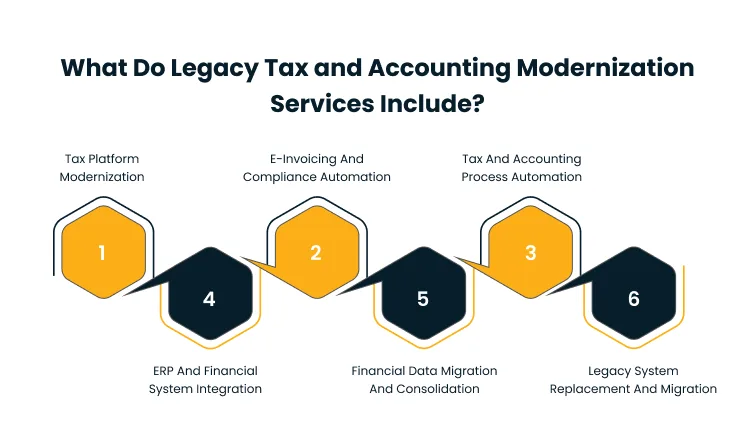
Modernizing legacy tax and accounting systems addresses inefficiencies, fragmented data, and complex compliance demands. By combining cloud-enabled platforms, automated workflows, and centralized financial management, enterprises gain operational visibility, reduce manual errors, and allow finance teams to dedicate time to strategic initiatives.
Tax Platform Modernization
Upgrading tax platforms strengthens core financial operations while improving compliance across multiple jurisdictions. Modern engines handle complex corporate, GST, and VAT obligations with precision.
Key Functionalities:
- Modern engines execute real-time multi-jurisdiction tax calculations while maintaining historical audit trails for transparency. Transaction-level tax calculation under GST is critical for compliance, cash flow, and audits for Indian enterprises.
- Automates recurring tax workflows, including reconciliations and validation checks, reducing manual intervention.
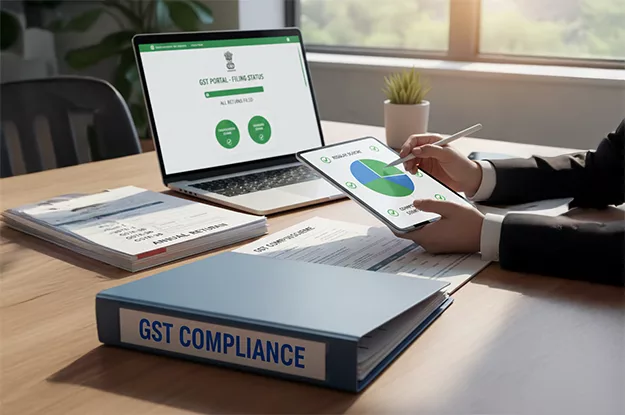
- Provides comprehensive dashboards showing tax positions, filing statuses, and compliance trends for strategic decision-making.
Advanced reporting and tracking allow leadership to quickly identify potential issues, prioritize corrective actions, and gain actionable insights across all tax processes.
ERP and Financial System Integration
ERP integration connects accounting, payroll, and enterprise management systems to unify operational data and workflows. It reduces silos and delivers a consolidated view of enterprise financial performance.
Key Functionalities:
- Real-time dashboards display reconciled financial records, cash flow metrics, and operational performance across departments.
- Structured API connectivity enables seamless data flow between legacy systems and modern platforms for consistent reporting.
- Synchronizes transactions and financial entries across units, supporting coordinated financial planning and operational control.
Integrated ERP systems give teams the ability to monitor activity, identify deviations, and make informed decisions promptly, improving operational efficiency across the enterprise.
E-Invoicing and Compliance Automation
Automated e-invoicing streamlines invoice validation, submission, and reporting to comply with regional tax mandates efficiently.
Key Functionalities:
- Provides live dashboards for monitoring pending and completed invoices across multiple jurisdictions.
- Automatically calculates and submits taxes according to local and international rules.
- Detects anomalies or discrepancies in invoicing and reporting to allow proactive corrections.
Automation maintains operational and regulatory consistency, reduces processing time, and allows finance teams to focus on analysis and strategic planning.
Financial Data Migration and Consolidation
Data migration consolidates financial records into a centralized, standardized platform, ensuring accuracy and consistency across all reporting functions.
Key Functionalities:
- Validates and maps legacy and current financial records for accuracy, traceability, and audit readiness.
- Provides consolidated reporting capabilities to monitor cash flow, tax obligations, and departmental performance.
- Supports advanced trend analysis, scenario modeling, and forecasting for better strategic decision-making.
Centralized data allows leadership to monitor operations comprehensively and enables proactive financial management across all departments.
Tax and Accounting Process Automation
Automation transforms repetitive accounting and tax operations into efficient, rule-based workflows, improving speed and accuracy.
Key Functionalities:
- Automates reconciliations, journal entries, and tax calculations to reduce human error.
- Routes approvals and exceptions automatically to ensure smooth workflow progression.
- Real-time dashboards allow monitoring of operations, exceptions, and compliance metrics.
Process automation frees finance teams to focus on variance analysis, cash flow forecasting, and strategic decision-making, improving operational resilience.
Legacy System Replacement and Migration
Phased replacement transitions legacy systems to modern platforms while maintaining compliance and operational continuity.
Key Functionalities:
- Validates and reconciles migrated data at each stage to maintain accuracy and integrity.
- Supports multi-jurisdiction compliance, automated workflows, and seamless reporting.
- Provides scalable architecture to handle growing transaction volumes and enterprise expansion.
Modernized platforms enable finance teams to operate efficiently, maintain consistent compliance, and respond rapidly to operational or regulatory changes.
Step-by-Step Legacy Tax and Accounting Modernization Roadmap
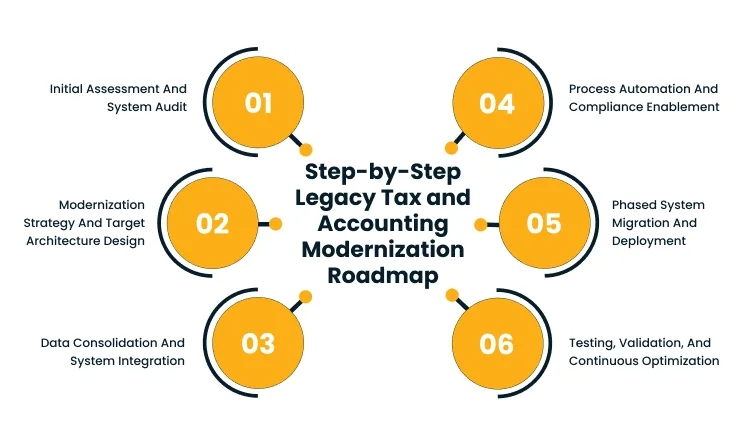
Modernizing legacy tax and accounting systems can seem overwhelming, but breaking the process into structured steps makes it manageable. This roadmap guides finance and IT teams through assessment, strategy, integration, and optimization, making the transition to modern platforms smooth and effective.
Step 1: Initial Assessment and System Audit
The first step focuses on understanding the current landscape. Teams evaluate ERP modules, tax engines, and reporting workflows to identify how information flows across the enterprise.
Finance teams examine data quality and reconciliation processes, highlighting areas that slow down month-end or year-end closings. This creates a baseline for prioritizing modernization activities.
Project teams map dependencies between departments, workflows, and systems. This structured overview reveals operational bottlenecks and identifies where automation can make the most impact.
The assessment also captures historical transaction accuracy and compliance adherence. With this information, leadership can plan modernization initiatives with confidence and clarity.
Step 2: Modernization Strategy and Target Architecture Design
This step sets the vision for the future-state system. Teams define objectives for automation, cloud adoption, and integration while aligning with enterprise growth and regulatory requirements.
Target architecture specifies platform choices, integration patterns, and compliance workflows. Teams select the modernization approach, phased, hybrid, or full replacement, based on operational needs.
Regulatory compliance is woven into the design for every jurisdiction where the enterprise operates. This includes reporting structures, audit controls, and standardized data flows.
Leadership and project teams agree on performance benchmarks, timelines, and success metrics. Clear alignment ensures every team understands priorities and expected outcomes.
Step 3: Data Consolidation and System Integration
Data consolidation brings fragmented financial records together into a unified repository. Teams standardize formats, validate historical data, and map all transactions to the new platform.
Integration connects ERP, payroll, and accounting systems, allowing real-time data exchange and eliminating silos. Finance teams can see reconciled accounts instantly across departments.
Consolidated and connected data enables reliable dashboards for reporting, planning, and compliance. Leadership gains visibility into cash flow, liabilities, and tax positions without waiting for manual updates.
These integrated systems also allow monitoring for anomalies and trends. Teams can identify areas for improvement and make timely decisions based on accurate, complete information.
Step 4: Process Automation and Compliance Enablement
Automation converts repetitive accounting and tax workflows into efficient, rule-based processes. Teams can handle reconciliations, journal entries, and tax calculations consistently and faster. Transaction-level tax determination highlights how real-time tax calculation for each transaction reduces errors and supports compliance, allowing finance teams to focus on higher-value tasks like analysis and planning.
Compliance is built directly into workflows. Alerts and validations flag potential issues before they escalate, helping teams maintain accurate reporting.
Exception management and approval routing run automatically. This frees staff to focus on higher-value activities, like financial analysis and scenario planning.
Automation also provides real-time insight into operations. Teams can track task progress, resolve delays quickly, and maintain full compliance across all transactions.
Step 5: Phased System Migration and Deployment
Migration happens in phases to maintain day-to-day operations while introducing modern platforms. Each phase targets specific modules or departments, balancing speed and operational stability.
Teams validate data at every stage to confirm accuracy and performance. This careful approach reduces errors and avoids disruption to financial reporting cycles.
Dependencies between workflows and business units are managed proactively. Daily operations continue smoothly as each new system component goes live.
The phased approach also integrates with external stakeholders and regulatory systems. Teams maintain operational continuity while introducing automation, reporting improvements, and real-time analytics.
Step 6: Testing, Validation, and Continuous Optimization
The final step ensures the new system performs reliably across all processes. End-to-end testing confirms reconciliations, reporting, and tax calculations are accurate and consistent.
Validation includes verifying compliance with internal policies and regulatory requirements. Teams can spot inconsistencies and correct them immediately.
Optimization continues after deployment. Analytics monitor workflow efficiency, system utilization, and compliance performance, highlighting areas for further refinement.
Ongoing adjustments keep the platform aligned with business growth and regulatory changes. Teams maintain operational resilience while gaining the full benefits of modernized tax and accounting systems.
What Enterprises Should Look for in Legacy Tax Services?
Enterprises evaluating legacy tax modernization partners must focus on capabilities that maintain compliance, scalability, and seamless integration with existing financial systems. Each area contributes directly to operational efficiency and strategic decision-making.
- Tax Domain Expertise: A partner with deep tax knowledge manages direct and indirect tax obligations, including GST, VAT, and corporate tax. Experience with enterprise-scale compliance across multiple jurisdictions allows finance teams to handle filings accurately and on time. Advisory support helps navigate complex tax scenarios while keeping operations aligned with regulatory requirements.
- Integration Capability: Seamless connectivity with ERP, billing, and financial systems like SAP and Oracle allows data to flow efficiently across platforms. API-driven architecture facilitates real-time reporting, reconciliations, and consolidated insights. Teams gain visibility into financial performance and can coordinate processes across departments without delays.
- Compliance Alignment: Built-in alignment with regional and global regulations standardizes reporting practices and maintains audit readiness. Structured documentation and traceable workflows provide clarity for internal and external reviews. Multi-jurisdiction capabilities support consistent compliance across all operational areas.
- Security Standards: Strong encryption protects sensitive financial and tax data, while role-based access regulates permissions across teams. Security frameworks maintain operational transparency and accountability. Continuous monitoring of data integrity reduces the risk of errors and enhances trust in financial operations.
Why Enterprises Choose Cygnet.One?
At Cygnet.One, we focus on modernizing tax, ERP, and finance systems for enterprises. We have a consistent track record in helping clients replace legacy compliance and invoicing systems with platforms built for efficiency, accuracy, and scale. Our approach simplifies complex processes, streamlines reporting, and supports finance teams across multiple jurisdictions.
- Tax and Finance Focus: Cygnet.One brings deep expertise in tax and finance operations. We manage GST, VAT, and corporate tax requirements across multiple regions with precision. Our team guides enterprises through complex scenarios and supports smooth workflows, turning compliance into a strategic advantage.
- ERP Integration Strength: With over 250 integrations across SAP, Oracle, Microsoft Dynamics, and Tally, Cygnet.One connects legacy systems with modern platforms seamlessly. We deliver smooth data flows, real-time reporting, and reconciliations across departments. Clients gain unified operations, clear visibility, and actionable insights for better decisions.
- Multi-Jurisdiction Compliance: Cygnet.One supports frameworks such as GSTN, HMRC, FTA UAE, ZATCA, MDEC, and BOSA. Platforms apply tax rules automatically and provide dashboards showing obligations and deadlines. Enterprises maintain consistent compliance across regions while staying aligned with evolving regulations.
- Proven Business Outcomes: Clients achieve faster invoice processing, reduced manual effort, improved ITC recovery, and accelerated ROI. Finance teams complete routine tasks efficiently and focus on strategic initiatives. Cygnet.One delivers measurable improvements in operational efficiency, reporting accuracy, and financial performance.
- Certified Enterprise Platform: Cygnet.One platform holds SOC 2 Type II, CMMI Level 5, and OpenPeppol certifications. These reflect strong security, mature processes, and adherence to global standards. Enterprises scale operations confidently with secure, reliable, and compliant systems.
Cygnet.One transforms legacy tax and accounting systems into modern, integrated, automated platforms. Its Unified Tax Data Lake centralizes tax and financial data, enabling comprehensive visibility and streamlined compliance across enterprise operations.
Conclusion
Legacy tax and accounting systems slow compliance, reduce accuracy, and limit financial agility. Enterprises are moving toward modern, cloud-enabled, automated platforms that provide real-time processing, consistent data, and scalable operations. Modernization empowers finance teams to focus on strategy while maintaining regulatory alignment and operational efficiency. Ready to see how Cygnet.One transforms your tax and accounting processes? Book a free demo and explore how our platforms streamline compliance, automate workflows, and provide actionable insights for your enterprise.
FAQs
Legacy tax and accounting systems are older, on-premise platforms managing tax, compliance, and accounting through batch-based workflows. They create fragmented data, slow reporting cycles, and reduce operational flexibility, making real-time insights and strategic financial decision-making more challenging for finance teams across enterprises.
Legacy tax systems lack real-time processing, automation, and integration with modern platforms. This causes delays in compliance, increases manual workloads, and reduces accuracy. Modernization introduces automated workflows, centralized data, and real-time insights, enabling finance teams to operate efficiently while maintaining regulatory compliance.
Key challenges include fragmented data, manual reconciliation, limited scalability, and difficulty integrating with modern ERP or cloud platforms. These systems slow financial close cycles, increase operational effort, and create errors, restricting finance teams from focusing on strategic analysis and improving overall operational performance.
Modernization approaches include cloud migration, application updates for automation, ERP integration, and data consolidation into centralized platforms. Enterprises often follow phased migration roadmaps to transition systems methodically, maintaining continuity while improving efficiency, reporting accuracy, and compliance across all tax and accounting operations.
Modern tax and accounting systems accelerate compliance, provide real-time reporting, and reduce manual workloads. They consolidate financial data across departments and jurisdictions, creating integrated, scalable operations. Enterprises gain accurate insights, improve efficiency, and enable finance teams to focus on strategic planning and decision-making.
Author


Yogita Jain
Content Lead
Yogita Jain leads with storytelling and Insightful content that connects with the audiences. She’s the voice behind the brand’s digital presence, translating complex tech like cloud modernization and enterprise AI into narratives that spark interest and drive action. With a diverse of experience across IT and digital transformation, Yogita blends strategic thinking with editorial craft, shaping content that’s sharp, relevant, and grounded in real business outcomes. At Cygnet, she’s not just building content pipelines; she’s building conversations that matter to clients, partners, and decision-makers alike.