






























Many enterprise finance teams still run their tax systems on older ERP systems, which involves a lot of manual work. Even when one tax rule changes, it will not be reflected across all systems at the same time.
As a result, numbers start to differ between tax, ERP, and statutory reports. Finance teams spend significant time in every close cycle reviewing entries line by line, matching records across systems, and fixing differences instead of focusing on analysis.
This slows reporting and creates challenges during audits. Even small differences lead to repeated checks, and leadership does not get a clear, up-to-date view of compliance status.
In this blog, we will explore the key challenges caused by legacy tax systems, how inconsistencies arise across ERP and reporting environments, and how modern tax services help organizations streamline compliance, improve accuracy, and achieve faster, more reliable financial close processes.
Legacy Tax Services and Their Business Impact on Enterprises
Legacy tax services help enterprises modernize outdated ERP tax systems by moving tax processes from manual, fragmented workflows to automated and integrated tax operations. This improves tax accuracy, reduces reconciliation effort, and gives finance teams better visibility across compliance, reporting, and audit activities.
Many enterprises still rely on disconnected tax setups across ERP, finance, and regional reporting systems. When tax rules change, updates may not flow consistently across every platform. This creates mismatches in tax calculations, delayed filings, and additional review work during financial close.
Common business challenges include:
- Higher operating costs due to manual reconciliation and repeated finance efforts
- Delayed compliance updates when tax rule changes are not applied consistently across systems
- Greater IT dependency for tax configuration changes, slowing down business response
- Reporting inconsistencies caused by different tax logic across ERP and regional systems
The 2025 Deloitte Tax Transformation Trends found that 86% of organizations use outsourcing for at least one tax process, and 57% of tax professionals view AI skills as essential for their tax function’s future success. These figures highlight the shift toward automation and external services to manage tax complexity.
Legacy tax services help address these challenges by unifying tax rules, automating repetitive processes, and improving data consistency across connected systems. This gives enterprises stronger financial control, better audit readiness, faster reporting cycles, and more reliable compliance across regions.
What Leading Legacy Tax Modernization Services Deliver?
Legacy tax modernization services help enterprises move from fragmented tax setups to connected, automated, and scalable tax operations. They improve how tax data, rules, calculations, validations, and reports flow across ERP and compliance systems.
This reduces manual updates, improves consistency across finance workflows, and helps teams manage higher transaction volumes with fewer disruptions.
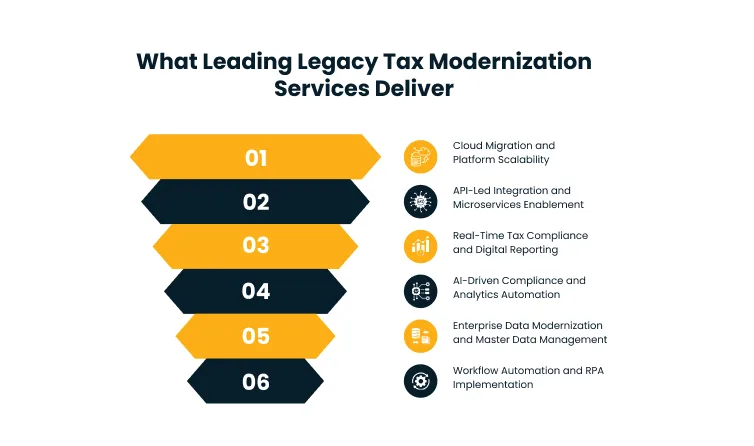
Cloud Migration and Platform Scalability
Cloud migration moves tax workloads from on-premises servers to scalable platforms such as AWS or Azure. This helps enterprises handle high transaction volumes during reporting cycles, filings, audits, and financial close without depending on aging infrastructure.
Key benefits include:
- Scalable processing to manage peak tax and reporting workloads without performance issues
- Auto-scaling infrastructure that adjusts resources based on transaction volumes
- Reduced hardware dependency for better flexibility, availability, and control
- Faster tax rule updates through centralized configuration and cloud-based deployment
- Better system visibility through monitoring tools that track performance, usage, and cost
Cloud-based modernization gives finance and tax teams a more stable foundation for compliance operations. It supports faster updates, smoother processing, and better control over tax workloads as business and regulatory requirements change.
API-Led Integration and Microservices Enablement
API-led integration connects tax engines, ERP platforms, and reporting systems through standardized data exchange. This helps tax data move more consistently across calculation, validation, posting, and reconciliation workflows.
Microservices make the setup more flexible by separating key tax functions into independent services. Teams can update or scale calculation, validation, and reporting components while keeping the broader system stable.
Key benefits include:
- Modular tax functions for calculation, validation, and reporting
- Standardized APIs to connect tax engines with ERP and finance platforms
- Cleaner data exchange across posting, reconciliation, and reporting workflows
- Controlled updates without major system disruption
- Flexible scaling for specific tax functions based on business demand
Together, API-led integration and microservices improve system stability, reduce integration gaps, and help enterprises adapt faster to tax rules, processes, or volume changes.
Real-Time Tax Compliance and Digital Reporting
Real-time tax compliance allows tax calculations and validations to happen during live transactions. Each transaction carries the required tax logic at the point of entry, helping finance teams apply jurisdiction-specific rules earlier in the process.
Digital reporting systems use continuously updated transaction data to generate statutory reports in the required formats. With our unified tax data approach, enterprises can improve submission readiness, reduce reporting gaps, and gain clearer visibility into compliance status across regions.
Key benefits include:
- Live tax calculation during transaction processing
- Built-in validation at the point of entry
- Updated statutory reporting based on active financial data
- Synchronized tax rule updates across connected systems
- Improved reconciliation accuracy across reporting and audit workflows
With real-time compliance and digital reporting, enterprises can keep tax execution aligned across systems, respond faster to regulatory changes, and improve accuracy across filings, reconciliations, and audit reviews.
AI-Driven Compliance and Analytics Automation
AI-driven compliance tools analyze tax transactions across invoices, ledgers, returns, and ERP records to identify patterns, anomalies, and potential risk areas. This gives finance and tax teams earlier visibility into issues that may affect reporting, reconciliation, or audit reviews.
Validation engines apply rule-based checks across large datasets to improve tax treatment consistency. They can flag issues such as missing tax codes, unusual rate changes, duplicate entries, mismatched invoice values, or differences between ERP postings and statutory reports.
The 2024 Gartner Finance AI Adoption Survey reported that 58% of finance functions are using AI in their operations, with 44% applying AI to smart process automation and 39% using AI for anomaly detection in financial data. These adoption rates illustrate how AI is reshaping finance and tax workflows and support the growing role of automated validation in enterprise tax operations.
Key benefits include the following:
- Anomaly detection across invoices, ledgers, returns, and tax records
- Rule-based validation for tax codes, rates, jurisdictions, and transaction data
- Risk indicators based on historical trends and live transaction patterns
- Continuous monitoring to strengthen governance and oversight
- Earlier issue identification before reporting, filing, or audit review
AI-driven analytics help enterprises improve compliance visibility, identify tax risks earlier, and make review cycles more focused, accurate, and efficient.
Enterprise Data Modernization and Master Data Management
Enterprise data modernization creates a unified data foundation for tax, ERP, and finance systems. Shared data models help teams apply tax rules, process transactions, and generate reports with greater consistency across business units and regions.
Legacy tax services organize master data to standardize key tax information such as tax codes, jurisdictions, entities, rates, and reporting structures. This improves data accuracy and provides finance teams with more reliable inputs for calculation, reconciliation, and compliance activities.
Key benefits include:
- Shared data models for consistent transaction processing
- Centralized data management to reduce duplication and improve accuracy
- Standardized tax master data for codes, entities, rates, and jurisdictions
- Stronger reference data governance across connected systems
- More reliable reporting inputs for reconciliation, compliance, and audit workflows
A modern data foundation helps enterprises improve tax accuracy, strengthen reporting confidence, and support better financial decisions across regions and business units.
Workflow Automation and RPA Implementation
Workflow automation helps tax teams standardize reconciliation, reporting, and compliance tasks across connected systems. Instead of relying on repeated manual effort, teams can use predefined workflows to move tax data through review, validation, and reporting steps with greater consistency.
RPA (Robotic Process Automation) is software that automates repetitive tasks. It supports activities such as data extraction, record matching, tax code updates, and report preparation, enabling automated tax determination for high-volume transactions. This improves processing speed and gives finance teams more control over high-volume tax activities.
Key benefits include:
- Automated reconciliation workflows for faster matching and review
- RPA-based task execution for extraction, validation, and updates
- Rule-based compliance workflows to guide tax activities through standard steps
- More predictable data movement across reconciliation and reporting cycles
- Faster processing for high-volume finance and tax tasks
Workflow automation and RPA help enterprises improve tax process consistency, reduce operational effort, and maintain more accurate outputs across reporting, compliance, and audit activities.
How Enterprises Choose the Right Tax Modernization Providers?
Choosing the right tax modernization provider depends on ERP integration depth, compliance coverage, migration planning, and long-term system performance. Enterprises need a partner that can modernize legacy tax systems while keeping finance operations stable during transformation.
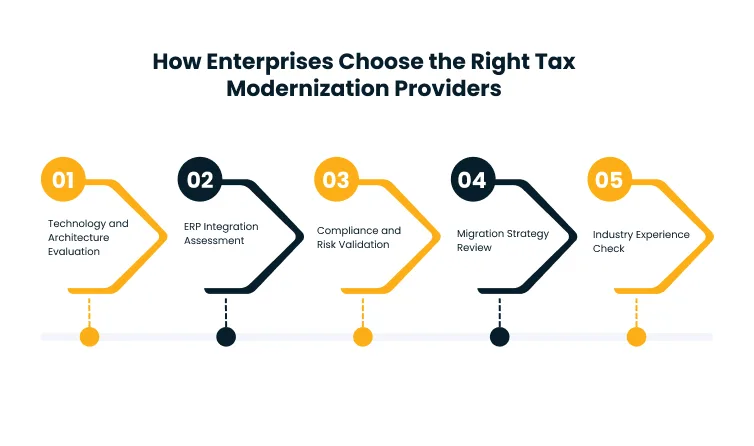
Technology and Architecture Evaluation
Cloud-native and hybrid architecture capabilities are important for tax systems that process large transaction volumes across multiple business units. The platform should support distributed workloads, reliable performance, and smooth integration with the existing IT setup.
Scalability should be reviewed based on how well the solution manages transaction growth, reporting complexity, and regulatory change. A flexible architecture helps tax systems adapt to new business structures, markets, and compliance needs over time.
Enterprises should also assess alignment with the broader IT roadmap. This supports consistency across technology stacks, integration models, security standards, and governance practices.
ERP Integration Assessment
ERP (Enterprise Resource Planning) integration capability is a key factor when evaluating providers. Providers’ Enterprise ERP integration should connect smoothly with platforms such as SAP, Oracle, and Microsoft Dynamics and support clean data exchange across finance modules.
A robust ERP integration allows tax and finance teams to automate data flows between systems, reducing manual effort and supporting streamlined direct tax compliance across jurisdictions. This creates a single source of truth for financial data, streamlines reporting, and helps maintain compliance with internal and external regulations.
Real-time synchronization keeps accounting entries, tax calculations, and reporting data aligned, improving reconciliation accuracy and giving finance teams clearer visibility during close and compliance cycles.
Real-time synchronization keeps accounting entries, tax calculations, and reporting data aligned. This improves reconciliation accuracy and gives finance teams clearer visibility during close and compliance cycles.
Enterprises should also assess how the integration fits into existing workflows. A strong provider supports tax processing within current ERP operations and maintains business continuity.
Compliance and Risk Validation
Providers should support tax rules across multiple jurisdictions and business structures. The system should manage varied tax requirements and keep calculation, validation, and reporting processes aligned.
Built-in compliance controls validate tax rules during transaction processing. This improves accuracy and creates a stronger foundation for filings, reconciliations, and audit reviews.
Audit-ready reporting is another important evaluation point. Structured, traceable outputs help finance teams review tax records, respond to audit requests, and maintain clearer visibility into compliance.
Migration Strategy Review
A strong migration strategy should follow a phased approach that supports controlled movement from legacy tax systems to modern platforms. This helps finance teams maintain continuity as modernization activities progress.
Data integrity planning is essential during migration. Providers should define how tax data will be cleansed, mapped, validated, and protected throughout the transition.
Rollback planning and downtime management should also be reviewed. These controls reduce operational risk and keep close, filing, and reporting activities on track.
Industry Experience Check
Industry experience matters when tax modernization involves regulated markets, complex finance structures, and high-volume transactions. Providers with relevant experience understand sector-specific tax rules and compliance expectations.
Enterprises should review the provider’s track record in similar implementation environments. Large-scale project experience shows whether the provider can manage multiple systems, integrations, data dependencies, and stakeholder requirements.
A proven implementation history gives finance and IT leaders more confidence in execution quality, timeline control, and long-term system reliability.
Enterprises seeking reliable ERP and tax modernization should consider providers with proven expertise in technology, integration, and regulatory compliance. Consulting the top legacy system modernization companies can help identify vendors capable of delivering scalable, efficient, and compliant solutions for complex finance operations.
Why Cygnet.One Is a Strong Choice for Legacy Tax Modernization?
Cygnet.One delivers structured enterprise tax modernization across ERP and finance systems, enabling large-scale transformation and system-wide upgrade initiatives.
25+ Years of Tax Modernization Expertise
We have spent over 25 years working with complex ERP environments, helping organisations modernize their tax processes with confidence. Our experience with frequent tax rule changes, fragmented systems, and large-scale finance transformations means we know where challenges arise and how to prevent them.
Instead of trial-and-error implementations, we bring a proven approach that reduces rework and ensures stable, accurate tax logic throughout the transition.
250+ ERP Integrations Delivered
We have maintained consistency and consistently delivered ERP integrations across SAP, Oracle, Microsoft Dynamics, and other major platforms. Our experience allows us to handle complex tax data across systems without disrupting finance operations.
Our ERP integration capabilities keep tax logic aligned across multiple ERPs running in parallel. This reduces repeated reconciliation cycles during financial close and keeps finance processes running smoothly and reliably.
Multi-Jurisdiction Compliance Coverage
At Cygnet.One, we help enterprises manage different tax rules across regions while keeping group-level reporting aligned. We provide a unified compliance framework that applies consistent tax treatment across jurisdictions and adapts to local regulatory requirements.
Our approach helps finance teams improve reporting accuracy, reduce reconciliation effort, and maintain better control over regional compliance.
Government-Accredited Tax Infrastructure
Government-accredited tax infrastructure is important for statutory reporting and e-invoicing processes, and our work ensures strict regulatory alignment, accurate submissions, and strong audit controls.
Cygnet.One connects tax workflows with regulatory systems to improve reporting accuracy, reduce manual intervention, and strengthen audit readiness across regulated tax processes.
Proven Enterprise Implementation Track Record
We have delivered large-scale rollouts across high-volume environments, combining strong execution planning with stable migration governance.
Cygnet.One supports phased implementation so finance operations continue smoothly during modernization. This helps enterprises protect close cycles, reporting timelines, and compliance activities while upgrading legacy tax systems.
Conclusion
Legacy tax systems create ongoing challenges in compliance speed, reporting accuracy, and cross-system integration. As regulatory environments become more complex, maintaining these systems increases operational effort and risk for enterprises.
Legacy tax services help address these challenges by modernizing tax infrastructure into automated, integrated, and compliance-ready environments that support scalability and consistent performance across regions.
Selecting the right modernization provider becomes a key factor in achieving stable execution, smoother ERP integration, and long-term operational efficiency across finance environments. Provider capability directly influences how effectively tax systems adapt to evolving compliance and business requirements.
Want real-time ERP tax reconciliation for audit-ready compliance?
Schedule a personalized demo with Cygnet.One and see real-time tax reconciliation across your ERPs.
FAQs
Legacy tax services refer to the modernization of outdated tax systems within ERP and finance environments. They improve tax accuracy, automation, and reporting consistency across enterprise operations and regulatory frameworks.
Enterprises invest in legacy tax modernization to reduce manual tax effort and improve compliance speed. These services also support real-time processing, stronger integration, and scalable finance system performance.
Legacy tax systems create delays in filings, inconsistent compliance across regions, and high IT dependency. They also increase reporting complexity, audit effort, and slow down financial decision-making processes.
A tax modernization provider should support ERP integration, cloud architecture, and multi-jurisdiction compliance. Strong migration experience, enterprise scalability, and reliable execution across complex systems are essential.
Enterprises evaluate providers based on ERP integration depth, migration strategy, and compliance readiness. Industry experience, execution stability, and ability to handle large-scale transformation also influence selection decisions.
Author


Abhishek Nandan
AVP, Marketing
Abhishek Nandan is the AVP of Services Marketing at Cygnet.One, where he drives global marketing strategy and execution. With nearly a decade of experience across growth hacking, digital, and performance marketing, he has built high-impact teams, delivered measurable pipeline growth, and strengthened partner ecosystems. Abhishek is known for his data-driven approach, deep expertise in marketing automation, and passion for mentoring the next generation of marketers.