































Tax compliance can become complex quickly for enterprise finance teams. Each country has its own rules; invoices need accurate tax treatment, reports must be filed on time, and the data often comes from multiple ERPs or finance systems.
The pressure becomes clearer during month-end close, reconciliations, and audits. A missed tax update, an incorrect invoice detail, or a broken data flow can lead to manual checks, last-minute corrections, and a higher compliance risk. Over time, these issues make tax operations harder to manage and control.
This is why many enterprises rely on tax automation software to improve accuracy, consistency, and visibility across the compliance process. In 2026, the market includes tax engines, e-invoicing platforms, finance-suite tools, and ERP-native modules that can sound similar at first glance.
In this blog, we explain what tax automation software does, how it works, which platforms to compare, and how to choose the right solution for your compliance needs.
What Is Tax Automation Software?
Tax automation software helps enterprises calculate tax, validate compliance, manage reporting, and support filing across business operations. It applies current tax rules to transactions, connects with ERP and finance systems, and gives tax teams a clearer flow of data. This helps reduce manual checks and improve consistency across tax workflows.
The category includes tax engines, e-invoicing platforms, direct tax modules, and compliance suites. Enterprises use these tools to manage VAT, GST, sales tax, withholding tax, and statutory reporting across regions while reducing spreadsheet work and keeping audit records organized.
Why Enterprises Are Investing In Tax Automation?
Enterprises are investing in tax automation because tax teams now manage higher compliance, data, and reporting demands across more systems and regions. As businesses grow, manual tax processes become slower, harder to control, and more prone to errors.
According to the 2025 Deloitte Tax Transformation Trends Report, 86% of tax leaders now outsource or automate at least part of the tax function, which means the question for most enterprise buyers in 2026 is which platform to standardise on rather than whether to automate.
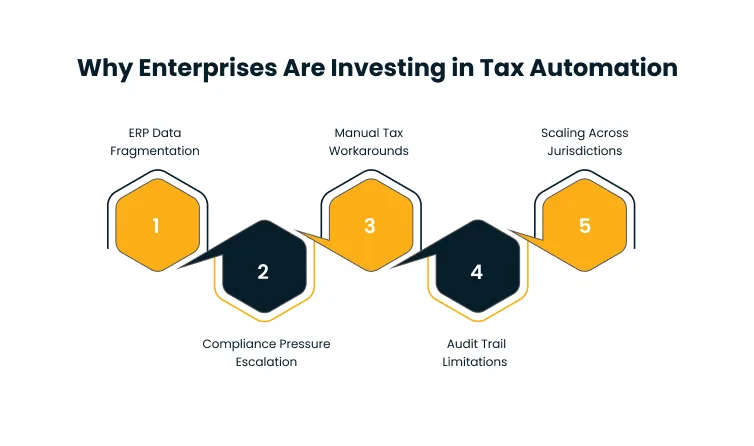
1. ERP Data Fragmentation
Most enterprises work across multiple ERPs, finance tools, and regional systems. When these systems do not connect smoothly, tax data gets scattered across platforms. This makes it harder for finance teams to maintain one reliable view for compliance and reporting.
The issue grows with every acquisition, new market, and finance system update. Tax teams then spend more time finding, cleaning, and reconciling data before they can use it. Automation helps bring these data flows into a more controlled and consistent process.
2. Compliance Pressure Escalation
Tax rules are becoming more detailed, frequent, and specific to each jurisdiction. Enterprises must keep up with new filing formats, reporting timelines, and regulatory requirements. This increases pressure on finance and tax teams that already work with tight close cycles.
According to the 2025 Deloitte Q4 CFO Signals Survey, 87% of CFOs expect AI to be extremely or very important to their finance department’s operations in 2026, with technology transformation flagged as the top CFO priority for the year. Real-time e-invoicing mandates and country-by-country reporting needs continue to expand.
3. Manual Tax Workarounds
Many organizations still depend on spreadsheets and manual adjustments for tax calculations and reconciliations. These workarounds slow down routine tax tasks and make results harder to review. Errors often surface during quarter-end close, audits, or reporting checks.
According to the 2025 McKinsey Survey on How Finance Teams Are Putting AI to Work, finance professionals spend 20% to 30% less time on data work in functions where AI and automation have been adopted at scale. For tax teams, this means more time can shift from repetitive data work to review, planning, and exception handling.
4. Audit Trail Limitations
Without centralized automation, tax teams may struggle to show how calculations, adjustments, and decisions were made. This creates challenges during audits, internal reviews, and regulatory inspections. A weak audit trail can turn simple evidence requests into time-consuming manual searches.
Modern tax automation platforms help store source data, calculation logic, and adjustment history in one place. This gives teams clearer documentation for each period, jurisdiction, and rule change. It also makes audit response faster, more consistent, and easier to manage.
5. Scaling Across Jurisdictions
As enterprises expand into new markets, tax complexity increases across structures, rates, filings, and local rules. Each region can bring different compliance timelines and reporting expectations. Manual processes make this growth harder to support consistently.
Tax automation helps enterprises apply rules, manage filings, and maintain records across jurisdictions with greater control. It also supports faster market expansion by reducing the tax team’s dependence on custom workflows. This makes compliance easier to scale as the business grows.
Features To Look For In Tax Automation Software
Tax automation software should simplify compliance, improve accuracy, and connect smoothly with existing finance systems. The right platform helps tax teams reduce manual effort and manage tax rules across jurisdictions. It should also keep tax operations consistent as ERP environments and reporting needs grow.
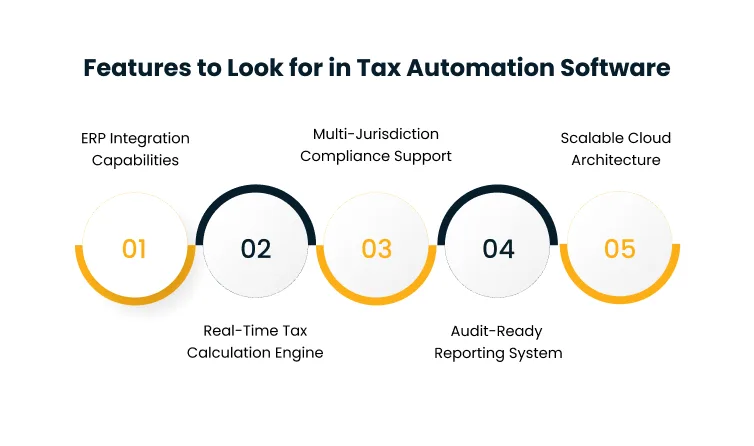
1. ERP Integration Capabilities
Strong tax platforms connect directly with ERP and finance systems to create a consistent flow of tax data. The integration should cover APIs, schemas, master data, customer segments, pricing tiers, and tax codes. Cygnet.One’s Enterprise Integration practice supports this layer for clients standardizing tax across multiple ERPs.
2. Real-Time Tax Calculation Engine
A mature tax engine applies updated tax rules during orders, invoices, and payments. It should support high transaction volumes, versioning of rules, and exception workflows for complex cases. Buyers should test the engine using their actual transaction profile to assess real business performance.
3. Multi-Jurisdiction Compliance Support
The platform should support tax regulations across current and future operating regions. This includes VAT, GST, sales tax, withholding tax, digital services tax, and local reporting requirements. Continuous tax-content updates help enterprises expand into new jurisdictions with fewer delays.
4. Audit-Ready Reporting System
Mature platforms maintain structured logs for tax calculations, rule changes, approvals, and adjustments. Teams should be able to export audit packs by jurisdiction, entity, or reporting period. Cygnet.One’s Governance, Risk Management, and Compliance practice supports continuous control validation on top of the tax data layer.
5. Scalable Cloud Architecture
The platform should handle rising transaction volumes, data growth, and peak reporting periods with stable performance. Multi-tenant cloud architecture, regional data residency, and elastic capacity are important for enterprise scale. Architecture should also cover release management, rollback processes, and urgent regulatory updates.
Best Tax Automation Software Platforms
Below are leading tax automation platforms used by enterprises to manage compliance, automate tax calculations, and support multi-jurisdiction reporting with ERP integration. These platforms cover the most common buyer needs, including unified tax and compliance suites, ERP-focused tax engines, cloud-based sales tax compliance, e-invoicing platforms, and ERP-native tax modules.
1. Cygnet.One
Cygnet.One is an enterprise compliance and finance transformation platform for tax, e-invoicing, finance, and regulatory operations at scale. It connects tax automation, global e-invoicing, reconciliation, and financial intelligence into a single ecosystem. The platform supports 125+ ERPs, operates across 35+ countries, and is strengthened by Cygnet.One’s TaxAssurance run-state support.
Features
- Global e-invoicing and tax compliance automation with real-time validation across 40+ countries
- GST IRP-based invoice registration, processing, and reconciliation
- Direct and indirect tax compliance with audit-ready reporting
- TaxAssurance support for ongoing compliance operations, controls, and review workflows
- Finance analytics with invoice-based credit decisioning and insights
Ideal for: Large enterprises managing complex tax, compliance, and e-invoicing workflows across multiple jurisdictions, ERPs, and finance systems.
2. Vertex
Vertex is an enterprise-grade tax engine built for complex global tax calculations within large ERP environments. It supports indirect tax determination across regions and helps finance teams manage tax accuracy across high-volume transactions. The platform is widely used by large enterprises that need ERP connectivity and tax content updates for multi-country operations.
Features
- Real-time tax calculation engine
- SAP and Oracle ERP integration
- Global indirect tax coverage and content updates
Ideal for: Large enterprises with complex ERP ecosystems and multi-country indirect tax operations.
3. Avalara
Avalara is a cloud-based tax compliance platform for sales tax calculation, returns filing, and reporting across multiple jurisdictions. It connects with ERP, billing, ecommerce, and accounting systems to support transaction-heavy business models. The platform is commonly used by e-commerce, SaaS, and retail companies that manage frequent sales across states and markets.
Features
- Automated sales tax calculation, returns filing, and remittance
- ERP, billing, and e-commerce integrations
- Scalable cloud compliance platform
Ideal for: E-commerce, SaaS, and retail businesses managing high-volume transactions across US states and international markets.
4. Sovos
Sovos is a global compliance platform focused on e-invoicing, VAT/GST compliance, and regulatory reporting. It helps organizations manage tax obligations across jurisdictions where reporting rules and invoice mandates change frequently. The platform is often used by global businesses that need regulatory content, real-time tax determination, and continuous compliance support.
Features
- E-invoicing and VAT/GST compliance support
- Regulatory content updates across jurisdictions
- Real-time tax determination and reporting
Ideal for: Organizations operating across multiple jurisdictions with strict and frequently changing compliance requirements.
5. SAP Tax
SAP Tax is a native tax solution embedded within SAP ERP systems. It supports real-time tax calculation inside SAP finance workflows and helps SAP-centric enterprises manage tax processes within their existing ERP environment. The platform suits organizations that already run major finance operations on SAP and want tax capabilities connected to core financial processes.
Features
- Native SAP ERP and SAP S/4HANA integration
- Real-time tax calculation inside finance workflows
- Tax reporting and compliance support
Ideal for: SAP-centric enterprises that want tax calculation and compliance support within their existing SAP environment.
Tax Automation Software Comparison
Tax automation platforms differ in ERP integration, compliance coverage, and automation depth. The comparison below highlights leading solutions across enterprise use cases and key capabilities.
| Platform | Best for | ERP integration | Compliance coverage | Key strength |
| Cygnet.One | Enterprises managing tax compliance, e-invoicing, and finance transformation | 125+ ERP and business system integrations | Global e-invoicing, GST, direct tax, indirect tax, and statutory reporting | Unified platform for tax automation, e-invoicing, and finance intelligence |
| Vertex | Large enterprises with complex ERP environments | SAP, Oracle, Microsoft Dynamics, and other major ERP systems | Global indirect tax, including VAT, GST, and sales tax | Deep tax calculation engine for high-complexity enterprise tax operations |
| Avalara | E-commerce, SaaS, retail, and transaction-heavy businesses | ERP, billing, accounting, and commerce platform integrations | Sales tax, VAT, GST, excise tax, and cross-border compliance | Scalable cloud tax automation for high transaction volumes |
| Sovos | Global organizations with heavy compliance and regulatory reporting needs | SAP, Oracle, and enterprise finance system integrations | VAT, GST, e-invoicing, tax reporting, and continuous transaction controls | Strong regulatory content and compliance coverage across multiple jurisdictions |
| SAP Tax | SAP-centric enterprises that want tax processes embedded in SAP finance workflows | Native SAP ERP and SAP S/4HANA integration | Enterprise tax compliance, real-time tax calculation, and reporting support | Embedded tax calculation and compliance support inside SAP finance operations |
How To Choose The Right Tax Automation Platform?
Selecting the right tax automation platform depends on how well it fits your systems, compliance needs, and growth plans. Most enterprises should compare solutions across ERP integration, tax coverage, real-time accuracy, audit support, and scalability. A clear evaluation process helps teams choose a platform that can support daily tax operations and future expansion.
- ERP Integration Fit: Check how smoothly the platform connects with your ERP and finance systems. The platform should let tax calculations run within everyday transactions such as orders, invoices, and payments. This reduces manual data movement and keeps tax workflows easier to manage.
- Geographic and Tax Coverage: Check whether the platform supports your current and planned operating regions. It should cover VAT, GST, sales tax, withholding tax, digital services tax, and local reporting needs. This helps tax teams manage compliance across jurisdictions with fewer disconnected processes.
- Real-Time Tax Accuracy: Review how quickly the platform applies updated tax rules to orders, invoices, and payments. This matters for enterprises with high transaction volumes and fast-moving finance operations. It also helps reduce errors before they reach the reporting or audit stages.
- Compliance and Audit Support: Look for built-in reports, approval logs, and audit trails that make evidence easier to access. The platform should support Governance, Risk Management, and Compliance needs with clear records by jurisdiction, entity, and reporting period. This makes audit preparation more organized and easier to manage.
- Scalability for Growth: Choose a platform that can support new transactions, entities, and markets as the business expands. This helps tax teams keep pace with growth while maintaining control over compliance workflows. It also reduces the need for major process changes when new regions or tax requirements are added.
A practical final decision should compare two shortlisted platforms through the same quarter-end close scenario. Use the same scoring rubric, validate references in your industry and region, and review the implementation partner’s operating model. This gives the selection team a clearer view of platform fit before signing.
Conclusion
Choosing tax automation software in 2026 should start with the way your enterprise actually runs tax operations. ERP complexity, jurisdictional coverage, reporting cadence, audit evidence, and implementation support all affect whether a platform can work smoothly beyond the demo stage.
The right evaluation process compares each platform against real business scenarios. Run shortlisted vendors through the same quarter-end close, test ERP integration with actual data flows, review audit pack quality, and assess how the implementation partner supports ongoing compliance operations.
Cygnet.One brings global e-invoicing, GST IRP, direct and indirect tax compliance, finance intelligence, and TaxAssurance into one connected platform for enterprise tax teams. To see how Cygnet.One can support your ERP environment and compliance needs. Book a demo with the Cygnet.One tax team.
FAQs
Tax automation software helps businesses manage tax calculation, compliance checks, reporting, and filing across business systems. It connects with ERP, invoicing, and finance platforms so tax teams can process transactions accurately, reduce manual work, and keep records ready for review across multiple jurisdictions.
Tax automation software connects with ERP, billing, invoicing, and transaction systems to apply tax rules in real time. It calculates tax during orders, invoices, or payments, validates compliance requirements, and creates reports based on current regulations, giving teams a consistent way to manage tax data.
Tax compliance software improves calculation accuracy, reduces manual errors, and supports changing tax requirements across regions. It also simplifies reporting, creates clear audit trails, and gives finance teams faster access to tax data, approvals, and evidence during reviews, filings, and audits.
Automated tax filing software is useful for organizations managing multi-jurisdiction tax requirements, high transaction volumes, or complex ERP environments. It helps finance and tax teams prepare filings, track obligations, reduce spreadsheet dependence, and manage compliance workflows more efficiently as business operations expand.
Choose tax automation software by reviewing ERP integration, real-time tax calculation, jurisdiction coverage, audit reporting, and scalability. The platform should fit your existing finance systems, support your current and planned markets, and give tax teams a reliable way to manage compliance as transaction volumes grow.
Author


Abhishek Nandan
AVP, Marketing
Abhishek Nandan is the AVP of Services Marketing at Cygnet.One, where he drives global marketing strategy and execution. With nearly a decade of experience across growth hacking, digital, and performance marketing, he has built high-impact teams, delivered measurable pipeline growth, and strengthened partner ecosystems. Abhishek is known for his data-driven approach, deep expertise in marketing automation, and passion for mentoring the next generation of marketers.