



































Month-end compliance reporting often start with a familiar challenge for enterprise tax teams. Collecting and consolidating data from multiple ERPs, finance systems, business units, and regional operations can turn a simple task into a time-intensive process of validation, reconciliation, and manual review.
As enterprises expand across jurisdictions, managing fragmented tax data becomes more complex. A tax data warehouse centralizes and organizes this information, making reporting faster, compliance more reliable, and audit processes simpler.
In this blog, we explore how tax data warehouses work, their benefits, and how centralized tax systems support modern enterprise reporting and compliance.
What is a tax data warehouse?
A tax data warehouse is a centralized system that organizes all tax-related information in a structured format. It integrates data from multiple sources, including ERPs, billing systems, and regional finance platforms, giving tax teams a reliable environment for reporting, analysis, and compliance.
The warehouse stores GST and VAT records, invoices, and transaction details, and cross-border tax information. Each dataset is validated, cleaned, and standardized to maintain consistency and accuracy.
By providing a unified source of truth, a tax data warehouse enables faster reporting cycles, audit-ready records, and efficient management of complex, global tax operations. It supports enterprises in meeting regulatory requirements while reducing operational complexity.
Why Is Tax Data Becoming Hard to Manage?
Tax data is increasingly complex for enterprises due to fragmented systems, diverse regulations, and high transaction volumes. As operations scale globally, managing data consistently becomes more challenging.
The 2026 Deloitte Banking and Capital Markets Outlook found that over 90% of bank data users report that the information they need is often unavailable or takes too long to retrieve, and 81% cite data quality as a top challenge.
This emphasizes the need for centralized tax data systems that consolidate, clean, and structure information to enable faster reporting, accurate compliance, and audit-ready records.
- Multiple ERP and Source Systems: Data is spread across different ERP and finance platforms, each with its own structure. Consolidating these systems manually slows reporting and increases the risk of errors. Automated integration ensures consistent access and faster insights.
- Multi-Jurisdiction Tax Complexity: Varying tax rules across countries and frequent regulatory updates create compliance challenges. Centralized systems track these changes and provide accurate reporting across regions.
- High Data Volume: Daily transactions generate massive datasets that are difficult to process manually. Scalable storage and automated processing allow timely handling of high-volume data.
- Inconsistent Data Formats: Data comes in structured, semi-structured, and unstructured formats. Standardizing formats across all sources reduces errors and improves reporting accuracy.
- Manual Processes: Spreadsheets and manual reconciliation slow reporting cycles and increase errors. Automated workflows streamline operations, freeing tax teams to focus on analysis and compliance.
By addressing these challenges through centralized, automated systems, enterprises can simplify tax data management. Standardization, integration, and scalable processing improve accuracy and reduce delays.
Data migration and modernization services help enterprises streamline data processes, enabling tax teams to maintain compliance, generate reports efficiently, and focus on strategic priorities.
How Does a Tax Data Warehouse Work?
A tax data warehouse centralizes enterprise tax information from ERPs, billing systems, finance applications, and regional databases.
It organizes this data into a structured environment for reporting, compliance, analytics, and audit preparation. With all tax records available in one place, teams can improve data accuracy, speed up reporting cycles, and track obligations across jurisdictions.
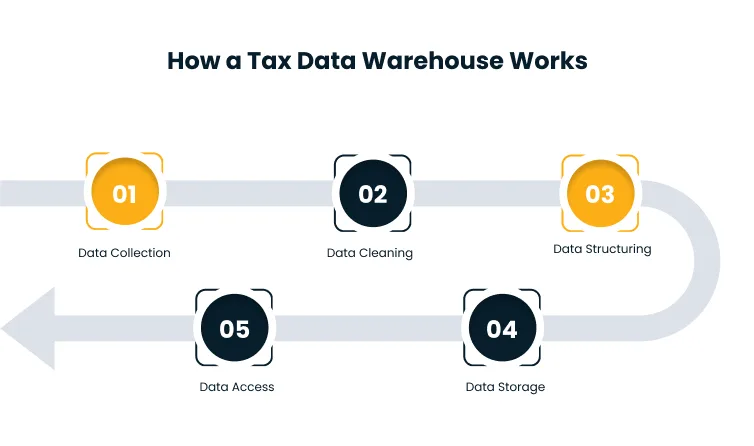
Step 1: Data collection
Tax data is collected from ERP platforms, billing systems, finance applications, regional databases, and other enterprise sources. This includes invoices, adjustments, transactions, tax codes, and jurisdiction-specific records needed for reporting and compliance.
Modern tax data warehouses use APIs, file imports, and real-time data streams to bring information into a staging environment. This creates a consistent flow of tax data and helps teams manage high transaction volumes without relying on scattered spreadsheets or disconnected systems.
Centralized collection gives enterprises a complete view of incoming tax data across departments and geographies. It also helps teams check data completeness early in the process, reducing correction efforts later in the workflow.
Step 2: Data cleaning
Collected data is validated to identify duplicates, missing fields, format issues, and inconsistent entries. Key elements such as tax codes, currency formats, invoice numbers, supplier details, and transaction values are standardized before further processing.
Clean and consistent data support accurate tax calculations, regulatory reporting, and cross-jurisdictional analysis. It also gives compliance teams more confidence in the data used for filings, reconciliations, and internal reviews.
This step improves the quality of insights generated from the warehouse. With verified records, teams can analyze trends, compare tax positions, and prepare reports using a reliable data foundation.
Step 3: Data structuring
After cleaning, the validated data is organized into structured tables, fields, and relational models. This structure helps teams query tax records, connect related transactions, and generate reports aligned with compliance requirements.
Relationships between invoices, tax obligations, entities, locations, and transaction types are clearly mapped. This makes it easier to consolidate data across departments and jurisdictions while preserving accuracy and context.
Structured tax data also supports faster retrieval during audits and regulatory reviews. Teams can drill down into specific records, trace transaction histories, and analyze large datasets with greater control.
Step 4: Data Storage
Once structured, data is stored in a centralized repository designed for tax management. The repository gives tax teams, auditors, and finance professionals secure access to the same consistent dataset. Enterprises can improve storage, scalability, and access by focusing on data warehouse modernization.
Historical records are preserved in a way that supports audit readiness and long‑term compliance monitoring. With past and current datasets available in one place, teams can track trends, analyze changes over time, and document decisions with full traceability.
Centralized storage also improves operational efficiency by reducing time spent locating files or reconciling divergent sources. Tax professionals can focus on reporting and analysis instead of tracking down information from disparate systems.
Step 5: Data Access
Tax teams and analysts access the warehouse through dashboards, business intelligence tools, and reporting applications. These tools turn centralized tax data into clear views for compliance tracking, reporting, reconciliation, and analysis.
Dashboards and query tools help teams retrieve the information they need quickly. They can generate reports, review compliance metrics, track trends, and respond to regulatory updates with accurate data from a single source.
A tax data management platform improves visibility across teams and regions. It helps organizations standardize reporting, coordinate tax operations, and give finance, tax, and audit teams reliable access to the same data.
Tax Data Warehouse vs Tax Data Lake
Enterprises manage increasing volumes of tax data using both tax data warehouses and tax data lakes. While both systems support storage and analysis, they serve distinct purposes. Understanding the differences helps organizations choose the right architecture for reporting, compliance, and analytics.
| Feature | Tax Data Warehouse | Tax Data Lake |
| Data Type | Structured tax data only | Raw, structured, and unstructured data |
| Processing | Cleaned before storage | Stored first, cleaned later |
| Usage | Tax reporting, compliance | Data exploration, AI/ML analytics |
| Users | Tax teams, finance, and auditors | Data engineers, data scientists |
| Performance | Fast and reliable | Flexible but slower for analytics |
| Governance | Built-in controls | Requires external tools |
A tax data warehouse centralizes structured data for accurate reporting, compliance, and audit readiness, while data lakes store raw and unstructured data for advanced analytics. Together, they enable efficient management of high-volume tax data, regulatory compliance, and actionable insights.
Benefits of a Tax Data Warehouse
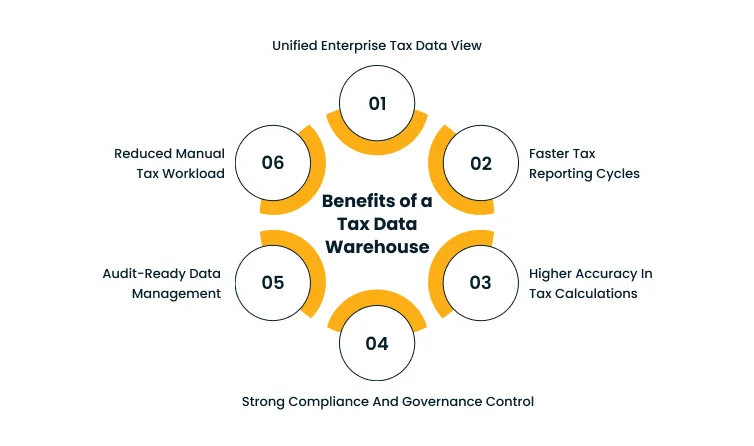
A tax data warehouse enables enterprises to manage complex tax data in a structured and controlled environment. By consolidating, standardizing, and securing information, it enhances reporting consistency, accelerates processes, and improves overall accuracy in tax operations.
The 2025 Gartner IT Infrastructure, Operations & Cloud Strategies research found that 50% of cloud compute resources will be devoted to AI workloads by 2029, up from less than 10% today, highlighting the growing reliance on AI and machine learning in enterprise data operations.
This trend underscores the need for AI-ready, centralized tax systems to handle high-volume, automated data processing effectively.
1. Unified Enterprise Tax Data View
A tax data warehouse integrates data from multiple ERPs, finance systems, and regional sources into a single environment, giving teams a complete view of enterprise-wide obligations and transactions.
- Consolidates data across systems
- Monitors liabilities and transactions across departments
- Provides a holistic view of obligations and trends
Centralized access allows teams to reconcile discrepancies efficiently, track patterns across departments, and generate actionable insights. By connecting data from different sources within a unified tax data repository, enterprises improve operational alignment, reduce fragmented reporting, and maintain consistency in compliance and regulatory reporting. This approach ensures reliable, standardized processes across all jurisdictions.
2. Faster Tax Reporting Cycles
Automating data collection, cleaning, and structuring reduces manual consolidation, enabling teams to generate returns and compliance reports efficiently.
- Accelerates report preparation
- Reduces time on manual data entry
- Supports timely submission of compliance filings
Faster reporting cycles free resources for analytical and strategic tasks. By streamlining repetitive processes, enterprises can focus on planning and proactive compliance. Teams respond quickly to regulatory changes while maintaining operational accuracy and control, strengthening overall performance.
3. Higher Accuracy in Tax Calculations
Standardized datasets eliminate inconsistencies in calculations and reporting outputs. Validated data ensures computations follow regulatory rules and internal accounting standards.
- Standardizes tax codes, currency, and invoice formats
- Reduces calculation errors
- Supports precise cross-jurisdictional reporting
Accurate tax calculations reduce penalties and support reliable planning and forecasting. With precise data, teams can make informed operational and financial decisions confidently. Accurate calculations also strengthen credibility with auditors and regulators.
4. Audit-Ready Data Management
Historical records are stored with complete traceability, giving auditors and regulators direct access to verified information. Logs of data changes create a full audit trail.
- Maintains historical and current records
- Tracks changes systematically
- Simplifies audit preparation and regulatory review
Audit-ready management enhances transparency and enables rapid responses to compliance inquiries. By maintaining a clear record of all transactions, enterprises reduce the time and effort required for audits. Teams provide credible documentation while maintaining consistent oversight.
5. Reduced Manual Tax Workload
Automating reporting and consolidation minimizes repetitive tasks, freeing teams to focus on analysis and strategic initiatives.
- Eliminates spreadsheet-based reconciliation
- Reduces repetitive administrative tasks
- Frees time for high-value work
Reduced manual workload improves operational efficiency and interdepartmental coordination. By decreasing manual effort, teams can prioritize process improvement and planning initiatives. Enterprises achieve faster reporting cycles, more reliable outputs, and smoother collaboration across departments.
6. Strong Compliance and Governance Control
Centralized and standardized tax data enforces consistent handling across business units and systems. Controlled access restricts sensitive information to authorized personnel.
- Standardizes data handling across departments
- Provides secure access
- Maintains regulatory compliance and accountability
Strong governance strengthens operational control, mitigates risk, and supports scalable tax management. By integrating compliance into day-to-day operations, enterprises reduce exposure to errors and enhance oversight. Teams can manage complex, high-volume tax processes confidently while maintaining transparency and accountability.
As tax complexity grows and data volumes rise, enterprises need a single platform to manage operations efficiently.
Cygnet.One centralizes tax data from multiple ERPs and jurisdictions into one system, streamlining reporting, automating compliance workflows, and maintaining audit-ready records. Organizations gain faster reporting, higher accuracy, and full visibility, allowing them to handle complex, high-volume data confidently.
Why Enterprises Must Adopt Centralized Tax Data Systems?
Enterprises operate in a complex environment where tax data spans multiple systems, jurisdictions, and reporting structures. Fragmented data reduces visibility, slows reporting, and increases compliance risks.
Centralized tax data systems consolidate information into a single framework, giving teams clear, structured access to critical tax information. Solutions like data engineering and management help unify these systems, enabling consistent, accurate, and efficient tax operations.
- Distributed Tax Data Landscape: Tax information is often scattered across ERPs, finance platforms, and regional systems, limiting visibility across the enterprise. Centralized systems bring these datasets together, allowing tax teams to track transactions, monitor liabilities, and reconcile records consistently.
- Evolving Compliance Requirements: Tax regulations vary across jurisdictions and are subject to frequent changes. Centralized systems maintain consistent data formats and standardized workflows, allowing teams to align operations with evolving regulations while maintaining accuracy and accountability.
- Delayed Reporting Cycles: Manual consolidation from disconnected systems slows reporting and filing processes. Centralized systems automate data intake and structuring, enabling faster preparation of tax returns and compliance reports without relying on repetitive manual work.
- Reduced Audit Readiness: Fragmented data makes tracing transactions and generating audit-ready reports challenging. Centralized repositories maintain complete records with clear traceability, giving auditors and regulators straightforward access to verified information, while semantic data layers help link structured data directly to users for actionable insights.
- Scaling Complexity in Operations: As businesses expand, transaction volumes and operational complexity increase. Centralized systems integrate additional sources and jurisdictions seamlessly, maintaining consistent data handling, reliable reporting, and manageable tax operations across growing footprints.
Conclusion
Enterprise tax data is often spread across ERPs, finance systems, and regional processes, which makes reporting and compliance difficult to manage consistently. As transaction volumes and regulatory requirements grow, manual consolidation and disconnected datasets create delays, errors, and limited visibility.
A tax data warehouse organizes tax data into a centralized and structured system, improving accuracy, simplifying reporting, and streamlining compliance across jurisdictions. It reduces operational complexity, allowing tax teams to focus on strategic tasks rather than repetitive manual work.Cygnet.One centralizes tax data, automates workflows, and provides real-time, actionable insights. Book a demo to see how Cygnet.One can transform your tax operations into a fully connected, efficient, and data-driven system.
FAQs
A tax data warehouse centralizes tax-related data from multiple systems, creating a single, structured environment for enterprises. It supports accurate tax reporting, compliance management, audit readiness, and analytics, allowing teams to streamline processes, reduce errors, and gain complete visibility into their tax operations.
A tax data warehouse stores cleaned, structured, and validated data optimized for reporting and compliance workflows. In contrast, a tax data lake can store raw, semi-structured, and unstructured data, enabling broader analytics, exploration, and advanced modeling but requiring additional processing before regulatory reporting.
Centralized tax data architecture reduces fragmentation across ERPs, regional systems, and finance platforms. It enhances data consistency, improves reporting accuracy, strengthens governance, and provides operational control across the organization. Teams can track tax obligations efficiently and maintain compliance across jurisdictions.
A tax data warehouse typically stores GST/VAT records, invoices, financial transactions, cross-border tax information, and other compliance-related datasets. The structured environment ensures all critical tax data from various enterprise systems is accessible, validated, and ready for reporting, analysis, and audit purposes.
By using standardized, validated, and consolidated tax datasets, a tax data warehouse allows enterprises to generate accurate compliance reports, maintain audit trails, and reduce manual reconciliation. Teams can respond to regulatory requirements quickly while minimizing errors and improving operational efficiency in tax processes.
Author


Abhishek Nandan
AVP, Marketing
Abhishek Nandan is the AVP of Services Marketing at Cygnet.One, where he drives global marketing strategy and execution. With nearly a decade of experience across growth hacking, digital, and performance marketing, he has built high-impact teams, delivered measurable pipeline growth, and strengthened partner ecosystems. Abhishek is known for his data-driven approach, deep expertise in marketing automation, and passion for mentoring the next generation of marketers.