































AWS environments scale faster than the manual processes managing them. A team managing five microservices across two pipelines can coordinate releases manually. The same team at forty services, multiple deployment environments, and a daily release cadence cannot maintain that consistency without accumulating deployment failures, environment drift, and delayed releases that compound with every sprint.
Manual deployment decisions cannot scale to the speed of cloud-native development demands. Infrastructure provisioned by hand drifts between environments, and deployments run by runbook accumulate inconsistency across every release cycle.
AWS DevOps services provide the automation architecture that addresses each of these gaps. CI/CD pipelines eliminate manual release handoffs, infrastructure as code produces consistent environments on every execution, container orchestration handles runtime scaling without human scheduling decisions, and observability surfaces failures before they reach production users.
2024 Gartner analysis of infrastructure and operations trends says 80% of large organisations will embrace platform engineering to successfully scale DevOps initiatives in hybrid cloud environments by 2027, up from less than 30% in 2023. The speed of that shift reflects how quickly manual delivery processes are becoming a structural constraint at enterprise scale.
This guide covers: How AWS DevOps services connect as an integrated delivery architecture, where enterprise CI/CD and IaC implementations most often break down, how to evaluate whether a deployment stack will hold at production scale, and what to prioritise when building or scaling your AWS DevOps environment.
How AWS DevOps Services Support CI/CD And Automation?
AWS DevOps services function as an integrated delivery architecture. The value of each component depends on how it connects to the others. A CI/CD pipeline deposits build artifacts to a staging environment provisioned by the same IaC configuration as production, monitored by the same observability stack that surfaces deployment health at every stage.
The core service stack spans five components, each handling a distinct layer of the delivery lifecycle:
- CodePipeline orchestrates stage sequences from source to build, build to test, and test to deployment, with conditions at each transition that determine whether the pipeline advances.
- CodeBuild executes compilation, automated testing, and security scanning with configurable pass/fail gates that stop the pipeline when quality thresholds are not met.
- CodeDeploy manages deployment mechanics to ECS, EKS, EC2, or Lambda targets with traffic shifting and automated rollback triggered by deployment health check failures.
- Terraform or CloudFormation provisions environments from version-controlled definitions, eliminating the manual provisioning steps that cause drift between deployments.
- CloudWatch provides deployment-aware alerting that surfaces failures in automated workflows before they reach production users.
What distinguishes a connected AWS DevOps environment from a partially automated one is whether each component passes artifacts, configuration state, and health signals forward to the next. Teams that adopt these tools in isolation find that automation helps in individual stages while manual effort persists at every transition point, and that persistent manual overhead is what prevents the architecture from scaling.
Why Enterprises Adopt AWS DevOps Services?
Manual delivery processes work at a small scale, and the failure mode becomes visible when teams add application services faster than they can design release processes for each one. Deployment instructions accumulate in runbooks, environment configurations diverge between staging and production, and release schedules create bottlenecks at the point where speed matters most.
The returns from addressing these pressures are measurable. 2023 McKinsey analysis on measuring software developer productivity says, organisations that implemented structured developer productivity practices achieved a 20 to 30% reduction in customer-reported product defects, alongside measurable gains in employee experience and delivery throughput.
Enterprise AWS DevOps adoption is driven by five specific operational pressures:
- Manual provisioning produces environments that drift between teams and across release cycles, and IaC eliminates the deployment failures caused when production does not match the environment in which the application was tested.
- Release reliability. Automated test gates enforce the same quality threshold on every deployment, removing the variability introduced when individual engineers make manual release decisions under pressure.
- Compliance auditability. Automated pipeline execution produces a full record of every change, including who approved it, what tests it passed, and when it was deployed, at a granularity manual runbooks cannot match.
- Operational scale. Manual oversight works at five services. At fifty services, the same approach creates release bottlenecks that compound with every new service added to the environment.
- Recovery time. Automated rollback triggered by deployment health checks restores service in minutes, against the hours manual diagnosis and redeployment typically takes.
- The cost of staying on manual delivery processes accelerates as environments grow and release frequency increases. What begins as manageable overhead compounds into a structural delivery constraint.
Core Capabilities Included In AWS DevOps Services
A complete AWS DevOps implementation spans five operational domains, each addressing a distinct failure point in the delivery lifecycle, and the absence of any one creates pressure on the others to compensate through manual effort.
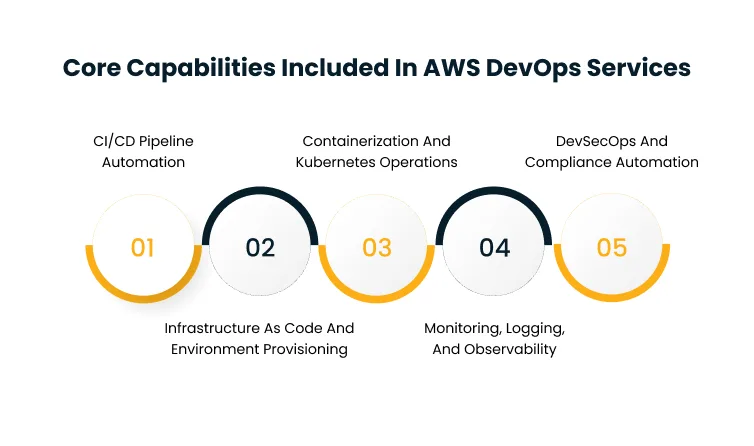
CI/CD Pipeline Automation
CI/CD automation connects source control, build execution, testing, and deployment into a repeatable, auditable workflow.
CodePipeline sequences the stages, CodeBuild executes compilation, automated testing, and security scanning with pass/fail conditions that determine whether the pipeline advances, and CodeDeploy handles deployment to the target environment with rollback triggers pre-configured to activate on health check failures.
The design decision that determines pipeline quality is what those gate conditions contain. A pipeline that advances from build to production without enforced test results produces consistent deployment speed while release quality varies.
Well-implemented pipelines encode thresholds as machine-enforced conditions, so every release meets the same standard regardless of release pressure, team availability, or who is on call.
Cygnet.One’s Cloud Native Development practice designs and implements these pipeline architectures for AWS environments, integrating CodePipeline, CodeBuild, and CodeDeploy with the quality gates and rollback logic each environment requires.
Infrastructure As Code And Environment Provisioning
IaC replaces manual provisioning with version-controlled, declarative configurations that produce identical environments on every execution. Terraform and CloudFormation are the primary options for AWS environments. Terraform offers a provider-agnostic model suited to multi-cloud and hybrid deployments.
CloudFormation provides deeper native AWS service integration for teams operating exclusively within AWS.
- Development, staging, and production environments built from the same configuration eliminate the class of deployment failures caused by environment divergence
- Infrastructure changes are peer-reviewed and version-controlled the same way application code is, making configuration drift visible before it reaches production
- New environment creation is automated and reproducible, with rollback meaning a revert to a known configuration state rather than a manual reconstruction effort
Containerization And Kubernetes Operations
Containers standardise application runtime behaviour across environments by packaging the application with its dependencies, removing the failure class caused by environment-specific runtime conditions.
Orchestration platforms handle container scheduling, workload scaling in response to demand, and automated recovery of failed instances without human intervention. The AWS choice between ECS and EKS turns on operational complexity versus ecosystem access.
ECS uses AWS’s native scheduler, integrates directly with IAM and Application Load Balancer, and carries lower operational overhead. EKS runs managed Kubernetes on AWS, providing the full Kubernetes ecosystem at the cost of greater operational complexity.
- Without existing Kubernetes expertise, ECS typically delivers a faster path to production with lower operational overhead.
- With multi-cloud requirements or Kubernetes-native tooling already in place, EKS provides the long-term workload portability and ecosystem compatibility that multi-cloud deployments require.
Monitoring, Logging, And Observability
CloudWatch captures metrics, logs, and events across AWS services and application runtimes. AWS X-Ray adds distributed tracing for microservices architectures, connecting request traces across service boundaries so teams can isolate failure points without manually correlating log streams from separate services.
This becomes especially important in microservices environments, where traditional monitoring can fail in distributed AWS architectures without deployment-aware visibility across services.
Observability configured before the first deployment serves a different operational function than observability added after the first production incident, and mature implementations follow a consistent standard.
- Deployment health alarms are configured and validated before a service goes live.
- Log retention and alert thresholds are defined in IaC alongside the resources they monitor.
- Distributed traces are enabled by default for every service that calls another service.
DevSecOps And Compliance Automation
Security controls embedded in CI/CD pipelines catch vulnerabilities earlier and at lower remediation cost than controls applied after deployment. Automated static analysis, dependency scanning, and policy validation execute on every commit in CodeBuild.
AWS Config continuously evaluates deployed resources against compliance rules and flags configuration drift before it becomes an audit finding. For enterprises scaling DevSecOps across AWS environments, AWS guardrails that support secure cloud innovation can help enforce the right controls without slowing delivery teams down.
The 2023 IBM Cost of a Data Breach Report says that organisations with a high level of DevSecOps integration saw data breach costs nearly $1.7 million lower on average than those with low or no DevSecOps adoption. A vulnerability caught at the build stage costs a code fix, while the same issue reaching production costs an incident response, potential regulatory notification, and measurable customer impact.
Where AWS DevOps Implementations Commonly Struggle?
Most AWS DevOps failures trace back to architecture and sequencing decisions made before any automation was deployed, typically in the form of automation introduced before the operational baseline exists to support it.
Tool adoption without integration design. Teams deploy CodePipeline for one application, use a separate pipeline tool for another, and manage infrastructure through a mix of Terraform modules, console changes, and undocumented scripts. Each component operates in isolation. Handoffs between them remain manual.
The result is an automation layer that adds maintenance overhead without reducing the operational burden. Pipelines and deployments are configured first. Monitoring is treated as a follow-on task. When automated workflows fail without deployment-aware alerting in place, those failures surface through customer reports.
The response-time advantage of automation is lost at the moment it matters most. Security scanning is configured as a warning with no enforcement gate. Infrastructure changes bypass IaC through quick console edits. Pipeline configurations diverge across teams without a common template. Each deviation accumulates technical debt that pulls manual review back into the release process.
Automation built by specialist engineers and handed to generalist operations teams creates systems that get bypassed when they are not understood. Manual workarounds rebuild the operational burden that automation was designed to eliminate.
Cygnet.One’s Cloud Engineering practice addresses this directly by beginning every AWS DevOps engagement with a structured assessment of the current delivery environment, identifying which of these patterns are active before any automation is designed or deployed.
How AWS DevOps Implementation Works In Enterprise Environments?
Enterprise AWS DevOps implementations follow a phased approach because each phase needs to deliver working automation before the next phase expands scope. Attempting a full-environment transformation before individual components are proven in production produces fragile systems and extended delivery timelines.
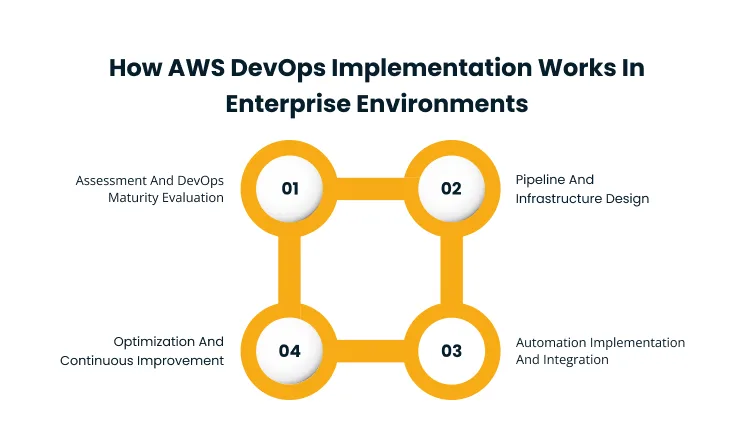
Assessment And DevOps Maturity Evaluation
Assessment maps the current delivery state with enough specificity to sequence automation investments correctly. The output is a prioritised inventory of which workflows are manual, which tools are already deployed and whether they are integrated or siloed, where configuration drift is accumulating, and which teams have the skills to maintain an automated environment.
Teams that skip this phase build automation for the highest-visibility workflows first, then discover during delivery that those workflows depend on manual processes they did not map, leaving the real bottleneck untouched while the visible problem appears solved.
Pipeline And Infrastructure Design
The design phase establishes the decisions that constrain everything downstream. Pipeline architecture covers stage sequence, test gate conditions, approval workflows, and rollback triggers, and must accommodate the organisation’s full release cadence and governance requirements across all teams and environments the platform will serve.
IaC module structure, state management approach, and account boundary definitions require planning here. Module structure designed for one team needs significant rework when ten teams consume the same platform, making these decisions considerably cheaper to get right at design time than to refactor under active use.
Automation Implementation And Integration
Implementation brings the designed components into operation by integrating CI/CD pipelines, IaC configurations, container registries, orchestration platforms, and observability as a connected system, validated end-to-end before any service goes live.
For teams migrating from existing manual processes, this phase includes validating that the automated workflow produces identical outcomes to the process it replaces. A pipeline that deploys differently from the manual process introduces transition risk, making validation a required gate before cutover.
Observability is configured in parallel, because teams that defer it to after the first deployment typically find it deferred indefinitely.
Optimization And Continuous Improvement
After initial deployment, continuous optimisation works across three tracks.
- Pipeline performance through build parallelisation, test selection, and build caching to reduce execution time per release.
- Infrastructure cost through rightsizing and reserved capacity to reduce per-environment spend as automation covers more workloads.
- Automation coverage through expansion to additional services and teams as the platform matures and teams build familiarity with the tooling.
Establishing baseline metrics before each phase creates the evidence base needed to validate that automation delivered its intended value, and gives engineering leadership the data to justify the next phase of investment.
What To Evaluate In An AWS DevOps Services Partner?
Selecting an AWS DevOps partner is a delivery risk decision where performance under actual release pressure is a different test than proposal quality. The criteria below predict partner performance more reliably than the strength of a pre-sales presentation.
AWS Certifications And Technical Expertise
AWS partner tier and active certifications indicate sustained investment in technical depth. An AWS Advanced Tier Partner has validated expertise across migration, cloud-native development, and DevOps implementation, with access to AWS architectural guidance during client engagements.
The more predictive signal is team composition, and specifically, which certified practitioners will be assigned to the engagement. Certifications held at the firm level say nothing about who is actually working on your project.
CI/CD And Automation Experience
Ask the partner to walk through a CI/CD implementation they delivered at a comparable scope. The answer should cover:
- Tool selection rationale and why those tools were chosen for that specific environment.
- How was environment promotion across dev, staging, and production handled?
- Which test gates were configured, what they validated, and why those thresholds were set?
- How is rollback triggered, and what is the expected recovery time?
A partner that cannot provide specific details from a prior engagement, covering stage design, test gates, and rollback behaviour, is unlikely to have delivered at the scope they are claiming.
Infrastructure As Code And Kubernetes Capability
IaC capability is a reliable proxy for delivery maturity, so ask to see a sample Terraform module or CloudFormation stack from a prior engagement and ask the partner to explain their state management approach and the trade-offs in that choice.
For Kubernetes implementations, ask about the ECS versus EKS decision framework. The partner should be able to articulate the specific criteria that drove each recommendation in past engagements, with clear reasoning on operational overhead, portability, and long-term architecture fit.
Security, Governance, And Compliance Readiness
DevOps pipelines without integrated security controls create faster deployments with expanded compliance exposure. Evaluate the partner’s approach to pipeline-integrated security scanning, IAM governance, and AWS Config rule design.
For regulated industries, verify the partner has delivered in the applicable compliance framework and can show what audit artefacts the automated environment produces as part of normal pipeline operations.
Scalability And Operational Support
An implementation designed for three teams needs a different architecture than one built for thirty teams and a hundred microservices. Ask what scale assumptions the partner makes at design time and how those assumptions shape the pipeline and IaC platform architecture.
Post-delivery support matters as much as delivery quality, because teams that receive documented, maintainable systems operate better than teams that inherit undocumented pipelines. Ask specifically how the partner handles knowledge transfer and IaC code ownership after the engagement closes.
Delivery track records at a comparable scale offer the most reliable signal. In one engagement with a UK-based BNPL fintech serving 1.5 million users, Cygnet.One implemented containerised microservices on Amazon EKS, automated CI/CD through CodeBuild and Bitbucket Pipelines, Terraform-managed infrastructure, and a unified observability stack across CloudWatch and New Relic.
The engagement delivered 40% faster feature delivery through cloud-native DevOps automation and a 30% reduction in AWS infrastructure costs.
How To Successfully Scale AWS DevOps Automation?
Initial AWS DevOps implementations typically cover one team and a subset of applications. Scaling to full organisational coverage requires treating the automation architecture as a platform that other teams consume, with standardised patterns and documented extension points built in from the start.
For enterprises scaling automation across multiple AWS accounts, secure multi-account scaling with AWS Control Tower can help standardise governance before DevOps patterns expand across teams.
Standardise CI/CD Pipelines Across Teams
Standardised pipeline templates reduce the time each team spends on CI/CD design and the audit effort required to verify configurations for compliance. Templates should encode the organisation’s quality gates, security checks, and approval workflows by default, with documented extension points for team-specific requirements.
Teams that each build independent pipelines from scratch create a maintenance burden that grows with every service added. Pipeline consolidation becomes significantly more expensive after configurations have diverged across ten teams than if standardisation were established at the start.
Integrate Security Into DevOps Workflows
Security integration in CI/CD means static analysis and dependency scanning run on every commit and fail the build when issues are found. Pipeline failures on security findings must be enforced as deployment gates, with no override path that bypasses the gate without an explicit approval record.
Scaling security integration means extending these pipeline-embedded controls to every team and every service in the environment. Teams that add services without adding them to the security scanning platform create blind spots that accumulate with every new deployment, and those blind spots are rarely visible until an audit or incident makes them consequential.
Continuously Measure Deployment Performance
Deployment frequency, lead time for changes, change failure rate, and mean time to recovery provide an objective view of DevOps maturity over time. These four metrics give engineering leadership an evidence-based baseline for evaluating each automation investment and identifying which stages of the delivery pipeline carry the most friction.
Teams that track these metrics consistently can distinguish genuine performance improvement from the feeling of progress. Teams without this baseline cannot justify the next phase of automation investment to engineering leadership or validate that the current phase delivered its intended value.
Cygnet.One’s Amazon Web Services practice supports organisations at this stage, providing the architectural patterns and platform design that make AWS DevOps automation scalable across multiple teams, accounts, and application portfolios.
How Cygnet.One Implements AWS DevOps?
As an AWS Advanced Tier Partner with 700+ active AWS certifications across the delivery team, Cygnet.One brings validated expertise across CodePipeline, CodeBuild, CodeDeploy, Terraform, CloudFormation, ECS, EKS, and CloudWatch observability. Delivery covers CI/CD pipeline design, IaC for infrastructure provisioning, container orchestration, and observability configured before the first production release.
Every engagement is structured so the client team owns the platform after delivery. IaC code ownership, pipeline documentation, and knowledge transfer are included as phases of each engagement, with automation investments sequenced based on the current delivery environment rather than a standard template.
Conclusion
AWS DevOps implementations that scale to production are built on architecture decisions made before tool deployment began. The integration between CI/CD pipelines, IaC configurations, container platforms, and observability determines whether automation reduces operational burden or shifts it to different handoffs.
Scaling that integration across multiple teams is where most organisations face the harder challenge. The practices that work at one team, three applications, and a monthly release cadence require a different architecture at ten teams, sixty applications, and daily deployments.
Building the platform for the scale you are moving towards is what determines whether the architecture holds as teams and services multiply. If the current AWS delivery environment depends on manual release steps, inconsistent provisioning, or reactive monitoring, the next action is a structured assessment of which failure modes are active.
Cygnet.One’s Cloud Engineering team works with organisations at this point, mapping delivery gaps and designing AWS DevOps architectures sequenced for the environment you actually have. Book a demo to build a DevOps implementation plan around your current scale and release requirements.
FAQs
AWS DevOps services are a set of managed services and tooling that automate software delivery, infrastructure provisioning, container orchestration, and operational monitoring within AWS environments. Core services include CodePipeline, CodeBuild, CodeDeploy, Terraform or CloudFormation for IaC, ECS or EKS for containers, and CloudWatch for observability.
AWS CI/CD services automate every stage from code commit to production. CodePipeline sequences the stages, CodeBuild executes builds and tests with configurable pass/fail gates, and CodeDeploy handles deployment to the target environment with rollback triggers. The result is consistent release quality at any deployment frequency without manual handoffs between stages.
ECS uses AWS’s native container scheduler and integrates directly with IAM, ALB, and Fargate, with lower operational overhead and a faster path to production. EKS runs managed Kubernetes on AWS, offering the full Kubernetes ecosystem at the cost of more operational complexity. Teams without Kubernetes expertise typically deploy faster with ECS. Teams with multi-cloud requirements often choose EKS for workload portability.
Evaluate AWS partner tier and active certifications as a proxy for technical depth, ask for CI/CD delivery examples at comparable scope with specific details on test gates and rollback design, assess IaC capability by reviewing sample Terraform or CloudFormation code, confirm security automation is part of pipeline design, and verify that engagements are structured for client-team ownership after delivery.
IaC provisions identical environments from version-controlled configurations, eliminating drift between development, staging, and production that causes deployment failures. Terraform and CloudFormation are the primary AWS options, enabling peer-reviewed infrastructure changes and predictable rollback without manual reconstruction
Security controls integrated into CI/CD run automated scanning
on every commit and enforce findings as deployment gates. AWS Config monitors
resources against compliance rules continuously, catching vulnerabilities at
build time and producing audit trails from every pipeline execution without
reliance on post-release security reviews.
Author


Abhishek Nandan
AVP, Marketing
Abhishek Nandan is the AVP of Services Marketing at Cygnet.One, where he drives global marketing strategy and execution. With nearly a decade of experience across growth hacking, digital, and performance marketing, he has built high-impact teams, delivered measurable pipeline growth, and strengthened partner ecosystems. Abhishek is known for his data-driven approach, deep expertise in marketing automation, and passion for mentoring the next generation of marketers.