


































• Cygnet IRP
  • Glib.ai
  • IFSCA
Cygnet.One
  • About
  • Products
  • Solutions
  • Services
  • Partners
  • Resources
Generic selectors
Exact matches only
Search in title
Search in content
Post Type Selectors
Get Started
About
  • Overview

    A promise of limitless possibilities

  • We are Cygnet

    Together, we cultivate an environment of collaboration

  • Careers

    Join Our Dynamic Team: Careers at Cygnet

  • CSR

    Impacting Communities, Enriching Lives

  • In the News

    Catch up on the latest news and updates from Cygnet

  • Contact Us

    Connect with our teams across the globe

What’s new

chatgpt

Our Journey to CMMI Level 5 Appraisal for Development and Service Model

Full Story

chatgpt

ChatGPT: Raising the Standards of Conversational AI in Finance and Healthcare Space

Full Story

Products
  • Cygnet Tax
    • Cygnet Tax
    • e-Invoicing / Real time reportingIRP-integrated e-Invoicing with real-time validation
    • e-Way Bills / Road permitsGST-compliant centralized e-Way Bill platform for scalable operations
    • Direct Tax ComplianceAccurate direct tax compliance, filings, litigation, and assessments
    • Indirect Tax ComplianceEnterprise-grade platform for indirect tax compliance
      • Indirect Tax Compliance
      • GST Compliance India
      • VAT Compliance EU
      • VAT Compliance ME
    • Managed ServicesEnd-to-end indirect tax compliance support by experts
  • Global e-Invoicing
    • Global e-Invoicing
    • APAC
      • India
      • Malaysia
      • Singapore
      • Japan
    • Africa
      • Egypt
      • Kenya
      • Zambia
      • Nigeria
    • Europe
      • Spain
      • France
      • Germany
      • Poland
      • Belgium
    • Oceania
      • Australia
      • New Zealand
    • Middle East
      • UAE
      • Oman
      • Saudi Arabia
      • Bahrain
      • Qatar
      • Jordan
  • Cygnet Vendor Postbox
    • Cygnet Vendor PostboxDigitize purchase invoice validation & posting to ERPs & maximize ITC
  • Finance Transformation
    • Finance Transformation
    • Cygnet FinalyzeUnlock working capital with data-driven invoice-based credit decisions
    • Bank Statement AnalysisEvaluate company health by analyzing performance and financial risk
    • Financial Statement AnalysisAssess company performance and risk with financial statement analysis
    • GST Business Intelligence Report360-degree financial health insights using GST data analytics
    • GST Return Compliance ScoreGST-based compliance score to assess business risk and credibility
    • ITR AnalysisAssess creditworthiness and lending risk using ITR filing analysis
    • Invoice Verification for Trade FinanceVerify invoices to reduce fraud and improve credit decisions
    • Account Aggregator – Technology Service Provider (AA-TSP)Onboard to the Account Aggregator ecosystem with FIP & FIU modules
  • Cygnet BridgeFlow
    • Cygnet BridgeFlowAutomated digital onboarding with real-time validations and compliance
  • Cygnet Bills
    • Cygnet BillsGST-compliant centralized e-Way Bill platform for scalable operations
  • Cygnet IRP
    • Cygnet IRPIRP-integrated e-Invoicing with real-time validation
  • Cygnature
    • CygnatureSecure, compliant digital signing with audit-ready traceability

What’s new

e-Invoicing compliance Timeline

Know More →

UAE e-Invoicing: The Complete Guide to Compliance and Future Readiness

Read More →

Types of Vendor Verification and When to Use Them

Read More →

Safeguard Your Business with Vendor Validation before Onboarding

Read More →

Modernizing Dealer/Distributor & Customer Onboarding with BridgeFlow

Read More →

Accelerate Vendor Onboarding with BridgeFlow

Read More →

GST Filing 360°: GST, E-Invoicing, E-Way Bills & Annual Returns Made Simple

Read More →

Why Manual Tax Determination Fails for High-Volume, Multi-Country Transactions

Read More →

GST Filing 360°: GST, E-Invoicing, E-Way Bills & Annual Returns Made Simple

Read More →

Key Features of an Invoice Management System Every Business Should Know

Read More →

Automating the Shipping Bill & Bill of Entry Invoice Operations for a Leading Construction Company

Read More →

From Manual to Massive: How Enterprises Are Automating Invoice Signing at Scale

Know More →

Solutions
  • HireAI
  • Agent as a Service
  • AI-powered Voice Assistant
  • Generative AI Workshop
  • TestingWhiz
  • VIPRE

What’s new

AI powered Interviewer

AI-Powered Interviewing Helped an Education Group Reduce Hiring Time Significantly

Know More

Generative AI ebook

Navigating the Generative AI Landscape

Download eBook

Services
  • Data Analytics & AI
    • Data Analytics & AI
    • Data Engineering and ManagementData engineering and management for smart, scalable systems
    • Data Migration and ModernizationData migration and modernization for future-ready platforms
    • Insights Driven Business TransformationInsight-driven business transformation for faster decisions
    • Business Analytics and Embedded AIBusiness analytics and embedded AI for data-led growth
  • Digital Engineering
    • Digital Engineering
    • Technical Due DiligenceEnabling smarter decisions through future-ready digital ecosystems
    • Product EngineeringEngineering impactful digital products that elevate business growth
    • HyperautomationSmarter hyperautomation using low-code for agile business processes
    • Enterprise IntegrationIntegrating enterprise systems for seamless operations and growth
    • Application ModernizationModernizing IT ecosystems with scalable, AI-driven innovation
  • Quality Engineering
    • Quality Engineering
    • Test Consulting & Maturity AssessmentTest consulting and maturity assessments for reliable software QA
    • Business Assurance TestingBusiness assurance testing aligned with real business outcomes
    • Enterprise Application & Software TestingEnterprise application testing for continuity and scale
    • Data Transformation TestingData transformation testing for scalable, trusted data quality
  • Cloud Engineering
    • Cloud Engineering
    • Cloud Strategy and DesignCloud strategy and design services for secure, scalable growth
    • Cloud Migration & ModernizationORBIT: a proven framework for measurable cloud transformation
    • Cloud Native DevelopmentCloud-native development for resilient, scalable innovation
    • Cloud Operations and OptimizationCloud optimization and operations for enterprise resilience
    • Cloud for AI FirstAI-first cloud transformation for smarter, scalable enterprises
  • Managed IT Services
    • Managed IT Services
    • IT Strategy and ConsultingStrategic IT consulting to align technology with business goals
    • Application Managed Services24/7 managed application services for performance and security
    • Infrastructure Managed ServicesEnd-to-end infrastructure management for resilient IT operations
    • CybersecurityComprehensive cybersecurity solutions to protect business assets
    • Governance, Risk Management & ComplianceGRC solutions to manage risk, compliance, and governance
  • Cygnet TaxAssurance
    • Cygnet TaxAssurance
    • Tax DatalakeUnified tax data lake for intelligent, compliant decision-making
    • Tax InfraDigital tax infrastructure for efficient, compliant transformation
  • Amazon Web Services
    • Amazon Web Services
    • Migration and ModernizationMake Your Move to the Cloud With AWS Smarter & Faster
    • Generative AIRun your Gen AI workloads on AWS with full control

What’s new

AI-Powered Voice Assistant for Smarter Search Experiences

Explore More →

Cygnet.One’s GenAI Ideation Workshop

Know More →

Our Journey to CMMI Level 5 Appraisal for Development and Service Model

Read More →

Extend your team with vetted talent for cloud, data, and product work

Explore More →

Enterprise Application Testing Services: What to Expect

Read More →

Future-Proof Your Enterprise with AI-First Quality Engineering

Read More →

Cloud Modernization Enabled HDFC to Cut Storage Costs & Recovery Time

Know More →

Cloud-Native Scalability & Release Agility for a Leading AMC

Know More →

AWS workload optimization & cost management for sustainable growth

Know More →

Cloud Cost Optimization Strategies for 2026: Best Practices to Follow

Read More →

Cygnet.One’s GenAI Ideation Workshop

Explore More →

Practical Approaches to Migration with AWS: A Cygnet.One Guide

Know More →

Tax Governance Frameworks for Enterprises

Read More →

Cygnet Launches TaxAssurance: A Step Towards Certainty in Tax Management

Read More →

Partners
  • Products Partner Program
Resources
  • Blogs
  • Case Studies
  • eBooks
  • Events
  • Webinars

Blogs

A Step-by-Step Guide to E-Invoicing Implementation in the UAE

A Step-by-Step Guide to E-Invoicing Implementation in the UAE

View All

Case Studies

Cloud-Based CRM Modernization Helped a UK Based Organization Scale Faster and Reduce Deployment Complexity

Cloud-Based CRM Modernization Helped a UK Based Organization Scale Faster and Reduce Deployment Complexity

View All

eBooks

Build Smart Workflow with Intelligent Automation and Analytics

Build Smart Workflow with Intelligent Automation and Analytics

View All

Events

11th CIO Conclave & Awards

11th CIO Conclave & Awards

View All

Webinars

Beyond Chat: How Voice-Assisted AI is Redefining Digital Engagement

Beyond Chat: How Voice-Assisted AI is Redefining Digital Engagement

View All
Cygnet IRP
Glib.ai
IFSCA

How to Manage Multi-Agent Coordination Using AWS Tools Without Added Overhead

  • By Abhishek Nandan
  • November 14, 2025
  • 5 minutes read
Share
Subscribe

Building systems powered by multiple AI agents often looks efficient on paper but turns complicated in practice. Teams face duplicated processes, idle compute cycles, and unclear handoffs between agents. The goal is simple: ensure that every agent performs its task, communicates results, and responds to context, without introducing extra cost or operational friction.

That’s the essence of AWS AI orchestration — ensuring agents interact smoothly and scale intelligently.  When done correctly, it allows intelligent agents to interact smoothly, share context, and complete distributed workflows through structured orchestration. The advantage is not just performance. It’s about controlling complexity as you scale AI operations.

Defining Coordination Goals

Before bringing in any cloud service, you need clarity on what your coordination framework should achieve. In multi-agent coordination with AWS, these goals usually include:

  • Task clarity – Each agent should know exactly what it is responsible for.
  • Communication flow – Agents must share results and context in a predictable sequence.
  • Parallel efficiency – Tasks that don’t depend on each other should run simultaneously.
  • Failure isolation – When one agent fails, others continue working.

Example: A Reasoning-Driven Workflow

Think of a generative AI system that answers customer queries. One agent fetches data, another validates it, and a third writes the response. Coordination ensures that the data retrieval agent finishes before the validation agent starts, while the writing agent waits for both.

Without coordination, this same flow would double requests, increase costs, and risk inconsistent responses.

AWS as a Coordination Layer

AWS provides native building blocks that help orchestrate complex, agent-driven workflows without adding heavy middleware. The most effective setup combines three services — Step Functions, EventBridge, and AWS Bedrock — to build scalable coordination layers. Together, they deliver automation, synchronization, and reasoning at scale.

1. AWS Step Functions: Structured Workflow Orchestration

AWS Step Functions act as the backbone for multi-agent coordination with AWS, defining how each agent interacts within workflows. They define and manage how each agent interacts within a larger process.

Key functions:

  • Represent workflows as state machines — each “state” can trigger a Lambda function or API call that runs an agent.
  • Enable parallel branches so multiple agents can operate at the same time.
  • Manage retries, error catching, and fallback logic.
  • Maintain execution history for visibility and debugging.

In effect, Step Functions make agent management systematic. Instead of relying on agents to signal each other directly, the workflow handles it automatically.

Example structure:

State Machine:
   ├── RetrievalAgent → ValidationAgent → SummaryAgent
   ├── Parallel Branch: AnalyticsAgent + PolicyCheckAgent
   └── End → Return to Supervisor

This type of orchestration ensures that tasks run in the right order and agents remain loosely coupled.

2. Amazon EventBridge: Event-Driven Communication

When systems grow, agents need to communicate asynchronously. AWS orchestration tools like EventBridge act as the event bus that routes messages between components.

With EventBridge:

  • Agents can publish events (e.g., “retrieval_complete”) without knowing who consumes them.
  • Other agents subscribe to relevant patterns and trigger automatically.
  • Scheduled or conditional triggers can start or pause entire workflows.

This decouples your architecture and supports a resilient event-driven architecture, reducing inter-agent dependencies. It also means you can add or replace agents without editing existing code paths.

3. Amazon Bedrock: Intelligent Agent Implementation

Once orchestration is defined, Bedrock becomes the environment where individual agents live. It supports multiple foundation models and provides the foundation for reasoning, context sharing, and automation.

Bedrock enables developers to:

  • Build and deploy domain-specific agents with defined instructions.
  • Connect them to tools or data sources through API actions.
  • Maintain shared memory so that agents remember previous outputs.

A common design pattern is to create a supervisory agent that coordinates sub-agents through reasoning. The supervisor decides when to trigger retrieval, when to summarize, and how to merge outcomes.

In this structure, multi-agent coordination with AWS isn’t manual — it’s codified logic connecting Bedrock’s reasoning with Step Functions’ orchestration and EventBridge’s signaling.

Designing for Low Overhead

Building a functional system is one thing; keeping it cost-efficient and simple is another. The challenge with multi-agent coordination using AWS is not just scaling, but doing so with cloud cost optimization in mind.

Here are three principles that help maintain balance.

1. Optimize Cost at Every Layer

  • Use Express Workflows in Step Functions for high-volume, short-running tasks.
  • Choose right-sized foundation models in Bedrock — not every task needs a large model.
  • Cache intermediate results in S3 or DynamoDB to avoid repeated inference.
  • Monitor execution logs to identify idle states and redundant transitions.

By aligning workflow structure to task duration, you reduce per-state costs while preserving response time.

2. Keep Context Lightweight

Passing massive payloads through orchestration can slow systems down. Instead:

  • Store long-term state in DynamoDB or S3.
  • Pass only identifiers or summaries between agents.
  • Use shared memory features or vector stores for context retrieval instead of raw data passing.

This keeps workflows modular, faster to update, and easier to debug.

3. Simplify Agent Design

Complex agents that try to “do everything” create maintenance problems. Instead:

  • Define one purpose per agent.
  • Use smaller reasoning chains for focus and transparency.
  • Combine results at the supervisor level, not within each agent.

This supports cleaner agent management and makes scaling linear — you can add more specialized agents instead of redesigning the entire system.

Coordinated AI Workflow on AWS
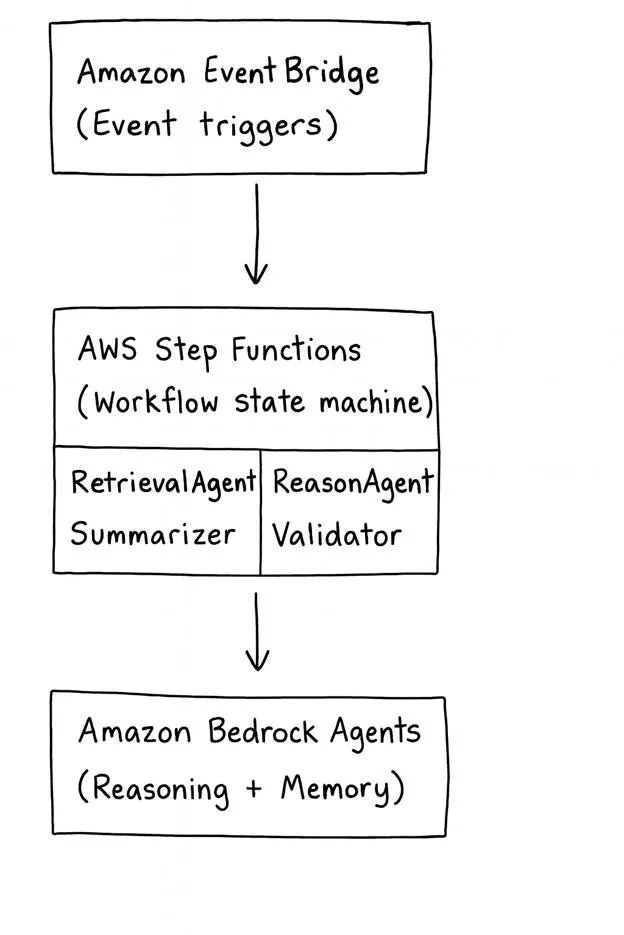
This model illustrates how AWS services combine for event-driven, managed coordination while staying modular and cost-conscious.

Handling Scaling and Reliability

AI Scaling Strategy

As you increase traffic or add new agents, orchestration should adapt automatically. AWS enables this through:

  • Parallel states in Step Functions for concurrent execution.
  • Lambda concurrency controls to avoid throttling.
  • EventBridge rules to queue or delay events under load.

This ensures AI scaling is controlled, not chaotic. Your agents grow in number and scope, but the supervision layer stays stable.

Reliability and Fault Isolation

Every orchestration plan should assume that an agent will fail at some point. To protect the system:

  • Use Step Functions’ retry logic with exponential backoff.
  • Include fallback states that call simpler backup agents.
  • Use EventBridge’s dead-letter queues for unprocessed events.

A coordinated recovery path maintains service continuity while isolating faulty agents.

Putting It All Together

Here’s how these principles come together in a real scenario.

  1. Trigger – A customer submits a request. EventBridge captures it and triggers a Step Function.
  2. Workflow Initialization – The Step Function starts the supervisor agent.
  3. Task Delegation –
    1. Agent A retrieves data.
    2. Agent B validates compliance.
    3. Agent C synthesizes the final response.
  4. Parallel Execution – Agents A and B run simultaneously. When done, their outputs feed into C.
  5. Aggregation and Output – The supervisor merges all results and stores them in S3.

The system stays reactive, cost-optimized, and transparent. Each agent performs a single, defined task.

Measuring Effectiveness

How do you know if your coordination design is working? Monitor these metrics:

  • Workflow completion time – Shorter runtimes show efficient orchestration.
  • Agent utilization – Track which agents remain idle too long or run too frequently.
  • Error retry counts – Frequent retries signal dependency or logic issues.
  • Cost per execution – Benchmark per 1,000 workflow runs to detect overhead growth.

These metrics align with multi-agent coordination with AWS best practices — visibility, traceability, and performance feedback loops.

Frequently Asked Questions

1. How does this approach differ from traditional orchestration?

Traditional pipelines run in a fixed sequence. Multi-agent workflows are adaptive — agents can run based on conditions or reasoning outcomes. The orchestration doesn’t just call functions; it manages intelligence flow.

2. How can I keep costs predictable as I scale?

Group related agents into workflow segments and run them using AWS orchestration tools that support express executions. Combine small model calls where possible, and monitor Bedrock usage for spikes.

3. What’s the easiest way to start?

Prototype with three agents: one retrieval, one reasoning, and one generation. Use Step Functions for flow control and EventBridge for event routing. Once stable, add more specialized agents.

Key Takeaways

  • Multi-agent coordination with AWS is about structured communication, not just automation.
  • Step Functions, EventBridge, and Bedrock together create a clear coordination backbone.
  • Keep payloads light, agents focused, and workflows modular for smoother agent management.
  • Prioritize cost control and transparency while planning for AI scaling.
  • Build for fault tolerance — assume agents will fail and design graceful recovery.

Conclusion

Enterprises building AI ecosystems face a consistent problem: coordination overhead. As agents multiply, so do dependencies and costs. The solution lies in clear orchestration, event-driven logic, and modular design. By combining AWS orchestration tools with Bedrock’s reasoning capabilities, you can achieve multi-agent coordination with AWS that is structured, scalable, and sustainable. It keeps agents focused, operations predictable, and growth affordable — without adding layers of complexity that slow innovation.

Author

Abhishek Nandan Linkedin
Abhishek Nandan
AVP, Marketing

Abhishek Nandan is the AVP of Services Marketing at Cygnet.One, where he drives global marketing strategy and execution. With nearly a decade of experience across growth hacking, digital, and performance marketing, he has built high-impact teams, delivered measurable pipeline growth, and strengthened partner ecosystems. Abhishek is known for his data-driven approach, deep expertise in marketing automation, and passion for mentoring the next generation of marketers.

Related Blog Posts

Common Patterns That Improve Success Rates in AWS Migration Projects

CalendarNovember 10, 2025

How to Replatform Windows and .NET Applications to .NET Core on Linux Without Downtime

CalendarAugust 14, 2025

Designing Guardrails That Don’t Slow Down AWS Innovation 

CalendarFebruary 23, 2026

Sign up to our Newsletter

    Latest Blog Posts

    Designing Enterprise Data Contracts to Improve Data Reliability Across Teams 
    Designing Enterprise Data Contracts to Improve Data Reliability Across Teams 

    CalendarMarch 31, 2026

    Why Traditional Monitoring Fails in Distributed AWS Architectures 
    Why Traditional Monitoring Fails in Distributed AWS Architectures 

    CalendarMarch 31, 2026

    How Technology Simplifies Direct Tax Compliance Across Multiple Jurisdictions 
    How Technology Simplifies Direct Tax Compliance Across Multiple Jurisdictions 

    CalendarMarch 18, 2026

    Let’s level up your Business Together!

    The more you engage, the better you will realize our role in the digital transformation journey of your business


      I agree to the Terms & Conditions and Privacy Policy and allow Cygnet.One (and its group entities) to contact me via Promotional SMS / Email / WhatsApp / Phone Call.*

      I agree to receive occasional product updates and promotional messages from Cygnet.One (and its group entities) on Promotional SMS / Email / WhatsApp / Phone Call.

      I agree to receive promotional SMS messages from Cygnet.One (and its group entities). Up to 4 messages per month. Message & data rates may apply. Reply STOP to opt out. Consent is not a condition of purchase.

      Cygnet.One Locations

      India India

      Cygnet Infotech Pvt. Ltd.
      2nd Floor, The Textile Association of India,
      Dinesh Hall, Ashram Rd,
      Navrangpura, Ahmedabad, Gujarat 380009

      Cygnet Infotech Pvt. Ltd.
      6th floor, A-wing Ackruti Trade Center,
      Road number 7, MIDC, Marol,
      Andheri East, Mumbai-400093, Maharashtra

      Cygnet Infotech Pvt. Ltd.
      WESTPORT, Urbanworks,
      5th floor, Pan Card Club rd.,
      Baner, Pune, Maharashtra 411045

      Cygnet Infotech Pvt. Ltd.
      10th floor, 73 East Avenue,
      Sarabhai campus, Vadodara, 391101

      Global

      CYGNET INFOTECH LLC
      125 Village Blvd, 3rd Floor,
      Suite 315, Princeton Forrestal Village,
      Princeton, New Jersey- 08540

      CYGNET DIGITAL IT SOLUTION LLC
      Office 707, Magnum Opus Tower,
      Al Thanyah First, Dubai, U.A.E,
      P.O. Box 125608

      CYGNET INFOTECH PRIVATE LIMITED
      Level 35 Tower One,
      Barangaroo, Sydney, NSW 2000

      CYGNET ONE SDN.BHD.
      Unit F31, Block F, Third Floor Cbd Perdana 3,
      Jalan Perdana, Cyber 12 63000 Cyberjaya Selangor, Malaysia

      CYGNET INFOTECH LIMITED
      C/O Sawhney Consulting, Harrow Business Centre,
      429-433 Pinner Road, Harrow, England, HA1 4HN

      CYGNET INFOTECH PTY LTD
      152, Willowbridge Centre,
      39 Cronje Drive, Tyger Valley,
      Cape Town 7530

      CYGNET INFOTECH BV
      Peutiesesteenweg 74, Machelen (Brab.), Belgium

      Cygnet One Pte. Ltd.
      160 Robinson Road,
      #26-03, SBF Centre,
      Singapore – 068914

      • Explore more about us

      • Download Corporate Deck
      • Terms of Use
      • Privacy Policy
      • Contact Us
      © Copyright – 2026 Cygnet.One
      We use cookies to ensure that we give you the best experience on our website. If you continue to use this site we will assume that you are happy with it.

      Cygnet.One AI Assistant

      ✕
      AI Assistant at your help. Cygnet AI Assistant