




































Generative AI has opened up practical possibilities across knowledge access, content creation, customer support, software development, and business decision-making. Many enterprises have already moved past asking where the technology can be used. The harder decisions begin when a promising use case is expected to enter production — the transition point examined in depth in the guide to AI adoption challenges every enterprise faces in 2026.
At that point, technical feasibility is only one part of the decision. The organization needs clarity on use case approval, data access, human oversight, and accountability for outcomes. These decisions are a key part of enterprise AI governance — and they sit at the core of how mature generative AI programmes are structured to move safely from experiment to production.
The need for clearer decision structures is becoming harder to ignore. PwC’s 2025 Responsible AI survey found that half of respondents cited difficulty turning responsible AI principles into operational processes as their biggest hurdle. It also found that 56% of executives said first-line teams such as IT, engineering, data, and AI now lead responsible AI efforts. This puts governance closer to the teams building and operating AI systems.
A GenAI governance council gives these decisions a formal home. It brings business, IT, security, legal, data, and risk perspectives into one decision process. The council determines which use cases can proceed, what controls are required, who accepts the remaining risk, and what evidence is needed before broader deployment.
Why GenAI Needs Governance Before Wider Adoption
Traditional technology reviews often focus on architecture, security, cost, and vendor fit. Generative AI adds a different set of questions because behavior is partly probabilistic and highly dependent on context.
The same model can carry very different risk depending on what it does. Summarizing an internal meeting note is different from drafting a regulatory submission. Creating product descriptions is different from recommending credit action. Searching approved policy documents is different from answering questions from unrestricted internet content.
This is why enterprise AI governance works best when it governs use cases rather than model names alone.
A useful starting point is to ask five questions before technical build work goes too far:
- What business decision or task will the system influence?
- What data will enter the model, retrieval layer, logs, and output?
- Who could be affected if the output is wrong or misleading?
- What human review remains before action is taken?
- What evidence will show the system is still operating within approved limits?
These questions force the organization to evaluate consequence, not novelty.
Who Should Sit on the GenAI Governance Council?
A GenAI governance council should be cross-functional because no single function sees the full risk picture. Technical teams understand model behavior and system design. Legal teams understand contractual and regulatory exposure. Security teams understand access paths, data movement, and attack surfaces — the same scope covered by governance, risk management, and compliance functions that must be represented in any cross-functional AI governance council. Business leaders understand the decision being changed.
The council works best when each member owns a specific type of decision.
| Function | Primary responsibility in the council | Typical questions |
| Business | Business value, process ownership, acceptable operational risk | Does the use case solve a real problem? Who owns the outcome? |
| IT / AI engineering | Architecture, integration, model controls, technical feasibility | How is the system built, tested, logged, and maintained? |
| Security | Data protection, access, model abuse, third-party exposure | What can the system access, expose, or be manipulated into revealing? |
| Legal | Contracts, intellectual property, regulatory obligations | Are data rights, output rights, and vendor terms acceptable? |
| Data | Data quality, lineage, permitted use, retention | Is the data suitable and authorized for this purpose? |
| Risk / compliance | Risk classification, control sufficiency, residual exposure | Which risks require mitigation, acceptance, or rejection? |
| Internal audit, where relevant | Independent assurance | Can the decision and its evidence be reconstructed later? |
A responsible AI committee can sit inside this structure or serve as the same governing body. What matters is clarity around authority.
Define AI Governance Decision Rights Before Reviewing Use Cases
Many governance councils become slow because they discuss everything and own very little. The fix is explicit decision authority.
For each decision, the organization should define who recommends, who reviews, who approves, who can block, and who accepts residual risk. These AI governance decision rights should also distinguish enterprise-wide decisions from business-unit decisions.
The central council may approve model providers, prohibited use categories, baseline controls, and high-risk deployments. Business units may handle lower-risk use cases that already fit those boundaries.
This tiered structure prevents routine work from being pushed into executive review while keeping sensitive decisions visible.
A practical decision-rights model can separate four categories:
- Policy decisions: Permitted models, prohibited data, logging standards, human oversight requirements.
- Use case decisions: Whether a proposed application can proceed under defined conditions.
- Exception decisions: Whether an approved standard can be bypassed for a documented reason.
- Risk acceptance decisions: Who can accept exposure after required controls are applied.
Without this structure, enterprise AI governance turns into meeting-based judgment. With it, teams know where decisions belong before the request arrives.
Build a Generative AI Approval Process Around Evidence
A generative AI approval process should begin with a short intake that captures enough information to classify risk. Long forms create poor answers. Vague forms create repeated meetings.
The intake should identify the business purpose, user group, data involved, model or service, expected output, level of human review, downstream action, third-party dependencies, and accountable business owner.
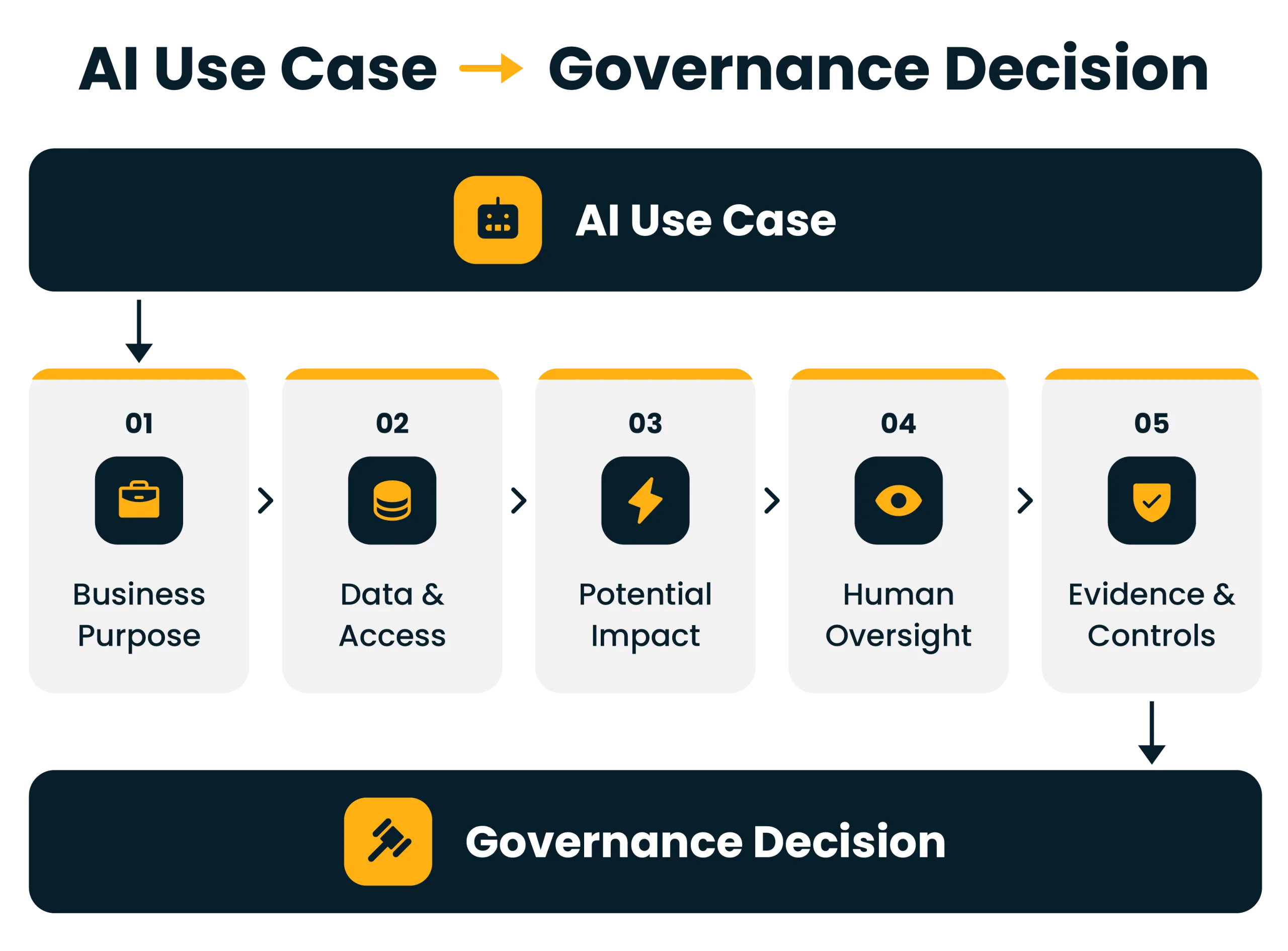
The goal is triage.
Low-risk internal productivity tools may move through a standard review path. Higher-risk applications should receive deeper scrutiny when they influence customers, employees, regulated decisions, financial reporting, safety, legal obligations, or sensitive data.
Review the full system. Retrieval sources, prompts, APIs, permissions, moderation, logging, and human review all affect the final risk.
This is where AI use case governance becomes more useful than a simple approved-model list. The same approved model can support one acceptable application and another that requires stricter controls.
Run GenAI Risk Review Against the Real Failure Modes
A GenAI risk review should test how the proposed system can fail in its actual business setting.
Generic checklists help establish coverage, but the review should connect each risk to a concrete consequence. Hallucination matters differently in a brainstorming assistant than in a policy interpretation tool. Data leakage matters differently for public marketing content than for confidential client records.
At minimum, the review should examine:
- Data sensitivity and authorization
- Output accuracy requirements
- Bias and unfair treatment
- Intellectual property exposure
- Prompt injection and unauthorized access
- Traceability of sources and actions
- Human oversight and override paths
- Vendor dependency and model changes
- Record retention and auditability
- Misuse outside the approved purpose
The GenAI governance council should then decide whether each material risk is avoided, reduced through controls, transferred contractually, or accepted by the right owner.
Testing criteria also need to become specific. “The model was tested” says little. Better evidence records the scenarios, thresholds, failures, reviewers, and unresolved issues.
Make Approval Conditional Instead of Permanent
A common governance mistake is treating approval as a permanent yes or no.
Generative AI systems change after launch. Vendors update models. Retrieval content changes. New data sources are connected. User behavior reveals workarounds that were never considered during design.
Approval should therefore be conditional.
A use case might be approved for internal users only, approved with restricted data classes, approved with mandatory human review, approved for a defined period, or approved only after a control is implemented.
This gives approval more precision. It also creates a record of the assumptions behind the decision.
Conditional approval is useful when business value is promising but evidence remains incomplete. The council can define a narrower operating boundary and require further evidence.
Decide What Must Be Monitored After Approval
Enterprise AI governance does not end when a use case enters production. Monitoring should test the assumptions that justified approval.
Measures vary by application, but common signals include output quality, unsupported responses, human overrides, policy violations, unusual access, sensitivedata events, source reliability, and shifts in model behavior.
Ownership matters here. Monitoring without an owner creates dashboards that nobody acts on.
Each approved use case should have:
- A business owner responsible for the outcome
- A technical owner responsible for system behavior
- A defined review cadence
- Thresholds that trigger investigation
- A route for incident escalation
- Criteria for suspension or retirement
A responsible AI committee should review exceptions and patterns across the portfolio rather than rechecking routine metrics for each application.
Set Criteria for Wider Deployment Before the Pilot Ends
Pilots often prove a tool works, but not that the organization can run it safely at scale—across more users, data, and workflows.
Before wider deployment, the GenAI governance council should ask whether the use case has passed four tests.
Value – Is there evidence that the application improves a real business task or decision?
Control – Are required security, data, legal, and operational controls working as designed?
Ownership – Are named teams accountable for performance, incidents, changes, and user support?
Repeatability – Can the approved configuration, controls, testing, and monitoring be reproduced across additional environments or business units?
This is the point where AI use case governance becomes a portfolio discipline. The council should compare use cases, identify reusable controls, retire weak experiments, and direct investment toward stronger applications.
A second risk review may also be required when user groups, data categories, geography, autonomy, or business consequences materially change. Expansion changes the risk profile, even when the underlying model stays the same.
What Good Enterprise AI Governance Looks Like in Practice
A mature governance model is easy to recognize because teams know what happens next.
Requests enter through one intake path. Risk level determines the review depth. Decision owners are known in advance. Conditions are recorded. Evidence is retained. Production monitoring feeds back into governance. Material changes trigger reassessment.
The GenAI governance council becomes most useful when it reduces ambiguity rather than adding ceremony.
Strong AI governance decision rights also keep senior leaders focused on decisions that genuinely require senior authority. Routine approvals can move through predefined controls, while sensitive or novel cases receive deeper scrutiny.
The result is a governance system that can support faster decisions because boundaries are clearer.
Governance Should Make AI Decisions Easier to Defend
The real test is not how many AI policies the organization publishes. It is whether the organization can explain why an AI use case was approved, which risks were considered, who accepted the remaining exposure, what controls were required, and what would cause the decision to be revisited.
That standard changes governance from an advisory conversation into an operating discipline.
Effective enterprise AI governance connects business purpose, technical design, risk ownership, approval evidence, and production monitoring — the operating model that a well-structured enterprise AI strategy roadmap puts in place before use cases reach production scale. It gives teams room to build while making accountability visible.
For enterprises moving beyond isolated experiments, the strongest governance question is simple: can each AI decision still be defended six months after it was made?
Author


Yogita Jain
Content Lead
Yogita Jain leads with storytelling and Insightful content that connects with the audiences. She’s the voice behind the brand’s digital presence, translating complex tech like cloud modernization and enterprise AI into narratives that spark interest and drive action. With a diverse of experience across IT and digital transformation, Yogita blends strategic thinking with editorial craft, shaping content that’s sharp, relevant, and grounded in real business outcomes. At Cygnet, she’s not just building content pipelines; she’s building conversations that matter to clients, partners, and decision-makers alike.