



































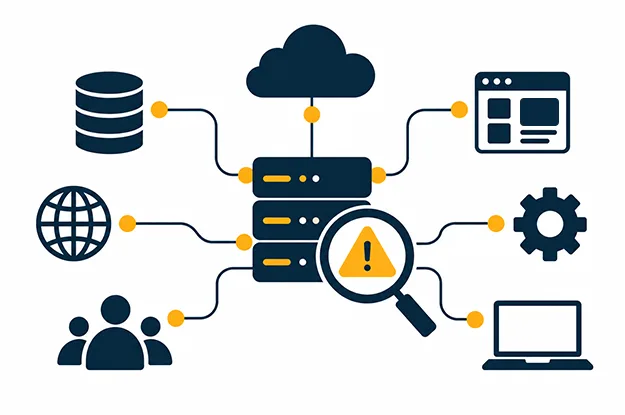
A customer order can pass every application check and still fail to reach the warehouse. The database is available, and the dashboard remains green. Yet a partner integration cannot authenticate, leaving an outbound queue stuck. Fulfillment discovers the problem hours later.
This is the gap that service dependency mapping needs to close. A useful map follows a business outcome through its required handoffs, including failures that escape infrastructure alerts.
The external boundary deserves particular attention. Uptime Institute’s 2026 outage analysis found that third-party IT and data center providers accounted for about two-thirds of publicly reported outages over nine years of tracking. The finding concerns publicly reported events, not all enterprise incidents, but highlights external operational exposure.
For managed IT services, IT service visibility begins with a harder question than whether individual components are healthy: can the intended work still finish?
Why Hidden Dependencies Turn Small Faults Into Service Incidents
Asset inventories can support ticket ownership while leaving the conditions for business completion unclear. An application may have an owner, a hosting location, and an uptime target, while the integration that determines whether its output reaches another team remains undocumented.
Hidden dependencies tend to surface as:
- Direct failure: A login provider, database connection, or network route becomes unavailable and interrupts a transaction immediately.
- Delayed failure: Messages remain in a queue, a scheduled job misses its window, or an export stops updating. The user-facing application continues to respond.
- Conditional failure: A backup authentication route, certificate renewal process, or exception approval becomes important only during a change or disruption.
These patterns can mislead responders. The first alarm may identify the component that noticed trouble, rather than the one that caused it. A reporting job might fail because its source feed stopped hours earlier. Without the dependency path, triage starts with the wrong owner.
Delayed and conditional failures deserve scrutiny. A month-end reconciliation or overnight supplier interface may remain broken until its deadline passes.
IT service visibility requires proof of completion. An API response alone cannot confirm that downstream records were processed.
Map the Business Transaction Before the Technology Stack
Start service dependency mapping with a business action and a clear finish line. Checkout is an intermediate event. An order is complete when the warehouse can act on it.
Trace identity, storefront, payment, order database, message broker, ERP, integration gateway, logistics partner, and warehouse confirmation. Include the people who authorize exceptions or restart transfers. Their decisions affect recovery time.
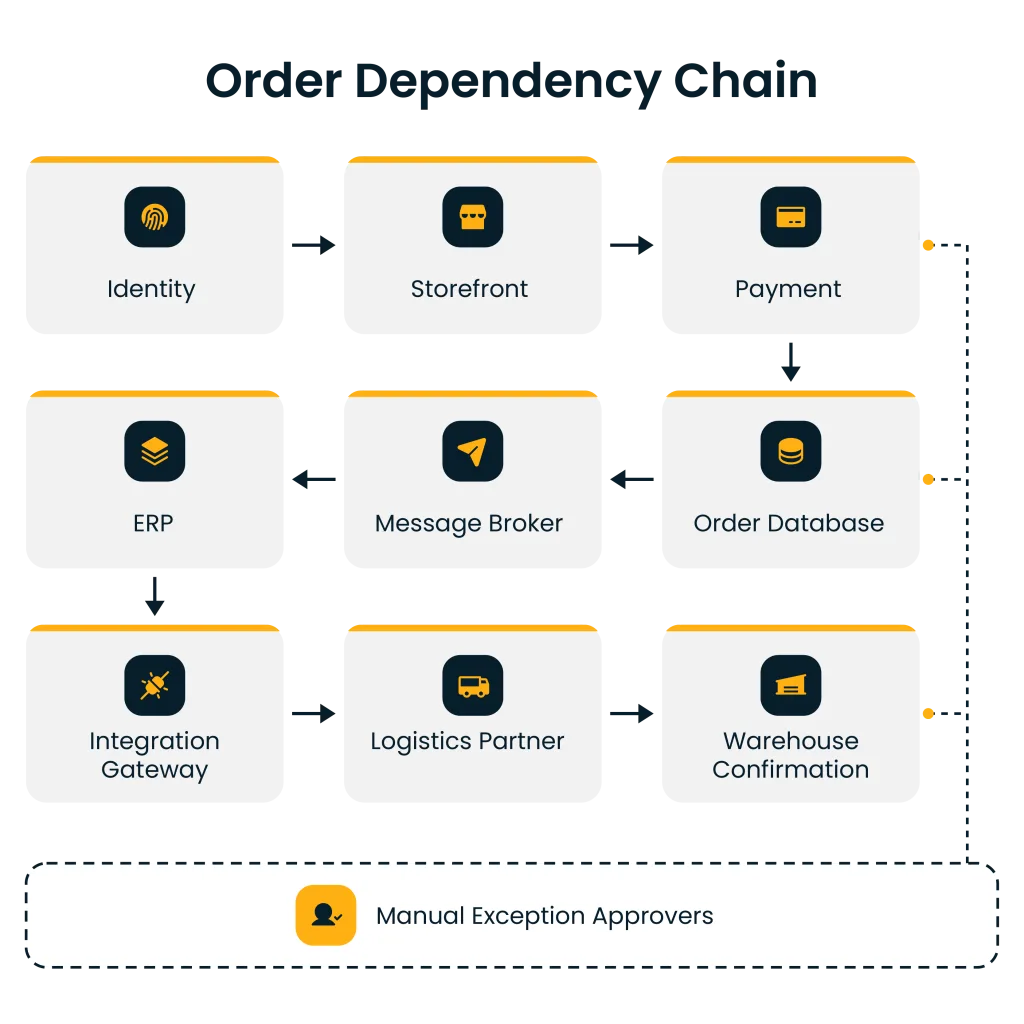
Application dependency mapping can identify which services exchange requests. Add the expected result, verification method, and failure consequence.
Each handoff also needs a business deadline. An order export due before warehouse dispatch has a different tolerance from a customer profile synchronization. Capturing that distinction keeps teams from assigning the same severity to very different interruptions.
| Dependency layer | Common blind spot | Evidence worth checking |
| Application and data | Successful API call without downstream completion | Transaction IDs and end-to-end reconciliation |
| Network and identity | DNS, certificates, service accounts, partner allowlists | Authentication failures and connection paths |
| Asynchronous integrations | Queues, scheduled exports, batch cutoffs | Message age, job status, missing confirmations |
| Vendors and partners | External change windows and support boundaries | Contract contacts, status feeds, escalation paths |
| Users and operations | Manual approvals and exception handling | Role ownership, handover steps, tested workarounds |
This view makes IT service visibility more useful during incident triage. Responders can follow the transaction stage that stopped progressing.
Identify the Dependencies That Infrastructure Inventories Miss
Infrastructure dependency risks frequently sit outside the server, storage, and network inventory, making IT infrastructure management important for mapping shared services, identity, vendors, jobs, and human handoffs. A configuration management database cannot explain every failure path.
Identity is a good example. A service can keep running while a token issuer, federation trust, or privileged service account prevents new sessions. Emergency access may depend on the identity system that failed.
Vendor integrations create a different problem. A partner API may pass a connectivity check while rejecting transactions after a validation change.
Dependency reviews should also examine:
- Shared services: DNS, secrets management, time synchronization, and common databases used by otherwise separate applications.
- Scheduled work: Overnight extracts, certificate renewals, settlement files, and jobs that have no regular user traffic.
- Human handoffs: Approvals, vendor callouts, and specialist-only recovery procedures that can delay restoration.
Service dependency mapping must show where failure crosses ownership boundaries. Each handoff needs a responsible team or provider.
Turn Dependency Links Into a Practical Risk Review
A line between two boxes does not reveal the risk of their connection. Describe its direction, necessity, failure effect, and detection signal.
Service dependency mapping becomes more valuable when links are classified by their effect on the service. A payment authorization is a hard dependency for completing a purchase. A recommendation engine may be optional. A warehouse update might tolerate a short delay but become business-critical when dispatch closes.
Prioritize infrastructure dependency risks using deadlines, available workarounds, data consistency, and recovery ownership.
Test whether the fallback shares the original failure point. A secondary connection using the same identity provider cannot mitigate its outage. An alternate vendor endpoint may share the same network route.
Recovery authority needs its own entry. A provider may operate an integration yet lack permission to replay failed financial transactions. Separating approval rights from technical ownership reveals a potential delay that conventional infrastructure diagrams rarely capture.
Record actionable findings: an unmonitored queue, missing partner contact, or recovery step blocked by unavailable access. Assign these to change or remediation work.
Validate Service Maps Against What Actually Runs
Automated diagrams help, but tracing tools generally show only observed interactions. A monthly batch job, an uninstrumented vendor system, or an approval completed outside the application may be absent from the picture.
Automated discovery tools can identify communication between applications, databases, and infrastructure components. However, they may miss scheduled integrations, external vendor dependencies, and manual processes. Managed IT teams need to verify these relationships using configuration records, operational documentation, and inputs from service owners.
A managed services service map should combine runtime traces, network flow records, configuration data, change tickets, integration schedules, and interviews with service owners. If an allegedly retired server still carries traffic, investigate before removing it.
Validate with a controlled transaction. Follow it through downstream acknowledgement, compare the documented path, and flag unverified steps.
Map freshness should depend on evidence, not only an edited date. A connection verified by yesterday’s transaction deserves more confidence than one copied from a migration design. Mark each critical link as observed, owner-confirmed, or unverified.
Better IT service visibility comes from identifying uncertain links instead of treating discovered connections as complete or current.
Monitor Transaction Progress Across Service Boundaries
CPU, memory, latency, and host availability cannot confirm that cross-system work finished.
For business service monitoring, the most useful signals often sit at handoffs, where cloud operations and optimization can help connect queue age, missed batch completion, rejected partner messages, failed token exchanges, and final confirmation. They show actual progress.
Consider an order interface that is healthy at the API layer but has a growing queue of unprocessed messages. An alert on queue depth alone may generate noise during normal bursts. An alert combining message age with missed downstream acknowledgements gives the responder a clearer reason to investigate.
Missing activity can be a stronger warning than a recorded error. If a supplier sends a file each morning, silence after the agreed cutoff deserves an alert. Monitoring should confirm the file arrived, passed validation, and entered the receiving process.
IT incident prevention improves when alerts also contain context from the dependency map. A responder should see the affected business activity, likely downstream systems, recent changes, and the owner of the next handoff. This supports targeted response.
IT service visibility should ultimately help teams separate a service that is slow, a service that is degraded, and a service that has stopped completing work. Each needs a different response.
Build Recovery Plans Around the Order of Dependencies
Recovery should start with the transaction that must resume. Restoring a database before restoring an upstream identity service may be correct technically, yet users could remain unable to log in. Restarting consumers before fixing a rejected partner endpoint could flood the queue with repeated failures.
Service dependency mapping makes recovery sequencing explicit. Document the minimum components, restart order, and completion evidence for each critical path.
Plans should answer specific operational questions. Can new orders be accepted while warehouse transmission is unavailable? Is the backlog retained without duplication? Who authorizes a temporary manual process? How will teams reconcile records once the partner connection returns?
Limited operation is sometimes safer than total shutdown, provided the business has approved it. The plan should specify which functions can continue, which transactions must pause, and who can authorize normal processing once the dependency returns.
This is where business service monitoring also supports recovery. Verify recovery when transactions complete and backlogs are reconciled.
Test the failure of an integration or shared service. Check whether the team can identify the affected business process, reach the correct vendor, and execute the recovery sequence without undocumented access or assumptions.
Keep the Map Current Through Managed IT Operations
A service map loses value quietly. An application owner changes, a vendor introduces a new endpoint, or an integration moves from real-time processing to a nightly job. Old maps can look deceptively familiar.
IT strategy and consulting can address this through a recurring ownership and evidence review that connects service maps, owners, dependencies, and recovery expectations. The managed services service map should be updated when relevant changes are approved, incidents expose missing dependencies, vendors revise interfaces, or recovery tests reveal unexpected behavior.
A manageable review cadence includes several practical checks:
- Change review: Identify downstream business services before modifying shared components, credentials, routing, or integration rules.
- Incident review: Add newly discovered connections and correct mistaken assumptions about impact or ownership.
- Service review: Recheck critical paths, aged map entries, unresolved ownership, and alerts that failed to identify stalled work.
- Recovery exercise: Verify escalation contacts, restoration order, manual steps, and evidence of successful business completion.
A diagram owner maintains records. A service owner decides acceptable delay, availability, and business impact. Managed IT teams need both roles to maintain reliable IT service visibility.
Providers should connect maps with incident, change, problem, and vendor management. Daily operational use makes IT service visibility dependable and gives owners a reason to keep maps accurate.
Make Hidden Dependencies Part of Everyday Service Decisions
The value of service dependency mapping appears before an outage, when a proposed change exposes an overlooked dependency, and during recovery, when responders know which handoff to restore first.
Organizations should begin with a few business-critical transactions, validate their complete paths, and rank missing controls by the work they could interrupt. IT incident prevention then becomes more concrete: monitor the handoffs, test the recovery sequence, and assign ownership where responsibility crosses systems or suppliers to reduce IT downtime before hidden dependencies become outages.
Better maps shorten the distance between a technical signal and a business decision. They show what stopped, who acts, and how to verify recovery.
Author


Yogita Jain
Content Lead
Yogita Jain leads with storytelling and Insightful content that connects with the audiences. She’s the voice behind the brand’s digital presence, translating complex tech like cloud modernization and enterprise AI into narratives that spark interest and drive action. With a diverse of experience across IT and digital transformation, Yogita blends strategic thinking with editorial craft, shaping content that’s sharp, relevant, and grounded in real business outcomes. At Cygnet, she’s not just building content pipelines; she’s building conversations that matter to clients, partners, and decision-makers alike.