



































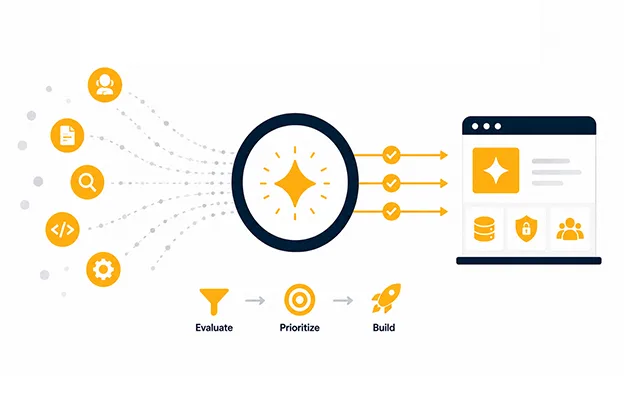
The first GenAI build creates a precedent. It tells finance what returns count, security what risk will be tolerated, data teams which sources must be governed, and employees how much confidence to place in the program. A disciplined first choice makes the next decision easier.
That is why generative AI use case prioritization deserves more attention than idea generation, especially when enterprises are evaluating generative AI use cases for measurable business value. Most enterprises already have long lists of possible applications, from knowledge assistants and service copilots to document review and workflow agents. The harder question is which one deserves committed funding first.
IBM’s 2025 CEO Study gives this problem useful context. Surveyed CEOs reported that only 25% of AI initiatives had delivered expected ROI over the previous few years, while only 16% had scaled enterprise wide. The findings point to a clear need for stronger criteria when deciding which AI use cases should receive further investment.
A credible GenAI strategy needs a portfolio rule: prioritize the use case that can create meaningful business evidence with an acceptable amount of uncertainty, operating change, risk, and cost.
Why Does Generative AI Use Case Selection Matter?
Enterprises often rank ideas too early. Teams assign value and feasibility scores, and the highest total becomes the pilot. The scores may still hide unresolved questions about data rights, review effort, user behavior, integration work, or correction cost.
Good generative AI use case prioritization asks: what must be true for this use case to produce value in a real workflow?
A customer-support assistant may appear attractive because ticket volume is high. Its priority depends on whether the knowledge base is current, responses can be grounded, errors can be detected, and agents will use it inside their existing process.
Google Cloud’s current guidance similarly starts with measurable business goals, success criteria, user expectations, constraints, and required process changes before selecting the AI approach. It also recommends checking whether the problem requires generative AI at all.
This is where enterprise GenAI use cases should move from idea lists to decision records. Each candidate needs an owner, a measurable outcome, a known user group, an evidence source, and a defined operating boundary.
Start With a Gate Before You Score Any Use Case
A scoring model works only after obvious blockers are exposed, especially because AI adoption challenges often begin with unclear ownership, data readiness gaps, and weak workflow fit. Otherwise, a high business-value score can hide a condition that should stop the project.
Before applying an AI value feasibility matrix, run each candidate through five gates:
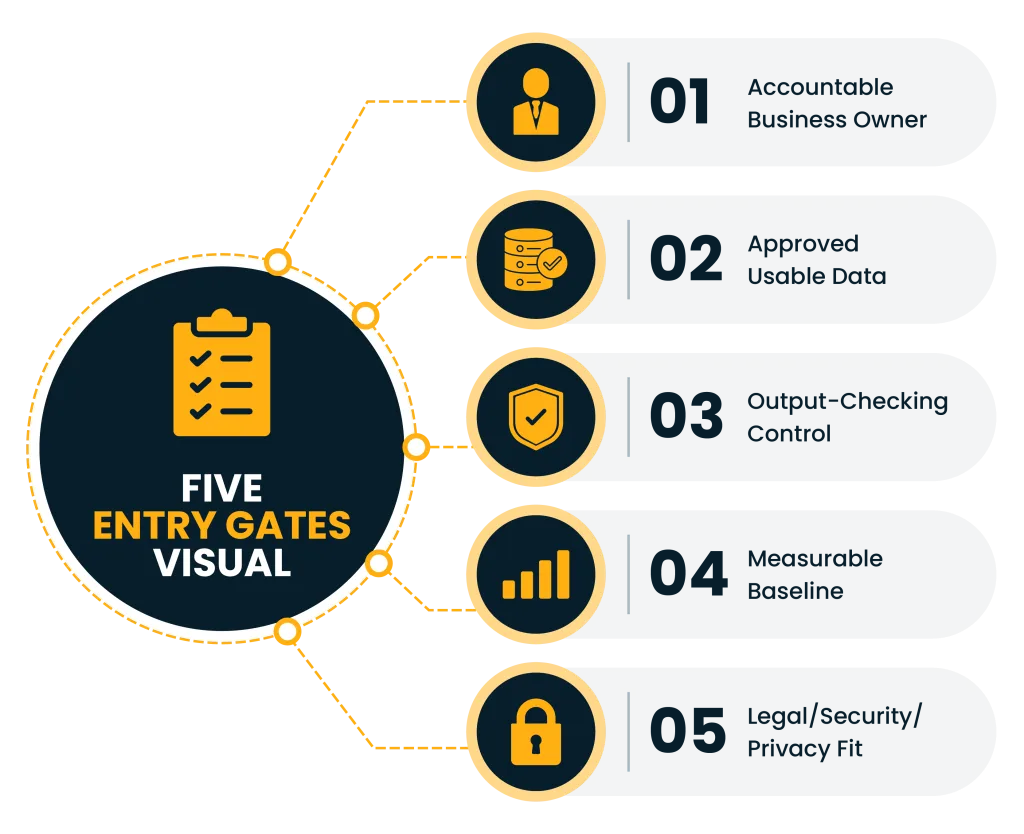
- Is there a named business owner accountable for the outcome?
- Is the required data available, usable, and approved for this purpose?
- Can the output be checked with a practical human or automated control?
- Is there a measurable baseline for the process being changed?
- Can the use case operate within current legal, security, privacy, and policy boundaries?
A “no” changes the status of the idea. It moves into dependency resolution before build commitment.
This matters for a GenAI strategy because research work and production work should not compete in the same queue. A promising idea with unresolved data permission is a discovery item. A moderate-value use case with clean data and clear ownership may be the better first production candidate.
What Should Enterprises Score When Prioritizing GenAI Use Cases?
Once a candidate passes the entry gate, score it across six dimensions. The aim is to expose hidden assumptions.
| Dimension | What to test | Evidence that deserves a higher score |
| Business value | Does it change cost, revenue, cycle time, quality, risk exposure, or capacity? | Baseline, target, accountable owner, and a plausible link to the outcome |
| Feasibility | Can it be built with available models, integrations, controls, and skills? | Known architecture pattern, accessible systems, clear evaluation method |
| Data availability | Is the information current, permissioned, findable, and fit for use? | Identified sources, ownership, access path, quality checks |
| Risk | What happens when the system is wrong, incomplete, biased, unsafe, or misused? | Bounded impact, review controls, traceability, escalation path |
| Adoption readiness | Will people use the output where work happens? | Workflow fit, user incentive, manager ownership, feedback route |
| Cost | What will it cost to build, run, evaluate, secure, support, and improve? | Unit economics tied to expected usage and support effort |
The most common scoring mistake is treating value as a broad statement such as “improves productivity.” A stronger generative AI business case identifies the unit of work being changed, such as minutes per service ticket, analyst hours per review, proposal cycle time, or documentation rework.
Cost needs similar discipline. Include evaluation, observability, retrieval infrastructure, security controls, integration maintenance, human review, and exception handling.
AWS makes a related point in its 2025 guidance on project prioritization: responsible AI concerns can increase the actual job size because mitigations require engineering, governance, monitoring, or human oversight. AWS recommends considering these issues during initial prioritization.
That principle belongs inside responsible AI prioritization. Risk changes feasibility, cost, release timing, and sometimes the basic economics of the idea.
How Do You Build AI Value and Feasibility Prioritization Framework?
A practical framework should make trade-offs visible without pretending all criteria are equal. Start with a 1-to-5 score for each dimension, then assign weights based on enterprise priorities. A regulated financial workflow may give risk and data readiness more weight than an internal content assistant.
| Criterion | Suggested weight | What a score of 5 means |
| Business value | 25% | Material, measurable outcome tied to a priority process |
| Feasibility | 20% | Known build pattern with limited technical uncertainty |
| Data availability | 15% | Approved, accessible, current data with clear ownership |
| Risk readiness | 15% | Risks are bounded and practical controls are defined |
| Adoption readiness | 15% | Users, workflow, incentives, and ownership are clear |
| Cost efficiency | 10% | Expected value is credible relative to full operating cost |
This AI value feasibility matrix is a comparison device rather than an approval mechanism. A candidate can receive a high weighted score and still fail a mandatory gate.
Add one more field: confidence. Tag every score as proven, evidenced, estimated, or assumed. Two use cases may both score 4.2, yet one may be backed by production data while the other rests on estimates. Their priorities should differ.
A useful decision rule for generative AI use case prioritization is:
Priority = weighted attractiveness × evidence confidence, subject to mandatory gates.
The formula prevents weak assumptions from looking equal to measured facts.
How Should Data Availability Change Priority?
Data readiness deserves its own decision because generative AI often depends on poorly prepared information, making data governance essential before enterprise AI use cases are prioritized for production.
A knowledge assistant may require policies, manuals, ticket history, contracts, and internal guidance. Access alone proves little. Teams still need the authoritative version, content owner, permission rules, and a way to correct stale material.
This is one reason GenAI strategy should connect use-case selection with data governance. Data work created for one priority use case can help later candidates if sources, permissions, retrieval patterns, and ownership are reusable.
A GenAI adoption roadmap should show data dependencies alongside application milestones. If three candidates depend on the same ungoverned content domain, preparing that domain may deserve priority before any of the applications.
How Should Risk and Human Review Affect the Ranking?
Risk should be scored as operating burden rather than a vague red-yellow-green label.
Ask what happens after a wrong answer. A meeting-summary error may be cheap to correct. An error influencing credit, medical guidance, employment, legal interpretation, or a financial commitment carries a very different control burden.
NIST’s Generative AI Profile is designed to help organizations incorporate trustworthiness considerations across design, development, use, and evaluation. Its structure supports a lifecycle view of risk rather than a single pre-release check.
That makes responsible AI prioritization a sequencing issue. Higher-risk ideas may still deserve investment, though they may require more preparation, narrower scope, stronger evaluation, or a human decision point before production use.
A sound GenAI strategy also distinguishes assistance from authority. The closer a system gets to taking consequential action without review, the more evidence should be required before it moves ahead.
Why Adoption Readiness Can Change the Winner
A technically strong application can fail quietly when it sits outside the user’s normal work.
Adoption readiness should test behavior, not training attendance. Where will the output appear? What task does it shorten? Who checks it? What happens when the user disagrees? Does it add another screen or approval step?
These questions matter because many enterprise GenAI use cases create value only when people change how work moves.
For that reason, the generative AI business case should include the cost of workflow change and the value lost when adoption is partial. A use case that saves ten minutes in theory but adds five minutes of review, and copy-paste work has a different economic profile.
How Do You Turn Prioritization into a GenAI Adoption Roadmap?
The ranked list should become a sequence of commitments rather than a backlog of promises. This is where a GenAI strategy becomes a funding sequence.
- Commit: High value, passed gates, strong evidence, clear owner.
- Prove: Attractive ideas with one or two assumptions that can be tested cheaply.
- Prepare: Valuable ideas blocked by data, policy, integration, or operating readiness.
- Stop: Weak economics, poor fit, duplicate capability, or unacceptable exposure.
This is where generative AI use case prioritization becomes portfolio management. “Prepare” items receive dependency work. “Prove” items receive time-boxed experiments with explicit pass or stop criteria. “Commit” items receive delivery funding. “Stop” items leave the active queue.
The roadmap should include review points after launch. Priority can change when usage is low, model economics shift; a better platform capability appears, or the business process changes.
A mature GenAI strategy treats stopping as a valid outcome. Continuing a weak use case because a pilot already exists is sunk-cost thinking.
What Should Enterprises Build First?
The first build should create business value and better evidence for the portfolio that follows.
That is the practical standard for generative AI use case prioritization. Start with measurable business importance, then test feasibility, data readiness, risk, adoption, and full cost. Use hard gates before weighted scores. Record confidence separately from attractiveness. Fund dependency work separately from production delivery.
Choose a use case with measurable outcomes, manageable risks, real user demand, and sensible operating cost, supported by Enterprise AI solutions that help move GenAI ideas from prioritization to governed implementation.
A strong GenAI strategy can then answer the executive question: why this use case, why now, and what evidence would make us continue, change direction, or stop?
When those answers are explicit, generative AI use case prioritization becomes a repeatable management discipline rather than a contest between the loudest ideas.
Author


Yogita Jain
Content Lead
Yogita Jain leads with storytelling and Insightful content that connects with the audiences. She’s the voice behind the brand’s digital presence, translating complex tech like cloud modernization and enterprise AI into narratives that spark interest and drive action. With a diverse of experience across IT and digital transformation, Yogita blends strategic thinking with editorial craft, shaping content that’s sharp, relevant, and grounded in real business outcomes. At Cygnet, she’s not just building content pipelines; she’s building conversations that matter to clients, partners, and decision-makers alike.