


































It usually starts with a spreadsheet.
Someone exports CRM data manually because it doesn’t sync with the ERP. Finance re-enters the same numbers elsewhere. Operations waits on a file stuck in someone’s inbox. Nobody flags it because it’s always been this way.
Then you add another tool. And another. Each one promises to simplify work, but without a way to connect them, each one just adds another manual step. Eventually, your team isn’t moving work forward; they’re spending hours shuffling data between systems that should already be talking to each other.
This is exactly the problem API integration services are built to solve.
They connect your enterprise systems so data moves automatically: CRM to ERP, payment to fulfillment, new SaaS tool to existing stack, without manual handoffs or delays. And the scope goes beyond just connecting two endpoints. It covers REST API integration, third-party connections, API management, security, and ongoing monitoring across your whole environment.
This guide breaks down what API integration services include, how enterprise systems connect, and when outside help makes sense.
What Are API Integration Services?
API integration services cover the planning, building, and ongoing management of connections between software systems using APIs (Application Programming Interfaces). For enterprise environments, this typically means working with a specialized IT partner who handles the full scope, from architecture design through post-deployment monitoring.
In practice, it means:
- Your CRM pushes new customer records to your ERP without anyone moving a file
- A payment confirmation triggers a fulfillment workflow without manual input
- A new SaaS tool connects to your existing environment in days, not months
Here is what separates API integration as a managed service from a one-time build:
- It spans multiple systems across your enterprise environment
- It covers the full lifecycle: strategy, architecture, implementation, and ongoing maintenance
- It handles authentication, data mapping, error handling, and security across every connection
- It scales from a single third-party connection to a full enterprise integration architecture
The scope matters because enterprise environments rarely stay static. Systems change, third-party APIs deprecate, and business requirements evolve. A managed integration engagement keeps your connected environment stable as that happens, so your teams are not left troubleshooting broken workflows every time something upstream changes.
How API Integration Services Differ From API Development
API development and API integration services are related but solve different problems.
API development is the process of building new APIs from scratch. It involves creating endpoints, writing business logic, and producing documentation. The output is a new interface that other systems can connect to.
API integration services connect existing APIs across systems. The work involves managing data flow between platforms, handling authentication, orchestrating error recovery, and monitoring performance across a connected environment. The output is a working, maintained ecosystem where your systems communicate reliably.
Some providers handle both. But the scope, deliverables, and ongoing responsibilities are different:
| Aspect | API Development | API Integration Services |
| Focus | Building new APIs | Connecting existing APIs across systems |
| Output | API endpoints, documentation | Connected workflows, synced data |
| Scope | Single application | Cross-system, enterprise-wide |
| Ongoing Need | Versioning, updates | Monitoring, maintenance, optimization |
Types of APIs Used in Enterprise Integration
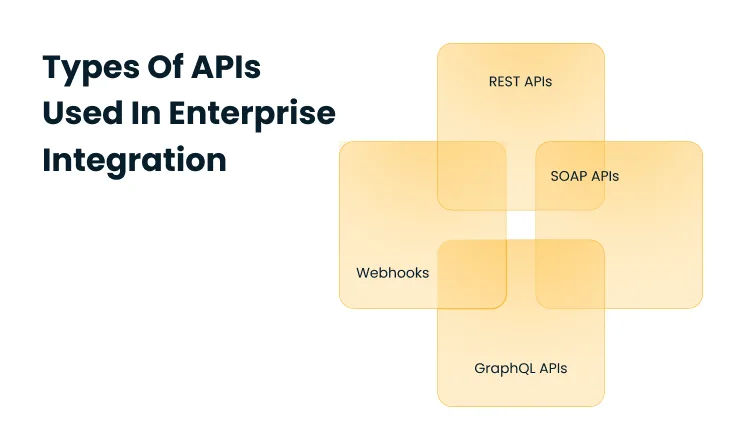
Enterprise integrations rely on four primary API types, each suited to specific data formats, security requirements, and latency tolerances.
REST APIs
Before REST became the standard, enterprise integrations were slow to build, expensive to maintain, and tightly coupled to specific platforms. REST changed that by introducing a lightweight, stateless communication model built on HTTP methods (GET, POST, PUT, DELETE) and JSON payloads. Each request is independent, which simplifies caching, load balancing, and horizontal scaling across distributed systems.
REST APIs are well-documented, widely supported across SaaS platforms, and integrate cleanly with cloud-native infrastructure. Most modern platforms expose REST endpoints by default.
Best for: cloud-native applications, SaaS platforms, mobile backends, and microservices architectures.
SOAP APIs
SOAP (Simple Object Access Protocol) is a protocol-based standard that uses XML messaging and formal WSDL contracts to define exactly how systems communicate. Unlike REST, SOAP enforces a strict message structure and includes built-in WS-Security standards covering encryption, authentication, and message integrity.
This makes SOAP the preferred choice in regulated industries where auditability, non-repudiation, and formal contracts are required. It is also common in legacy enterprise systems that predate REST adoption.
Best for: BFSI, healthcare, government, and enterprise environments where security, compliance, and formal contracts are non-negotiable.
GraphQL APIs
GraphQL is a query language for APIs that lets clients request exactly the data they need from a single endpoint. Unlike REST, which returns fixed response structures, GraphQL resolves queries dynamically, eliminating over-fetching and under-fetching. This makes it particularly effective when multiple clients (web, mobile, partner portals) need different data shapes from the same backend.
In enterprise integration, GraphQL is useful when aggregating data from multiple upstream sources into a single, composable response layer.
Best for: complex data retrieval, multi-source aggregation, product architectures, and frontend-heavy systems with diverse data consumption patterns.
Webhooks
Webhooks are event-driven HTTP callbacks that push data to a destination URL the moment a trigger fires. Unlike polling-based approaches, where a system repeatedly checks for updates, webhooks eliminate unnecessary API calls and reduce latency to near real-time.
In production environments, webhook reliability depends on more than just the trigger. Retry logic, failure alerting, and idempotency handling are critical, since a missed or duplicated event can silently break downstream workflows. Well-implemented webhooks include dead-letter queues or retry policies to handle delivery failures gracefully.
Best for: real-time workflows, event-driven architectures, payment processing, CRM sync, order notifications, and any integration where timing directly affects business outcomes.
| API Type | Protocol | Data Format | Best For |
| REST | HTTP | JSON | Cloud, SaaS, microservices |
| SOAP | SOAP/HTTP | XML | BFSI, healthcare, government, legacy |
| GraphQL | HTTP | JSON | Multi-source queries, product architectures |
| Webhooks | HTTP | JSON/XML | Real-time events, notifications, triggers |
What Do API Integration Services Include?
API integration services cover five core areas, from initial architecture design through post-deployment optimization.
API Strategy and Architecture Design
The wrong architecture decision at the start of an integration project compounds over time. A point-to-point setup that works for three systems becomes unmanageable at ten. An event-driven pattern chosen without schema governance creates data inconsistencies that are expensive to unwind later.
A strategy and architecture engagement prevents that. Providers map the existing system landscape: what platforms are in use, how data currently moves between them, where manual handoffs exist, and where the gaps are. From that audit, they define the integration architecture, selecting the right pattern, determining where APIs sit across the stack, and documenting data flows end to end. Business goals, compliance requirements, and expected system growth are all factored in before a single endpoint is configured.
Custom API Development When Integration Requires It
Not every enterprise use case has a ready-made API. Legacy systems, proprietary platforms, and internal tools often lack the endpoints needed to support a connected architecture. When that happens, custom API development becomes part of the integration scope.
This covers building new endpoints, configuring existing ones for specific data requirements, and managing versioning and documentation so connections stay maintainable as systems evolve. The distinction from standalone product development matters: custom APIs built within an integration engagement are scoped to a specific integration outcome, not built as general-purpose interfaces.
Third-Party API Integration
This covers connecting enterprise systems to external platforms: payment gateways, CRMs, ERPs, marketing automation tools, and cloud services. The work includes data mapping between systems, format transformation between JSON and XML, field-level normalization, and maintaining compatibility as external APIs update or deprecate endpoints.
Third-party integrations are often the most fragile part of an enterprise environment because the provider controls the API. A managed integration engagement includes version monitoring so upstream changes do not silently break connected workflows.
API Security, Gateway Management, and Governance
Security in API integration operates at multiple layers. Authentication protocols, including OAuth 2.0, JWT, and API keys, control who can access what. API gateways handle centralized routing, rate limiting, caching, and logging across all connections. Role-based access controls enforce least-privilege principles across the environment.
Compliance requirements add another layer. HIPAA, PCI-DSS, and GDPR each impose specific constraints on how data moves, where it is stored, and how access is logged. Governance also covers API versioning and deprecation policies, so decommissioning an endpoint does not break dependent systems without warning.
Monitoring, Maintenance, and Optimization
Post-deployment is where most integration projects either hold or fall apart. Continuous monitoring covers uptime, latency, error rates, and throughput across every connected system. Automated alerting catches failures before they cascade downstream and create data gaps that are difficult to trace after the fact.
Optimization is ongoing. API call efficiency, payload sizes, response times, and connection health all degrade over time without active management. Maintenance accounts for third-party API changes, internal system updates, and evolving business requirements that alter how data needs to move.
Common API Integration Patterns in Enterprise Systems
Integration architecture determines how systems connect, how data flows, and how the environment scales over time. Choosing the wrong pattern early is expensive to fix later. Three patterns dominate enterprise deployments.
Point-to-Point Integration
Each system connects directly to another through its API. For one or two integrations, this is the fastest path to a working connection. There is no middleware, no broker, and minimal setup overhead.
The problem surfaces as the environment grows. Every new system added requires a direct connection to every system it needs to talk to, and a change in one system can break multiple connections simultaneously.
Most enterprises inherit point-to-point from earlier decisions that were never revisited, and spend significant IT time maintaining it instead of building new capabilities.
Point-to-point is fast to deploy but becomes increasingly difficult to maintain as the system count grows.
Event-Driven Integration
Event-driven architectures decouple systems by routing communication through a central event bus or message broker. Producers publish events when something happens. Consumers subscribe to the events they care about. Neither side needs direct knowledge of the other.
This model handles high-throughput, real-time workloads well. A payment confirmation, an inventory update, or a logistics status change can propagate across multiple downstream systems simultaneously without any system waiting on another.
Message brokers like Apache Kafka or AWS EventBridge add durability, replay capability, and delivery guarantees that webhooks alone do not provide.
The operational challenge is schema governance. As event volumes grow and more producers and consumers join the environment, inconsistent schemas create silent data errors that are difficult to trace. A schema registry and versioning policy are not optional in production event-driven environments.
Event-driven architecture scales well for real-time use cases but requires disciplined schema governance to prevent downstream data inconsistencies.
API-Led Connectivity
API-led connectivity organizes APIs into three functional tiers, each with a distinct responsibility:
- System APIs connect directly to backend systems: databases, ERPs, legacy infrastructure, and core platforms. They abstract the complexity of the underlying system and expose clean, reusable interfaces.
- Process APIs orchestrate business logic across multiple system APIs. They handle sequencing, transformation, and error handling without exposing backend complexity to consuming applications.
- Experience APIs compose data from one or more process APIs and deliver it in the format each consuming application needs, whether that is a mobile app, web frontend, or partner portal.
This layered model centralizes governance, routing, and access control. Adding a new system means building a system API, not rewiring every existing connection. Platforms like MuleSoft are built around this model, but the architectural principle applies regardless of tooling.
The upfront investment is real. API-led connectivity requires more design work and organizational discipline than point-to-point. For enterprises running complex, multi-system environments, that investment pays back quickly in reduced maintenance overhead and better reuse across teams.
API-led connectivity demands more upfront design effort than other patterns, but delivers significantly better scalability, governance, and reuse over time.
| Pattern | How It Works | Best For | Scalability |
| Point-to-Point | Direct system-to-system connections | 1 to 2 integrations | Low |
| Event-Driven | Publish and subscribe via a message broker | IoT, real-time workflows | High |
| API-Led Connectivity | Three-tier layered architecture | Complex enterprise environments | Very High |
Common Challenges in API Integration
API integration delivers clear operational value, but poorly planned implementations introduce their own risks. These are the most common challenges enterprises encounter:
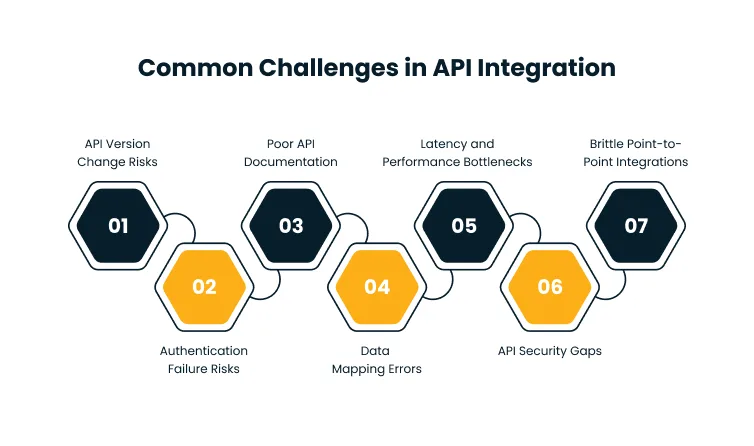
- API version changes breaking integrations: Third-party APIs update or deprecate endpoints without warning. Without active version tracking, downstream systems break silently.
- Authentication failures: Token expiration, mismatched OAuth scopes, or gaps in credential rotation cause intermittent failures that are difficult to diagnose without centralized logging.
- Poor API documentation: Undocumented endpoints, outdated specifications, or inconsistent error codes slow integration work and compound debugging time.
- Data mapping errors: Mismatched field formats, naming conventions, or data types between systems produce sync failures and dirty data that affect downstream reporting.
- Latency and performance bottlenecks: High-volume API calls without rate limiting, caching, or payload optimization degrade performance across connected platforms.
- Security gaps: Unsecured endpoints, weak authentication protocols, or missing encryption expose enterprise data to unauthorized access.
- Brittle point-to-point connections: Direct system integrations become a maintenance burden as connected tools multiply and each change creates cascading dependencies.
Most of these challenges trace to insufficient planning, missing governance structures, or an integration approach that wasn’t designed for scale. A well-defined integration strategy resolves them before they become operational problems.
Benefits of API Integration Services for Enterprises
API integration services shift enterprises from fragmented, manually connected systems to automated, governed, and scalable data flows. The impact spans IT operations, finance, and business functions.
- Automated data exchange: Real-time sync across CRM, ERP, and cloud platforms eliminates manual intervention and data lag
- Faster onboarding of new tools: Structured architecture and pre-built connectors reduce time-to-connect when adding new systems or platforms
- Consistent security posture: Centralized authentication and governance policies apply uniformly across all API connections, reducing compliance exposure
- Lower maintenance overhead: Provider-managed monitoring and optimization frees internal IT from reactive integration support
- Scalable architecture: Well-designed integration grows with the business, and adding new systems doesn’t require rebuilding existing connections
- Visibility into data movement: Centralized logging and monitoring make API performance auditable and traceable across the enterprise
The combined result: fewer errors, faster decisions, and lower integration operating costs. Enterprise integration partners like Cygnet.One delivers these outcomes through structured integration architecture, proactive API management, and governance built for enterprise scale.
When Do Enterprises Need API Integration Services?
Signals You Need API Integration Services
External integration support is warranted when internal capacity or complexity has exceeded what in-house teams can manage effectively:
- You manage more than 5–10 SaaS or cloud tools that don’t share data natively
- Manual data transfers like exports, imports, and copy-paste workflows consume team hours weekly
- Internal IT spends more time maintaining existing integrations than building new capabilities
- A system migration or digital transformation requires connecting legacy and modern platforms simultaneously
- Compliance or data governance requirements have outpaced your current integration infrastructure
- Brittle connections are causing downstream data failures or operational delays
When external services may not yet be necessary:
- You have only 1–2 simple integrations covered by available pre-built connectors
- Standard iPaaS tools meet your needs without customization
- Your internal team has the integration engineering expertise and bandwidth to manage it in-house
What to Look For in a Provider
Not every integration provider delivers the same depth. A few specific capabilities separate a partner who builds something durable from one who hands off a fragile setup.
- Architectural range is the first signal. Look for demonstrated experience across API-led, event-driven, and hybrid cloud architectures, and the ability to recommend the right pattern based on your environment rather than their preferred tooling.
- Security and compliance maturity matter more in regulated industries, but applies everywhere. OAuth 2.0, JWT, RBAC, and encryption at rest and in transit are baseline requirements. If your environment touches healthcare, financial services, or customer data, verify direct experience with HIPAA, PCI-DSS, and GDPR, not just familiarity with the frameworks.
- Platform and protocol coverage determine whether a provider can work across your actual stack. REST, SOAP, and GraphQL support should be standard, alongside hands-on experience with AWS, Azure, Salesforce, and SAP.
- Post-deployment ownership is where many integrations fail quietly. Monitoring, alerting, and proactive optimization should be part of the engagement, not an optional add-on after go-live.
- SLA transparency and scalability track record close the evaluation. Uptime guarantees, response times, and escalation paths should be defined before the engagement starts. Ask whether the provider has supported environments that grew over time, across new systems, new regions, or expanded business units.
- The right provider does not just connect your systems. They build an environment that stays connected as your business changes.
See how Cygnet.One structures API integration engagements, from architecture design through long-term API management.
Conclusion
API integration services are the operational backbone of connected enterprises. They determine how systems communicate, how data moves, and whether your technology investments deliver compound value or compound complexity.
The right approach depends on integration complexity, architecture maturity, and long-term system goals. For enterprises managing dozens of applications across legacy and cloud environments, a managed integration partner brings the architecture expertise, security discipline, and operational continuity that internal teams rarely sustain at scale.
If your systems are more disconnected than connected, that gap has a direct cost: in hours, in data errors, in decisions made on stale information. Talk to Cygnet.One about what a structured integration approach looks like for your environment.
FAQs
ETL (Extract, Transform, Load) moves data in scheduled batches, typically into a data warehouse. API integration connects systems in real time, exchanging data based on live events or requests. ETL is suited for bulk historical loads. API integration is better for live, bidirectional system communication where timing matters.
iPaaS (Integration Platform as a Service) is a software tool, like MuleSoft, Boomi, or Zapier, that provides connectors, workflow builders, and a visual interface for setting up integrations. API integration services are the professional engagement that plans, builds, and manages those integrations, often using iPaaS platforms as part of the delivery. iPaaS is a product. API integration services are the expertise that makes it work at an enterprise scale.
Simple integrations between two systems with available APIs generally take two to four weeks. Complex projects involving legacy systems, custom API development, or multi-system architecture design typically run three to six months. Ongoing monitoring and maintenance continue after the initial build is complete.
Third-party providers update endpoints, change authentication methods, or shut down APIs, sometimes with limited notice. A managed integration environment includes version monitoring and automated alerts for breaking changes, along with a defined process for updating affected connections. Without that, a single upstream change can silently stop data from moving until someone notices something is missing.
Low-code tools like Zapier or Make work well for simple, linear workflows between popular SaaS apps. They run into limits when integrations involve legacy systems, custom authentication, complex data transformations, high transaction volumes, or strict compliance requirements. Enterprise API integration typically requires custom logic, performance configuration, and security controls that low-code platforms don’t support.
Author


Abhishek Nandan
AVP, Marketing
Abhishek Nandan is the AVP of Services Marketing at Cygnet.One, where he drives global marketing strategy and execution. With nearly a decade of experience across growth hacking, digital, and performance marketing, he has built high-impact teams, delivered measurable pipeline growth, and strengthened partner ecosystems. Abhishek is known for his data-driven approach, deep expertise in marketing automation, and passion for mentoring the next generation of marketers.