

































• Cygnet IRP
  • Glib.ai
  • IFSCA
Cygnet.One
  • About
  • Products
  • Solutions
  • Services
  • Partners
  • Resources
Generic selectors
Exact matches only
Search in title
Search in content
Post Type Selectors
Get Started
About
  • Overview

    A promise of limitless possibilities

  • We are Cygnet

    Together, we cultivate an environment of collaboration

  • Careers

    Join Our Dynamic Team: Careers at Cygnet

  • CSR

    Impacting Communities, Enriching Lives

  • In the News

    Catch up on the latest news and updates from Cygnet

  • Contact Us

    Connect with our teams across the globe

What’s new

chatgpt

Our Journey to CMMI Level 5 Appraisal for Development and Service Model

Full Story

chatgpt

ChatGPT: Raising the Standards of Conversational AI in Finance and Healthcare Space

Full Story

Products
  • Cygnet Tax
    • Cygnet Tax
    • e-Invoicing / Real time reportingIRP-integrated e-Invoicing with real-time validation
    • e-Way Bills / Road permitsGST-compliant centralized e-Way Bill platform for scalable operations
    • Direct Tax ComplianceAccurate direct tax compliance, filings, litigation, and assessments
    • Indirect Tax ComplianceEnterprise-grade platform for indirect tax compliance
      • Indirect Tax Compliance
      • GST Compliance India
      • VAT Compliance EU
      • VAT Compliance ME
    • Managed ServicesEnd-to-end indirect tax compliance support by experts
  • Global e-Invoicing
    • Global e-Invoicing
    • APAC
      • India
      • Malaysia
      • Singapore
      • Japan
    • Africa
      • Egypt
      • Kenya
      • Zambia
      • Nigeria
    • Europe
      • Spain
      • France
      • Germany
      • Poland
      • Belgium
    • Oceania
      • Australia
      • New Zealand
    • Middle East
      • UAE
      • Oman
      • Saudi Arabia
      • Bahrain
      • Qatar
      • Jordan
  • Cygnet Vendor Postbox
    • Cygnet Vendor PostboxDigitize purchase invoice validation & posting to ERPs & maximize ITC
  • Finance Transformation
    • Finance Transformation
    • Cygnet FinalyzeUnlock working capital with data-driven invoice-based credit decisions
    • Bank Statement AnalysisEvaluate company health by analyzing performance and financial risk
    • Financial Statement AnalysisAssess company performance and risk with financial statement analysis
    • GST Business Intelligence Report360-degree financial health insights using GST data analytics
    • GST Return Compliance ScoreGST-based compliance score to assess business risk and credibility
    • ITR AnalysisAssess creditworthiness and lending risk using ITR filing analysis
    • Invoice Verification for Trade FinanceVerify invoices to reduce fraud and improve credit decisions
    • Account Aggregator – Technology Service Provider (AA-TSP)Onboard to the Account Aggregator ecosystem with FIP & FIU modules
  • Cygnet BridgeFlow
    • Cygnet BridgeFlowAutomated digital onboarding with real-time validations and compliance
  • Cygnet Bills
    • Cygnet BillsGST-compliant centralized e-Way Bill platform for scalable operations
  • Cygnet IRP
    • Cygnet IRPIRP-integrated e-Invoicing with real-time validation
  • Cygnature
    • CygnatureSecure, compliant digital signing with audit-ready traceability

What’s new

e-Invoicing compliance Timeline

Know More →

UAE e-Invoicing: The Complete Guide to Compliance and Future Readiness

Read More →

Types of Vendor Verification and When to Use Them

Read More →

Safeguard Your Business with Vendor Validation before Onboarding

Read More →

Modernizing Dealer/Distributor & Customer Onboarding with BridgeFlow

Read More →

Accelerate Vendor Onboarding with BridgeFlow

Read More →

GST Filing 360°: GST, E-Invoicing, E-Way Bills & Annual Returns Made Simple

Read More →

Why Manual Tax Determination Fails for High-Volume, Multi-Country Transactions

Read More →

GST Filing 360°: GST, E-Invoicing, E-Way Bills & Annual Returns Made Simple

Read More →

Key Features of an Invoice Management System Every Business Should Know

Read More →

Automating the Shipping Bill & Bill of Entry Invoice Operations for a Leading Construction Company

Read More →

From Manual to Massive: How Enterprises Are Automating Invoice Signing at Scale

Know More →

Solutions
  • HireAI
  • Agent as a Service
  • AI-powered Voice Assistant
  • Generative AI Workshop
  • TestingWhiz
  • VIPRE

What’s new

AI powered Interviewer

AI-Powered Interviewing Helped an Education Group Reduce Hiring Time Significantly

Know More

Generative AI ebook

Navigating the Generative AI Landscape

Download eBook

Services
  • Data Analytics & AI
    • Data Analytics & AI
    • Data Engineering and ManagementData engineering and management for smart, scalable systems
    • Data Migration and ModernizationData migration and modernization for future-ready platforms
    • Insights Driven Business TransformationInsight-driven business transformation for faster decisions
    • Business Analytics and Embedded AIBusiness analytics and embedded AI for data-led growth
  • Digital Engineering
    • Digital Engineering
    • Technical Due DiligenceEnabling smarter decisions through future-ready digital ecosystems
    • Product EngineeringEngineering impactful digital products that elevate business growth
    • HyperautomationSmarter hyperautomation using low-code for agile business processes
    • Enterprise IntegrationIntegrating enterprise systems for seamless operations and growth
    • Application ModernizationModernizing IT ecosystems with scalable, AI-driven innovation
  • Quality Engineering
    • Quality Engineering
    • Test Consulting & Maturity AssessmentTest consulting and maturity assessments for reliable software QA
    • Business Assurance TestingBusiness assurance testing aligned with real business outcomes
    • Enterprise Application & Software TestingEnterprise application testing for continuity and scale
    • Data Transformation TestingData transformation testing for scalable, trusted data quality
  • Cloud Engineering
    • Cloud Engineering
    • Cloud Strategy and DesignCloud strategy and design services for secure, scalable growth
    • Cloud Migration & ModernizationORBIT: a proven framework for measurable cloud transformation
    • Cloud Native DevelopmentCloud-native development for resilient, scalable innovation
    • Cloud Operations and OptimizationCloud optimization and operations for enterprise resilience
    • Cloud for AI FirstAI-first cloud transformation for smarter, scalable enterprises
  • Managed IT Services
    • Managed IT Services
    • IT Strategy and ConsultingStrategic IT consulting to align technology with business goals
    • Application Managed Services24/7 managed application services for performance and security
    • Infrastructure Managed ServicesEnd-to-end infrastructure management for resilient IT operations
    • CybersecurityComprehensive cybersecurity solutions to protect business assets
    • Governance, Risk Management & ComplianceGRC solutions to manage risk, compliance, and governance
  • Cygnet TaxAssurance
    • Cygnet TaxAssurance
    • Tax DatalakeUnified tax data lake for intelligent, compliant decision-making
    • Tax InfraDigital tax infrastructure for efficient, compliant transformation
  • Amazon Web Services
    • Amazon Web Services
    • Migration and ModernizationMake Your Move to the Cloud With AWS Smarter & Faster
    • Generative AIRun your Gen AI workloads on AWS with full control

What’s new

AI-Powered Voice Assistant for Smarter Search Experiences

Explore More →

Cygnet.One’s GenAI Ideation Workshop

Know More →

Our Journey to CMMI Level 5 Appraisal for Development and Service Model

Read More →

Extend your team with vetted talent for cloud, data, and product work

Explore More →

Enterprise Application Testing Services: What to Expect

Read More →

Future-Proof Your Enterprise with AI-First Quality Engineering

Read More →

Cloud Modernization Enabled HDFC to Cut Storage Costs & Recovery Time

Know More →

Cloud-Native Scalability & Release Agility for a Leading AMC

Know More →

AWS workload optimization & cost management for sustainable growth

Know More →

Cloud Cost Optimization Strategies for 2026: Best Practices to Follow

Read More →

Cygnet.One’s GenAI Ideation Workshop

Explore More →

Practical Approaches to Migration with AWS: A Cygnet.One Guide

Know More →

Tax Governance Frameworks for Enterprises

Read More →

Cygnet Launches TaxAssurance: A Step Towards Certainty in Tax Management

Read More →

Partners
  • Cygnet Elevate Global Partner Program
  • Products Partner Program

Partner Program

Cygnet Elevate Global Partner Program

Cygnet Elevate Global Partner Program

Strategic Services Partner Program

A partner program built for services businesses to collaborate, expand offerings, and drive shared growth with Cygnet. Tap into shared expertise, go-to-market support, and long-term value creation.

Know more→

Products Partner Program

Products Partner Program

Co-create value through our global SaaS products.

Partner with Cygnet.One, a global leader in AI-powered compliance, tax, e-Invoicing, and automation solutions. Deliver seamless digital experiences, enable client success, and scale across markets with a future-ready platform.

Know more→

Resources
  • Blogs
  • Case Studies
  • eBooks
  • Events
  • Webinars

Blogs

A Step-by-Step Guide to E-Invoicing Implementation in the UAE

A Step-by-Step Guide to E-Invoicing Implementation in the UAE

View All

Case Studies

Cloud-Based CRM Modernization Helped a UK Based Organization Scale Faster and Reduce Deployment Complexity

Cloud-Based CRM Modernization Helped a UK Based Organization Scale Faster and Reduce Deployment Complexity

View All

eBooks

Build Smart Workflow with Intelligent Automation and Analytics

Build Smart Workflow with Intelligent Automation and Analytics

View All

Events

AWS Summit Mumbai

AWS Summit Mumbai

View All

Webinars

Agents as a Service: Redesigning Operating Models for the AI Era

Agents as a Service: Redesigning Operating Models for the AI Era

View All
Cygnet IRP
Glib.ai
IFSCA

How AWS Control Tower Accelerates Secure Multi-Account Scaling? 

  • By Yogita Jain
  • January 19, 2026
  • 9 minutes read
Share
Subscribe

If you have more than a handful of AWS accounts, you already know the problem. Governance starts strong, then slowly breaks down as new teams ask for exceptions. What begins as a clean multi-account strategy on AWS turns into manual reviews and patchwork controls. AWS Control Tower addresses this by enforcing consistency at the account level, not through process documents. 

That tension is exactly why AWS Control Tower exists. It gives you a repeatable way to set up accounts with consistent guardrails, shared logging, and standard baselines, without turning the platform team into a bottleneck. AWS positions it as a single place to set up and govern a multi-account environment with rules for security, operations, and compliance.  

This blog breaks the topic into five parts: growth challenges, Control Tower capabilities, security guardrails, Account Factory, and field-tested best practices. You will also see simple diagrams to make the moving pieces easier to picture. 

Why multi-account growth breaks teams? 

A multi-account strategy is easy to agree with and hard to execute. At first, everyone shares a few accounts. Then the org adds more apps, more teams, more regions, more vendors, and more environments. The account count climbs and three problems show up fast: 

A. Inconsistent foundations 

One account has CloudTrail configured “the old way.” Another sends logs to the wrong place. A third has open security group rules that nobody remembers approving. Those gaps are how audit findings happen. 

B. Identity and access sprawl 

When teams create IAM roles ad hoc, you lose consistency. The platform team spends time reviewing patterns that should have been standard. 

C. Governance becomes reactive 

Without clear AWS governance, you end up with policy after incidents. That leads to exception handling as the default operating model. 

The fix is not “more process.” The fix is a reliable baseline that creates safe defaults every time, plus visibility when someone drifts away from those defaults. 

What does AWS Control Tower actually do? 

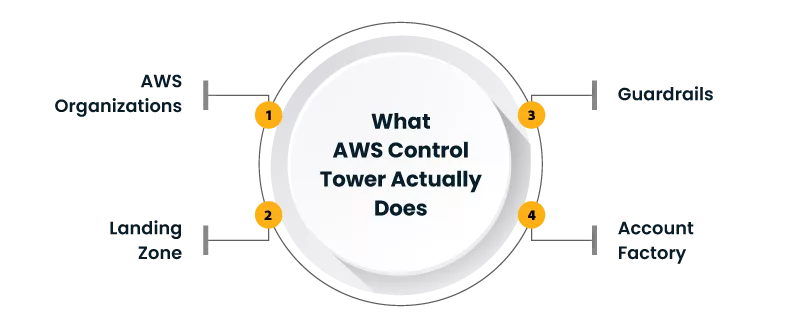
AWS Control Tower is not just a wizard. It is an orchestration layer that sets up a governed multi-account environment using AWS Organizations and a defined landing zone. AWS describes its landing zone as a well-architected, multi-account environment based on security and compliance best practices. 
What does AWS Control Tower actually do? 

Here is the practical view of what AWS Control Tower gives you: 

  • A landing zone with foundational accounts and OUs 
  • A catalog of controls (guardrails) you can apply to OUs  
  • A dashboard to see compliance posture 
  • Account provisioning through Account Factory  
  • Events you can use for automation and evidence trails  

A lot of blogs stop here. The real value comes when you treat the setup like a product. Meaning: you define patterns once, then reuse them as your org grows. 

Landing zone architecture, explained like a platform blueprint 

Most teams hear “landing zone” and think “networking.” It is broader than that. Landing zone architecture is the blueprint for how accounts, identity, logging, and guardrails come together. 

AWS Prescriptive Guidance frames landing zone design around account structure plus networking, logging, and authentication choices.  

Here is a simplified picture: 

                   +—————————–+ 
                    |        Management           | 
                    |  (governance + setup)       | 
                    +————–+————–+ 
                                   | 
                                   v 
                 +—————–+—————–+ 
                 |     AWS Organizations (OUs)        | 
                 +——–+—————+———–+ 
                          |               | 
                          v               v 
               +———-+—+     +—–+———–+ 
               |  Security OU |     |  Workloads OU   | 
               |  (shared accts)     |  (apps/teams)  | 
               +———-+—+     +—–+———–+ 
                          | 
                          v 
           +————–+—————-+ 
           | Central logging + audit trail | 
           +——————————–+ 
 

A good landing zone architecture does two things at the same time: 

  1. It protects the org by default 
  1. It gives teams a fast path to get a clean account that is ready for work 

This is where AWS governance stops being a set of slide decks and starts being a working system. 

Guardrails: the security mechanics that keep you sane 

The term “guardrail” can sound fuzzy. In AWS Control Tower, controls are very specific and are applied to OUs. The controls are documented in the Control Catalog.  

Two useful mental models: 

  • Preventive controls: stop a risky action before it happens (often implemented with policies) 
  • Detective controls: allow actions but flag issues for follow-up 

You also need to plan for drift. AWS documents drift detection and examples of changes that can break landing zone assumptions, including deleting required OUs or roles.  
AWS also documents drift monitoring for preventive controls and notifications (including SNS and active scans) for certain setups.  

Guardrail flow in plain terms 

Request in a workload account 
          | 
          v 
Is there a preventive control for this OU? 
   |                     | 
  Yes                   No 
   |                     | 
Block + log        Allow action 
   |                     | 
   v                     v 
Evidence trail     Detective controls evaluate 
                         | 
                         v 
               Findings for remediation 
 

This is the part that accelerates security. You move from “review every account” to “trust the baseline, verify the drift.” 

And that makes your multi-account strategy workable at higher account counts. 

Account Factory: your account vending machine, but with standards 

Most platform teams feel pain in account provisioning first. Tickets like: 

  • “Need a new dev account” 
  • “Need a new business unit OU” 
  • “Need a clean account for vendor access” 

AWS Control Tower addresses this with Account Factory, which supports provisioning and managing accounts in the landing zone, including enrollment, OU placement, and updates.  

Think of Account Factory as a controlled template flow: 

  • You define what “good” looks like (baseline, OU, shared services expectations) 
  • Teams request accounts through a standard path 
  • The created account arrives with the expected baseline 

A practical Account Factory pattern that works 

Use a small set of account types. Too many templates becomes a new kind of sprawl. 

  • Sandbox: limited access, short-lived resources, strict cost boundaries 
  • Dev/Test: broader service access, still controlled 
  • Prod: strict controls, strong logging, least privilege by default 
  • Shared services: only for platform-managed components 

This keeps AWS governance simple enough that teams follow it, instead of working around it. 

Best practices that are not obvious until you run it 

Below is a playbook that avoids the most common operational traps. It is written for teams that already know AWS basics and want repeatable outcomes. 

1) Design OUs around policy boundaries, not org charts 

A classic mistake is mapping OUs to departments. Departments change. Security boundaries change less often. 

Good OU split signals include: 

  • Prod vs non-prod 
  • Regulated workloads vs general workloads 
  • Internet-facing vs internal-only services 

This makes your multi-account strategy resilient. 

2) Treat landing zone changes like production changes 

Changes to landing zone architecture should go through review, testing, and a defined rollout path. If you let ad hoc edits happen, drift will become your full-time job. AWS explicitly calls out drift conditions that can block actions until remediated.  

Suggested practice 

  • Maintain a written “landing zone contract” 
  • Track which controls apply to which OUs and why 
  • Review exceptions monthly, not yearly 

3) Use lifecycle events for automation and audit evidence 

AWS Control Tower emits lifecycle events delivered via CloudTrail and EventBridge, which you can use to trigger workflows and keep an evidence trail.  

Examples: 

  • When a new account is created, auto-create baseline repositories, tags, and budget alarms 
  • When a control is enabled, auto-run validation checks and notify owners 

This turns governance into a system that runs itself. 

4) Plan for centralized logging from day one 

Central logging is where many teams trip. The point is not only “logs exist.” The point is “logs are protected and reviewable.” 

AWS guidance on multi-account environments highlights central management concepts in AWS Organizations and the use of policies across accounts and OUs.  

5) Make guardrails readable to engineers 

If guardrails feel like surprises, engineers will resent them. Document them like product constraints: 

  • What does this control prevent or detect? 
  • Why does it exist? 
  • What is the approved alternative pattern? 

This improves adoption and reduces exception requests, which strengthens AWS governance over time. 

6) Keep “break glass” access, but make it measurable 

You will need emergency access. Define it with: 

  • Time-bound approvals 
  • Strong logging 
  • Mandatory retrospective review 

Your landing zone architecture should assume emergencies happen, without making emergencies the normal path. 

Putting it together: a simple operating model 

If you want one clean way to run this, use a three-layer model: 

  • Foundation layer: AWS Control Tower landing zone, shared accounts, core controls 
  • Workload layer: app accounts, OU-based guardrails, standard networking patterns 
  • Delivery layer: pipelines, golden paths, and automation triggered by events 

This keeps the platform team focused on improving the system, not doing repetitive account work. 

It also gives you a credible, repeatable multi-account strategy that new teams can join without custom onboarding. 

FAQs 

Is AWS Control Tower only for new organizations? 
No. AWS states it can be used for new or existing organizations.  

What happens if someone changes things outside the Control Tower console? 
That can create a drift. AWS documents drift detection, examples of major drift, and remediation impacts.  

How do I know what controls exist? 
Use the Control Catalog. AWS documents the controls reference by control entries and groupings.  

Closing thought 

If your cloud program is growing, speed and safety will always feel like they compete. AWS Control Tower reduces that tension by making “secure by default” repeatable, visible, and enforceable across accounts. The win is not just faster account creation. The win is confidence that your AWS governance and landing zone architecture hold up as the account count grows, without turning every new account into a custom project. 

Author

Yogita Jain Linkedin
Yogita Jain
Content Lead

Yogita Jain leads with storytelling and Insightful content that connects with the audiences. She’s the voice behind the brand’s digital presence, translating complex tech like cloud modernization and enterprise AI into narratives that spark interest and drive action. With a diverse of experience across IT and digital transformation, Yogita blends strategic thinking with editorial craft, shaping content that’s sharp, relevant, and grounded in real business outcomes. At Cygnet, she’s not just building content pipelines; she’s building conversations that matter to clients, partners, and decision-makers alike.

Related Blog Posts

Modernizing Legacy Integrations Using EventBridge and Step Functions 

CalendarApril 15, 2026

Steps That Reduce Risk When Moving Monolithic Apps With AWS Transform

CalendarOctober 06, 2025

Designing a Resilient Multi-Account AWS Architecture 

CalendarDecember 10, 2025

Sign up to our Newsletter

    Latest Blog Posts

    How to Build an AI Strategy Roadmap for Your Enterprise
    How to Build an AI Strategy Roadmap for Your Enterprise

    CalendarApril 22, 2026

    The 4 Types of Data Analytics and How to Use Them
    The 4 Types of Data Analytics and How to Use Them

    CalendarApril 22, 2026

    Data Engineering Services: How They Work and Why They Matter
    Data Engineering Services: How They Work and Why They Matter

    CalendarApril 22, 2026

    Let’s level up your Business Together!

    The more you engage, the better you will realize our role in the digital transformation journey of your business


      I agree to the Terms & Conditions and Privacy Policy and allow Cygnet.One (and its group entities) to contact me via Promotional SMS / Email / WhatsApp / Phone Call.*

      I agree to receive occasional product updates and promotional messages from Cygnet.One (and its group entities) on Promotional SMS / Email / WhatsApp / Phone Call.

      I agree to receive service-related messages from Cygnet.One, including account updates, notifications, and support-related communications via SMS, email, or phone call.

      I agree to receive promotional SMS messages from Cygnet.One. Message and data rates may apply. Reply STOP to opt out.

      Cygnet.One Locations

      India India

      Cygnet Infotech Pvt. Ltd.
      2nd Floor, The Textile Association of India,
      Dinesh Hall, Ashram Rd,
      Navrangpura, Ahmedabad, Gujarat 380009

      Cygnet Infotech Pvt. Ltd.
      6th floor, A-wing Ackruti Trade Center,
      Road number 7, MIDC, Marol,
      Andheri East, Mumbai-400093, Maharashtra

      Cygnet Infotech Pvt. Ltd.
      WESTPORT, Urbanworks,
      5th floor, Pan Card Club rd.,
      Baner, Pune, Maharashtra 411045

      Cygnet Infotech Pvt. Ltd.
      10th floor, 73 East Avenue,
      Sarabhai campus, Vadodara, 391101

      Global

      CYGNET INFOTECH LLC
      125 Village Blvd, 3rd Floor,
      Suite 315, Princeton Forrestal Village,
      Princeton, New Jersey- 08540

      CYGNET DIGITAL IT SOLUTION LLC
      Office 707, Magnum Opus Tower,
      Al Thanyah First, Dubai, U.A.E,
      P.O. Box 125608

      CYGNET INFOTECH PRIVATE LIMITED
      Level 35 Tower One,
      Barangaroo, Sydney, NSW 2000

      CYGNET ONE SDN.BHD.
      Unit F31, Block F, Third Floor Cbd Perdana 3,
      Jalan Perdana, Cyber 12 63000 Cyberjaya Selangor, Malaysia

      CYGNET INFOTECH LIMITED
      C/O Sawhney Consulting, Harrow Business Centre,
      429-433 Pinner Road, Harrow, England, HA1 4HN

      CYGNET INFOTECH PTY LTD
      152, Willowbridge Centre,
      39 Cronje Drive, Tyger Valley,
      Cape Town 7530

      CYGNET INFOTECH BV
      Peutiesesteenweg 74, Machelen (Brab.), Belgium

      Cygnet One Pte. Ltd.
      160 Robinson Road,
      #26-03, SBF Centre,
      Singapore – 068914

      • Explore more about us

      • Download Corporate Deck
      • Terms of Use
      • Privacy Policy
      • Contact Us
      © Copyright – 2026 Cygnet.One
      We use cookies to ensure that we give you the best experience on our website. If you continue to use this site we will assume that you are happy with it.

      Cygnet.One AI Assistant

      ✕
      AI Assistant at your help. Cygnet AI Assistant