


































The operational debt in AWS usually hides inside ordinary green status indicators. A backup job completed. An alarm stayed quiet. A patch window ran. An IAM role still works. Those signals matter, yet none proves that the environment will behave correctly when a dependency fails, access changes, or cost spikes.
A useful operating rule is to judge a control by the evidence it produces.
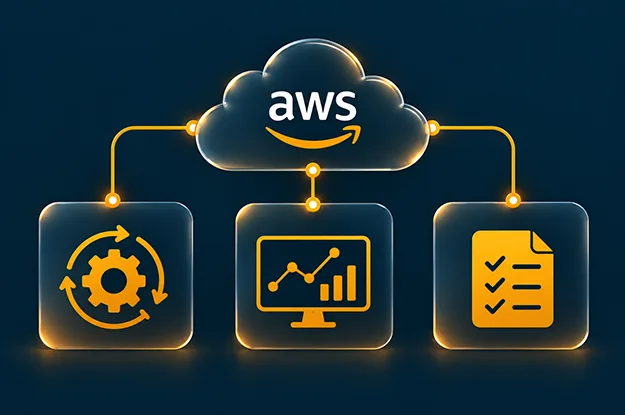
That is the practical purpose of AWS managed operations. It is the disciplined running of AWS workloads through defined automation, meaningful telemetry, recurring human review, tested recovery procedures, and clear ownership. AWS makes many of the underlying controls available through services such as Systems Manager, CloudWatch, CloudTrail, Config, IAM Access Analyzer, and AWS Backup. The harder work is deciding what can run automatically, what deserves attention, and what still requires an accountable person. AWS itself treats workload observability, actionable alerts, operations metrics, and recurring review as part of operational excellence.
A strong model for managed AWS services starts with control design rather than ticket volume, and aws cloud consulting services help define the operating model, governance controls, review cadence, and ownership structure, which aligns with AWS workload lifecycle governance across access, backup, monitoring, cost, and ownership. What should happen automatically, what should create an actionable signal, and what must be reviewed before risk accumulates?
What Does AWS Managed Operations Actually Cover?
Teams often describe operations through activities: monitoring, patching, backup, incident response, access administration, and cost control. That list says what the team does, but it still leaves the decision model unclear.
Give each recurring control four properties:
| Control property | Question to answer |
| Trigger | What event, threshold, schedule, or change starts the control? |
| Action | What can happen automatically, and where must automation stop? |
| Evidence | What proves the control ran and produced the expected result? |
| Exception owner | Who owns failures, overrides, and unresolved findings? |
This is the foundation of effective cloud operations management. It prevents activity from being mistaken for control and lets buyers assess managed AWS services against measurable operating outcomes.
What Should Be Automated in AWS Operations?
The best automation targets repeatable work with clear preconditions, bounded impact, and a known recovery path. Patching, standard configuration remediation, backup policy execution, and routine evidence collection often fit.
AWS Systems Manager Patch Manager automates patching for managed nodes, and AWS currently recommends patch policies through Quick Setup for configuring recurring patch operations across selected accounts and Regions. AWS Config conformance packs can group Config rules and remediation actions and deploy them across an organization.
Good AWS operations automation should remove predictable manual work without turning each finding into an immediate change. A noncompliant tag can often be corrected automatically. A production security group change may need evidence, context, and approval before remediation. The distinction should depend on reversibility, business impact, and the chance that the automation is acting on incomplete context.
For AWS managed operations, automation should usually cover:
- Scheduled patch scans and approved patch deployment;
- Approved configuration remediations with bounded impact;
- Backup scheduling and retention enforcement;
- Collection of inventory, compliance, and operational evidence;
- Routine start, stop, or cleanup actions where ownership is explicit.
Automation becomes dangerous when “auto-remediate” replaces workload context. AWS operations automation earns its place when the team can explain what starts it, what it changes, how failure is detected, and how exceptions are handled.
What Should Be Monitored Continuously?
Monitoring should answer whether the workload is healthy, whether its dependencies are behaving normally, and whether control-plane activity has changed the risk profile, making cloud-native observability critical for AWS operations.
Amazon CloudWatch can collect and analyze operational telemetry, while CloudTrail records account activity and can send supported events to CloudWatch Logs for filtering, metrics, alarms, and automated actions. Organization trails can also apply logging across member accounts in AWS Organizations.
Useful AWS monitoring best practices focus on signals that change an operator’s decision. CPU utilization alone may say little about customer impact. Error rate, latency, queue depth, failed jobs, database connection pressure, dependency health, and synthetic transaction results often provide better operational context.
A managed monitoring model should cover three signal classes:
- Workload signals: Availability, latency, errors, saturation, job failures, and dependency health.
- Control signals: Failed backups, patch noncompliance, disabled logging, configuration drift, expiring certificates, and failed automation.
- Change signals: Sensitive API activity, privilege changes, network policy changes, and unusual resource creation.
This is where managed AWS services should prove alert quality. A dashboard full of data is not the same as an operating signal. Alerts need an owner, severity logic, response target, context, and a defined first action. Those are practical AWS monitoring best practices because they reduce the gap between detection and a useful response.
Access Reviews Need More Than an IAM Inventory
Identity risk accumulates quietly. Roles remain after projects close. Permissions survive temporary migrations. Service access grows while nobody revisits whether it is still needed.
IAM Access Analyzer can identify external access, internal access paths for supported resources, and unused access. For unused access analysis, AWS lets teams set a tracking period between 1 and 365 days, which gives operations teams a way to tune findings to their own usage patterns.
Human reviews still matter. An unused permission may support an infrequent recovery procedure, so automatic removal can damage a control that is rarely exercised.
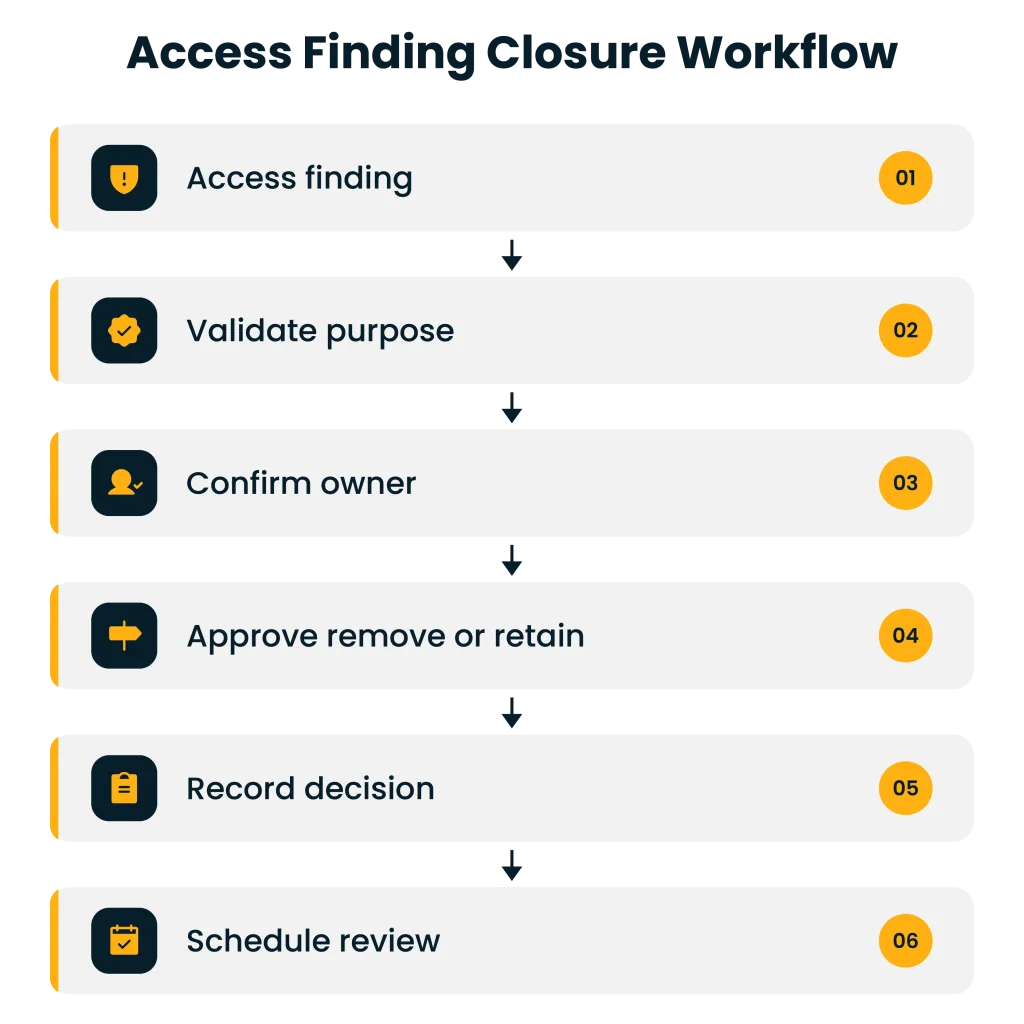
Within AWS managed operations, access review should connect four pieces of evidence: current entitlement, recent use, business ownership, and the reason the permission exists. This makes access review a decision process rather than an IAM export.
For buyers, ask what happens after an access finding appears. Who validates it? Who can approve removal? How are emergency roles treated? How is the decision recorded? The quality of those answers tells you more than the presence of an IAM report.
Patching Is a Compliance Loop, Not a Maintenance Window
Patching often looks complete because a scheduled task ran. Operations teams should care about which nodes were eligible, what was missed, which reboots were deferred, and which exceptions remain open.
Patch Manager supports both scanning and installation and records compliance information for managed nodes. AWS also supports centralized patch policies across selected accounts and Regions.
This changes how an AWS managed services checklist should be written. “Run patching monthly” is weak. A better control states the approved baseline, maintenance window, exception path, compliance threshold, reboot handling, and evidence required after execution.
That approach also prevents patch automation from hiding unmanaged assets. If a server is outside Systems Manager coverage, a clean patch report can still create false confidence. The review should therefore compare the managed inventory with the expected workload inventory.
Incident Response Should Start Before the Alarm Fires
An incident runbook is useful only if the team can execute it under current conditions. Contacts change. Permissions change. Dependencies move. A runbook that worked six months ago may now contain an invalid command, missing role, or obsolete recovery step.
The incident process should connect alert context, recent changes, dependency information, response actions, communications, and post-incident evidence. Routine diagnostic steps can be automated. High-impact recovery actions should have explicit guardrails and decision ownership.
A practical test is the opening minutes of an incident. Can the responder identify the affected service, recent changes, dependencies, current owner, and safe first action without searching across unrelated systems? If not, the model still depends too heavily on individual memory.
This is also where managed AWS services should be judged by response design rather than a support queue. Coverage hours matter, along with triage quality, runbook freshness, handoff rules, and post-incident learning.
Backup Success Is Not Recovery Proof
A completed backup job confirms that the process ran. It does not prove that the restored resource will start, the application can use it, or its dependencies are available.
AWS Backup restore testing supports scheduled restore tests and records restore job status and duration. AWS Backup Audit Manager can also evaluate whether restored resources completed within a target restore time.
This should change the backup section of any AWS managed services checklist. The control needs two separate questions: are protected resources being backed up as intended, and has recovery been tested recently enough for the workload’s risk?
Restore evidence should be treated as an operational artifact. A useful record includes the recovery point used, restore result, validation performed, duration, failed dependencies, and follow-up action. This turns backup reporting into evidence of recovery readiness.
Cost Checks Belong in Operations, Not Just Finance
Cost problems often reveal operational problems first: abandoned resources, runaway logging, duplicated environments, unexpected data transfer, or a workload pattern that changed without an owner.
AWS Cost Anomaly Detection uses machine learning to detect unusual spend patterns and can identify likely root causes across service, account, Region, and usage type. AWS states that anomaly detection runs approximately three times a day, while the underlying Cost Explorer data can be delayed by up to 24 hours.
That timing matters. Cost alerts are valuable, but they are not an instant control. Cloud operations management should combine anomaly detection with budgets, ownership tags, architecture context, and recurring review of known cost drivers.
A cost finding needs operational triage. First establish whether the spend is expected, then identify the workload, owner, recent change, and safe corrective action. This is another area where managed AWS services should show a closed-loop process instead of forwarding billing alerts.
How Often Should AWS Operations Be Reviewed?
A continuous AWS review does not mean that a person should inspect every control all day. It means the environment is evaluated at the cadence at which risk can change.
| Cadence | Typical controls |
| Event-driven | Security changes, failed automation, backup failures, major availability signals |
| Daily | Unresolved critical alerts, failed jobs, high-risk access findings, unusual spend |
| Weekly | Recurring incident patterns, patch exceptions, capacity trends, operational backlog |
| Monthly | Access recertification targets, restore evidence, cost drivers, control exceptions |
| Quarterly | Runbook tests, ownership checks, architecture risks, operating model gaps |
Cadence should tighten as reversibility falls and business impact rises. A failed production backup deserves immediate attention. A stale dashboard can wait. A privileged access change may require rapid detection plus a later human decision.
This is the discipline behind continuous AWS review. It keeps operations from becoming a calendar ritual disconnected from actual risk.
How to Evaluate a Managed AWS Operations Provider
A serious managed AWS services engagement should make operating evidence easy to inspect. Before accepting a scope, check the following:
- Which controls are automated and which require approval
- Which AWS accounts, Regions, workloads, and resource classes are covered
- How alert severity and ownership are defined
- How access findings, patch exceptions, and failed backups are closed
- How restore testing is scheduled and validated
- How incidents are handed off and reviewed
- How cost anomalies are investigated
- What operational evidence is retained and reported
This is where AWS managed operations becomes commercially meaningful. The buyer is purchasing a defined operating model with controls, evidence, exceptions, and accountability.
Manage the Exceptions, Not Just the Routine
Strong AWS operating models automate predictable work, monitor signals that can change a decision, and reserve human attention for exceptions with business consequence. Engineers spend less time on repetitive administration while judgment stays where context matters.
A useful operating baseline is simple: automate what is repeatable, monitor what can deteriorate quickly, review what requires context, and test what you may need during failure, similar to the discipline behind a strong cloud automation strategy.
That is what separates routine administration from dependable AWS managed operations. It is also the standard buyers should apply when comparing managed AWS services: not how many tasks are listed in the scope, but whether the provider can show who owns each control, what evidence proves it worked, and what happens when it does not.
Author


Yogita Jain
Content Lead
Yogita Jain leads with storytelling and Insightful content that connects with the audiences. She’s the voice behind the brand’s digital presence, translating complex tech like cloud modernization and enterprise AI into narratives that spark interest and drive action. With a diverse of experience across IT and digital transformation, Yogita blends strategic thinking with editorial craft, shaping content that’s sharp, relevant, and grounded in real business outcomes. At Cygnet, she’s not just building content pipelines; she’s building conversations that matter to clients, partners, and decision-makers alike.