



































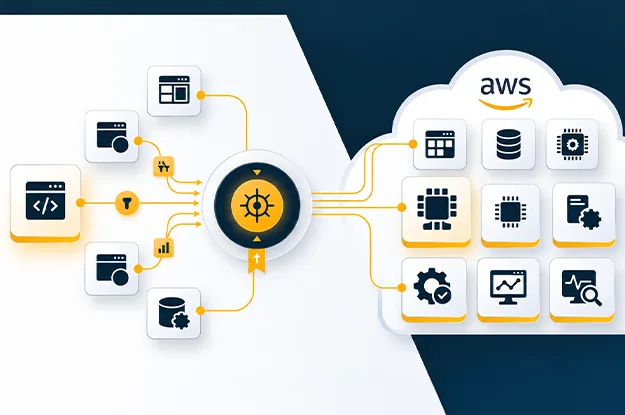
A payroll platform at 10:00 a.m. on payday and an internal reporting sandbox can both run in AWS. An outage in each environment may produce the same red alarm, yet the business consequences are nowhere close.
That gap is where support design often breaks down. Infrastructure gets grouped by account, platform, or technology, while operational attention is distributed almost uniformly. The result is predictable: low-impact incidents consume senior engineering time, while genuinely important workloads reach the right people too slowly.
A better AWS workload support strategy starts with business consequence. It decides, before an incident, which workloads deserve deeper monitoring, faster human response, tighter recovery targets, and more formal incident coordination — the kind of structured approach that AWS services programmes build into operating agreements before a single alarm fires. Cloud support tiers then turn that decision into an operating standard rather than an improvised reaction.
AWS itself recommends defining workload recovery categories according to business impact and assigning recovery time and recovery point objectives to those categories. Its current support guidance also distinguishes case severity by production and business impact. These principles provide a strong foundation, but enterprises still need an internal model that connects workload importance to day-to-day support behavior.
Why One Support Model Fails Across Different AWS Workloads
Uniform support looks simple on paper. One queue, one monitoring standard, one on-call process, and one set of response targets are easy to document. Operationally, that simplicity becomes expensive — a pattern that mirrors the broader challenge of how to reduce IT downtime in enterprise environments where undifferentiated response slows resolution for the workloads that matter most.
A customer checkout service, identity platform, analytics pipeline, employee portal, and development environment do not create the same exposure when degraded. Treating them alike forces one of two bad outcomes. Either lower-impact systems receive excessive operational attention, or high-impact systems receive less protection than the business expects.
Effective AWS workload support should therefore answer a harder question than “Is this production?” Production status alone says little about consequence.
The stronger question is: what happens to the business if this workload becomes unavailable, loses data, slows materially, or fails during a sensitive operating window?
That question belongs inside the AWS operational support model, because support priority should be designed around the effect of failure rather than the technical label attached to the resource.
This also changes how cloud support tiers are discussed. They are not simply Bronze, Silver, and Gold packages with different response times. A useful tier defines what the operations team watches, who gets called, how quickly triage begins, when management is informed, which recovery path applies, and what evidence is required after restoration.
Classify Workloads by Business Impact Before Setting Support Tiers
A tier should never start with monitoring tooling or staffing. It should start with a workload impact assessment.
AWS Well-Architected guidance recommends examining financial, reputational, operational, and regulatory effects when setting recovery objectives — the same framework that informs AWS Well-Architected reviews used to identify and fix gaps left by earlier migrations. That is a better starting point than server count or monthly cloud spend because business damage rarely maps neatly to infrastructure size.
For business critical workload classification, four factors are especially useful in enterprise environments.
Revenue and Transaction Impact
The first factor is direct commercial exposure. Does an outage stop sales, payments, bookings, order processing, or another transaction tied to revenue?
The important detail is timing. A workload may have modest impact for most of the month and become highly sensitive during quarter-end, a product launch, payroll processing, or a settlement window. Static classification can miss this.
A mature model records both the normal tier and any time-bound uplift in operational priority.
Compliance and Regulatory Exposure
Some workloads matter because failure creates evidence, reporting, retention, privacy, or control issues — exactly the conditions that make governance, risk management, and compliance a stakeholder in workload classification, not just an audience for the outcome.
A system supporting regulated records may have limited customer traffic and still deserve a high support level. The deciding factor is the consequence of unavailable data, incomplete audit evidence, delayed reporting, or a control failure.
This is where enterprise cloud operations must include compliance teams in classification. Technical owners can explain architecture. They cannot independently decide what level of regulatory exposure is acceptable.
Availability and Recovery Need
Availability expectations should be tied to the maximum tolerable disruption, not copied from a generic availability target.
AWS recommends setting RTO and RPO according to business needs and warns against objectives that are either too lenient or unnecessarily strict. Tighter objectives can increase cost and operational complexity, so the target should reflect actual business need.
This gives cloud support tiers a measurable recovery dimension. A high tier may require rapid failover, rehearsed recovery steps, recent restore validation, and named recovery owners. A lower tier may reasonably accept restoration during staffed hours.
User and Process Impact
User count is useful, but it is incomplete. Ten finance users closing the books may carry more business consequence than thousands of users accessing a nonessential information page.
Classification should therefore examine which process stops, who depends on it, whether a workaround exists, and how long that workaround remains practical.
That last point is often missed. A manual workaround may make a four-hour disruption acceptable. The same workaround may fail operationally after twelve hours.
A Practical Workload Tiering Model for AWS Operations
The following model keeps classification understandable enough for business owners while giving operations teams something they can implement.
| Tier | Typical business condition | Monitoring expectation | Operational response | Recovery expectation |
| Tier 1 | Material revenue, regulatory, safety, or enterprise-wide process impact | Continuous service and dependency monitoring with actionable alerting | Immediate on-call engagement, named incident lead, management communication | Tight, tested RTO/RPO with rehearsed recovery |
| Tier 2 | Important business process or customer function with limited tolerance for disruption | Continuous monitoring of service health and key dependencies | Fast engineering response with defined incident ownership | Documented recovery path tested on a planned cadence |
| Tier 3 | Departmental or internal service with workable short-term alternatives | Core availability and failure monitoring | Response within agreed support hours or target window | Standard backup and restoration procedure |
| Tier 4 | Development, test, temporary, or low-impact service | Basic health and cost controls | Best-effort or business-hours handling | Rebuild or restore when operationally practical |
This framework makes AWS workload support easier to govern because each tier carries an operational promise. It also prevents a common mistake: assigning a critical label without funding the monitoring, staffing, recovery engineering, and testing needed to support it.
A useful rule is that a tier is valid only when the operating controls behind it exist.
Map Monitoring Depth to the Cost of Missing a Failure
Monitoring should differ by workload consequence.
Tier 1 services generally need visibility beyond infrastructure health. CPU, memory, and instance status rarely explain whether a business service is functioning. Monitoring should include transaction success, dependency health, queue behavior, error rates, authentication paths, and business-relevant failure signals.
Tier 3 or Tier 4 workloads may need far less. Adding the same telemetry depth everywhere creates alert volume without equivalent operational value.
This is where cloud support tiers should define detection expectations in plain terms:
- What condition must be detected?
- How quickly must the signal reach an accountable responder?
- Which dependency failures need separate alerts?
- Which signals can wait for business-hours review?
- What evidence confirms that service has actually recovered?
The point is not more alerts. It is shorter time between meaningful failure and informed action.
Set Response and Escalation Expectations Before the Incident
AWS currently lists first-response targets of less than 30 minutes for a business-critical system under Business Support+ and less than 15 minutes under Enterprise Support. For that severity level, Unified Operations specifies a five-minute response from an Incident Management Engineer. AWS also states that these are initial response targets rather than guarantees for resolution.
Those figures matter, but they should not become the internal cloud support SLA by default.
The enterprise still controls detection time, internal triage, case creation, evidence gathering, stakeholder communication, and application recovery — the internal operating discipline that AWS managed service provider selection should evaluate as rigorously as provider response SLAs. A fifteen-minute provider response offers limited value if the incident spends forty minutes moving through internal queues first.
An effective AWS operational support model therefore defines two clocks:
- Internal response clock: Time from actionable detection to qualified engineering engagement.
- External support clock: Expected provider response after a correctly classified AWS case is opened.
This separation exposes where delay actually occurs.
For high-impact incidents, AWS workload support should also specify who can raise a critical AWS case, who contacts the Technical Account Manager when applicable, what diagnostic information must be attached, and who owns the conference bridge. AWS guidance for high-severity cases recommends summarizing business impact, supplying metrics and symptoms, and keeping personnel available to work the case.
Recovery Expectations Must Match the Support Tier
Support tiering fails when response targets are strict but recovery design is vague.
If a workload is classified as Tier 1, its architecture and operating procedures need to support the recovery objective attached to that tier. A one-hour restoration target has little meaning when backups have not been tested, dependencies have different recovery objectives, or nobody has rehearsed failover.
The second workload impact assessment should happen after the recovery design is known. This catches a useful problem: workloads sometimes receive a high business classification while their current architecture cannot meet the expected restoration window.
At that point, the decision becomes explicit. Improve recovery capability, revise the business expectation, introduce a temporary risk acceptance, or change the tier.
That is stronger than leaving an impossible cloud support SLA inside an operations document.
Review Tier Assignments When Business Context Changes
Workload tiers should be reviewed when the business role of a system changes.
A reporting application may become part of a regulatory submission. An internal API may become a dependency for customer transactions. A temporary integration may become permanent. A low-use service may suddenly support a major operating process.
For business critical workload classification, triggers are more reliable than an annual spreadsheet review. Useful triggers include major architecture changes, new regulatory use, acquisition integration, new customer-facing dependencies, material changes in transaction volume, and revised recovery requirements.
This keeps cloud support tiers aligned with current business exposure instead of historical assumptions. Well-defined cloud support tiers also reduce arguments over priority during active incidents.
It also gives enterprise cloud operations a cleaner governance question: does the workload still receive the level of operational attention its present business consequence requires?
What Enterprises Should Expect From an AWS Support Tiering Model
A good tiering model creates consistency before pressure arrives.
It gives operations teams a shared basis for prioritization. It gives application owners a clear view of what their workload classification includes. It gives leadership a way to decide where faster recovery and deeper monitoring justify additional cost.
Most importantly, it prevents “critical” from becoming a label applied after an incident has already become painful. A documented AWS workload support policy also makes ownership easier to audit.
The strongest AWS workload support approach connects business consequence to detection, engineering response, provider engagement, recovery, and review. Cloud support tiers then become an operating agreement across technology and business teams.
That agreement is what makes prioritization defensible. When two incidents arrive together, the team should not have to debate which system deserves attention first. The answer should already exist in the workload’s classification, recovery targets, support path, and business impact.
Author


Yogita Jain
Content Lead
Yogita Jain leads with storytelling and Insightful content that connects with the audiences. She’s the voice behind the brand’s digital presence, translating complex tech like cloud modernization and enterprise AI into narratives that spark interest and drive action. With a diverse of experience across IT and digital transformation, Yogita blends strategic thinking with editorial craft, shaping content that’s sharp, relevant, and grounded in real business outcomes. At Cygnet, she’s not just building content pipelines; she’s building conversations that matter to clients, partners, and decision-makers alike.