



































Hiring an AWS managed services provider in 2026 is usually where the shortlist starts to feel confusing. On paper, most MSPs look capable. They talk about AWS expertise, 24/7 support, FinOps, security, and onboarding. The real question is whether their credentials, operating model, and handoff process match the way your workloads actually run.
Assume a sev-1 incident happens at 3 a.m., your AWS bill needs action before the next monthly finance review, or a key engineer rotates off the account. These moments reveal how the provider manages escalation, cost governance, documentation, and continuity.
According to the 2024 Forrester Global IT Services Market Forecast, global IT services spend will reach $2 trillion by 2028, with managed services among the top three growth drivers, which means the talent pool is being absorbed by partners that scaled their operating model early.
Your selection process should look past the sales deck and into the operating details. In this blog, we explain how to evaluate AWS managed services providers by credentials, SLAs, FinOps discipline, security controls, onboarding artifacts, and the questions worth asking before you choose a partner.
What Should You Look For In An AWS Managed Services Provider?
Choosing an AWS managed services provider should start with how well the partner can run your production environment, control AWS spend, and support governance at scale. The evaluation should cover AWS credibility, operating discipline, security posture, FinOps maturity, and workload fit. This gives buyers a practical way to compare providers beyond the sales deck.
Key criteria to check include the following:
- AWS validation: Look for Advanced Tier or Premier Tier status with AWS MSP validation.
- Operational depth: Review 24/7 monitoring, SLAs, escalation paths, and runbook quality.
- Security and compliance: Check threat monitoring, identity controls, audit support, and compliance evidence.
- FinOps and workload fit: Assess cost optimization, AI/ML capability, relevant competencies, and industry references.
AWS Partner Tier and MSP Validation are important for production workloads because they show that the provider has met AWS delivery and operational standards. According to the 2025 Gartner Forecast on Worldwide IaaS Public Cloud Services, the worldwide IaaS public cloud services market grew 22.5% in 2024, reaching $171.8 billion, showing why MSPs need deeper capability across performance and governance.
How Do You Score AWS MSPs With A Decision Matrix?
Scoring AWS MSPs works best when the eight evaluation criteria are weighted against your workload priorities. Each shortlisted provider gets a 1 to 5 score using the same rubric across AWS validation, security, FinOps, SLAs, AI capability, references, and communication fit. This gives procurement, security, engineering, and leadership a shared basis for comparison.
The matrix turns vendor evaluation into a documented recommendation with weights, scores, tie-breakers, and decision logic. It also gives teams a practical record for contract review after the first year. Every score should connect to evidence such as certifications, references, runbooks, SLA documents, or sample reports.
1. Weigh Criteria Against Your Workload Priorities
Start with the workload type because each environment needs a different scoring emphasis:
- Regulated workloads: Give higher weight to security, compliance, audit evidence, and data residency.
- Cost-sensitive SaaS workloads: Prioritize FinOps cadence, rightsizing, RI/SP planning, and cost visibility.
- AI-heavy environments: Score GenAI capability, GPU planning, inference cost controls, and data pipeline reliability.
The weighting step helps stakeholders agree on what matters before vendor presentations begin. Procurement, security, finance, and engineering should confirm the scoring logic together. Once the weights are set, apply the same model to every shortlisted provider.
2. Which Scoring Scale Prevents Subjective Bias?
Use a 1 to 5 anchored scale with clear descriptions for each score:
- 5: AWS MSP Validation plus multiple references in your vertical.
- 3: Advanced Tier status with limited run-state proof.
- 1: Basic AWS credentials with little evidence of production operations.
Each score should be tied to proof such as AWS credentials, SLA samples, FinOps reports, onboarding plans, security artifacts, and customer references. This keeps scoring consistently across evaluators. It also makes the final recommendation easier to explain during leadership review.
3. How Do You Turn Scores Into A Defensible Shortlist?
Use the weighted total to rank providers, then review close scores carefully:
- Rank by weighted score: Compare each provider against the agreed criteria.
- Review close contenders: Treat scores within 0.5 as close enough for deeper discussion.
- Use tie-breakers: Look at reference quality, communication style, onboarding clarity, and delivery confidence.
The shortlist should show why one provider moved ahead of another. Capture trade-offs, risks, and contract points while the decision is still fresh. This gives the procurement memo a clear narrative and helps stakeholders understand the final recommendation.
What Should You Ask An AWS MSP In The Vendor Pitch?
Questions in the vendor pitch should test technical depth, operating maturity, and commercial transparency. They should also clarify whether the partner is built for a co-managed versus fully managed engagement, since that decision affects the runbook, escalation model, ownership split, and on-call calendar.
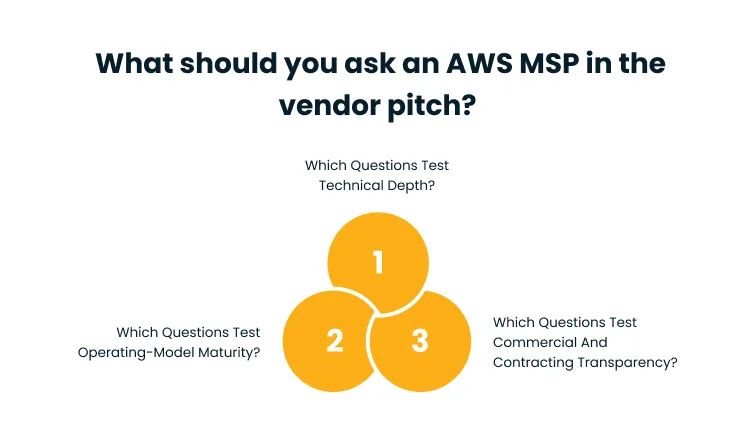
1. Which Questions Test Technical Depth?
Ask questions that require proof of real AWS operating experience. The goal is to see how the provider handles incidents, reviews, and security events in live environments. Artifact quality will tell you more than a polished case study.
- Ask for a redacted runbook.
- Request a recent incident post-mortem.
- Review three AWS Well-Architected reviews completed in the last six months.
- Ask how the team handles a CVE from detection to closure.
The artifact request is the real test. Providers with delivery depth can show how they work, document issues, and improve after incidents. This gives buyers a clearer view of technical capability before signing.
2. Which Questions Test Operating-Model Maturity?
Operating model questions show how the MSP will work with your internal team after onboarding. They should clarify team structure, review cadence, documentation habits, and the recommended model for your estate. This is where you can assess fit for full-service, co-managed, or project-then-run support.
- Ask who will be on the named delivery team.
- Review the cadence for service reviews and governance meetings.
- Ask how knowledge is documented, transferred, and retained.
- Confirm which model fits your estate: full-service, co-managed, or project-then-run.
A mature MSP can explain roles, workflows, and handover states without delay. The answer should give your team a clear view of ownership from onboarding through contract end. It also shows how well the provider can work inside your existing operating rhythm.
3. Which Questions Test Commercial And Contracting Transparency?
Commercial questions should show how pricing, scope, ownership, and exit terms work under real business changes. This helps you understand how the contract behaves when AWS spend rises, workloads change, or the partnership ends. The goal is to check flexibility before signing.
- Ask how pricing changes if AWS spend doubles or drops by 30%.
- Confirm the cost of change requests outside the scope.
- Review the termination-for-convenience clause.
- Clarify who owns IaC, runbooks, and documentation at exit.
Transparent MSPs can explain pricing elasticity, scope boundaries, and exit ownership clearly. These answers reduce cost surprises and make future transitions easier to manage. They also help buyers understand the long-term commercial fit before committing.
What Red Flags Should Disqualify An AWS Managed Services Provider?
Red flags during AWS MSP evaluation usually appear in evasive answers, generic SLAs, missing validations, and year-one pricing that becomes harder to sustain later. These signals should pause the selection process and trigger deeper review because the same issues can raise cost, transition, and incident-response risk over time.
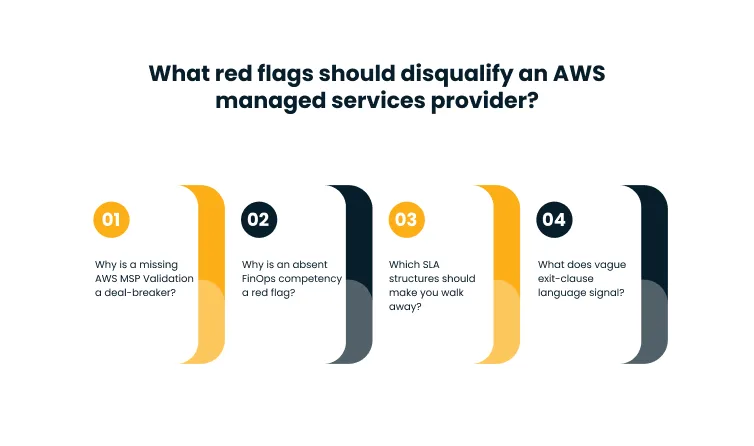
1. Why Is A Missing AWS MSP Validation A Deal-breaker?
AWS MSP Validation is a third-party audit of operational maturity, separate from the AWS Partner Tier. It reviews incident response, change management, security posture, and FinOps practice. Production operations need this level of audited delivery discipline.
Look for validation across:
- Incident response
- Change management
- Security posture
- FinOps practice
The 2024 IBM Cost of a Data Breach Report put the global average cost of a breach at USD 4.88 million, with cloud misconfigurations behind 15% of breaches, which sets the price of a partner running run-state operations without an audited posture.
2. Why Is An Absent FinOps Competency A Red Flag?
FinOps is now a distinct AWS Competency and signals a structured approach to AWS cost control. It should cover reserved instances, savings plans, rightsizing, tagging, and architecture-level optimization. AWS costs need active governance across the full contract period.
Check for capability across:
- Reserved Instances and Savings Plans
- Rightsizing and tagging
- Budget governance
- Architecture-level cost optimisation
According to the 2024 McKinsey Insight on the FinOps Way, organizations that adopt mature FinOps practices can reduce cloud costs by 20% to 30%, with another 10% to 20% in untapped savings beyond what first-generation FinOps teams typically capture. A partner without the competency is leaving the savings on the table for the entire contract life.
3. Which SLA Structures Should Make You Walk Away?
Weak SLA structures create accountability issues during real incidents. Review whether the contract defines response targets, resolution targets, severity classes, escalation paths, and service credits. The SLA should also include a quarterly review cadence.
Watch for:
- Response-only commitments
- Single-tier severity definitions
- “Best effort” language
- No quarterly SLA review
The redline should require resolution targets per severity class, a defined escalation matrix, credit structures for missed targets, and a quarterly SLA review embedded in the contract.
4. What Does Vague Exit-Clause Language Signal?
A clean exit clause should make transition planning clear before the contract starts. It should name the transition-out period, deliverables, fee cap, and documentation ownership. This gives buyers control when they need to change providers or bring operations back in-house.
Confirm the clause includes:
- A 60 to 90-day transition-out period
- Runbooks, IaC, and runtime artefacts
- Knowledge transfer sessions
- Fee cap and documentation of ownership
Vague exit language can create pricing pressure during renewal, when switching costs are highest. The exit clause allows buyers to utilize early. It also protects continuity across infrastructure, documentation, and operations.
What Does Great AWS MSP Onboarding Look Like In The First 90 Days?
Great AWS MSP onboarding turns the first 90 days into a clear operating routine. By day 30, baselines, access, and workload priorities should be documented. By day 60, monitoring and runbooks should be live. By day 90, the MSP should have handled an incident and delivered a FinOps win.
1. What Should The MSP Deliver In Days 0 To 30?
A complete environment discovery, baseline AWS cost report, security posture review (IAM hygiene, IMDSv2, S3 public access, KMS coverage), draft runbook inventory, and shadowed participation in your existing on-call rota. The first thirty days are diagnostic. Anything billed as a transformation in this window is being sold ahead of the data.
2. What Should Be In Place By Day 60?
Monitoring agents and dashboards live, runbooks operational, first FinOps recommendation memo delivered with quantified savings, and an escalation matrix tested in a tabletop incident drill. The drill is the early proof point. A partner that resists running it before a live incident is hoping the first incident happens later.
3. What Proves The MSP Is Operationally Ready By Day 90?
The MSP has owned at least one real incident end-to-end with a written post-mortem, delivered the first monthly business review with SLA evidence, and is tracking against committed FinOps optimization targets. The day-90 review is also the calibration point for the year-one plan, which should name the next two architecture reviews, the GenAI and AI/ML roadmap commitments, and the SLA refresh schedule.
Why Is Cygnet.One A Strong AWS Managed Services Provider Partner?
Cygnet.One is an AWS Advanced Tier Partner with dedicated AWS expertise across migration, modernization, FinOps, GenAI, and 24/7 managed services. We combine cloud engineering and managed IT depth to support AWS operations from planning to run-state. Our AWS migration playbook is mapped against the 7Rs, giving discovery teams a clear strategy library from the start.
1. Which AWS Credentials Does Cygnet.One Hold?
We hold AWS Advanced Tier Partner status, supported by 700+ AWS-certified architects and a dedicated AWS Services line. Our teams cover migration, modernization, GenAI, FinOps, and managed services on AWS. We also align with AWS solution architects and the AWS Well-Architected Framework to keep operating decisions current.
2. How Does Cygnet.One’s ORBIT Framework De-Risk AWS Migration?
Our AWS migration and modernization practice uses the ORBIT methodology across Observe, Roadmap, Build, Iterate, and Transform. We bring discovery, migration, modernization, and run-state into one operating model. FinOps guardrails, security controls, rollback procedures, and testing gates help make risk visible before cutover.
3. How Does Cygnet.One Deliver FinOps And GenAI Workload Value?
We deliver FinOps value through rightsizing, RI/SP commitments, and architecture-level cost improvements inside the operate phase. Our GenAI practice supports Bedrock and SageMaker workloads, including AgentCore and Strands Agents for multi-agent systems. We bring both practices into monthly business reviews, giving buyers a clear view of cost, performance, and workload progress.
Conclusion
The right AWS MSP should prove operational depth before the contract is signed. The vendor pitch should test technical capability, operating-model maturity, commercial transparency, and the first 90-day plan across cost baselines, monitoring, incident response, and FinOps outcomes.
Buyers should look for a partner that can defend the scoring matrix with a redacted SLA, runbook, AWS MSP Validation evidence, and relevant references. Long-term value comes from monthly business reviews, quarterly strategy reviews, named ownership, and steady improvement across cloud operations.
Cygnet.One runs its AWS practice as an Advanced Tier Partner with the ORBIT framework, named account teams, and FinOps embedded in the operate phase. Book a demo with our AWS team to see how your first 90 days can be structured for cost control, resilience, and operational accountability.
FAQs
AWS MSP fees usually range from 10% to 20% of monthly AWS spend. The final price depends on scope, SLA tier, compliance needs, and on-call coverage. Fixed-fee, consumption-based, and hybrid models are common, so compare the included services before the rate.
AWS Managed Services is AWS’s own run-state operations offering for AWS workloads. A third-party AWS MSP can customize runbooks, support broader environments, and manage FinOps, GenAI, and compliance layers. AMS fits AWS-only estates, while third-party MSPs often suit multi-cloud or regulated environments.
AWS Partner Tier shows revenue, certifications, and customer count on AWS. AWS MSP Validation is a separate audit focused on runbook quality, incident response, security posture, and FinOps practice. Production run-state operations usually need both partner depth and audited operational maturity.
Yes, many AWS MSPs support smaller environments through scaled plans. Entry engagements often start around USD 5,000 to USD 10,000 per month with business-hours support and escalation. The fit depends on AWS spend, internal skills, and the need for 24/7 coverage.
Initial AWS MSP contracts usually run two to three years, followed by annual renewals. This gives the provider enough time to build operational knowledge and improve the run-state model. Review termination terms, transition duties, and exit deliverables closely before signing.
Many AWS MSPs also support Azure and Google Cloud as multi-cloud providers. Depth varies across platforms, so ask for comparable runbooks, named team members, non-AWS certifications, and recent delivery examples. The best fit should show proven operational experience across each cloud in scope.
Author


Abhishek Nandan
AVP, Marketing
Abhishek Nandan is the AVP of Services Marketing at Cygnet.One, where he drives global marketing strategy and execution. With nearly a decade of experience across growth hacking, digital, and performance marketing, he has built high-impact teams, delivered measurable pipeline growth, and strengthened partner ecosystems. Abhishek is known for his data-driven approach, deep expertise in marketing automation, and passion for mentoring the next generation of marketers.