


































• Cygnet IRP
  • Glib.ai
  • IFSCA
Cygnet.One
  • About
  • Products
  • Solutions
  • Services
  • Partners
  • Resources
Generic selectors
Exact matches only
Search in title
Search in content
Post Type Selectors
Get Started
About
  • Overview

    A promise of limitless possibilities

  • We are Cygnet

    Together, we cultivate an environment of collaboration

  • Careers

    Join Our Dynamic Team: Careers at Cygnet

  • CSR

    Impacting Communities, Enriching Lives

  • In the News

    Catch up on the latest news and updates from Cygnet

  • Contact Us

    Connect with our teams across the globe

What’s new

chatgpt

Our Journey to CMMI Level 5 Appraisal for Development and Service Model

Full Story

chatgpt

ChatGPT: Raising the Standards of Conversational AI in Finance and Healthcare Space

Full Story

Products
  • Cygnet Tax
    • Cygnet Tax
    • e-Invoicing / Real time reportingIRP-integrated e-Invoicing with real-time validation
    • e-Way Bills / Road permitsGST-compliant centralized e-Way Bill platform for scalable operations
    • Direct Tax ComplianceAccurate direct tax compliance, filings, litigation, and assessments
    • Indirect Tax ComplianceEnterprise-grade platform for indirect tax compliance
      • Indirect Tax Compliance
      • GST Compliance India
      • VAT Compliance EU
      • VAT Compliance ME
    • Managed ServicesEnd-to-end indirect tax compliance support by experts
  • Global e-Invoicing
    • Global e-Invoicing
    • APAC
      • India
      • Malaysia
      • Singapore
      • Japan
    • Africa
      • Egypt
      • Kenya
      • Zambia
      • Nigeria
    • Europe
      • Spain
      • France
      • Germany
      • Poland
      • Belgium
    • Oceania
      • Australia
      • New Zealand
    • Middle East
      • UAE
      • Oman
      • Saudi Arabia
      • Bahrain
      • Qatar
      • Jordan
  • Cygnet Vendor Postbox
    • Cygnet Vendor PostboxDigitize purchase invoice validation & posting to ERPs & maximize ITC
  • Finance Transformation
    • Finance Transformation
    • Cygnet FinalyzeUnlock working capital with data-driven invoice-based credit decisions
    • Bank Statement AnalysisEvaluate company health by analyzing performance and financial risk
    • Financial Statement AnalysisAssess company performance and risk with financial statement analysis
    • GST Business Intelligence Report360-degree financial health insights using GST data analytics
    • GST Return Compliance ScoreGST-based compliance score to assess business risk and credibility
    • ITR AnalysisAssess creditworthiness and lending risk using ITR filing analysis
    • Invoice Verification for Trade FinanceVerify invoices to reduce fraud and improve credit decisions
    • Account Aggregator – Technology Service Provider (AA-TSP)Onboard to the Account Aggregator ecosystem with FIP & FIU modules
  • Cygnet BridgeFlow
    • Cygnet BridgeFlowAutomated digital onboarding with real-time validations and compliance
  • Cygnet Bills
    • Cygnet BillsGST-compliant centralized e-Way Bill platform for scalable operations
  • Cygnet IRP
    • Cygnet IRPIRP-integrated e-Invoicing with real-time validation
  • Cygnature
    • CygnatureSecure, compliant digital signing with audit-ready traceability

What’s new

e-Invoicing compliance Timeline

Know More →

UAE e-Invoicing: The Complete Guide to Compliance and Future Readiness

Read More →

Types of Vendor Verification and When to Use Them

Read More →

Safeguard Your Business with Vendor Validation before Onboarding

Read More →

Modernizing Dealer/Distributor & Customer Onboarding with BridgeFlow

Read More →

Accelerate Vendor Onboarding with BridgeFlow

Read More →

GST Filing 360°: GST, E-Invoicing, E-Way Bills & Annual Returns Made Simple

Read More →

Why Manual Tax Determination Fails for High-Volume, Multi-Country Transactions

Read More →

GST Filing 360°: GST, E-Invoicing, E-Way Bills & Annual Returns Made Simple

Read More →

Key Features of an Invoice Management System Every Business Should Know

Read More →

Automating the Shipping Bill & Bill of Entry Invoice Operations for a Leading Construction Company

Read More →

From Manual to Massive: How Enterprises Are Automating Invoice Signing at Scale

Know More →

Solutions
  • HireAI
  • AI-powered Voice Assistant
  • Generative AI Workshop
  • TestingWhiz
  • VIPRE

What’s new

AI powered Interviewer

AI-Powered Interviewing Helped an Education Group Reduce Hiring Time Significantly

Know More

Generative AI ebook

Navigating the Generative AI Landscape

Download eBook

Services
  • Data Analytics & AI
    • Data Analytics & AI
    • Data Engineering and ManagementData engineering and management for smart, scalable systems
    • Data Migration and ModernizationData migration and modernization for future-ready platforms
    • Insights Driven Business TransformationInsight-driven business transformation for faster decisions
    • Business Analytics and Embedded AIBusiness analytics and embedded AI for data-led growth
  • Digital Engineering
    • Digital Engineering
    • Technical Due DiligenceEnabling smarter decisions through future-ready digital ecosystems
    • Product EngineeringEngineering impactful digital products that elevate business growth
    • HyperautomationSmarter hyperautomation using low-code for agile business processes
    • Enterprise IntegrationIntegrating enterprise systems for seamless operations and growth
    • Application ModernizationModernizing IT ecosystems with scalable, AI-driven innovation
  • Quality Engineering
    • Quality Engineering
    • Test Consulting & Maturity AssessmentTest consulting and maturity assessments for reliable software QA
    • Business Assurance TestingBusiness assurance testing aligned with real business outcomes
    • Enterprise Application & Software TestingEnterprise application testing for continuity and scale
    • Data Transformation TestingData transformation testing for scalable, trusted data quality
  • Cloud Engineering
    • Cloud Engineering
    • Cloud Strategy and DesignCloud strategy and design services for secure, scalable growth
    • Cloud Migration & ModernizationORBIT: a proven framework for measurable cloud transformation
    • Cloud Native DevelopmentCloud-native development for resilient, scalable innovation
    • Cloud Operations and OptimizationCloud optimization and operations for enterprise resilience
    • Cloud for AI FirstAI-first cloud transformation for smarter, scalable enterprises
  • Managed IT Services
    • Managed IT Services
    • IT Strategy and ConsultingStrategic IT consulting to align technology with business goals
    • Application Managed Services24/7 managed application services for performance and security
    • Infrastructure Managed ServicesEnd-to-end infrastructure management for resilient IT operations
    • CybersecurityComprehensive cybersecurity solutions to protect business assets
    • Governance, Risk Management & ComplianceGRC solutions to manage risk, compliance, and governance
  • Cygnet TaxAssurance
    • Cygnet TaxAssurance
    • Tax DatalakeUnified tax data lake for intelligent, compliant decision-making
    • Tax InfraDigital tax infrastructure for efficient, compliant transformation
  • Amazon Web Services
    • Amazon Web Services
    • Migration and ModernizationMake Your Move to the Cloud With AWS Smarter & Faster
    • Generative AIRun your Gen AI workloads on AWS with full control

What’s new

Our Journey to CMMI Level 5 Appraisal for Development and Service Model

Read More →

Extend your team with vetted talent for cloud, data, and product work

Explore More →

Enterprise Application Testing Services: What to Expect

Read More →

Future-Proof Your Enterprise with AI-First Quality Engineering

Read More →

Cloud Modernization Enabled HDFC to Cut Storage Costs & Recovery Time

Know More →

Cloud-Native Scalability & Release Agility for a Leading AMC

Know More →

AI-Powered Voice Assistant for Smarter Search Experiences

Explore More →

Cygnet.One’s GenAI Ideation Workshop

Know More →

AWS workload optimization & cost management for sustainable growth

Know More →

Cloud Cost Optimization Strategies for 2026: Best Practices to Follow

Read More →

Cygnet.One’s GenAI Ideation Workshop

Explore More →

Practical Approaches to Migration with AWS: A Cygnet.One Guide

Know More →

Tax Governance Frameworks for Enterprises

Read More →

Cygnet Launches TaxAssurance: A Step Towards Certainty in Tax Management

Read More →

Partners
  • Products Partner Program
Resources
  • Blogs
  • Case Studies
  • eBooks
  • Events
  • Webinars

Blogs

A Step-by-Step Guide to E-Invoicing Implementation in the UAE

A Step-by-Step Guide to E-Invoicing Implementation in the UAE

View All

Case Studies

Cloud-Based CRM Modernization Helped a UK Based Organization Scale Faster and Reduce Deployment Complexity

Cloud-Based CRM Modernization Helped a UK Based Organization Scale Faster and Reduce Deployment Complexity

View All

eBooks

Build Smart Workflow with Intelligent Automation and Analytics

Build Smart Workflow with Intelligent Automation and Analytics

View All

Events

Global Fintech Fest (GFF) 2025

Global Fintech Fest (GFF) 2025

View All

Webinars

Rewiring Tax Infrastructure: Build Your Single Source of Truth

Rewiring Tax Infrastructure: Build Your Single Source of Truth

View All
Cygnet IRP
Glib.ai
IFSCA

Cloud Reference Architectures: Why Most Enterprises Get Them Wrong 

  • By Yogita Jain
  • February 23, 2026
  • 6 minutes read
Share
Subscribe

Many enterprises start their cloud journey by using ready-made architecture blueprints from cloud providers or consulting frameworks. These blueprints help teams launch environments quickly. It also helps them avoid designing everything from scratch. However, many organizations later realize that adopting a cloud reference architecture does not automatically improve performance or cost control. 

The issue often appears after deployment. Teams begin treating the reference architecture as a fixed setup, once and for all. Then, systems keep running, yet they slowly drift away from what applications actually require. This change usually becomes visible only when performance tuning or cost optimization starts taking more effort. To understand why this happens, it helps to first look at what reference architectures are really intended to do. 

What Is a Cloud Reference Architecture and Why Do Enterprises Use It? 

A cloud reference architecture is a blueprint that defines recommended infrastructure layers and governance controls. It serves as a starting framework. 

Enterprises typically rely on reference architectures for two practical reasons: 

  • They accelerate early infrastructure setup. 
  • They provide a validated structure for secure deployment. 

These advantages help organizations establish consistent foundations during the early stages of enterprise cloud design. Teams can begin building environments faster while aligning with tested operational practices derived from proven cloud-native architecture concepts and benefits. However, the way these frameworks are applied determines whether they remain helpful or begin creating constraints. 

The following table shows how reference architectures are intended to function compared with how they are sometimes used in practice: 

Intended Purpose What Happens in Practice When Misused 
Provide a flexible starting framework Treated as a fixed deployment template 
Support consistent governance models Enforced without workload-specific review 

When teams treat the architecture as adaptable guidance, environments evolve naturally as workloads change. When flexibility disappears, the same framework can begin introducing inefficiencies. This is where the first set of problems starts to appear, which leads directly to how enterprises unintentionally misuse these architectures. 

How Do Enterprises Misuse Reference Architectures? 

Misuse rarely happens intentionally. It usually begins when organizations try to maintain uniformity across multiple cloud environments. Then, consistency goals turn into rigid enforcement, and the architecture template becomes a mandatory configuration rather than a design reference. 

Two early cloud architecture mistakes tend to appear: 

  • Applying identical infrastructure layouts to workloads with different processing needs. 
  • Replicating the same architecture without reviewing performance or scaling requirements. 

These patterns gradually create reference architecture pitfalls that are difficult to detect at first. Applications continue running, yet optimization opportunities remain hidden because the architecture no longer reflects workload behavior. Resource consumption slowly increases, and teams find it harder to adjust performance without redesigning entire environments. 

This situation also affects governance. Engineering teams spend more time requesting exceptions instead of improving workload performance, which slows modernization efforts. As these conditions spread across systems, another risk begins to emerge — over-standardization — where architectural consistency starts limiting flexibility across the organization. Understanding this risk helps explain why many enterprises struggle to extract full value from otherwise well-designed cloud environments. 

What Risks Come from Over-Standardizing Cloud Architectures? 

Standardization helps maintain governance, yet excessive uniformity often introduces hidden limitations. When every workload follows the same infrastructure layout, teams lose the flexibility needed to adjust systems according to performance behavior or processing demands. Ultimately, this rigidity slows modernization and reduces the effectiveness of established enterprise cloud patterns. 

Two early signs of over-standardization usually appear: 

  • Performance tuning requires exception approvals before changes can be made. 
  • Resource allocation remains fixed even when workload demand shifts. 

These conditions gradually create environments where optimization becomes reactive. Teams focus on maintaining architectural consistency instead of improving workload efficiency through structured cloud operations and optimization frameworks. As a result, scaling actions take longer, and infrastructure begins operating below its potential. 

The impact becomes clearer when comparing flexible design environments with over-standardized environments. 

Architecture Approach Operational Outcome 
Context-adjusted patterns Faster scaling and workload tuning 
Fully standardized patterns Slower optimization cycles 

With time, excessive standardization limits how quickly teams can respond to new application requirements. This makes it difficult to introduce modernization practices such as container-based deployment or workload segmentation.  

As these limitations grow, organizations begin recognizing the need for more context-driven design decisions. This raises an important question: how should architecture adapt to workload realities? 

Why Does Context-Driven Cloud Design Deliver Better Outcomes? 

Context-driven design begins with understanding how each workload behaves. Some applications require high-throughput processing, while others demand low-latency response times. Aligning infrastructure with workload characteristics helps architecture support both performance and governance. 

A refined enterprise cloud design approach typically includes two operational practices: 

  • Periodic workload reviews to reassess architecture alignment. 
  • Governance frameworks that allow controlled customization where needed. 

These practices ensure that each system receives infrastructure tailored to its operational profile. With that, they reduce recurring cloud architecture mistakes by. As a result, teams gain clearer visibility into workload performance. 

Context-driven design also helps prevent repeating earlier reference architecture pitfalls. In this, teams adapt architecture gradually through structured review cycles. This approach creates environments that evolve steadily. 

Once organizations adopt context-aware design practices, a couple of more strategic questions begin to emerge: when should enterprises use standard reference architectures, and when should they customize them for specific workloads? 

When Should Enterprises Customize and When Should They Adopt Reference Architectures? 

Once organizations understand the limits of rigid standardization, the next steps are deciding where standard reference designs remain useful and where customization becomes necessary.  

Reference models continue to provide value when workloads share similar security, connectivity, and operational requirements. At the same time, systems that support specialized processing or unique scaling patterns often require adjustments that extend beyond default templates. 

Two decision signals help guide this choice: 

  • Workloads with predictable processing patterns usually perform well under standardized frameworks. 
  • Applications with variable demand or performance sensitivity benefit from controlled customization. 

These decisions influence how enterprise cloud patterns evolve. 

The table below illustrates how adoption and customization decisions typically align with workload characteristics: 

Workload Characteristic Recommended Approach 
Stable processing demand Adopt standardized reference design 
Dynamic or performance-sensitive workloads Customize architecture components 

Making these decisions early helps organizations avoid recurring reference architecture pitfalls that appear when templates are applied without context review. Thereafter, balanced adoption practices allow environments to remain consistent without limiting optimization opportunities. As organizations refine this decision-making approach, the next challenge becomes ensuring that architecture strategy remains adaptable as environments grow.
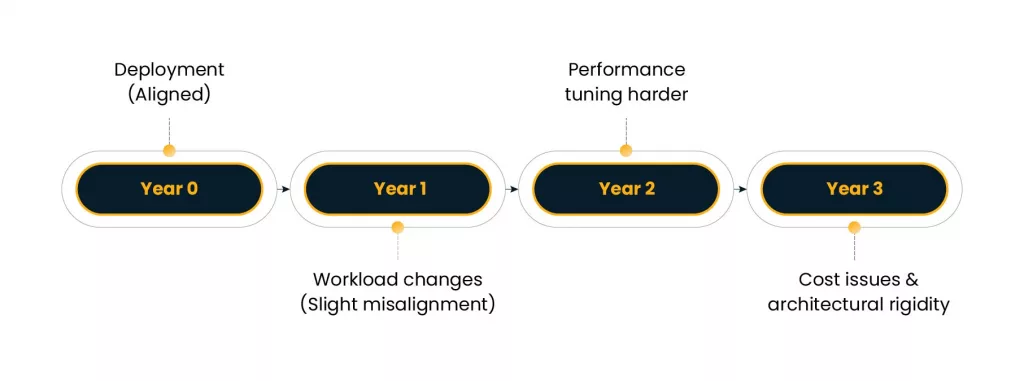
Architecture Drift Happens Quietly

How Can Enterprises Build a Balanced Cloud Reference Architecture Strategy? 

A balanced strategy begins with treating each cloud reference architecture as a living framework rather than a permanent template. Teams establish periodic architecture reviews, evaluate workload performance trends, and update deployment patterns when operational needs shift. This practice ensures that the cloud reference architecture evolves alongside application growth and changing usage patterns. 

Two operational practices typically sustain this balance: 

  • Scheduled architecture review cycles aligned with workload performance metrics. 
  • Governance frameworks that allow controlled design adjustments without bypassing compliance requirements. 

Organizations that apply these practices gradually reduce design rigidity while maintaining operational consistency. After that, architecture governance becomes proactive. It allows teams to refine infrastructure before inefficiencies accumulate.  

Many enterprises partner with specialized cloud engineering teams that provide modernization roadmaps and governance frameworks. This support helps internal teams keep evolving workloads aligned with architectural standards. 

As these practices mature, the cloud reference architecture becomes a strategic asset rather than a static design document. This shift enables infrastructure to support long-term scalability, operational clarity, and sustained innovation across enterprise environments. 

Frequently Asked Questions 

1. Why do enterprises struggle even after using cloud reference architecture? 

Many teams assume the architecture will keep working the same way. Workloads change, but the design often stays the same. Small gaps start appearing. Over time, those gaps become harder to fix. 

2. Should every workload follow the same reference architecture? 

Some workloads fit well within a standard design. Others behave differently and need adjustments. When teams allow small changes where needed, systems stay stable and easier to manage. 

3. How often should organizations review their cloud architecture? 

A review once or twice a year usually works well. Reviews also help after large application changes. These checks keep the environment aligned with how systems actually run. 

4. What is the biggest mistake teams make with reference architectures? 

Many teams treat the architecture like a final template. They stop adjusting once deployment is complete. The environment keeps running, but performance tuning becomes slower over time. 

5. How can organizations avoid long-term architecture problems? 

Regular reviews help more than large redesigns. Small adjustments keep systems efficient. Over time, this approach prevents major performance or cost issues. 

Author

Yogita Jain Linkedin
Yogita Jain
Content Lead

Yogita Jain leads with storytelling and Insightful content that connects with the audiences. She’s the voice behind the brand’s digital presence, translating complex tech like cloud modernization and enterprise AI into narratives that spark interest and drive action. With a diverse of experience across IT and digital transformation, Yogita blends strategic thinking with editorial craft, shaping content that’s sharp, relevant, and grounded in real business outcomes. At Cygnet, she’s not just building content pipelines; she’s building conversations that matter to clients, partners, and decision-makers alike.

Related Blog Posts

What is Cloud Native Application Development?

CalendarNovember 18, 2025

The Best Cloud Migration Strategies for Modern Enterprises

CalendarFebruary 03, 2026

Cloud Migration Security: Best Practices to Protect Your Data

CalendarDecember 01, 2025

Sign up to our Newsletter

    Latest Blog Posts

    Digital Banking & Road Ahead
    Digital Banking & Road Ahead

    CalendarMarch 03, 2026

    Claiming GST Input Tax Credit? Here’s a checklist for you!
    Claiming GST Input Tax Credit? Here’s a checklist for you!

    CalendarMarch 03, 2026

    GST Audit: Top 5 Steps To Get Ready!
    GST Audit: Top 5 Steps To Get Ready!

    CalendarMarch 03, 2026

    Let’s level up your Business Together!

    The more you engage, the better you will realize our role in the digital transformation journey of your business


      I agree to the Terms & Conditions and Privacy Policy and allow Cygnet.One (and its group entities) to contact me via Promotional SMS / Email / WhatsApp / Phone Call.*

      I agree to receive occasional product updates and promotional messages from Cygnet.One (and its group entities) on Promotional SMS / Email / WhatsApp / Phone Call.

      Cygnet.One Locations

      India India

      Cygnet Infotech Pvt. Ltd.
      2nd Floor, The Textile Association of India,
      Dinesh Hall, Ashram Rd,
      Navrangpura, Ahmedabad, Gujarat 380009

      Cygnet Infotech Pvt. Ltd.
      6th floor, A-wing Ackruti Trade Center,
      Road number 7, MIDC, Marol,
      Andheri East, Mumbai-400093, Maharashtra

      Cygnet Infotech Pvt. Ltd.
      WESTPORT, Urbanworks,
      5th floor, Pan Card Club rd.,
      Baner, Pune, Maharashtra 411045

      Cygnet Infotech Pvt. Ltd.
      10th floor, 73 East Avenue,
      Sarabhai campus, Vadodara, 391101

      Global

      CYGNET INFOTECH LLC
      125 Village Blvd, 3rd Floor,
      Suite 315, Princeton Forrestal Village,
      Princeton, New Jersey- 08540

      CYGNET DIGITAL IT SOLUTION LLC
      Office 707, Magnum Opus Tower,
      Al Thanyah First, Dubai, U.A.E,
      P.O. Box 125608

      CYGNET INFOTECH PRIVATE LIMITED
      Level 35 Tower One,
      Barangaroo, Sydney, NSW 2000

      CYGNET ONE SDN.BHD.
      Unit F31, Block F, Third Floor Cbd Perdana 3,
      Jalan Perdana, Cyber 12 63000 Cyberjaya Selangor, Malaysia

      CYGNET INFOTECH LIMITED
      C/O Sawhney Consulting, Harrow Business Centre,
      429-433 Pinner Road, Harrow, England, HA1 4HN

      CYGNET INFOTECH PTY LTD
      152, Willowbridge Centre,
      39 Cronje Drive, Tyger Valley,
      Cape Town 7530

      CYGNET INFOTECH BV
      Peutiesesteenweg 74, Machelen (Brab.), Belgium

      Cygnet One Pte. Ltd.
      160 Robinson Road,
      #26-03, SBF Centre,
      Singapore – 068914

      • Explore more about us

      • Download Corporate Deck
      • Terms of Use
      • Privacy Policy
      • Contact Us
      © Copyright – 2026 Cygnet.One
      We use cookies to ensure that we give you the best experience on our website. If you continue to use this site we will assume that you are happy with it.

      Cygnet.One AI Assistant

      ✕
      AI Assistant at your help. Cygnet AI Assistant