



































Enterprise cloud decisions can set the ceiling for cost control, security posture, and AI readiness over the next five years. For CIOs, VPs of Engineering, and Heads of Cloud, the bigger challenge is selecting a partner and defining the scope before technical choices become expensive to reverse.
Weak architecture can lead to runaway spend, recurring audit findings, fragmented governance, and AI initiatives that struggle to reach production. These issues often build gradually, which makes the partner selection stage a critical step.
The right cloud enterprise architecture partner combines cloud-native engineering depth, AWS Well-Architected fluency, a transparent engagement model, named architects, clear deliverables, regulated-industry experience, and FinOps thinking built into the design from the start.
This blog explains how to compare cloud enterprise architecture partners, identify the right signals early, and choose a team that can support long-term cost efficiency, security, compliance, and AI readiness.
What is cloud enterprise architecture?
Cloud enterprise architecture is the practice of designing how an organization uses cloud platforms to support applications, data, infrastructure, security, compliance, and long-term growth. It connects business goals with technical choices so cloud environments stay scalable, secure, cost-efficient, and easier to manage.
A cloud architecture framework usually covers six areas: business, applications, data, technology, security and governance, and AI readiness. These areas guide workload placement, data movement, access control, cost management, and the ability to scale digital or AI initiatives.
When should you bring in a cloud architecture partner?
A cloud architecture partner pays for itself when the cost of a wrong design choice is higher than the cost of the engagement, which in enterprise environments is almost always the case. The harder question is when, exactly, an enterprise has crossed that threshold. Five signals usually mean the answer is now, and most enterprises hit two or three of them at the same time, which compounds the urgency.
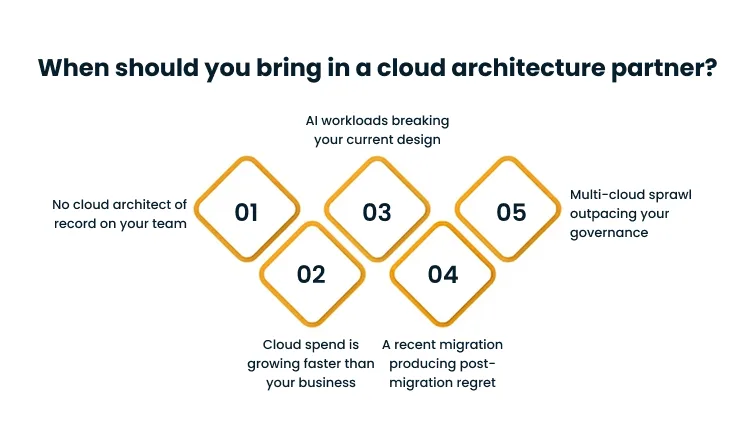
1. No cloud architect of record on your team
When no one owns cloud architecture across business units, teams make separate decisions on identity, security, data, and platforms. Over time, this creates inconsistent access models, duplicate systems, weak governance, and technical debt that becomes difficult to reverse.
External architecture support can bring immediate ownership, document key decisions, create governance standards, and leave future internal teams with a clear foundation to build on.
2. Cloud spend is growing faster than your business
When cloud cost growth outpaces revenue growth or workload growth for two consecutive quarters, the architecture is almost always the cause. According to the 2024 Gartner Forecast on Worldwide Public Cloud End-User Spending, worldwide public cloud spending will reach $723.4 billion in 2025, up 21.5% from 2024.
Inside individual enterprises, that growth often shows up as overprovisioned instances, idle reserved capacity, and storage tiers that no one is actively managing.
A partner runs an architecture review against the cost data to identify which design choices are driving spend and which can be unwound without re-platforming. The output is a remediation plan with named workloads, not a generic FinOps lecture.
3. AI workloads are breaking your current design
GPU-bound workloads, data gravity, and inference latency are pulling many existing cloud architectures past their original assumptions.
According to the 2025 Deloitte Enterprise AI Infrastructure Survey, ambition is not the constraint to scaling AI, infrastructure is, and more than half of the surveyed leaders said CIO or CTO leadership owns the infrastructure integration decisions.
An AI-first cloud architecture team designs the GPU, networking, and data layers as one system rather than three retrofits. Without that structure, AI projects launch on the existing architecture and then hit latency limits, cost spikes, or data residency conflicts that force a rebuild within twelve months.
4. A recent migration producing post-migration regret
Lift-and-shift migrations often expose architectural debt six to twelve months later through cost overruns, security gaps, brittle integrations, and applications that run but struggle to scale.
A post-migration review can identify which workloads need refactoring, retirement, or no change. For organizations on AWS, a structured Well-Architected review to fix migration gaps helps surface issues systematically instead of firefighting them one by one.
5. Multi-cloud sprawl outpacing your governance
When workloads are spread across multiple clouds without a shared identity, network, and policy model, governance fragments and audit cycles become longer. According to 2025 Forrester predictions on cloud, multicloud has shifted from accidental sprawl to a deliberate enterprise strategy.
A cloud architecture team can consolidate this into a multi-cloud reference architecture with one identity layer, one policy-as-code library, and one observability stack, making multi-cloud easier to govern and scale.
What does a strong enterprise cloud architecture look like?
Strong enterprise cloud architecture is built on six connected pillars. Each pillar has a clear role, and the real test is whether a change in one area is reflected across the rest of the system.
A cloud architecture model needs an operating structure that connects decisions, ownership, governance, and execution. Without that connection, most published cloud reference architectures fail in enterprise deployment because they stay theoretical instead of becoming a working system.
1. Business architecture pillar
Business architecture maps the capabilities the cloud must support, including products, markets, compliance requirements, customer journeys, and the workloads behind them. This keeps technical decisions tied to business priorities.
When business capabilities lead, technology choices have a clear rationale. Teams can choose platforms, controls, and services based on the outcomes the enterprise needs.
2. Application architecture pillar
Application architecture defines how workloads run in the cloud, including containerization, serverless, event-driven patterns, modernization paths, and integrations. It also clarifies which applications should be refactored, rehosted, retired, replaced, or deferred.
This pillar sets default patterns, an exception process, and a deprecation path for legacy systems. It keeps teams aligned and prevents the operating model from fragmenting.
3. Data architecture pillar
Data architecture covers residency, sovereignty, retention, access controls, lakehouse versus warehouse decisions, integrations, and AI data needs. In regulated industries, this pillar carries major compliance weight because many controls converge at the data layer.
A mature data pillar treats the data platform as a product with owners, SLAs, and a backlog. This improves data quality, supports AI use cases, and reduces friction across analytics and reporting.
4. Technology architecture pillar
Technology architecture covers cloud platforms, network topology, identity models, automation, and observability. Well-architecture and similar frameworks are useful here because the design choices are concrete.
The framework should guide decisions, surface risks, and clarify tradeoffs across performance, reliability, security, cost, and operations.
5. Security and governance pillar
Security and governance cover identity-first security, account isolation, policy as code, audit trails, and enforcement models. Automated guardrails help developers move faster and make audits easier to support with evidence.
A mature governance model treats the policy library like product code, with reviews, tests, owners, and updates. This keeps security consistent across teams and environments.
6. AI-readiness as the sixth pillar
AI readiness covers GPU and accelerator planning, data pipelines, model governance, latency, and cost behavior. It connects with the data, technology, security, governance, and application pillars.
A clear AI-readiness layer prepares the enterprise for model deployment, data isolation, inference performance, and cost control as AI moves deeper into production.
What does a cloud architecture engagement actually deliver?
A cloud architecture engagement should deliver five practical outputs: a current-state assessment, a target-state architecture, a migration and modernization plan, a governance model, and a handover package. Each output should have a clear owner, timeline, and purpose after the work is complete.
When these deliverables are unclear in the first conversation, the scope needs a tighter definition. Clear outputs help leadership, engineering, security, and operations teams move from assessment to execution with fewer gaps.
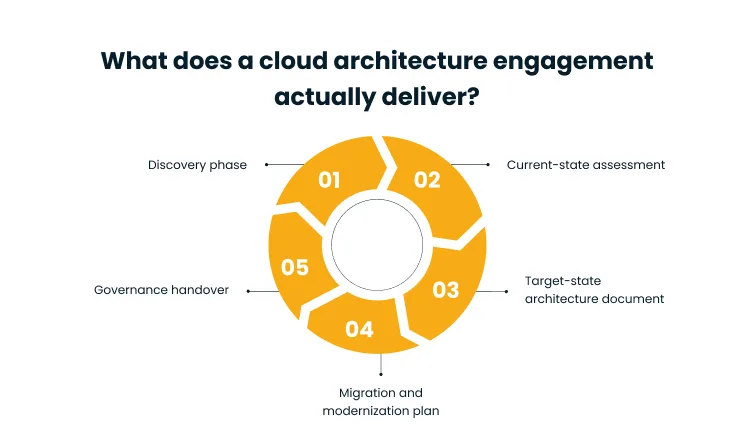
1. Discovery phase
Discovery usually runs for two to four weeks and sets the foundation for the work. It captures stakeholders, workload inventory, compliance and residency constraints, vendor commitments, and executive-approved outcomes.
This phase helps teams catch scope issues early, align priorities, and give later architecture decisions a clear reason.
2. Current-state assessment
A current-state assessment documents how the existing cloud environment performs across architecture, security, operations, compliance, and cost. It identifies specific gaps behind each recommendation.
Useful findings name the affected accounts, workloads, controls, recovery targets, and cost centers. This gives the steering committee clear actions to fund.
3. Target-state architecture document
A target-state architecture document defines the future cloud model across identity, networking, data, AI platforms, governance, FinOps, and operations. It should give internal teams enough detail to implement and update specific areas over time.
With regular reviews, this document can guide cloud decisions for three to five years as business priorities, compliance needs, and cloud services evolve.
4. Migration and modernization plan
A migration and modernization plan sequences workloads by risk, dependency, and business priority. For AWS environments, it should map each workload to the 7Rs of an AWS migration strategy: rehost, replatform, refactor, repurchase, retire, retain, or relocate.
The plan should also define phase gates, exit criteria, owners, and rollback procedures so teams can migrate with less disruption and fewer cost or compliance surprises.
5. Governance handover
Governance handover transfers the operating model behind the architecture. It should include policy-as-code, onboarding runbooks, FinOps cadence, escalation paths, and named internal owners.
A clean handover usually runs over four to eight weeks while internal teams take ownership of artifacts, standards, and review routines.
How do you choose a cloud architecture consulting partner?
Choosing a cloud architecture consulting partner is a six-criterion decision plus a short list of questions that expose the difference between a partner that has done this work and one that has slides about it. The criteria filter the longlist. The questions test the shortlist in real conversations.
1. Cloud-native engineering depth
Assess engineering depth through sample architecture artifacts, named architects, and references from similar enterprise workloads. A capable team should explain recent design decisions, tradeoffs, and implementation outcomes clearly.
The lead architect matters more than the firm logo. Engagement quality depends on the person guiding the platform, workload, security, and governance decisions.
2. Partner tiers and AWS specializations
Partner tiers and AWS specializations, such as Advanced Tier, Premier Tier, and competency badges, indicate sustained delivery experience on the platform. They also show access to deeper platform support for complex design questions.
Check which competencies the team holds, such as security, migration, data and analytics, or machine learning. These credentials show where the actual platform depth sits.
3. Regulated-industry experience
Regulated-industry experience is assessed by the compliance regimes the partner has shipped under, such as PCI, HIPAA, GDPR, RBI, GST, and country-specific data residency, and the audit posture of the architectures they have delivered. Generic enterprise references are not a substitute.
According to the 2023 Accenture Cloud Outcomes Report, even heavy cloud adopters fully achieve their expected outcomes only 47% of the time, with medium adopters at 36% and low adopters at 21%, and regulated-industry programmes typically sit at the higher end of complexity. A partner with sector-specific track records reduces that risk because compliance constraints are designed in from day one rather than retrofitted under audit pressure.
4. Engagement model
Test the engagement model through the SoW format, named architect, artifact cadence, review rhythm, and handover approach. Clear answers show how the work will move from assessment to design, planning, and ownership transfer.
A useful SoW names deliverables, dates, responsibilities, and decision owners on both sides. It should also explain what internal teams receive when the engagement ends.
5. FinOps and AI capability
Evaluate FinOps and AI capability through real artifacts, such as a FinOps cadence document, cost governance model, and AI workload architecture. These should cover compute, data pipelines, latency, and security controls.
A credible team can explain GPU provisioning, inference-latency budgets, data movement patterns, and cost controls in practical terms.
Questions to ask in the first call
Use the first call to test delivery quality and ownership. Ask who the named architect will be, what week four will produce, how handover works, what the smallest engagement looks like, and what the last enterprise client would have handled differently.
Specific answers usually come from real delivery experience. Listen for honest tradeoffs, clear examples, and lessons from past engagements.
How does Cygnet.One design cloud enterprise architecture?
Our Cloud Engineering practice designs and reviews enterprise cloud architecture across cloud strategy, cloud-native development, AI-first cloud, migration and modernization, and cloud operations. As an AWS Advanced Tier Partner, we align design decisions with the Well-Architected Framework while keeping each engagement focused on practical deliverables. Our practice also connects with Data & AI, Digital Engineering, and Managed IT to support the full architecture lifecycle.
1. Cygnet.One’s Cloud Engineering practice scope
At Cygnet.One, we structure our cloud engineering practice around five sub-services: cloud strategy and design, cloud-native development, cloud for AI-first, cloud migration and modernization, and cloud operations and optimization.
We scope each engagement around the enterprise’s actual need, whether it is a four-week Well-Architected review or a multi-quarter modernization program. Pricing, timelines, and deliverables are tied to the sub-services selected.
2. ORBIT migration framework
We apply the ORBIT migration framework to guide each migration through discovery, design, build, validate, and operate phases. Clear gates and written exit criteria keep the work controlled, help teams complete design decisions early, and reduce gaps that often appear in lift-and-shift migrations.
In a cloud-native modernization for a UK BNPL fintech serving 1.5 million users, the framework was used to re-architect a monolithic AWS estate into containerised microservices on Amazon EKS, with a 30% AWS cost reduction and 40% faster feature delivery as measured outcomes at handover.
3. AWS Advanced Tier partnership
AWS Advanced Tier partnership means Cygnet.One’s architects are trained and audited against AWS Well-Architected pillars. It also gives engagements access to AWS solution architects for deeper design questions, so architecture decisions can reflect current AWS service patterns.
For regulated and AI-heavy workloads, our access to AWS expertise matters because AWS capabilities continue to evolve across security, data, scalability, and machine learning. It helps bring in specialist input when the design requires deeper review.
4. Cygnet.One’s AI-first cloud track
Cygnet.One’s Cloud for the AI-First track builds GPU capacity, data pipelines, inference-latency budgets, and model deployment patterns into the architecture from the start.
Our approach covers foundation-model deployment, RAG architectures, agentic-workflow infrastructure, and the data-platform layer these workloads depend on. Buyers should ask for the reference architecture document instead of relying on a capabilities slide.
5. Cygnet.One’s FinOps practice
Cygnet.One’s FinOps practice is embedded inside cloud operations and optimization rather than offered as a separate post-migration service. The design intent is that cost governance is in place from architecture day one, not bolted on after the bill arrives.
In a recent AWS workload optimization for a 1,000-employee services firm with annual AWS spend at $1.02 million, the practice produced a 42% compute cost reduction through rightsizing, 58% storage savings via intelligent tiering, and 25% better price-performance through Graviton migration, with zero application downtime during the change.
6. Managed IT continuity
Our Managed IT Services carry the cloud architecture into day-to-day operations through 24/7 monitoring, infrastructure managed services, GRC, and cybersecurity operations. We keep the same policy library, observability stack, and identity model across design and operations.
This continuity helps cloud standards hold up after handover. Our teams operate from the same runbooks and controls used during the architecture engagement, so governance, security, and performance remain easier to manage over time.
Conclusion
Cloud enterprise architecture connects business strategy with the platforms, services, and operating model that run it. The need for expert support becomes clear when teams face no architect of record, rising cloud spend, AI workload pressure, post-migration issues, or multi-cloud sprawl.
A reliable architecture brings six pillars together: business, application, data, technology, security, governance, and AI readiness. A well-run engagement should also deliver clear artifacts, ownership, governance handover, and practical decision-making support from the first conversation.
Cygnet.One’s Cloud Engineering practice, ORBIT migration framework, and AWS Advanced Tier partnership help enterprises build cloud architectures that can support audit readiness, AI scalability, cost control, and multi-cloud governance.
Ready to build a cloud architecture that controls cost, reduces risk, and prepares your enterprise for AI? Book a free demo with Cygnet.One to scope your engagement.
FAQs
A cloud architect manages specific cloud platforms, workloads, or products. An enterprise cloud architect defines the broader enterprise-wide cloud strategy, including governance, operating models, identity, and multi-cloud frameworks. Their decisions guide long-term business architecture and support scalable, consistent cloud adoption across projects.
A cloud adoption framework provides structured guidance for successful cloud adoption, outlining key activities, capabilities, and best practices. Cloud enterprise architecture is the customized architecture designed for a specific business. The framework acts as the strategic guide, while the architecture represents the practical implementation aligned to enterprise goals.
A current-state assessment and target-state architecture for a mid-size enterprise usually takes 8 to 14 weeks. Including migration and modernization planning extends timelines to 16 to 24 weeks. Complete delivery, including migration and governance transition, often takes 9 to 18 months based on workload complexity, compliance needs, and internal team readiness.
Success is measured across three areas: artifact quality, outcome metrics, and handover durability. This includes whether the architecture and migration plan are practical, improve deployment speed and compliance, and remain actively enforced long after the engagement ends. Long-term adoption is the strongest indicator of sustained ROI.
Yes. Architecture reviews, Well-Architected assessments, and FinOps audits provide value even without a migration project. Many organizations conduct them after several years in the cloud to identify architectural drift, improve cost efficiency, optimize performance, and realign cloud environments with evolving workloads and business requirements.
Engagement costs vary by scope and complexity. A focused architecture review generally ranges from $25,000 to $75,000, while a full target-state architecture engagement for a mid-size enterprise often costs between $150,000 and $400,000. Larger migration and modernization programs are typically delivered over multiple phases with separately scoped investments.
Author


Abhishek Nandan
AVP, Marketing
Abhishek Nandan is the AVP of Services Marketing at Cygnet.One, where he drives global marketing strategy and execution. With nearly a decade of experience across growth hacking, digital, and performance marketing, he has built high-impact teams, delivered measurable pipeline growth, and strengthened partner ecosystems. Abhishek is known for his data-driven approach, deep expertise in marketing automation, and passion for mentoring the next generation of marketers.