




































A well-governed KPI gives every team a common reference point for the decisions that depend on it. Revenue is a simple example. Finance may look at recognized revenue, sales may track booked business, and customer success may account for credits or cancellations. Each view serves a valid purpose. The real value comes from knowing which definition applies to which decision, who owns it, and how that logic is carried consistently across reports, dashboards, and analytics systems.
That is where KPI governance becomes operational, where data analytics services help enterprises define, standardize, govern, and operationalize trusted business metrics, especially when enterprises need strong data governance to keep metric ownership, definitions, and usage consistent. It establishes clear ownership for metric meaning, calculation rules, change control, and approved use. Strong enterprise analytics governance ensures those decisions are documented and applied consistently across the systems that consume the data.
This matters more in 2026 because semantic models now feed dashboards, self-service analytics, copilots, and AI agents. The dbt Semantic Layer is documented as a place to centrally define metrics for consistent downstream use. Microsoft describes semantic` models as a business-friendly layer that carries reusable calculations and business meaning into analytics and AI experiences.
When two teams ask the same business question, they should know whether to use the same KPI, an approved variant, or two measures designed for different purposes.
Why Do KPI Conflicts Happen Inside Enterprises?
Metric conflict usually starts before anyone notices it in a board pack.
A team creates a local calculation. Another builds a similar metric with a different filter. A third copies the logic into SQL or a BI measure. Months later, the names still match while the calculations have drifted apart.
Five causes appear repeatedly:
- Different business events: “Revenue” may mean bookings, billings, recognized revenue, or cash collected.
- Different population rules: Teams include or exclude trials, returns, or inactive customers differently.
- Different time logic: Fiscal period, transaction date, posting date, and snapshot date can change the answer.
- Different grain: Customer-level and transaction-level ratios may share a label while answering different questions.
- Uncontrolled copies: Duplicated logic keeps running after the approved definition changes.
A KPI standardization framework should therefore begin with decision context, which connects closely with data product thinking because metrics must be owned, trusted, and used in real workflows. The question is not simply “How is this metric calculated?” Ask, “Which decision is this metric authorized to support?”
A practical KPI governance program records that answer as part of the definition.
KPI Ownership: Who Has the Authority to Define a Metric?
Many governance programs assign an “owner” without defining what ownership means.
The business owner should be accountable for meaning. The data team should be accountable for faithful implementation. The responsibilities should remain distinct.
A useful metric ownership model separates four responsibilities:
| Responsibility | What it covers | Evidence that should exist |
| Business owner | Purpose, policy, intended decisions | Named leader and approved definition |
| Metric steward | Documentation and issue intake | Metric record and dispute log |
| Technical custodian | Logic, tests, lineage | Version-controlled code and validation |
| Consumer authority | Approved places of use | Certified reports, APIs, or AI surfaces |
Analysts can propose a metric and engineers can implement it, while the designated business authority approves what the number means. That separation makes enterprise analytics governance faster because technical teams do not have to settle policy questions disguised as data defects. The metric ownership model also creates a clear escalation path when meaning and implementation diverge.
Define the KPI as a Contract, Not a Label
A KPI name cannot carry enough meaning on its own.
“Active customer,” “gross margin,” “churn,” and “on-time delivery” sound precise until teams compare the rules underneath them. A governed metric needs a compact contract that survives handoffs between business, analytics, engineering, and AI systems.
A useful KPI contract should record:
- Business purpose and decision supported
- Business event, grain, and aggregation rule
- Numerator and denominator where relevant
- Eligible and excluded populations
- Time basis and restatement policy
- Source system authority
- Owner, effective date, version, and approved consumption channels
This is the core of business definitions management. “Customer churn equals customers lost during the period” is documentation. A definition that specifies customer state, period boundary, exclusions, and reactivation treatment is executable governance.
It also gives KPI governance a useful test: can another team reproduce the metric without asking the original author what they meant?
Calculation Logic Needs Version Control and Effective Dates
Metric governance becomes weak when definitions are updated in place.
Suppose “active customer” changes from activity within 90 days to activity within 60 days. If the existing metric is silently edited, historical comparisons can shift overnight. A trend break may look commercial when it is actually definitional.
Each material change should capture the old rule, new rule, reason, approval, effective date, affected assets, and whether history will be restated.
Here enterprise analytics governance can borrow discipline from software change management without forcing business teams through a technical release process. Wording edits can remain lightweight. Changes to logic, grain, inclusion rules, or financial treatment should trigger review.
Once leaders use a metric for targets, forecasts, incentives, regulatory reporting, or resource allocation, its definition becomes part of the control environment.
Where Should Approved KPI Logic Live?
Central definitions help only when downstream tools can use them, which is why metadata management matters for tracing KPI meaning, lineage, ownership, and approved usage.
Modern semantic technologies express reusable dimensions, measures, relationships, and business rules. Looker’s LookML defines semantic models for data structure and business rules. The dbt MetricFlow engine generates queries from centrally defined semantic models and metrics.
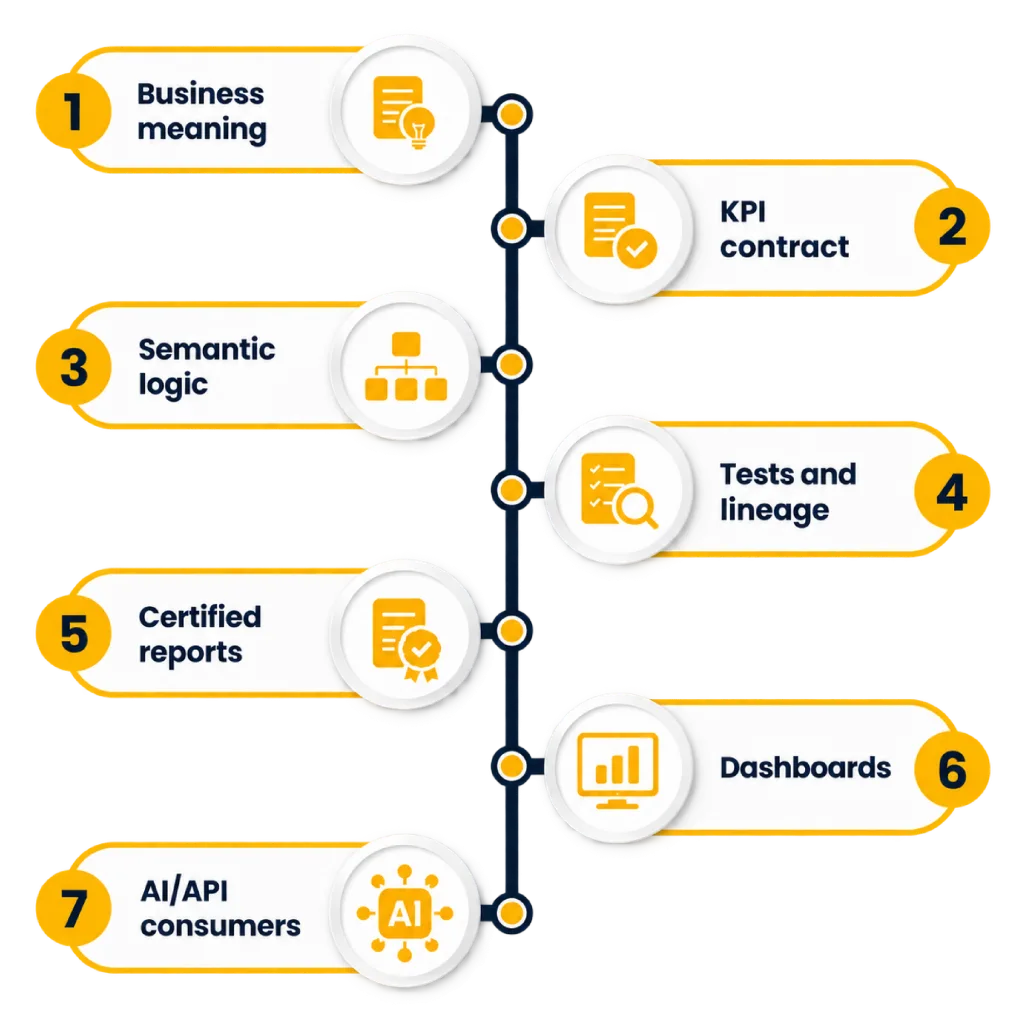
Semantic layer governance should answer four questions: Which metrics belong in the shared layer? Who can change them? How are changes tested? Which downstream assets may override them?
A practical rule is to centralize metrics that cross teams, appear in executive reporting, drive financial decisions, or are consumed by automated systems. Local exploratory measures can remain local until reuse justifies wider control.
This supports one version of truth analytics without pretending every business question has one universal number. Some concepts need approved variants. “Revenue” for statutory reporting can differ from “sales revenue” used in pipeline analysis. Governance should preserve the distinction through explicit names, contexts, and ownership.
The Governance Council Should Resolve Exceptions
A central council can become the slowest part of the model.
A better design uses tiered authority. Domain owners approve routine metrics within policy. Cross-functional or high-impact disputes move to a governance council, especially when they affect executive reporting, incentives, financial statements, regulatory obligations, or AI outputs.
This keeps KPI governance close to people who understand the business process while preserving an escalation route.
The council should review evidence rather than opinions. A disputed metric should come with competing definitions, lineage, affected decisions, and the consequence of each option. The result should be a recorded decision with an effective date. Different departmental versions are acceptable only when the distinction is formally approved and named.
Classify KPIs by Decision Risk
Treating every metric equally creates paperwork.
A better KPI standardization framework classifies metrics by decision risk. An executive margin KPI deserves more control than a temporary campaign diagnostic.
| KPI tier | Typical use | Governance expectation |
| Enterprise | Board, executive, financial, regulatory | Formal owner, controlled logic, lineage, certification, change approval |
| Cross-functional | Shared operational decisions | Shared definition, semantic implementation, monitored usage |
| Domain | Team performance | Domain approval, documented logic, basic testing |
| Exploratory | Analysis and hypothesis work | Clear label, local ownership, no enterprise certification |
This gives enterprise analytics governance a practical boundary. Governance effort follows decision exposure instead of the number of dashboards.
Stop Metric Drift with a Dispute Workflow
Conflicting numbers should create a traceable work item rather than a recurring meeting argument.
Start by identifying whether the conflict comes from freshness, source differences, calculation logic, time treatment, grain, exclusions, or naming. Many apparent disputes disappear once the difference is classified.
For genuine definition conflicts, the owner decides which rule is approved. The steward records the decision. The technical custodian updates shared logic and tests. Downstream owners receive an impact list.
This creates a history of metric decisions. That history strengthens business definitions management because it explains why a rule exists and reduces the chance that a future team “fixes” a deliberate rule because it looks unusual in code.
AI Raises the Cost of Ambiguous Metrics
Dashboard inconsistency is frustrating. AI-driven inconsistency can spread the same ambiguity further.
Salesforce’s second State of Data and Analytics report surveyed more than 7,600 data, analytics, and business leaders. In that research, 91% of business leaders said the rise of AI makes being data-driven more important.
Microsoft now positions semantic models as a foundation for more consistent natural-language answers and governed business definitions in AI-assisted experiences. This gives enterprise analytics governance a new consumer: AI.
That changes the audience for a metric definition. The consumer may be an analyst, copilot, agent, or application calling a metric API. Approved definitions therefore need machine-readable logic, clear metadata, and controlled access. Semantic layer governance becomes part of AI reliability because ambiguous metrics can produce confident answers based on the wrong business interpretation.
How Does KPI Governance Improve Decision Trust?
Decision trust improves when people can inspect how a number became authoritative.
Trust comes from visible controls: named ownership, explicit definitions, reproducible logic, lineage, tests, and change history.
Strong enterprise analytics governance also reduces reconciliation work. Analysts spend less time proving whose number is correct and more time explaining why it moved. Leaders can challenge assumptions without reopening definitions in each meeting.
This is the purpose of one version of truth analytics: a governed path from business meaning to calculation to consumption, with approved variants where needed.
A useful health check is to pick ten metrics from the executive pack and ask:
- Who owns each definition?
- Where is the approved logic stored?
- Which reports reproduce the calculation independently?
- What changed in the last year?
- Which AI or automated systems consume it?
- What happens when two teams dispute the result?
If several answers depend on one analyst’s memory, the reporting environment is carrying definition debt.
Trust the Metric Before You Trust the Dashboard
Enterprise reporting rarely fails because teams cannot calculate a percentage, count, or ratio. It fails because definitions become detached from authority.
Effective KPI governance reconnects the number to a business owner, a documented decision purpose, controlled calculation logic, and approved consumption paths. The operating model should make changes traceable and disputes resolvable.
For enterprise analytics governance, the stronger test is whether the organization can explain who approved the metric, what exact rule is running today, where that rule is reused, and what happens if the definition changes tomorrow.
That is how reporting stops producing competing truths and starts producing decisions people can defend.
Author


Yogita Jain
Content Lead
Yogita Jain leads with storytelling and Insightful content that connects with the audiences. She’s the voice behind the brand’s digital presence, translating complex tech like cloud modernization and enterprise AI into narratives that spark interest and drive action. With a diverse of experience across IT and digital transformation, Yogita blends strategic thinking with editorial craft, shaping content that’s sharp, relevant, and grounded in real business outcomes. At Cygnet, she’s not just building content pipelines; she’s building conversations that matter to clients, partners, and decision-makers alike.