



































Here is what happens in most fast-growing companies: the data team has 12 people, the business has 14 departments, and every single one of those departments thinks their request is the most urgent thing on the planet. As a result, pipelines break and dashboards go stale without strong data quality management.
Domain-oriented data teams fix this by redistributing ownership entirely. Each business domain gets its own embedded data function aligned with data engineering best practices, responsible for producing and maintaining its own data products. The model draws inspiration from data mesh principles formalized by Zhamak Dehghani in 2019, and it has since moved from theory to production at companies like Zalando, Intuit, and PayPal.
This blog breaks down how domain-oriented data teams are structured and what a sound analytics team structure looks like in practice.
What Does ‘Domain-Oriented’ Mean?
A domain is a business area with clear ownership of outcomes, such as, marketing, finance, or logistics.
A domain-oriented data team sits inside that boundary. These are cross-functional squads — usually 3 to 6 people — that handle their domain’s entire data lifecycle:
- Ingestion from source systems
- Transformation
- Quality checks
- Serving outputs
They own the pipeline from raw events to published data products.
Domain-oriented teams have full operational ownership over data products. If their data breaks, they fix it. If a consumer needs a new field, the domain team builds it.
Why Do Centralized Data Teams Stop Working at Scale?
A centralized team starts as five generalists serving the whole company. It works fine in the beginning, but not when the company grows.
By the time there are 8 business units and 40 active dashboards, things start to get messy. At that point, the central team becomes the organization’s biggest bottleneck.
The problems that result from this are:
- Pipeline ownership is ambiguous — when the marketing attribution model breaks, nobody on the central team has enough context to diagnose it quickly.
- Data definitions diverge — the marketing team’s definition of ‘active customer’ and the finance team’s definition are developed and maintained separately, leading to eventual conflict.
- Delivery velocity drops — average time-to-insight stretches from days to weeks as request queues lengthen.
- Trust erodes — stakeholders start maintaining their own spreadsheets because they’ve stopped trusting the official numbers.
But what does a domain-oriented setup actually look like in practice?
How Are Domain-Oriented Data Teams Structured?
The specific analytics team structure varies by company size and domain complexity. However, the core composition is consistent across implementations that work.
| Role | What They Actually Do | Typical Ratio |
| Domain Data Lead | Sets data product roadmap, aligns with business stakeholders, owns SLA definitions | 1 per domain |
| Data Engineer | Builds and maintains ingestion pipelines, manages data contracts with upstream sources | 1–2 per domain |
| Analytics Engineer | Transforms raw data into clean, modeled datasets using dbt; defines business logic in code | 1 per domain |
| Data Analyst | Builds dashboards, runs ad-hoc queries, translates business questions into analytical outputs | 1–2 per domain |
| Data Product Manager | Defines consumers, manages documentation, tracks data product health metrics | Shared across 2–3 domains |
A few things worth noting about this structure. The analytics engineer is often underappreciated. They define key business logic like revenue, active users, and churn in code. They do not let it get scattered across dashboards and reports.
The data product manager role is newer but critical. In data mesh teams, a data product has clear ownership, defined users, refresh schedules, and expectations.
What Is the Relationship Between Data Mesh Teams and Domain-Oriented Teams?
Data mesh is the architectural philosophy. Domain-oriented data teams are how that philosophy takes organizational shape.
The data mesh concept rests on four principles:
- Domain-oriented ownership
- Data as a product
- Self-serve data infrastructure
- Federated computational governance
Domain-oriented data teams operationalize the first two. The third — self-serve infrastructure — is the responsibility of a separate central platform team that builds the shared tooling all domain teams use. The fourth requires a cross-domain governance council.
Case Study: How Zalando Moved From a Centralized Data Lake to a Domain Data Model
Zalando — Europe’s largest fashion e-commerce platform — ran into the centralization wall early. Their engineering team, led by Data Engineering Manager Max Schultze, publicly documented the transition in detail.
The original setup was a centralized data lake managed by an infrastructure team with no domain-specific context.
The specific problems Zalando identified:
- Datasets were provided by a data-agnostic infrastructure team with no domain knowledge, leading to persistent quality issues.
- Pipeline responsibility sat with people who did not understand what the data represented or how it was used.
- The central team became an organizational bottleneck as Zalando’s product surface area grew.
The solution was a shift to domain-driven data architecture, where each product team took ownership of its data products, and the central team’s role changed from pipeline builder to platform provider.
Zalando reported a 40% gain in operational efficiency following this transition and cut manual data processing time by 50%. Data product creation — which previously required coordinating across multiple teams — moved toward a process measurable in minutes rather than weeks.
How Do You Actually Build Domain-Oriented Data Teams? A Step-by-Step Checklist
The transition from centralized to domain-oriented is as much an organizational challenge as it is a technical one. Executives have to accept that data quality is now their teams’ problem, not the data platform team’s problem. That conversation is harder than any infrastructure migration.
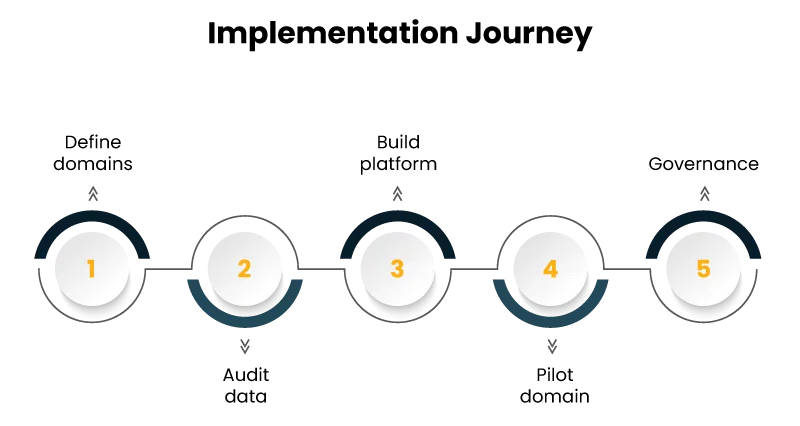
Step 1: Define Domain Boundaries Based on Business Ownership
Start with a simple question: who generates this data, and who is primarily accountable for it? Boundaries should follow P&L lines, product lines, or operational units — not technology systems. A supply chain team owns supply chain data. A marketing team owns campaign and attribution data. If two teams argue over who owns a dataset, that is a signal the domain boundary needs to be redrawn, not a reason to keep it centralized.
Step 2: Audit Current Data Products Before Assigning Teams
Firstly, catalog what data products already exist, who consumes them, and what SLAs (formal or informal) are currently expected. This audit usually surfaces 3–4 datasets that are consumed by 80% of the organization and need dedicated ownership immediately.
Step 3: Stand Up a Central Platform Team First
Domain teams need a self-serve platform to operate on. This means a shared cloud data warehouse (Snowflake, BigQuery, or Redshift), a pipeline orchestration layer (Airflow or Dagster), a data catalog (DataHub or Atlan), and standardized data contract tooling. Without this, domain teams build their own infrastructure, leading to fragmentation. The platform team’s job is to make infrastructure invisible.
Step 4: Pilot With One High-Priority Domain
Pick the domain with the loudest complaints and the clearest data product boundaries. Build the first domain team. Define one data product end-to-end: its schema, its consumers, its refresh SLA, its quality metrics, and its owner.
| Pilot Domain Checklist Item | Done? |
| Domain boundary documented and agreed with business leadership | ☐ |
| Existing datasets audited and consumer map created | ☐ |
| At least one data product fully defined with a schema and SLA | ☐ |
| Data contract established with upstream source system owners | ☐ |
| Quality monitoring set up (row count, freshness, null rate) | ☐ |
| Domain data catalog entry created and published | ☐ |
| Consumer feedback loop established (who uses it, how, how often) | ☐ |
Step 5: Set Up Federated Governance
Each domain team needs autonomy, but the organization needs consistency. Federated governance means a cross-domain council sets shared standards — naming conventions, data type conventions, access control policies, SLA tiers — while domain teams retain control over implementation. Tools support federated cataloging, so each domain team manages its own metadata.
Is Domain-Oriented the Right Model for Your Organization Right Now?
Probably yes, if your organization has more than 5 distinct business units generating their own data, a data team of 10 or more people, and a pattern of stakeholders complaining that the data team is slow.
Probably not yet, if you are pre-Series B, your data team is 3 people, and your biggest analytics problem is that you need more dashboards, not faster delivery. Here, a well-structured centralized team with strong domain documentation is the right call.
The inflection point is usually when a single centralized team regularly misses SLAs, or when two teams maintain conflicting definitions of the same metric.
The Takeaway
Domain-oriented data teams are a structural answer to a structural problem. When a centralized team owns all data for an organization that has outgrown centralization, the result is slow delivery, poor quality, and eroding trust. Moving ownership into the domains fixes the accountability gap.
The implementation requires a shared infrastructure platform powered by Enterprise AI solutions, formal data contracts, federated governance, and business leaders who accept that data quality is now part of their operational accountability. The organizations that have made this shift report faster delivery, cleaner data, and analytics teams that are finally working on the right problems.
The domain-driven data architecture is a structural commitment. But for organizations at the right stage of growth, it is the structure that makes scalable analytics delivery possible.
Author


Yogita Jain
Content Lead
Yogita Jain leads with storytelling and Insightful content that connects with the audiences. She’s the voice behind the brand’s digital presence, translating complex tech like cloud modernization and enterprise AI into narratives that spark interest and drive action. With a diverse of experience across IT and digital transformation, Yogita blends strategic thinking with editorial craft, shaping content that’s sharp, relevant, and grounded in real business outcomes. At Cygnet, she’s not just building content pipelines; she’s building conversations that matter to clients, partners, and decision-makers alike.