







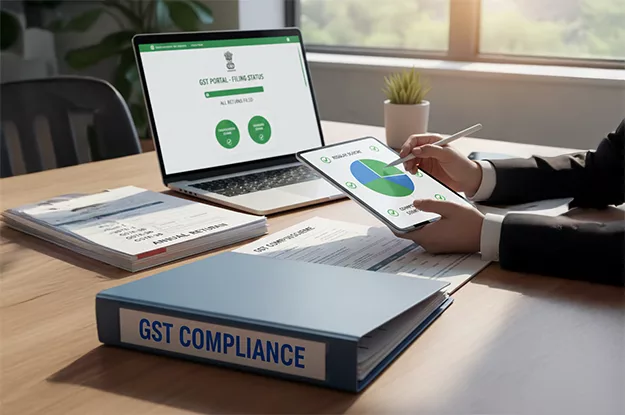



























GST compliance has become much more than just a filling task for Indian enterprises. It has grown to become more complex which has made the manual invoice processes completely insufficient. The organizations who are still employing the manual effort and are processing tens and thousands of invoices in a month are going themselves in a tough spot.
Invoice automation India has now become an operational imperative. The pressure is coming from all directions and GST authorities have stepped up reconciliation scrutiny. Also, GSTR-2B mismatches have led to notices, and the fallout from ITC leakage immediately pertains to the bottom line.
In this environment, finance controllers, AP leaders, and tax heads are revisiting the premise for their invoice processing activities and arriving at a common conclusion. Scale demands automation.
The Challenge of Managing High-Volume Invoices Under GST
Imagine running a bulk manufacturing company with procurement activities in several states with many vendors and hundreds of active ones, thousands working as the source of its business and volumes of invoicing approaching the monthly volume of 50,000.
Each invoice, they state GSTIN, HSN, tax, place of supply, tax value, and line-item requirements must be reconciled in line with data that the supplier has placed as they report in their GSTR-1. But in a retail chain that’s got distributed purchasing, the challenge is made more problematic. Regional bureaus, franchise distributors and direct vendor relationships create invoices in multiple formats
Shared service centres aggregating AP operations for various business units also grapple with the same diversity at greater scale. Hence, the common-sense impacts of high invoice volumes without systematic automation are:
- Mistakes making the errors like on manual entry that occur when capturing invoice in multi-format environments.
- Incentives are bottlenecks when invoices are queued up in departments or business units
- Invoice mismatches due to GSTIN discrepancies, difference in rates and missing fields.
- Long reconciliation cycles that stretch month-end close deadlines.
- Disparate data dispersed over procurement toolkits, ERP systems, email inboxes.
How Manual Invoicing Processes Increase GST Compliance Risks
Manual invoice handling and GST compliance risk are closely tied together and well established. It appears as different aspects at every stage of the invoice process and the collective burden at large enterprises is substantial. Wrong GSTIN capture is one of the most frequent mistakes in a manual processing environment.
With a single digit transposition on the supplier GSTIN, the invoice cannot be matched with the GSTR-2B, and the input tax credit cannot be claimed. At scale, a small error rate translates into material tax leakage. Missing or incorrect invoice fields generate a different risk category.
Manual review alone makes it hard for finance teams to identify these situations, so teams rely on individual vigilance instead of systemic controls that help mitigate GST errors. The consequences of manual invoice processing failures include:
- Vendor mismatches in GSTR-2B reconciliation that require manual resolution with each supplier
- Duplicate invoice submissions that inflate ITC claims and attract audit scrutiny
- Delayed invoice approvals that push GST filings past due dates
- Tax calculation errors that compound across large invoice sets
- Increased finance workload at period-end when reconciliation gaps become visible
The Role of GST Invoice Automation in Validation and Compliance
By automating the invoice process, GST billing risk is addressed at its source: invoice capture and verification. Instead of passing errors to reconciliation or audit downstream, a smart layer of automation performs systematic checking at the very point an invoice enters the processing workflow. The invoice data extraction automation does away with manual keying entirely. The system captures the relevant fields accurately and consistently when an invoice arrives as structured XML coming straight from the supplier’s ERP, PDF via a smaller vendor, or e-invoice using the IRP framework. This underlies all subsequent compliance checks. The validation layer then applies rule-based GST checking against each invoice:
- GSTIN format validation and active status verification against the GST portal.
- HSN and SAC code validation for the applicable tax rates.
- Tax amount computation checks against taxable value and applicable rates.
- Place of supply validation to ensure the correct IGST or CGST-SGST treatment.
- Invoice date and series validation for filing period alignment.
In addition to rule-based validation, AI-based anomaly detection brings in another layer of intelligence. Machine learning models trained on historical invoice behaviour detect unusual tax amounts, atypical vendor behaviour, and supply descriptions that do not align with registered business activities.
These signals can represent data entry error, classification problems, or in very severe instances, fraudulent submissions.
Manual vs Automated Invoice Processing: Compliance Impact
| Dimension | Manual Processing | GST Invoice Automation |
|---|---|---|
| GSTIN Validation | Dependent on manual review | Automated portal-verified check |
| Duplicate Detection | Missed in high volumes | Real-time pattern matching |
| ITC Reconciliation | Monthly, high effort | Continuous, exception-driven |
| Audit Readiness | Reactive documentation | Structured, always-on trail |
| Exception Handling | Email-based, untracked | Workflow-driven with escalation |
| ERP Integration | Manual data entry | Direct, validated data flow |
Duplicate Invoice Detection and Fraud Prevention
Duplicate invoices are risky and they are one of the most persistent roadblocks in enterprise Account Payable (AP) environments. The issue is not limited to obvious errors. In large organisations with multiple procurement channels, multiple approvers, and vendors submitting invoices through different mechanisms, duplicates can enter the system in ways that are genuinely difficult to catch manually.
Common duplicate scenarios in enterprise environments include:
- The same invoice submitted via email and through a vendor portal
- An invoice resubmitted after a payment query with a different reference number
- Multiple invoices for the same purchase order raised by different vendor entities
- Invoices from different billing periods with identical values and similar descriptions
Improving ITC Accuracy Through Accounts Payable Automation
Input Tax Credit (ITC) is significant for large business organizations that come within the GST framework. For instance, the manufacturing industry where raw material procurement generates a great deal of input tax, or in retail, where vendor invoices varies across suppliers, the accuracy of ITC claims directly affects working capital and effective tax cost.
The ITC accuracy is protected through the automated operational mechanism of Accounts payable. The system is straightforward: ITC can only be claimed on invoices that are correctly captured, matched to the corresponding supplier return, recorded in the right period, and approved before the filing deadline. Manual AP workflows introduce friction at every one of these steps.
Automated AP processes improve ITC outcomes through:
- Accurate invoice capture that preserves all GST-relevant fields without transcription errors
- Two-way and three-way matching that aligns invoices with purchase orders and goods receipt notes
- Real-time GSTR-2B reconciliation that flags mismatches at the invoice level rather than in aggregate
- Structured exception workflows that resolve discrepancies before the filing date
- Period-cut controls that prevent invoices from being recorded in the wrong tax period
Enterprise Scenarios Where Invoice Automation Delivers Measurable Value
The operational and compliance benefits of invoice automation are best understood through the lens of specific enterprise environments. Each industry presents a distinct combination of invoice volume, format complexity, and compliance risk.
Manufacturing: Supplier Invoice Management at Scale
A large automotive components manufacturer with procurement across seven states manages inbound invoices from over 600 vendors monthly. Invoice formats vary from EDI outputs from tier-one suppliers to PDF invoices from smaller sub-vendors. The challenge: ensuring that GSTIN details, HSN codes, and tax values across this diverse supplier base reconcile accurately with GSTR-2B before the filing window closes.
With GST invoice automation in place, the enterprise captures and validates invoices at the point of receipt. Rule-based checks flag GSTIN mismatches and HSN anomalies immediately. Automated GSTR-2B reconciliation runs daily rather than monthly, reducing period-end effort by over 60% and increasing eligible ITC capture.
Retail: Distributed Procurement and Vendor Compliance
A national retail chain with procurement operations distributed across regional hubs receives invoices from hundreds of FMCG and general merchandise vendors. Many smaller vendors lack the systems to generate structured invoices consistently, leading to missing fields, incorrect tax rates, and periodic reconciliation failures.
Accounts payable automation introduces a vendor-facing submission portal with built-in GST validation. Invoices that fail validation are returned to the vendor with specific error details before they enter the AP workflow. This shifts the correction burden to the source and reduces internal rework.
Telecom: High-Volume Recurring Vendor Invoices
A telecom operator processing invoices for infrastructure maintenance, network services, and managed operations deals with a combination of high volume and time sensitivity. Vendor invoices must be validated, approved, and recorded within tight payment cycles. Manual processing creates bottlenecks that affect both compliance and supplier relationships.
Invoice automation integrated with the operator’s ERP enables straight-through processing for invoices that meet all validation criteria. Exceptions are routed automatically to the appropriate approver with context.
Shared Service Centres: Centralised AP Compliance
Large enterprise groups that have centralised AP operations into shared service centres face a particular compliance challenge. The SSC processes invoices for multiple legal entities, each with distinct GSTINs, state registrations, and applicable tax treatments. Manual workflows in this environment carry a high risk of cross-entity errors and place of supply misclassification.
A GST compliance platform with entity-level rule sets ensures that each invoice is validated against the correct registration, tax treatment, and reconciliation requirements for the receiving entity. This allows the SSC to scale its operations without scaling its compliance risk.
The Path Forward: Automation as Compliance Infrastructure
Invoice automation has moved past the category of operational improvement. For enterprises managing GST compliance at scale in India, it is now foundational infrastructure.
The manual invoice processing models that were adequate for compliance in lower-volume, simpler-format environments are genuinely unsustainable at enterprise scale. The evidence is in the reconciliation gaps, the ITC leakage, and the audit notices.
The strategic value of GST invoice automation is not only in what it corrects. It is in what it prevents. Systematic validation, real-time reconciliation, and intelligent anomaly detection remove the conditions under which compliance failures originate. The audit trail that results is not assembled after the fact. It is generated as a natural output of every invoice that passes through an automated workflow.
FAQ's
It automates invoice capture, validation, processing, and reconciliation to reduce manual effort and errors.
It validates GSTINs, tax details, HSN/SAC codes, place of supply, and other GST-relevant fields.
Yes. It helps reconcile invoices with GSTR-2B and identify mismatches before ITC is claimed.
It identifies duplicate patterns across invoice numbers, vendors, values, and billing periods.
High-volume businesses such as manufacturing, retail, telecom, and shared service centres can benefit significantly.
Author


Kesha Shah
General Manager - Products Marketing
Kesha Kumar leads the global products marketing team at Cygnet.One, where she turns the complexity of tax and finance transformation into stories that resonate with the people who matter most. She’s the strategic force behind the brand’s presence across India, the GCC, Southeast Asia, and Europe, translating dense subjects like e-Invoicing mandates, digital engineering, and enterprise AI into narratives that inform and drive action. With expertise spanning tax and finance transformation, quality, enterprise applications, and data and AI, Kesha blends sharp strategic thinking with a marketer’s instinct for what truly connects. At Cygnet.One, she does more than build campaigns and content; she shapes the conversations that help enterprises navigate compliance with clarity and confidence, propelling the brand to the forefront of the industry along the way.