



































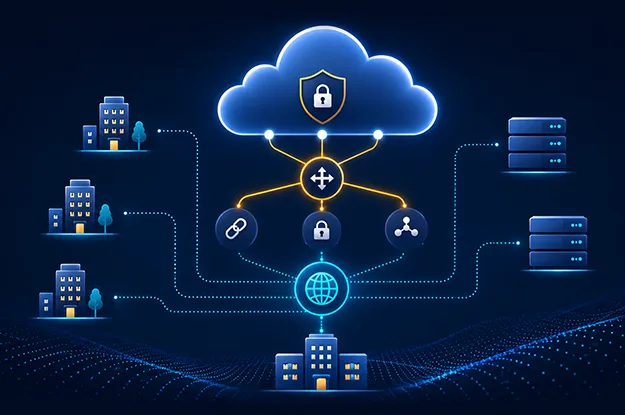
Most network architecture conversations at the enterprise level eventually come back to the same question: what is traversing the public internet, and what shouldn’t be? AWS private connectivity is the answer to that question in practice, where aws cloud consulting services help enterprises choose the right connectivity model for performance, security, and scale. It’s not a single feature or service. It’s a set of decisions about how your workloads, your users, and your data centers connect to AWS infrastructure without exposing traffic to the open internet.
Getting those decisions wrong is expensive. Not just in dollars, but in latency you can’t explain to an application team, in security incidents that didn’t have to happen, and in re-architecture work when a pattern that seemed fine at fifty workloads breaks at five hundred. Hybrid cloud connectivity on AWS requires understanding which tool solves which problem, and more critically, which combinations hold up under enterprise network connectivity AWS teams must manage at scale, especially when designing resilient multi-account AWS architecture.
Why Private Connectivity Matters
The instinct to “just use the internet” is understandable. TLS is secure. VPNs exist. But there’s a difference between encrypted and private. Public internet paths mean variable latency, shared infrastructure, and traffic that passes through routing hops you have no visibility into.
AWS private connectivity exists because that gap is real and consequential. For most enterprises with regulated data, internal SLA requirements, or latency-sensitive workloads, those aren’t acceptable conditions. Secure AWS connectivity patterns exist precisely because the default path isn’t good enough for production infrastructure that needs to behave predictably, making AWS landing zone best practices important for network, account, and security guardrails.
Overview of Direct Connect, VPN, PrivateLink, Transit Gateway, and VPC Peering
AWS Direct Connect
AWS Direct Connect is a dedicated physical connection between your data center and AWS. Traffic doesn’t go over the internet at all. You get consistent bandwidth, predictable latency, and a path that you can size and control. It’s the baseline assumption for any enterprise that’s serious about hybrid connectivity. The tradeoff is time and cost: provisioning takes weeks, there’s a port charge, and you need a colocation provider or a Direct Connect partner in your region.
VPN
VPN is faster to stand up and significantly cheaper. It encrypts traffic over the public internet, which is fine for lower-volume, non-latency-sensitive workloads or as a failover path for Direct Connect. The Direct Connect vs VPN decision usually comes down to whether consistent performance is a requirement or a preference. If your application team is calling you at 2am because latency spikes, VPN was the wrong choice.
AWS PrivateLink
AWS PrivateLink solves a specific problem: private access to AWS services, third-party SaaS products, and your own services across VPC boundaries, without peering or traversing a VPN. AWS PrivateLink use cases cluster around a few scenarios: accessing S3 or DynamoDB without routing through an internet gateway, consuming a partner service without exposing your VPC, or publishing an internal service across VPCs without full network adjacency. It’s interface-endpoint and gateway-endpoint based, and it doesn’t scale transit traffic between networks.
AWS Transit Gateway
AWS Transit Gateway is a regional routing hub. Where VPC peering creates pairwise connections that don’t scale, AWS Transit Gateway creates a hub-and-spoke topology that can connect hundreds of VPCs plus VPN and Direct Connect attachments. Transit Gateway vs VPC peering is essentially a scale question. Peering works fine at small counts, the management overhead becomes real fast, and there’s no transitive routing. Transit Gateway handles both problems.
VPC Peering
VPC Peering is still the right answer in isolated cases: two VPCs that need to talk privately, no need for centralized routing, and low complexity. But it isn’t the foundation for an enterprise network.
Decision Criteria by Latency, Security, Scale, and Cost
Choosing among AWS private connectivity options requires being honest about which requirements are hard constraints versus preferences.
Latency
If you need consistent latency from on-premises, AWS Direct Connect is the only answer. VPN introduces a jitter; PrivateLink is for service-level access, not bulk transit; Transit Gateway adds a routing hop, but it’s within AWS, so the overhead is negligible.
Security
PrivateLink gives the strongest isolation model for service access. It’s unidirectional by design. Direct Connect doesn’t encrypt by default, so MACsec or VPN-over-Direct-Connect matters for compliance-sensitive paths. VPN encrypts but the path is public.
Scale
More than a handful of VPCs, or any topology that needs centralized policy enforcement, points to AWS Transit Gateway. The Transit Gateway vs VPC peering calculus is simple: if your network team needs to track connection state across more than ten VPCs, peering is already creating operational debt.
Cost
VPN is the cheapest to provision. AWS Direct Connect has fixed port costs plus data transfer. Transit Gateway charges per attachment and per GB processed. PrivateLink has endpoint and data processing fees. None of these is the dominant cost in most architectures, but at high data volumes, Transit Gateway’s per-GB fee becomes visible.
Common Enterprise Patterns
Hub-and-spoke with Transit Gateway and Direct Connect
The standard for enterprises with multiple business units or accounts. A shared services VPC attaches to AWS Transit Gateway alongside Direct Connect, with spoke VPCs per team or environment. Transit Gateway route table policies define permitted traffic flows. This is the default starting point for enterprise network connectivity AWS architects recommend.
PrivateLink for shared services
Internal platform teams expose services (logging, secrets management, internal APIs) via PrivateLink rather than full VPC peering. Consumers get private access to AWS services without network-level adjacency. It’s cleaner than peering for service meshes that don’t need general connectivity.
VPN as Direct Connect failover
AWS Direct Connect can fail. A VPN in active/passive configuration behind a virtual private gateway or Transit Gateway attachment gives you continuity without paying for dual Direct Connect. For most enterprises, this is better than paying for a redundant Direct Connect circuit just for failover.
Isolated workload access via PrivateLink
High-compliance workloads that need access to AWS-managed services (ECR, Secrets Manager, Systems Manager) use interface endpoints per service rather than an internet gateway. No traffic leaves the VPC boundary. This is the implementation of private access to AWS services in its most literal form.
Connectivity Design Checklist
Before you finalize an architecture, run through these:
- Does your workload require consistent latency from on-premises? If yes, Direct Connect is mandatory.
- Are you connecting more than five VPCs, or do you expect that number to grow? Start with AWS Transit Gateway even if peering feels simpler today.
- Do services need to be shared across VPC or account boundaries without full network peering? Define your PrivateLink strategy before you start building service endpoints ad hoc.
- Is VPN your only on-premises path? It needs to be sized for the actual traffic volume, not a conservative estimate, because VPN throughput limits are real and they surface at the worst times.
- Have you accounted for encryption on Direct Connect paths that carry regulated data? A dedicated connection isn’t the same as an encrypted one.
- Does your Transit Gateway route table design match your segmentation requirements? The routing logic is powerful, but it requires an intentional design. Default routes propagating everywhere is an architecture decision, even if it wasn’t made consciously.
AWS private connectivity is not a checkbox. It’s a set of deliberate choices about which traffic goes where, under what conditions, and with what guarantees. The tools are mature. The decisions aren’t.
Author


Yogita Jain
Content Lead
Yogita Jain leads with storytelling and Insightful content that connects with the audiences. She’s the voice behind the brand’s digital presence, translating complex tech like cloud modernization and enterprise AI into narratives that spark interest and drive action. With a diverse of experience across IT and digital transformation, Yogita blends strategic thinking with editorial craft, shaping content that’s sharp, relevant, and grounded in real business outcomes. At Cygnet, she’s not just building content pipelines; she’s building conversations that matter to clients, partners, and decision-makers alike.