

































A production launch can look healthy and still be operationally unfinished. The application responds, dashboards show data, and backups exist. Then the first incident exposes what the review missed: an alert nobody owns, a role the on-call engineer cannot assume, or a backup that restores into the wrong network.
That is the purpose of AWS operational readiness, where aws cloud consulting services help define production readiness gates, operating controls, and launch governance. It asks whether the workload can be operated under pressure with the access, telemetry, recovery controls, cost signals, and support ownership available on the day it goes live.
AWS places operational readiness inside the Operational Excellence pillar of the Well-Architected Framework and recommends evaluating the workload, procedures, processes, and people before production. It also calls for explicit support plans for production workloads.
For enterprises, this review should work as a release gate. Architecture approval answers whether the design is acceptable. AWS production readiness answers whether the operating model around that design has been proven.
What Does Operational Readiness Mean Before Production?
A useful review starts with a simple test: can the operations team detect a meaningful failure, identify what changed, contain the issue, recover service, and explain the business impact without depending on the original project team, which is why cloud-native observability matters before launch.
If the answer depends on tribal knowledge, the workload is carrying launch risk.
This is why a serious AWS operational readiness review checklist should examine evidence rather than configuration presence. “CloudWatch enabled” is weak evidence. “The payment latency alarm fired during a test, opened the correct incident route, reached the named on-call owner, and linked to a runbook” is much stronger.
A practical review should classify each control into three states:
- Configured: The service, policy, alarm, backup rule, or process exists.
- Connected: It reaches the right workflow, person, or system.
- Proven: The team has exercised it and retained evidence.
The third state exposes work that would otherwise surface during an incident.
How to Validate AWS Identity and Access Before Production
Identity review often becomes a policy inspection. Production operations require a broader test.
AWS IAM guidance recommends federation for human users, temporary credentials for workloads, MFA, least privilege, and regular removal of unused identities and permissions. Production validation should also test how access behaves when normal workflows break.
For AWS production readiness, verify:
- Operations engineers can assume the intended production roles through the approved identity path.
- Emergency access has named owners, strong authentication, logging, and review.
- CI/CD roles cannot perform unrelated administrative actions.
- Cross-account access works in the accounts and Regions used by the workload.
- Incident access does not depend on a developer being available.
- Root credentials are protected and excluded from routine operations.
One revealing test is to give an on-call engineer a realistic incident scenario and ask them to reach the required resource using only documented access. A technically correct permission model can still fail operationally.
For teams evaluating production readiness AWS controls, this is the kind of issue to find before release.
Security Controls Need Live Findings and Clear Ownership
A security service being enabled does not prove that a security operating process exists.
Security Hub CSPM evaluates enabled controls and generates findings across supported services. AWS notes that after a new standard is enabled, some findings can take up to 24 hours to appear. A clean console immediately after enablement can therefore create false confidence.
Ask who receives a high-severity finding, which findings can block release, how exceptions are recorded, and who verifies closure.
CloudTrail deserves the same treatment. AWS recommends centralized logging, all-Region coverage, encryption, integrity validation, and controls that prevent logging from being disabled. Confirm that the audit trail reaches the expected destination and remains searchable during an investigation.
The goal is a working detection-to-response path, with evidence.
What Should AWS Monitoring Prove Before Go-Live?
Dashboards make activity visible. They can also hide poor monitoring design.
AWS states that dashboards should complement alerting. CloudWatch also provides recommended alarms for supported services, including infrastructure-as-code definitions for some recommendations.
The harder part of AWS production readiness is deciding which signals deserve action. A useful production alarm should answer four questions:
- What user or business function is at risk?
- What condition indicates a meaningful problem?
- Who receives the alert?
- What is the first diagnostic or containment action?
CPU utilization may matter. A checkout failure rate, queue age, dependency timeout rate, exhausted connection pool, or failed background job may reveal service impact sooner.
This is where cloud launch readiness becomes practical. Break a downstream endpoint or force an authentication failure in a safe environment. Confirm that the alert contains useful context and reaches someone who can act.
Telemetry should reduce investigation time. Collecting data alone does not satisfy the review.
Can Your Logs Reconstruct What Happened?
Logging reviews often focus on retention and storage. Production teams also need to reconstruct an event sequence.
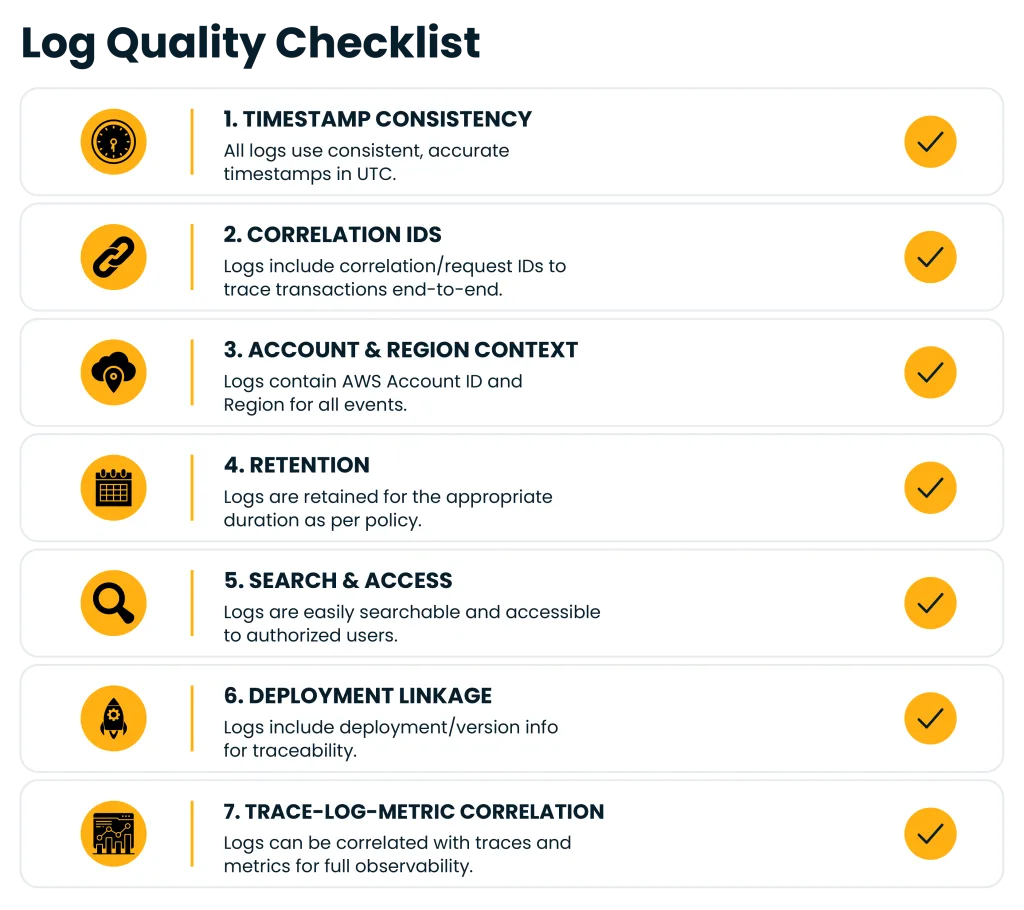
Validate timestamps, correlation identifiers, account and Region context, retention, search access, and links between logs, metrics, traces, and deployment events.
Then test a real question: “Which deployment or configuration change preceded this failure?”
CloudTrail records AWS API activity and can help identify who or what changed a resource, from which source, and when. Application logs should provide the service-level story around that change.
If teams collect large volumes of logs but cannot answer basic incident questions quickly, launch evidence is incomplete.
Backups Are Ready Only After Recovery Has Been Exercised
A successful backup job proves that data was copied. It does not prove usable recovery.
AWS Backup supports scheduled restore testing and records restore duration. Its restore-test validation can also record whether the restored resource passed a customer-defined validation workflow.
That changes the standard for AWS production readiness. Before production, recovery validation should cover:
- Which resources are protected and intentionally excluded.
- Whether recovery points meet retention requirements.
- Whether encryption keys and permissions are available during restore.
- Whether cross-account or cross-Region copies are required.
- Whether restored resources can reach required networks and dependencies.
- Whether application-level validation confirms usable data.
- Whether observed restore duration fits the recovery objective.
AWS Backup controls can evaluate items such as cross-Region copies, Vault Lock usage, encryption, and whether restore time meets a target.
A dated restore result, application validation record, owner, duration, and remediation note are stronger evidence than a backup-status screenshot.
Cost Visibility Must Be Ready Before Real Traffic Arrives
Cost review is often scheduled after launch. That creates a blind spot.
A production workload should enter service with cost ownership defined. Cost allocation should map spend to the application, environment, team, or business unit. Budgets and anomaly routes need named recipients.
AWS recommends cost visibility by team, application, environment, or other useful dimensions, and supports Budgets, Cost Explorer, and Cost Anomaly Detection for monitoring and notification.
One operational detail matters here. AWS states that Cost Anomaly Detection uses Cost Explorer data that can be delayed by up to 24 hours. Therefore, AWS security monitoring cost validation should distinguish between security telemetry that needs rapid response and cost controls that may operate on delayed billing data.
Ask what happens when usage jumps unexpectedly. Who investigates? Which resources can be reduced without harming service? Who can approve that action?
Cost ownership belongs in operational readiness because an unexplained billing spike still needs an owner and response path.
AWS Operational Readiness Requires Quota Checks
Quotas rarely attract attention in architecture diagrams. They become important when launch traffic, retries, failover, or automation pushes a service near a limit.
AWS recommends reviewing service quotas before production and monitoring utilization as workloads approach quota thresholds. For multi-account or multi-Region designs, required quotas should exist in each environment involved in production or failover.
For AWS operational readiness, identify the quotas tied to the critical path. Record current values, expected demand, warning thresholds, request lead time, and the owner responsible for increases.
Include third-party dependencies. API limits, certificate expiry, DNS controls, external identity providers, and vendor support terms can enter the failure path.
This is where enterprise AWS operations should connect technical readiness to vendor and platform ownership.
Support Handover Should Work Without the Project Team
The final readiness gap is usually organizational. AWS Well-Architected guidance recommends documented production support plans, current support contacts, clear escalation instructions, and an appropriate AWS Support level for the workload’s service needs. AWS Health events can also be routed through EventBridge so events affecting AWS resources can enter established notification or incident workflows.
A handover is complete when support can operate the workload without relying on project memory.
For AWS production readiness, validate ownership for incidents, changes, security findings, backup failures, cost anomalies, quotas, and vendor cases. Confirm escalation contacts. Open a test support case if that route matters to recovery.
A useful handover exercise is simple: remove the implementation team from a simulated incident and see what breaks.
A Pre-Production AWS Review Checklist That Produces Evidence
The following checklist is designed as a decision tool rather than a documentation inventory.
| Review area | Evidence required before approval | Failure the review should expose |
| Identity | Tested operator access, emergency path, role ownership | On-call staff cannot reach production safely |
| Security | Findings routed, severity ownership, exception record | Findings exist with no response path |
| Monitoring | Tested alarms, recipients, runbook links | Telemetry exists but nobody acts |
| Logging | Searchable audit and application history | Incident sequence cannot be reconstructed |
| Backup | Successful restore and application validation | Backup exists but recovery fails |
| Cost | Allocation, budgets, anomaly ownership | Spend rises without accountable response |
| Quotas | Critical limits reviewed in required accounts and Regions | Demand or failover hits a service limit |
| Support | Named owners, escalation route, vendor contacts | Incident stalls while teams find the right contact |
Use the AWS operational readiness review checklist as a release record. Each item should have an owner, evidence link, result, exception, and expiry date where relevant.
A second layer can assess AWS security monitoring cost validation across the launch package: are security signals actionable, is monitoring cost understood, and are log retention choices financially intentional?
For complex estates, enterprise AWS operations should maintain a reusable control baseline so new workloads inherit proven operating requirements, similar to applying AWS landing zone best practices across accounts and workloads.
This makes cloud launch readiness easier to govern and harder to approve on assumption.
What Should Block an AWS Production Launch?
Not every open item deserves a release delay. A useful review distinguishes cosmetic debt from operational risk.
AWS production readiness should be reconsidered when a critical service has no tested alert path, operators cannot obtain required access, recovery has not been demonstrated, audit history is incomplete, a known quota threatens launch demand, or ownership is unclear for a failure that could materially affect customers.
For production readiness AWS reviews, the operative phrase is “show the evidence.” If the control exists but nobody has tested the operating path, record it as unproven.
That discipline prevents the review from becoming a meeting where each team reports that its own configuration is “done.”
Production Readiness Is a Proof Standard
The strongest AWS operational readiness reviews leave behind more than a checklist. They produce an operational proof packet: tested access, alarm evidence, recovery results, searchable logs, cost ownership, quota status, support routes, known exceptions, and named decision owners.
That packet gives the operations team a usable starting point on day one.
It also changes the final launch question. Instead of asking whether the workload has been configured correctly, ask whether the enterprise can operate it through a bad deployment, a security finding, a failed dependency, a restore, an unexpected bill, and an AWS service event with the people and procedures available now.
That is the standard AWS production readiness should meet before production traffic is allowed in.
Author


Yogita Jain
Content Lead
Yogita Jain leads with storytelling and Insightful content that connects with the audiences. She’s the voice behind the brand’s digital presence, translating complex tech like cloud modernization and enterprise AI into narratives that spark interest and drive action. With a diverse of experience across IT and digital transformation, Yogita blends strategic thinking with editorial craft, shaping content that’s sharp, relevant, and grounded in real business outcomes. At Cygnet, she’s not just building content pipelines; she’s building conversations that matter to clients, partners, and decision-makers alike.