


































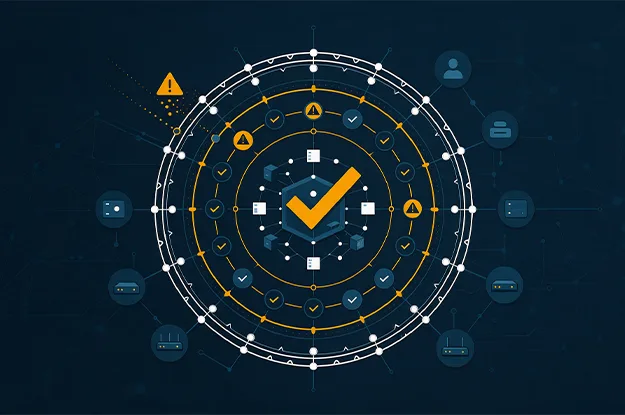
Support breakdowns rarely start with the ticket that finally gets executive attention. They start earlier, often in quieter places: an alert nobody trusts, a runbook that still names a former employee, a recurring incident closed as “resolved,” or an application dependency understood by one engineer and documented nowhere.
That gap between “systems are running” and “operations are healthy” deserves more attention — and it is precisely what a structured approach to IT managed services is designed to close through continuous oversight rather than reactive support.
- Uptime Institute’s 2026 outage analysis found that outage frequency per site has continued to decline, yet around one in ten respondents still said their most recent outage had serious or severe impact.
- Grafana’s 2025 observability survey points to another operational concern: alert fatigue was the most cited obstacle to faster incident response across most organizational roles.
An IT operations health check should therefore examine more than availability. It should test whether the operating model can recognize deterioration, assign ownership, make decisions, and recover under pressure. A managed IT assessment is useful when it exposes those weaknesses before users experience them as “IT support problems.”
The practical question is simple: if three small failures happened at once tomorrow morning, would your support model absorb them cleanly or expose gaps that have been accumulating for months? This is precisely why understanding how to reduce IT downtime in enterprise environments requires examining the operating model, not just the monitoring stack.
Why IT Support Problems Build Up Before the Outage
Operational failure usually has a prehistory. Ticket queues get noisier. Workarounds become normal. Understanding how managed IT services work in enterprise environments helps leaders distinguish a stable operation from one that is quietly accumulating risk. Monitoring produces more warnings than useful signals. Service owners stop challenging repeat incidents because the environment appears stable enough.
This is where enterprises misread health. Green dashboards can coexist with poor recoverability.
A strong IT support maturity review looks for that hidden operational debt. It asks whether teams can distinguish a one-off incident from a recurring condition, whether changes are tied back to service impact, and whether support knowledge survives staff movement.
One useful measure of support health is the distance between a signal and accountable action. The longer that distance becomes, the more fragile the service can become, even when SLA reports still look acceptable.
That distance can be tested through a structured operational review and examined in more detail through a managed IT assessment. The review should start with operational evidence rather than a tool inventory. Begin with recent operational evidence: repeat incidents, delayed resolutions, reopened tickets, noisy alerts, emergency changes, unresolved problem records, and cases where teams had to “find the right person” before work could begin.
What Should an IT Operations Health Check Cover
The review should follow the path an issue takes through the enterprise. A signal appears. Someone must interpret it. A team must own it. The right technical context must be available. Escalation must work. Recovery must be verified.
Review these six areas together:
| Review area | What to examine | Warning sign |
| Monitoring and alerts | Coverage, thresholds, routing, suppression, ownership | Teams routinely ignore or mute alerts |
| Service processes | Incident, problem, change, request, handoff practices | Recurring issues are repeatedly closed without root-cause follow-up |
| Ownership | Service owners, technical owners, vendor boundaries | Responsibility changes depending on who is available |
| Documentation | Runbooks, dependency maps, recovery steps, contacts | Engineers rely on memory or private notes |
| Escalation | Severity rules, response authority, vendor escalation | Critical cases stall while teams decide whom to involve |
| Recovery readiness | Backups, restoration steps, failover, validation | Recovery exists on paper but has not been exercised |
This structure keeps the review focused on operating behavior. It also prevents the familiar mistake of treating monitoring, service desk performance, infrastructure, and recovery as separate conversations.
Review Monitoring Quality, Not Monitoring Volume
Many environments have plenty of telemetry. The problem is signal quality.
CISA recommends logging across servers, firewalls, endpoints, cloud services, and other business systems, along with centralized monitoring, high-risk alerts, protected logs, and defined response roles. The practical challenge is deciding whether those controls help a team act quickly.
During an infrastructure health check, inspect what happens after an alert is triggered. Does it map to a service? Is there a clear owner? Does the alert include enough context to start diagnosis? Is it duplicated across tools? Does the threshold reflect business impact or merely technical activity?
A useful IT operations health check should sample alerts from the last 30 to 90 days and classify them into four groups:
- Actionable and correctly routed
- Actionable but poorly routed
- Informational with no immediate action required
- Repeated noise that should be tuned, combined, or retired
This produces a better view of monitoring health than counting dashboards or integrations.
The same evidence should feed the managed IT assessment. If engineers spend time proving that alerts do not matter, the support model is consuming capacity before a genuine incident even arrives.
Test Ownership Where Systems Cross Team Boundaries
Most difficult incidents do not stay inside one technology domain. An application slowdown may involve database performance, identity, network latency, cloud configuration, a third-party API, or a recent release.
Ownership becomes the hidden bottleneck.
An escalation path assessment should test real scenarios rather than review a contact sheet. Pick three recent incidents and reconstruct the path: who noticed the issue, who accepted ownership, when another team became involved, who had authority to set severity, and where the case waited.
Pay attention to handoff latency. A ten-minute technical fix can still create a two-hour business interruption when teams spend most of the time deciding where the problem belongs.
The managed IT assessment should also check vendor boundaries. When support involves internal teams, providers, or partners, ownership must stay explicit even with incomplete evidence. Ambiguous ownership is most damaging during the first phase of an incident, before it’s clear which component is responsible.
Treat Documentation as Operational Infrastructure
Documentation is often reviewed for completeness. But complete documentation is not necessarily usable documentation. The real test is whether someone can rely on it during an incident.
An IT documentation review should sample the material attached to actual services, including architecture diagrams, dependency maps, support contacts, known-error records, recovery instructions, privileged-access procedures, and maintenance notes, while also checking whether that information is current.
Ask an engineer who does not normally support that service to follow the runbook. If the instructions depend on tribal knowledge, undocumented credentials, obsolete screenshots, or a sequence that only the author understands, the document is not operationally reliable.
This is one reason an IT operations health check should include documentation alongside tools and processes. Documentation changes the speed and consistency of response. It also reduces operational risk when experienced staff members are unavailable.
A managed IT assessment should score documentation by usability, ownership, and freshness rather than by file count. A second IT documentation review should verify whether updated support instructions can be followed by someone outside the original service team.
Look for Gaps Across Applications, Infrastructure, Security, and the Service Desk
A support model can perform well in one layer while hiding weakness in another — one reason enterprises evaluating managed IT vs in-house IT need to look beyond headline SLAs and examine cross-domain operational behaviour. The health review should therefore inspect the connections between four operating domains.
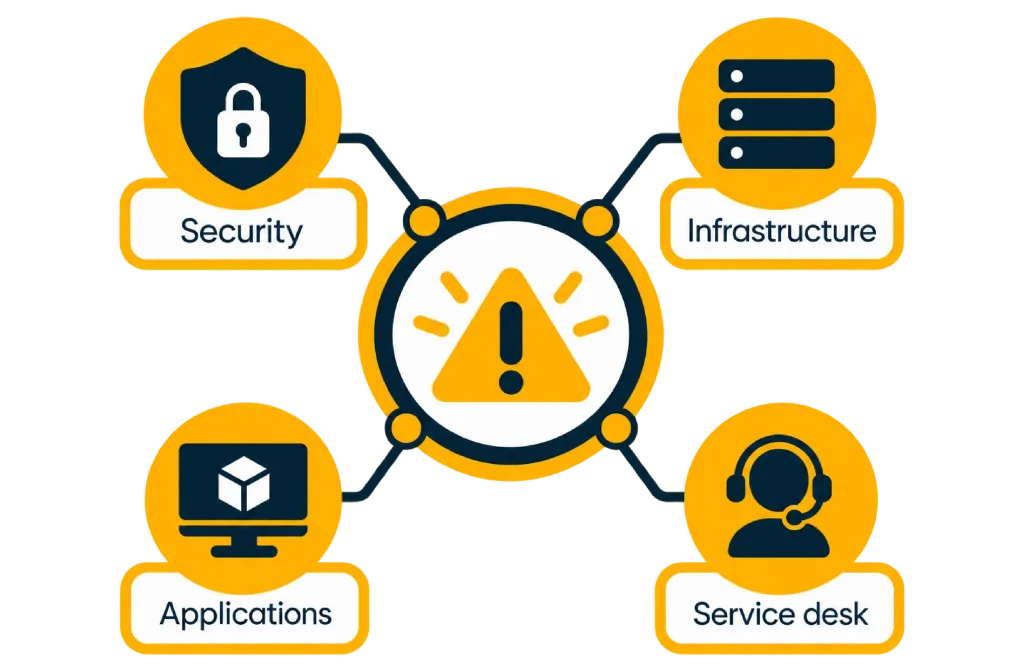
Applications: Review business criticality, dependencies, release history, repeat defects, batch failures, integration errors, and vendor support arrangements.
Infrastructure: Review capacity trends, hardware and cloud events, backup failures, certificate expiry, network dependencies, patch status, and recovery readiness — the same dimensions covered in a thorough IT infrastructure management review. A second infrastructure health check is especially useful for services where application incidents have repeatedly been traced to underlying platform conditions.
Security: Review logging coverage, privileged activity, endpoint visibility, vulnerability remediation handoffs, and the point at which a security event becomes an operational incident. NIST’s 2025 incident-response guidance explicitly places preparation, detection, response, and recovery within broader cybersecurity risk management rather than treating incident response as an isolated activity.
Service desk: Review categorization quality, assignment accuracy, aging tickets, reopen rates, recurring issues, knowledge use, and escalation timing.
The second IT support maturity review should examine whether these domains learn from one another. A service desk may see five “different” tickets that infrastructure recognizes as one platform issue. Security may see authentication anomalies before users report access failures. Application teams may know about a fragile integration that never appears in support documentation.
The purpose of the review is to identify dependencies across these domains before a service disruption exposes them.
Audit Escalation Before You Need It
Escalation paths often look clear until urgency removes the assumptions behind them.
A second escalation path assessment should answer practical questions. Who can declare a major incident? Who can approve emergency change? Which executive or business owner must be informed? What happens outside business hours? When does a supplier become accountable? What evidence must be collected before escalation?
Run a tabletop scenario and add one complication: the primary service owner is unavailable.
If the process immediately becomes uncertain, the organization has identified a real operational dependency.
This is also where a managed services audit can add value. The review should compare contracted responsibilities with operational reality: response commitments, support coverage, reporting, problem management, service improvement, documentation responsibilities, and supplier handoffs. Contract compliance matters, but the better question is whether the arrangement still supports the way the environment actually runs.
Turn Findings Into a Health Score That Leaders Can Use
A health score should compress evidence without hiding it. Avoid one generic percentage that mixes unrelated risks.
Use five dimensions:
| Dimension | Suggested question |
| Detect | Can the team see meaningful deterioration early? |
| Diagnose | Can it reach the right technical context quickly? |
| Own | Is responsibility clear across teams and suppliers? |
| Recover | Can the service be restored through tested procedures? |
| Learn | Do repeat incidents produce permanent corrective action? |
Score each dimension from 1 to 5, then attach evidence and a confidence level. A score of 4 supported by tested recovery records is different from a 4 based on interviews.
The final IT operations health check should show both the score and the weak evidence behind it. The corresponding managed IT assessment should convert those findings into an improvement roadmap with three horizons: immediate control gaps, near-term operating fixes, and structural work requiring budget or architecture decisions.
Prioritize by business exposure, recurrence, detection weakness, recovery uncertainty, and ownership ambiguity. This keeps the roadmap tied to service risk instead of producing a long backlog of housekeeping tasks.
A second managed services audit can then verify whether external support responsibilities, measures, and review cadences need adjustment as part of that roadmap.
The Best Time to Find a Support Failure Is Before It Looks Like One
Healthy IT operations are visible in small moments: alerts reach someone who can act, recurring incidents trigger investigation, documentation survives staff absence, and escalation does not depend on personal relationships.
An IT operations health check gives enterprises a disciplined way to examine those conditions before an outage forces the issue. The final managed IT assessment should leave leaders with more than findings. It should show which operating weaknesses can become business interruptions, who owns each correction, and how progress will be verified.
A meaningful health review should result in fewer assumptions, more tested evidence, and a shorter distance between the first warning signal and accountable action.
Author


Yogita Jain
Content Lead
Yogita Jain leads with storytelling and Insightful content that connects with the audiences. She’s the voice behind the brand’s digital presence, translating complex tech like cloud modernization and enterprise AI into narratives that spark interest and drive action. With a diverse of experience across IT and digital transformation, Yogita blends strategic thinking with editorial craft, shaping content that’s sharp, relevant, and grounded in real business outcomes. At Cygnet, she’s not just building content pipelines; she’s building conversations that matter to clients, partners, and decision-makers alike.