

































Oman’s Fawtara e-Invoicing initiative is changing how businesses create, exchange, validate, and report invoices. For enterprises, compliance is not simply a matter of generating an electronic document. The larger challenge is connecting existing ERP, billing, POS, and accounting systems with the e-Invoicing ecosystem while maintaining accurate tax data and uninterrupted invoice processing.
The Oman Tax Authority’s rollout is phased. The first phase began in August 2026 for 100 large VAT-registered companies, followed by all large VAT-registered companies from February 2027 and remaining VAT-registered taxpayers from August 2027. Government entities are planned for a later phase.
This makes Oman e-Invoicing integration an important technology and compliance consideration for finance, tax, ERP, and IT teams. Businesses need to understand how their existing systems will connect to service providers, how invoice data will be transformed into the required structure, and how validation responses will flow back into business processes.
What Is Oman ERP Integration for E-Invoicing?
Oman ERP integration for e-Invoicing connects an organization’s existing ERP or source systems to the Fawtara ecosystem so that invoice information can be processed electronically in the required structured format.
Businesses do not necessarily need to replace their existing ERP. Instead, the ERP can remain the system of record while an e-Invoicing layer handles activities such as:
- Extracting invoice data
- Mapping ERP fields to required e-Invoice fields
- Validating invoice information
- Converting data into the required structured format
- Sending invoices through the accredited service provider
- Receiving acknowledgements and error responses
- Tracking invoice status
- Maintaining audit records
The Oman Tax Authority describes Fawtara as an electronic operating model connecting taxpayers, service providers, buyers, and the Tax Authority through a five-corner architecture.
For enterprises, this means the integration architecture must account for both tax compliance and operational continuity.
Why Oman E-Invoicing Integration Matters for Enterprises
ERP systems contain the transaction data required to create invoices, but that data may be distributed across multiple modules and systems. Customer master data, product information, tax codes, pricing, payment terms, and transaction classifications may originate from different sources.
An effective Oman e-Invoicing integration approach creates a controlled connection between these systems and the compliance layer.
This is particularly important for large organizations operating multiple entities or business units. An enterprise may have:
- SAP or Oracle ERP for finance
- Separate billing systems
- POS systems for retail transactions
- Custom applications
- Procurement platforms
- Legacy databases
- Multiple invoice generation engines
A centralized integration layer can help standardize compliance processing without forcing every source system to undergo a major redesign.
How Does the Fawtara Integration Model Work?
Oman’s e-Invoicing framework uses a five-corner model involving the supplier, supplier service provider, buyer service provider, buyer, and Oman Tax Authority.
A simplified enterprise flow looks like this:
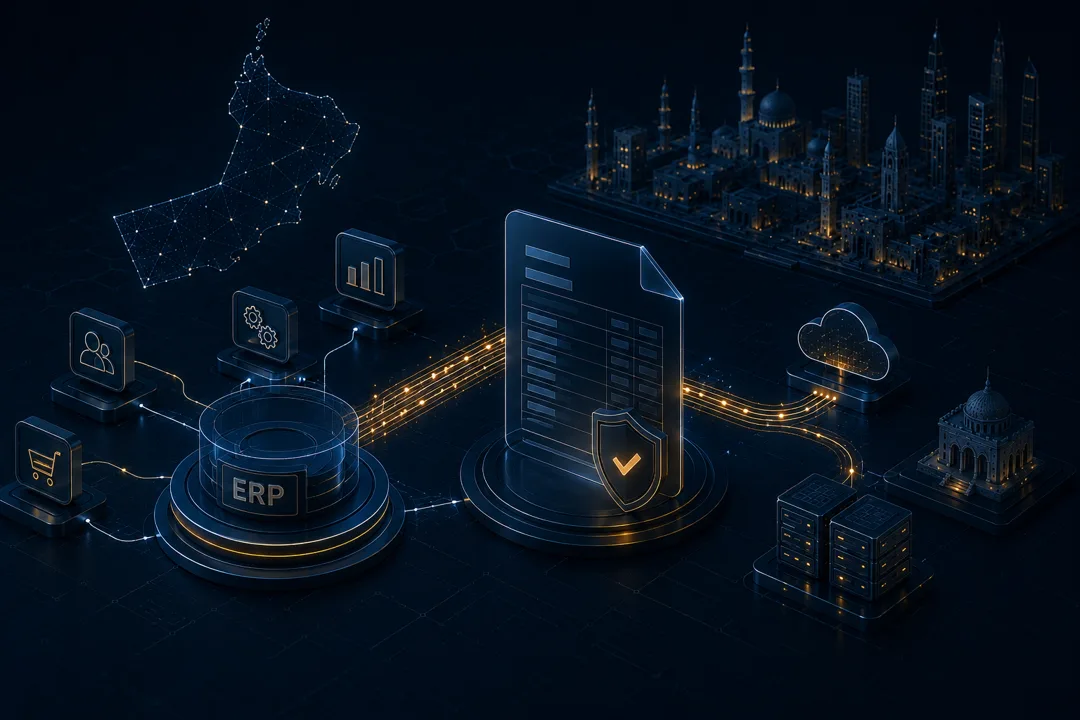
ERP or billing system → Integration layer → Accredited service provider → Buyer/service provider and Oman Tax Authority
The ERP generates the underlying transaction. The integration layer prepares the data for compliant electronic invoicing. The service provider validates and transmits the structured invoice through the relevant network.
This architecture means businesses should not treat the Tax Authority connection as an isolated API project. Integration must cover the complete invoice lifecycle, from source data creation to validation, transmission, response management, and archiving.
What ERP Systems Need to Provide
Before starting an integration project, businesses should identify whether their ERP contains all data required for compliant invoice generation.
Important data areas include:
1. Customer Master Data
Businesses should assess whether customer identification details, VAT information, addresses, country information, and transaction classifications are consistently maintained.
2. Supplier and Vendor Data
Vendor information becomes particularly important for purchase-side processes, reconciliation, and related tax reporting.
3. Product and Service Data
Item descriptions, units, tax classifications, pricing, and applicable VAT treatment should be available in a consistent structure.
4. Tax Data
Tax codes must accurately identify applicable VAT treatments and transaction categories. Incorrect tax mapping can cause invoices to fail validation or create downstream reconciliation problems.
5. Invoice References
Credit notes, debit notes, original invoice references, payment terms, and other document relationships need to be captured correctly.
As part of Oman e-Invoicing readiness, a gap assessment should begin with the ERP’s actual data rather than the integration technology alone.
Oman SAP Integration: What Enterprises Should Assess
For enterprises operating SAP environments, integration planning requires a detailed assessment of the existing architecture. Oman sap integration should not be treated as simply connecting SAP to an external endpoint.
Teams should assess:
- SAP version and deployment model
- Invoice generation processes
- Tax configuration
- Customer and vendor master data
- Billing and accounting modules
- Existing middleware
- Integration interfaces
- Custom fields
- Data transformation requirements
- Error-handling workflows
- High-volume transaction requirements
For organizations using SAP across multiple countries, the integration should ideally support a common architecture while allowing country-specific compliance rules.
A strong Oman sap integration approach should therefore separate the enterprise’s core transaction model from country-specific e-Invoicing requirements. This makes future regulatory changes easier to manage without repeatedly redesigning the ERP.
What Is Oman API Invoicing?
Oman API invoicing refers to using application programming interfaces to connect an ERP, billing platform, or other source system with the e-Invoicing processing layer.
APIs can support automated movement of invoice information without requiring finance teams to manually upload invoices. Depending on the architecture, the integration may support activities such as:
- Sending invoice data
- Receiving validation responses
- Receiving acknowledgement information
- Tracking processing status
- Managing rejected invoices
- Retrying failed transactions
- Updating the source system
However, API integration is only one possible integration method. Cygnet’s Oman e-Invoicing solution describes support for APIs, SFTP, database connectors, middleware, and file-based models, allowing enterprises to select an approach based on their existing architecture.
Therefore, Oman API invoicing should be evaluated as part of a broader integration strategy rather than as a standalone technical requirement.
Data Mapping Is a Critical Integration Step
One of the most important parts of Oman e-Invoicing implementation is mapping existing ERP data to the required structured invoice model.
For example, an ERP may store a customer’s VAT number, tax classification, address, and invoice type in separate fields. The integration layer must identify the correct source for each required e-Invoice data element.
A typical mapping exercise should cover:
| Data Area | ERP Assessment |
| Customer information | VAT number, name, address, country |
| Supplier information | Legal entity and tax details |
| Invoice details | Invoice number, date, currency |
| Line items | Description, quantity, unit price |
| VAT | Tax code, rate, taxable amount |
| Adjustments | Discounts, credit notes, debit notes |
| References | Original invoice and document relationships |
| Payment | Payment terms and methods |
Poor mapping can create failures even when the underlying ERP transaction is commercially correct.
Validation Should Happen Before Submission
Businesses should not rely entirely on downstream validation to identify problems.
Pre-submission controls can identify missing or inconsistent information before the invoice enters the exchange process. Cygnet’s Oman solution highlights structured invoice validation against Oman requirements as well as acknowledgement and exception tracking.
Validation can cover:
- Mandatory fields
- VAT information
- Tax calculations
- Customer details
- Invoice references
- Transaction classifications
- Business rules
- Data format
- Duplicate invoices
This approach helps reduce common e-Invoicing errors and gives finance teams an opportunity to resolve data issues at the source.
Managing Invoice Responses and Rejections
Integration does not end when an invoice is submitted.
An enterprise system needs to understand what happens after submission. A compliant integration architecture should provide visibility into:
- Accepted invoices
- Rejected invoices
- Pending transactions
- Validation errors
- Transmission failures
- Acknowledgements
- Retry status
- Resolution status
Cygnet highlights centralized tracking of invoice status, acknowledgements, errors, retries, and pending actions through its Oman e-Invoicing solution.
For finance teams, this visibility is important because an invoice rejection can affect payment cycles, customer communication, revenue processes, and tax records.
Integration Challenges Enterprises Should Expect
Multiple Source Systems
Large organizations rarely generate all invoices from one ERP. Billing platforms, POS systems, and custom applications may need to connect to the same compliance layer.
Inconsistent Master Data
Differences in customer, supplier, item, and tax master data can create validation problems.
Legacy Systems
Older applications may not support modern APIs or structured data formats. File-based, database, SFTP, or middleware approaches may therefore be necessary.
High Transaction Volumes
Retail, telecom, utilities, BFSI, and other high-volume businesses need architectures capable of processing large invoice volumes without disrupting operational systems.
Regulatory Changes
Oman is still progressing through its e-Invoicing rollout. The Tax Authority states that taxpayer guidance and project information are updated periodically as implementation and technical developments evolve.
The integration layer should therefore be designed for regulatory change rather than as a one-time implementation.
Oman ERP Integration Checklist
Before going live, enterprises should confirm that they can answer yes to the following questions:
- Is every invoice-generating system identified?
- Are customer and vendor master data complete?
- Are VAT codes correctly configured?
- Are invoice fields mapped to the required structure?
- Can the integration process high transaction volumes?
- Are validation rules implemented?
- Can rejected invoices be identified and corrected?
- Can acknowledgement and invoice status be tracked?
- Are retry mechanisms available?
- Can finance teams access an audit trail?
- Is the architecture prepared for future regulatory updates?
- Can the solution support multiple ERP and source systems?
Conclusion
Oman’s e-Invoicing is both an integration and compliance-readiness project. Enterprises need to connect ERP, billing, POS, and other source systems to Fawtara and they also must make sure invoice data is mapped, validated, transmitted, tracked and archived. So, a scalable Oman e-Invoicing integration plan needs to address the connection of ERP, master data, tax configuration, invoice generation, validation, rejection handling, status monitoring, reconciliation and audit readiness.
For organizations running multiple systems or jurisdictions the integration layer should also provide the flexibility to handle different source systems and changing regulatory requirements. Cygnet helps organizations connect enterprise applications, automate invoice validation and processing, manage exceptions and gain centralized visibility throughout the e-Invoicing lifecycle.
FAQ's
Yes. Enterprises using SAP can integrate their ERP environment with an Oman e-Invoicing solution. The integration should address invoice data extraction, tax-code mapping, master-data validation, structured invoice generation, submission, response handling, and status synchronization.
Oman API invoicing refers to connecting an ERP, billing system, or other source application with an e-Invoicing platform through APIs. It enables automated invoice-data exchange, validation responses, acknowledgements, status updates, and error handling without relying entirely on manual invoice uploads.
Multiple systems, inconsistent master data, legacy systems, data mapping, and handling validation or rejection issues can make integration challenging.
SAP can connect to Oman e-Invoicing through an integration layer that handles data mapping, validation, submission, and response management.
The rollout began in August 2026, followed by large VAT-registered companies in February 2027 and remaining VAT-registered taxpayers in August 2027.
Author


Kesha Shah
General Manager - Products Marketing
Kesha Kumar leads the global products marketing team at Cygnet.One, where she turns the complexity of tax and finance transformation into stories that resonate with the people who matter most. She’s the strategic force behind the brand’s presence across India, the GCC, Southeast Asia, and Europe, translating dense subjects like e-Invoicing mandates, digital engineering, and enterprise AI into narratives that inform and drive action. With expertise spanning tax and finance transformation, quality, enterprise applications, and data and AI, Kesha blends sharp strategic thinking with a marketer’s instinct for what truly connects. At Cygnet.One, she does more than build campaigns and content; she shapes the conversations that help enterprises navigate compliance with clarity and confidence, propelling the brand to the forefront of the industry along the way.