
































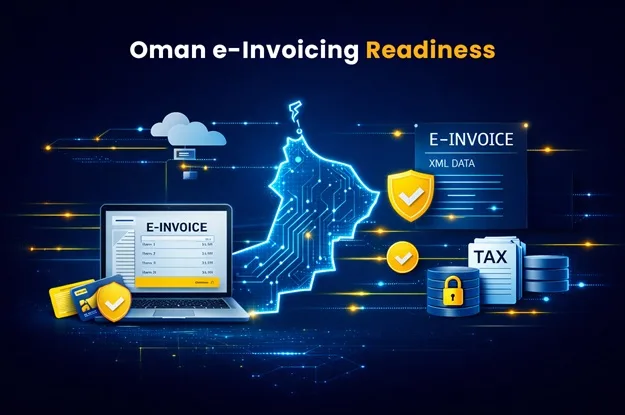
If you run a VAT-registered business in Oman, here is something worth paying attention to right now: e-Invoicing is coming, and it will change more than just how you send bills.
The Oman Tax Authority (OTA) is building a national e-Invoicing system as part of a broader push toward digital tax compliance. The goal is to make tax reporting more accurate, reduce fraud, and bring Oman in line with how many other countries around the world already operate.
But here is the thing many businesses miss: e-Invoicing is not just a technical upgrade. It is a fundamental change in how invoices are created, validated, shared, and stored. A PDF sent over email does not count. The system requires structured digital formats, connected systems, and real-time data flows.
That shift touches finance, IT, procurement, and compliance – all at once. Which is exactly why waiting until the last minute is a bad idea.
Oman e-Invoicing Rollout Timeline
The rollout is happening in stages, starting with the largest businesses and eventually covering everyone:
- August 2026 – 100 large VAT-registered companies go first
- February 2027 – all large VAT-registered businesses
- August 2027 – remaining VAT-registered taxpayers
- Government entities follow after that
In terms of technical requirements, quite a bit is already clear. Invoices will need to be in XML or PDF/A-3 format. Systems will communicate through APIs. Digital certificates will be required. B2B invoices are expected to be submitted in real time.
Some areas – like the exact timing for B2C invoices – are still being worked out by OTA. That uncertainty is actually one of the first challenges businesses need to deal with.
The Real Challenges Businesses Face
Most businesses are not starting from a clean slate. They have existing systems, existing habits, and existing gaps – and e-Invoicing puts all of those under a spotlight.
1. The rules are still evolving
OTA has given businesses a solid direction, but some details are not finalised yet. The B2C timeline is one example. Treatment of certain out-of-scope transactions is another. This creates a genuine dilemma – move too early and risk reworking things later, or wait too long and run out of time. The right answer is to build flexible systems now that can absorb future changes without requiring a complete overhaul.
2. ERP systems may not be ready
OTA has been clear that invoices must be generated from an approved electronic system. Manual uploads are not going to cut it. The problem is that most businesses have complex setups – multiple systems, custom approval workflows, different processes across departments.
The questions every business needs to honestly answer are:
- Can our current ERP generate structured invoices in the required format?
- Can it connect to external platforms through APIs?
- How does it handle rejected invoices or corrections?
- Does it give clear visibility into invoice status?
3. Data quality is often worse than people think
This is the one that surprises most businesses during implementation. Incorrect VAT numbers, incomplete customer details, wrong tax codes – these errors exist in almost every company’s master data. In the old world, they caused minor inconveniences. In the new system, they will cause invoices to be rejected outright. Cleaning up data before the deadline is not optional, it is foundational.
4. Complex transactions need special attention
Standard invoices are the easy part. The harder part is everything else: credit and debit notes, intercompany transactions, VAT groups, high-volume B2C activity. Unlike a traditional invoicing setup where you can simply delete and reissue, the e-Invoicing system requires proper adjustment processes. If those are not mapped out in advance, they become compliance risks.
5. Scale and speed matter more than people expect
Testing a system with a handful of invoices is very different from running it at full operational volume. Real-time processing, high transaction loads, and graceful error handling all need to be part of the design from day one – not an afterthought.
6. Security and audit readiness become non-negotiable
Digital invoicing means digital accountability. Businesses need to be able to answer questions like:
- Who created this invoice and when?
- Was it accepted or rejected by the OTA?
- Were any changes made after submission?
- Where is it stored and for how long?
Having clear, reliable answers to these questions is not just good practice – it will be required during audits.
How to Prepare for Oman e-Invoicing
A smooth Oman e-Invoicing implementation starts with early planning, clean data, and cross-functional collaboration. Focus on these key steps to reduce compliance risks and ensure a successful rollout.
- Treat it as a business project. Involve finance, tax, procurement, and IT teams from the beginning to align business and technical requirements.
- Clean your data first. Audit and update customer, supplier, product, and tax master data before implementing your e-Invoicing solution.
- Test complex scenarios early. Validate credit notes, invoice corrections, intercompany invoices, and other edge cases before go-live.
- Build for future changes. Choose flexible systems that can adapt as Oman e-Invoicing regulations continue to evolve.
- Start well before the deadline. Early preparation gives you time for testing, training, and process improvements while avoiding last-minute compliance risks.
Technology Requirements for Oman E-invoicing Compliance
The good news is that you do not have to build everything from scratch. OTA has indicated that businesses do not need to replace their existing ERP – they just need to make it compatible and connected.
A good e-Invoicing compliance solution takes care of the heavy lifting: connecting to your ERP, automating validations before submission, managing invoice workflows, tracking status across all transactions, and maintaining the records you will need for audits.
Cygnet’s Oman e-Invoicing solution is built specifically for this. It integrates with existing systems, handles large transaction volumes, automates compliance checks, and keeps businesses audit-ready – so the focus stays on running the business rather than managing compliance manually.
The Bottom Line
Oman’s e-Invoicing rollout is not a distant deadline. For large businesses, it is less than two years away. For everyone else, it follows quickly after.
The businesses that will find this transition easiest are not necessarily the ones with the biggest budgets. They are the ones that started early, involved the right people, and built systems that are ready to grow with the regulations.
The ones that wait? They tend to spend significantly more – on rushed implementations, rework, and the kind of compliance problems that are much harder to fix once operations are already live.
FAQ's
e-Invoicing in Oman refers to the generation, exchange, and storage of invoices in a structured electronic format, integrated with the Oman Tax Authority (OTA) system. Unlike PDFs sent via email, compliant invoices must follow specific formats (such as XML or PDF/A-3) and be validated electronically.
All VAT-registered businesses in Oman will eventually be required to comply. The rollout is phased, starting with large taxpayers and gradually covering all VAT-registered entities, followed by government entities.
Invoices must be generated in structured electronic formats such as XML or PDF/A-3. These formats allow system-to-system communication and validation by the OTA.
No. Businesses are not required to replace their ERP systems. However, they must ensure their systems can:
Yes, for B2B transactions, invoices are expected to be submitted to the OTA in real time or near real time. Exact requirements for B2C transactions are still being finalized.
If an invoice fails validation due to incorrect data or format issues, it will be rejected. Businesses must correct the errors and resubmit the invoice. Proper error handling and validation mechanisms are essential.
Author


Shivani Thakkar
Senior Marketing Executive
Shivani is a Senior Marketing Executive at Cygnet.One, where she supports the brand’s marketing presence across the Middle East region. Her work focuses on building campaigns and content around e-invoicing, VAT, and digital transformation, making complex regulatory and technology topics easier for business audiences to understand. With 3 years of marketing experience, she brings together content strategy, brand communication, and B2B storytelling to create messaging that is relevant, practical, and aligned with customer needs. Through her role, Shivani contributes to marketing initiatives that strengthen brand visibility, support audience engagement, and communicate Cygnet.One’s expertise across key regional markets.