































What’s new

Global e-Invoicing

e-Invoicing compliance Timeline

Know More →

Global e-Invoicing

UAE e-Invoicing: The Complete Guide to Compliance and Future Readiness

Read More →

Cygnet Vendor Postbox

Types of Vendor Verification and When to Use Them

Read More →

Cygnet Vendor Postbox

Safeguard Your Business with Vendor Validation before Onboarding

Read More →

Cygnet BridgeFlow

Modernizing Dealer/Distributor & Customer Onboarding with BridgeFlow

Read More →

Cygnet BridgeFlow

Accelerate Vendor Onboarding with BridgeFlow

Read More →

Cygnet Bills

GST Filing 360°: GST, E-Invoicing, E-Way Bills & Annual Returns Made Simple

Read More →

Cygnet Bills

Why Manual Tax Determination Fails for High-Volume, Multi-Country Transactions

Read More →

Cygnet IRP

GST Filing 360°: GST, E-Invoicing, E-Way Bills & Annual Returns Made Simple

Read More →

Cygnet IRP

Key Features of an Invoice Management System Every Business Should Know

Read More →

Cygnature

Automating the Shipping Bill & Bill of Entry Invoice Operations for a Leading Construction Company

Read More →

Cygnature

From Manual to Massive: How Enterprises Are Automating Invoice Signing at Scale

Know More →

What’s new

Data Analytics & AI

AI-Powered Voice Assistant for Smarter Search Experiences

Explore More →

Data Analytics & AI

Cygnet.One’s GenAI Ideation Workshop

Know More →

Digital Engineering

Our Journey to CMMI Level 5 Appraisal for Development and Service Model

Read More →

Digital Engineering

Extend your team with vetted talent for cloud, data, and product work

Explore More →

Quality Engineering

Enterprise Application Testing Services: What to Expect

Read More →

Quality Engineering

Future-Proof Your Enterprise with AI-First Quality Engineering

Read More →

Cloud Engineering

Cloud Modernization Enabled HDFC to Cut Storage Costs & Recovery Time

Know More →

Cloud Engineering

Cloud-Native Scalability & Release Agility for a Leading AMC

Know More →

Managed IT Services

AWS workload optimization & cost management for sustainable growth

Know More →

Managed IT Services

Cloud Cost Optimization Strategies for 2026: Best Practices to Follow

Read More →

Amazon Web Services

Cygnet.One’s GenAI Ideation Workshop

Explore More →

Amazon Web Services

Practical Approaches to Migration with AWS: A Cygnet.One Guide

Know More →

Cygnet TaxAssurance

Tax Governance Frameworks for Enterprises

Read More →

Cygnet TaxAssurance

Cygnet Launches TaxAssurance: A Step Towards Certainty in Tax Management

Read More →

Cygnet TaxAssurance

10 Generative AI Use Cases Driving Enterprise Value

Read More →

Cygnet TaxAssurance

Navigating the Generative AI Landscape

Read More →

Cygnet TaxAssurance

Truly Rise with SAP: The Business Integrators Guide

Read More →

Cygnet TaxAssurance

Mastering SAP S/4HANA Migration: Essential Pre-Migration Strategies and Preparation

Read More →

e-Invoicing Solution South Africa: Get Ready for the SARS Digital VAT Model

Get your finance, tax and IT departments ready for electronic invoicing in South Africa with one system that provides structured invoicing, ERP connectivity, validation, exception management and archiving for auditing purposes, tailored to change as the SARS standards emerge.

Why e-Invoicing Matters in the South Africa

South Africa is moving towards structured e-Invoicing and interoperability. While there is currently no B2B e-Invoicing mandate or confirmed implementation date, the Tax Administration Laws Amendment Act 4 of 2026 introduced definitions for e-Invoices and e-Reporting into the VAT Act.

Under the proposed Digital VAT Model, PDFs, scanned documents and emailed invoices would not qualify as structured e-Invoices. Businesses should therefore prepare their ERP, validation, reporting and archiving processes for future SARS requirements.

When evaluating electronic invoicing software in South Africa, organisations should look for flexible ERP integration, validation, reporting and secure invoice archiving capabilities.

Philippines BIR Electronic Invoicing

Key Challenges Businesses Face

Preparing for e-Invoicing requires businesses to assess whether their systems, data and finance processes are ready for structured invoicing as South Africa’s requirements continue to evolve.

  • Moving from PDF, email, and manual invoicing to structured, machine-readable e-Invoices that can support future SARS requirements.
  • Integrating ERP, accounting, billing, and finance systems with the emerging e-Invoicing and interoperability framework without disrupting operations.
  • Preparing invoice and master data for automated validation, reconciliation, VAT processing, and future near-real-time reporting.
  • Connecting enterprise systems to accredited Service Providers or Access Points under South Africa’s proposed five-corner interoperability model.
  • Preparing Accounts Receivable and Accounts Payable processes to issue, receive, validate, transform, and process structured invoices.
  • Managing invoice validation failures, corrections, exceptions, and resubmissions without delaying finance operations.
  • Maintaining secure, traceable, and audit-ready invoice records in line with tax record-retention requirements.
Common Challenges German Businesses Face

Everything you need to know about South Africa e-Invoicing

e-Invoicing has not been mandated in South Africa. SARS suggests a phased implementation starting from about 2030, which will be voluntary at first and then mandatory by taxpayer category. The dates mentioned here are only indicative.

Who Turnover Applicability Effective Date Format Transaction Type Notes
All businesses Any Current VAT invoicing rules apply; PDF and paper invoices still accepted In force Existing tax invoice rules Domestic

B2B
B2C
Tax records are generally retained for five years.
All businesses Any e-invoice, e-credit note, e-debit note and e-reporting defined in the VAT Act 1 Apr 2026 Structured, machine-readable (technical rules to follow)
B2B
B2C
B2G

(scope to be set)

Does not make e-invoicing generally mandatory. Regulations still to come.
All stakeholders Any SARS VAT Modernisation Consultation Paper 17 Aug 2026 (comments closed 16 Oct 2026) Under consideration: EN 16931 CIUS, UN/CEFACT CII, Peppol PINT BIS
B2B
B2C
B2G
No format or Access Point accreditation rules selected yet.
Selected businesses To be defined Controlled testing (voluntary) 2028/29 (indicative) To be defined
B2B
About six months.
Selected businesses To be defined Production-like pilot (voluntary) 2029/30 (indicative) To be defined
B2B
About six months.
Large businesses Threshold to be defined Phase 5a: voluntary first, mandatory later From 2030 (indicative) Structured e-invoice via accredited Access Points (five-corner model)
B2B
Phased rollout runs about 36 months.
Public sector buyers Any Phase 5b: ability to receive e-invoices From 2030 (indicative) To be defined
B2G
May run in parallel with Phase 5a.
Micro, small and medium businesses Thresholds to be defined Phase 5c: extension with support tools After Phase 5a (indicative) To be defined
B2B
Mandatory dates not yet defined.
Businesses selling to consumers Any Phase 5d: consumers and non-VAT-registered recipients Final phase (to about 2033) To be defined
B2C
Indicative SARS timeline.

Key Features of Our South Africa e-Invoicing Software

Cygnet.One’s South Africa e-Invoicing software helps enterprises prepare for structured invoicing and e-reporting while integrating with existing finance and ERP systems.

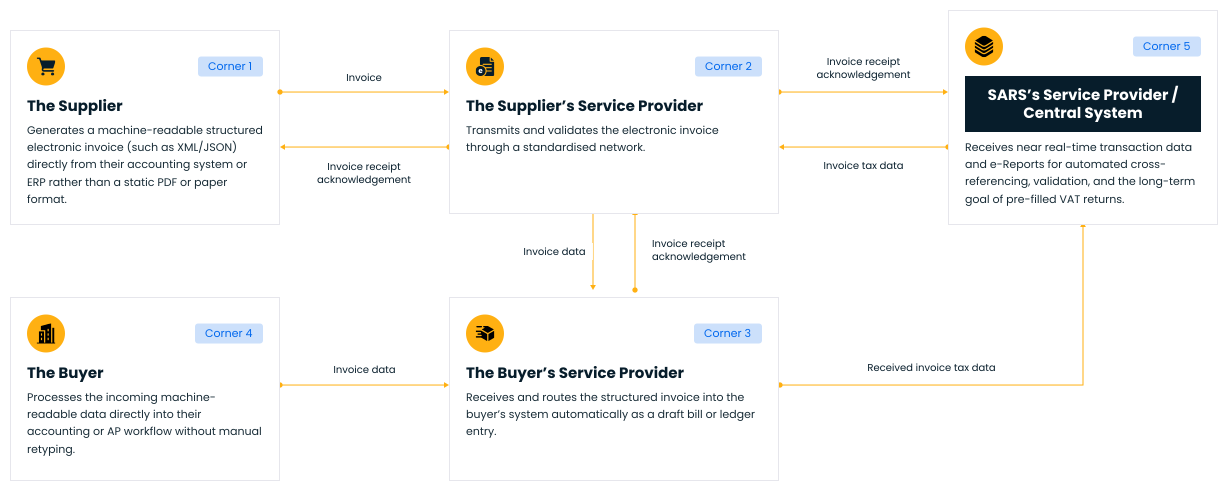
South Africa e-Invoicing Process Flow

Cygnet.One connects your ERP, POS and billing systems to structured e-Invoicing and e-reporting, with validation, exchange, reporting and archival handled in one flow.

Germany e-Invoicing Flow

How It Works

1

Invoice Creation

The supplier generates structured invoice data from its ERP, POS, accounting, or billing system.

2

Validation & Transmission

The supplier’s Service Provider validates the invoice and transmits it through the proposed interoperability network.

3

Invoice Exchange

The buyer’s Service Provider receives the structured invoice and routes it to the buyer’s accounting or AP system.

4

e-Reporting to SARS

Relevant transaction data may be reported to SARS before, during, or shortly after invoice exchange under the proposed model.

5

Processing & Recordkeeping

The buyer processes the invoice within its finance system while invoice and transaction records are retained for compliance and audit purposes.

Cygnet.One streamlines the complete e-invoice lifecycle, from creation and validation to exchange, reporting, and long-term archival, supporting regulatory readiness and operational efficiency.

Our Accreditations

Cygnet.One maintains regulatory compliance and certifications across multiple jurisdictions, ensuring enterprises can adopt a trusted digital invoicing solution for global operations.

Why Businesses Trust Cygnet.One for South Africa e-Invoicing

Organizations worldwide rely on our enterprise-grade e-Invoicing solution. 

26+ Years of Compliance Expertise:

Deep domain experience in global tax and e-invoicing regulations.

SARS Digital VAT Readiness

Built to adapt to structured e-invoicing, interoperability and e-reporting requirements as SARS finalises them.

Africa and Global Market Expertise

Experience supporting e-invoicing mandates across Africa, including Egypt, Kenya, Zambia and Nigeria, as well as APAC, the Middle East and Europe.

Enterprise-Grade Security

Robust infrastructure with advanced data protection and governance.

Flexible Integration Model:

Supports ERP, POS and hybrid system environments

Scalable for High Volumes:

Handles enterprise-scale transaction loads.

End-to-End Automation:

Streamlines invoicing from creation through validation, exchange and reporting, with built-in VAT-vs-e-invoice reconciliation.

Seamless ERP Integrations:

Pre-built connectors for leading enterprise systems.

One Platform, Global Compliance:

Manage South Africa and other global mandates from a unified solution.

Don’t Wait for the Mandate to Start Preparing

Get clarity on your ERP landscape, invoice volumes and readiness gaps before SARS confirms the rules.

FAQs

Not yet. There is currently no general requirement to issue B2B e-invoices and no confirmed effective date. SARS proposes a phased rollout beginning around 2030, initially on a voluntary basis, with mandatory requirements introduced later by taxpayer segment.

It is SARS’s proposed model built on three pillars: structured e-invoicing, an interoperability framework and e-reporting. Invoices would be exchanged through accredited service providers (Access Points) in a decentralised five-corner network, with transaction data reported to SARS

Under the proposed model, no. A PDF, scanned image or emailed invoice would not on its own be an e-invoice. It must be structured and machine-readable so it can be processed automatically.

This has not been decided. The SARS Consultation Paper cites EN 16931 CIUS, UN/CEFACT CII and Peppol PINT BIS as potential references, but the final specification will be set through future regulations.

Not at present. SARS has not selected Peppol or any other standard, and accreditation requirements for Access Points have not been defined.

From 1 April 2026 it added definitions of e-invoice, e-credit note, e-debit note, e-reporting and interoperability framework to the VAT Act and allows regulations for a voluntary e-reporting system. It does not make e-invoicing generally mandatory

Generally, SARS requires tax records to be retained for five years. Confirm current requirements with your tax adviser.

What should South African businesses look for in an e-Invoicing system?

It should create and validate structured invoices, integrate with your ERP, exchange invoices through whichever model SARS confirms, support e-reporting and keep audit-ready records for the required retention period.