



































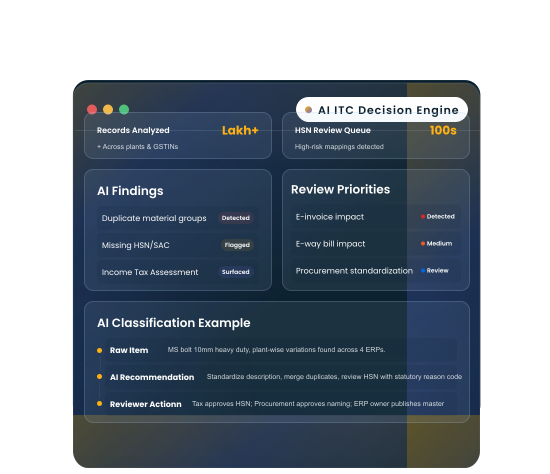
Material Master Data Errors Create GST, Procurement and ERP Risk
Large enterprises often carry years of accumulated SKU, service and material records across plants, entities and ERPs. Descriptions are inconsistent, duplicate records multiply, HSN/SAC codes are selected by judgment, tax rates drift, and critical GST attributes remain incomplete. The result is not just dirty master data. It is e-invoice errors, e-way bill issues, wrong GST treatment, procurement leakage, AP mismatches, reporting gaps and audit exposure.
Best-guess HSN/SAC
Classification depends on local interpretation instead of standardized, statutory-grounded logic.
Duplicate material codes
Similar items exist under multiple names, plants, units and ERP records.
Missing tax attributes
HSN/SAC, GST rate, RCM, exemption, import and business-use tags are incomplete or inconsistent.
Reactive cleanup
Teams fix issues after invoice rejection, audit query, procurement exception or compliance escalation.
How Cygnet Turns Material Master Cleanup into Continuous Governance
Cygnet.One’s AI-native layer reads material and service records, understands context, compares semantic similarity, validates HSN/SAC against statutory definitions, detects duplicate and inconsistent records, assigns confidence scores and routes exceptions to the right reviewer before the data creates downstream business risk.
Ingest
Pull material, service, vendor, invoice, PO, GRN, tax and ERP data from source systems.
Normalize
Standardize naming, units, categories, product families and record structures.
Detect
Identify duplicates, similar items, missing fields, rate mismatches and taxonomy gaps.
Classify
Recommend HSN/SAC, GST treatment and tax attributes with confidence and reason codes.
Review
Route low-confidence and high-risk mappings to tax, procurement or ERP owners.
Publish
Push approved records back into ERP and maintain a governed decision trail.
Two practical AI methods for HSN and Material Master governance
METHOD 1AI HSN/SAC Classification Intelligence
AI HSN/SAC Classification Intelligence recommends accurate HSN/SAC codes with GST rates using product descriptions, images, historical mappings, and statutory definitions.
It adds confidence scores, reason codes, reviewer actions, and audit trails to improve GST reviews, audits, and e-invoice/e-way bill accuracy.
METHOD 2AI Material Master Intelligence
AI Material Master Intelligence detects duplicate materials, inconsistent descriptions, missing attributes, tax mismatches, and plant-wise variations.
It helps standardize ERP data, improve procurement governance, enrich tax attributes, and generate ERP-ready correction files.
Material Master Data Governance Capabilities
Statutory-grounded HSN/SAC recommendation
Recommends HSN/SAC codes using description, taxonomy, historical patterns and statutory logic, reducing reliance on best-guess classification.
Semantic duplicate detection
Finds probable duplicates even when item descriptions, abbreviations, units or plant-specific naming conventions differ.
GST attribute enrichment
Suggests GST rate, tax category, RCM/exemption indicators and business-use tags needed for downstream compliance.
Confidence-scored review
Separates clean recommendations from high-risk or low-confidence records that require tax or procurement review.
ERP-ready correction workflow
Generates approved corrections and enriched records that can be published back into SAP, Oracle, Microsoft, Tally or other systems.
Audit-ready decision trail
Stores original record, AI recommendation, reason code, source logic, reviewer approval and override history.
Continuous governance
Moves master data cleanup from a one-time project to an always-on monitoring and improvement workflow.
Exception prioritization
Ranks material records by GST risk, invoice impact, procurement value, e-way bill impact and audit exposure.
Natural language review
Allows users to ask questions such as “show high-value SKUs with low-confidence HSN” or “find duplicates across plants”.
From Enterprise Challenges to AI-Driven Procurement Impact
AI-Governed Master material Data management Decisions
Human-in-the-loop review
Tax and procurement teams approve high-risk, high-value, low-confidence or policy-sensitive recommendations.
Explainable AI
Each recommendation includes reason code, classification basis, confidence score, source data and reviewer status.
Audit trail by record
Capture original master, AI suggestion, reviewer action, override reason, approval and publish status.
Role-based access
Control access by entity, plant, GSTIN, material group, function, approval level or reviewer role.
ERP integration governance
Publish approved corrections through controlled data exchange instead of uncontrolled spreadsheet uploads.
Continuous data quality scoring
Track data health by plant, entity, category, owner, tax risk and correction backlog.
Trusted Material Master Governance for Enterprise Teams
Start with a focused assessment of your vendor recommendation process, RFQ award logic, invoice approval risk, vendor performance data and ERP-connected source-to-pay workflows.Live platform walkthroughWalk through AI classification, duplicate clustering, confidence scoring, review queues and ERP-ready correction output.
HSN & master data assessmentBenchmark HSN/SAC accuracy, duplicate records, missing GST attributes and material master governance maturity.
Live platform walkthroughWalk through AI classification, duplicate clustering, confidence scoring, review queues and ERP-ready correction output.
HSN & master data assessmentBenchmark HSN/SAC accuracy, duplicate records, missing GST attributes and material master governance maturity.
Frequently asked questions
AI-native HSN classification uses material descriptions, service descriptions, product attributes, historical mappings, taxonomy and statutory definitions to recommend HSN/SAC codes with confidence score, reason code and reviewer workflow.
AI detects duplicates, similar items, missing fields, inconsistent naming, incorrect tax attributes and classification gaps across ERP material records, then recommends standardized corrections for review.
No. AI recommends, explains and prioritizes. Tax, procurement and ERP owners approve, override and publish final decisions with audit trail.
Cleaner HSN/SAC and GST attributes reduce wrong tax treatment, e-invoice errors, e-way bill issues, invoice mismatches, filing corrections and audit exposure.
The platform ingests standard SAP material master, long text, and purchase order exports, with no custom development or SAP integration required for Phase 1 analysis. For Phase 2 ERP enrichment, approved corrections are delivered as structured files that can be imported through standard SAP workflows, or through direct integration with SAP MDG, S/4HANA, or ECC. Oracle, Microsoft Dynamics, and Tally exports are also supported for organisations running non-SAP environments.