








Build quality into every release.
Let’s identify opportunities to improve coverage, reduce testing effort, and accelerate releases.

e-Invoicing compliance Timeline

UAE e-Invoicing: The Complete Guide to Compliance and Future Readiness

Types of Vendor Verification and When to Use Them

Safeguard Your Business with Vendor Validation before Onboarding

Modernizing Dealer/Distributor & Customer Onboarding with BridgeFlow

Accelerate Vendor Onboarding with BridgeFlow

GST Filing 360°: GST, E-Invoicing, E-Way Bills & Annual Returns Made Simple

Why Manual Tax Determination Fails for High-Volume, Multi-Country Transactions
GST Filing 360°: GST, E-Invoicing, E-Way Bills & Annual Returns Made Simple

Key Features of an Invoice Management System Every Business Should Know

Automating the Shipping Bill & Bill of Entry Invoice Operations for a Leading Construction Company

From Manual to Massive: How Enterprises Are Automating Invoice Signing at Scale

AI-Powered Voice Assistant for Smarter Search Experiences

Cygnet.One’s GenAI Ideation Workshop

Our Journey to CMMI Level 5 Appraisal for Development and Service Model

Extend your team with vetted talent for cloud, data, and product work

Enterprise Application Testing Services: What to Expect

Future-Proof Your Enterprise with AI-First Quality Engineering

Cloud Modernization Enabled HDFC to Cut Storage Costs & Recovery Time

Cloud-Native Scalability & Release Agility for a Leading AMC

AWS workload optimization & cost management for sustainable growth

Cloud Cost Optimization Strategies for 2026: Best Practices to Follow
Cygnet.One’s GenAI Ideation Workshop

Practical Approaches to Migration with AWS: A Cygnet.One Guide
Tax Governance Frameworks for Enterprises
Cygnet Launches TaxAssurance: A Step Towards Certainty in Tax Management

10 Generative AI Use Cases Driving Enterprise Value

Navigating the Generative AI Landscape

Truly Rise with SAP: The Business Integrators Guide

Mastering SAP S/4HANA Migration: Essential Pre-Migration Strategies and Preparation
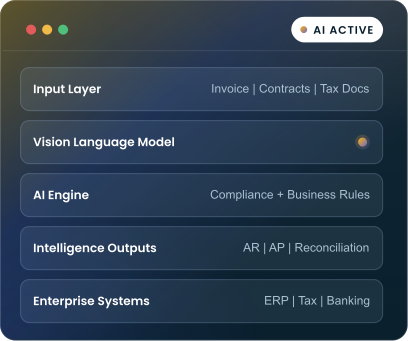
Manual validation, disconnected systems and rule-based extraction create delayed postings, blocked working capital, limited cash visibility and audit exposure. Cygnet.One delivers finance compliance automation as a governance layer - built into every document, not bolted on after.
invoices, credit notes, contracts and tax documents arrive across email, portals, scans and ERPs in inconsistent formats.
tax treatment, VAT fields, vendor status, PO/contract terms and refund eligibility are reviewed late, manually or inconsistently.
ERP, tax, banking and workflow systems operate in silos, weakening forecasting, reconciliation and audit confidence.
Invoices, credit notes and supporting documents are processed slowly, delaying approvals, payments, collections and access to working capital.
Visualizes invoices the way a human would, intelligently extracting layouts, line items, tables, tax fields, payment terms, supporting tax documents, and seals with contextual understanding – regardless of format or template.

Captures supplier, buyer, tax, PO, contract, payment, credit/debit note and line-level values with contextual accuracy.

Applies transaction rules, vendor controls, tax attributes, contract terms, approval thresholds, and reporting requirements to ensure compliance.

Provides payment date prediction, customer risk scoring, vendor compliance status, working capital optimization and cash flow planning.

Creates a reasoning trail for what was extracted, validated, flagged, corrected and posted, giving audit teams confidence.

Capture invoices, contracts, tax forms and credit notes from multiple channels and formats.
VLM reads and contextualizes financial and tax data the way a human expert would interpret it.
AI Engine applies business rules, compliance rules and enterprise context to identify risks and next actions.
Validated outputs are automatically integrated with ERP, tax, regulatory, and banking systems.
Teams manually review invoice data, tax fields, supplier details and supporting documents after the transaction has already entered downstream systems.
VLM reads the full document context, AI validates tax and business rules, and only structured, verified data moves into AR, AP, ERP and reporting workflows.
Fewer manual gaps, stronger VAT refund readiness, improved audit traceability, faster exception closure and better alignment with evolving digital tax frameworks.
Faster posting, improved cash visibility, optimized working capital, fewer blocked invoices and better finance decisions from trusted transaction intelligence.
AI-powered Vendor Postbox is a source-to-pay intelligence layer that recommends vendors for RFQs, evaluates award decisions and flags invoice risks using historical vendor, quote, delivery and invoice behaviour data.
How does AI vendor recommendation work?
AI evaluates submitted quotes against price benchmarks, vendor track record, delivery reliability, quality risk and concentration risk to recommend the best vendor or an alternative split-award strategy.
Invoice risk flagging helps AP teams identify invoices that require additional scrutiny based on vendor rejection history, approval pattern, amount anomaly and erratic billing behaviour.
No. AI recommends, explains and prioritizes. Procurement and finance teams review, approve, reject or override final vendor, award and invoice decisions.
Vendor Postbox AI generates recommendations using historical RFQ, vendor, quote, delivery and invoice data already available within the Vendor Postbox system.
Let’s identify opportunities to improve coverage, reduce testing effort, and accelerate releases.