




































Cloud operations affect cloud costs, uptime, security posture, and audit readiness for years. For most CIOs, VPs of infrastructure, and heads of cloud, outsourcing cloud operations is already a serious consideration. The harder part is choosing the right cloud managed services provider and setting clear expectations before the engagement begins.
This decision is difficult because many providers sound similar in early conversations. They often discuss 24/7 monitoring, FinOps, security operations, compliance support, and faster incident response. The real differences become clear in SLA terms, cost review processes, audit evidence management, escalation workflows, and incident ownership.
A weak provider fit often becomes clear when cloud spend increases, audit requests become urgent, ownership is unclear, or internal teams spend too much time following up with the provider. At that point, changing providers can become expensive and disruptive.
In this blog, you will learn what a Cloud Managed Services Provider does, where accountability begins, and how to evaluate providers before creating your shortlist.
What is a cloud managed services provider?
A cloud managed services provider is a third-party firm that manages an enterprise’s cloud environment after migration or deployment. This includes daily operations such as monitoring, security, governance, compliance support, cost optimization, patching, and incident response under a defined service-level agreement.
A cloud MSP usually supports the following:
- Monitoring: Tracks performance, uptime, alerts, and infrastructure health.
- Security: Manages threats, access controls, and response workflows.
- Compliance: Supports audit readiness, policies, and documentation.
- Cost control: Reviews usage, waste, and FinOps opportunities.
- Incident response: Handles escalations, fixes, and recovery steps.
The provider takes ownership of day-two cloud operations, while the enterprise keeps control of architecture, business logic, and roadmap decisions. Modern cloud MSPs often work across AWS, Azure, Google Cloud, and on-premises environments through a common runbook. This helps internal engineering teams focus more on product delivery and core systems.
When should you hire a cloud managed services provider?
A cloud managed services provider earns its fee when in-house cloud operations start costing more in delays, risk, and engineering time than the contract itself. In most enterprise environments, this point comes quickly once cloud costs, incidents, audits, and operational complexity begin to affect delivery.
The clearer question is when an enterprise has reached that point. Five operational signals usually mean the answer is now, and each one is observable in the current month’s cloud infrastructure management review.
1. Cloud spend is climbing faster than business growth
When monthly cloud spend grows faster than revenue or workload growth for two consecutive quarters, the operating model needs closer review. A managed services provider brings a structured FinOps cadence, improves tagging and account structure, and identifies the design choices driving unnecessary spend.
According to the 2024 Gartner Forecast on Worldwide Public Cloud End-User Spending, worldwide end-user spending on public cloud services is projected to reach $723.4 billion in 2025, a 21.5% year-over-year increase, which means the baseline cost curve every CIO is sitting on is already steep before workload growth gets added.
2. 24/7 monitoring is stretching your in-house team
When incident response depends on a small group of engineers covering nights and weekends, operating risk becomes too concentrated. A provider can take over monitoring, tier-one response, and tier-two response while internal engineering stays focused on roadmap work.
The 2025 Accenture State of Cybersecurity Resilience Report found that 83% of organizations have not established a secure cloud foundation with integrated monitoring, detection, and response, which means most in-house teams are running a partial operating model and absorbing the gap as on-call load.
3. Compliance and audit pressure is exceeding internal capacity
When audit cycles take weeks of engineering time every year, compliance becomes a recurring operating burden. A provider with GRC and cybersecurity operations can bring policy-as-code, audit trails, evidence collection, and continuous compliance into the cloud operating model.
This gives teams cleaner documentation across access, configuration, change history, and control status. It also keeps evidence ready across the year instead of creating pressure during audit windows. Security and compliance teams get better visibility into policy exceptions and remediation ownership.
4. Multi-cloud sprawl is creating operational drag
When workloads run across two or more clouds without a single identity, network, and policy model, routine work becomes slower. A provider can consolidate this into a multi-cloud operating model with a unified runbook, monitoring stack, and incident response process.
This drag often appears through duplicate tooling, inconsistent tagging, unclear ownership, and handovers that lose context between cloud environments. Over time, these issues make cost control, security operations, and audit preparation harder to manage.
5. AI workloads are pulling cloud operations into new territory
GPU capacity planning, inference cost behavior, model monitoring, and data pipeline reliability require a more specialized cloud operating model. A provider with an AI-first cloud track can manage the GPU, networking, and data layers as one connected system.
The 2025 McKinsey Report on the Cost of Compute projects $5.2 trillion in global capital expenditure on AI-ready data centers by 2030, which is the scale of operational change the next twenty-four months will demand of any cloud team running AI workloads in production.
What does a cloud managed services provider actually do?
A cloud managed services provider runs day-two cloud operations across monitoring, security, compliance, FinOps, platform maintenance, and business continuity. Traditional monitoring fails in distributed cloud architectures when static thresholds cannot capture cross-service degradation, so the provider relies on connected observability, agreed SLAs, runbooks, and escalation paths.
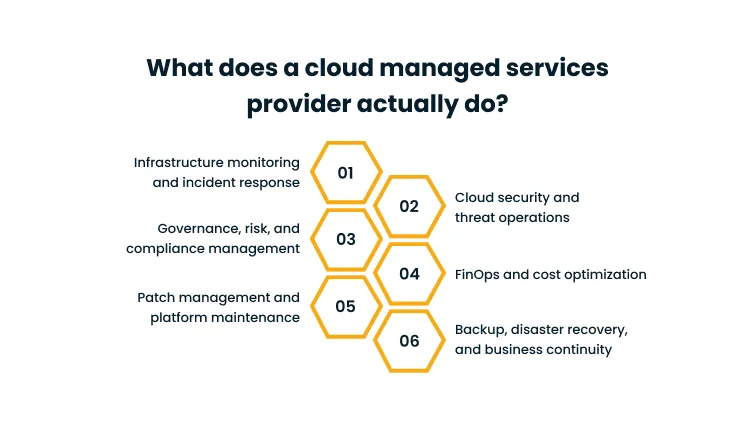
1. Infrastructure monitoring and incident response
Infrastructure monitoring gives the enterprise a live view of cloud health across compute, storage, network, identity, containers, and platform services. The provider also manages alert triage, escalation, communication, and recovery.
- Monitors infrastructure across regions, accounts, subscriptions, and services.
- Correlates logs, traces, and metrics to detect service degradation.
- Handles tier-one and tier-two incidents under defined SLAs.
- Escalates tier-three issues through a documented runbook.
Connected monitoring gives teams one view of service health across the cloud environment. It shows downstream dependencies, network issues, and platform failures early, while the runbook defines ownership, escalation, engineering handoff, and stakeholder updates during incidents.
2. Cloud security and threat operations
Cloud security and threat operations protect the environment through identity controls, vulnerability management, security monitoring, and response workflows. The provider helps make security a continuous cloud operating function.
- Manages access controls and privilege reviews.
- Runs vulnerability scans across workloads and services.
- Monitors security events and threat signals.
- Executes response workflows with named owners.
Security operations use policy-as-code and continuous control checks to track access, exposure, misconfigurations, and control performance. A clear response playbook defines investigation, communication, isolation, and recovery approvals during the first few minutes of a security event.
3. Governance, risk, and compliance management
Governance, risk, and compliance management keep cloud operations aligned with internal policies, industry standards, and regulatory requirements. This includes control mapping, evidence collection, audit support, and data residency oversight.
- Maps controls to relevant compliance regimes.
- Maintains compliance evidence across cloud services.
- Supports audits with documentation and activity records.
- Tracks policy exceptions and remediation ownership.
The provider should make audit evidence available when needed. This includes access logs, configuration records, control status, change history, and proof of remediation. Effective GRC support improves operating discipline across the cloud environment. Policies become part of provisioning, access management, change control, and incident handling.
4. FinOps and cost optimization
FinOps turns cloud cost management into a recurring operating process. The provider reviews usage, identifies waste, improves tagging, recommends commitments, and connects cost decisions to architecture choices.
- Builds tagging standards for cost visibility.
- Tracks budgets, anomalies, and usage trends.
- Recommends rightsizing and reserved capacity.
- Reviews cost drivers in a monthly cadence.
Cost reports should drive action, such as rightsizing workloads, removing idle resources, changing storage tiers, and improving deployment patterns. A useful FinOps cadence brings finance, engineering, and cloud operations into one review, giving teams a shared view of cost ownership and business priorities.
5. Patch management and platform maintenance
Patch management keeps operating systems, containers, databases, and platform services current through a controlled change process. The provider manages maintenance windows, approvals, testing, rollout steps, and emergency updates.
- Maintains patch calendars across systems and services.
- Coordinates changes within agreed maintenance windows.
- Applies emergency patches through accelerated workflows.
- Tracks update status, rollback plans, and validation.
This service lowers routine patching work for internal teams while keeping systems aligned with security and reliability standards. For zero-day risks, the provider identifies exposure, prioritizes affected workloads, applies fixes through an accelerated path, and confirms stability after deployment.
6. Backup, disaster recovery, and business continuity
Backup, disaster recovery, and business continuity protect critical workloads from outages, data loss, and service disruption. The provider defines recovery objectives, runs drills, updates runbooks, and tracks remediation after each test.
- Defines RPO and RTO targets for each workload.
- Manages backup schedules and retention policies.
- Runs periodic recovery drills.
- Logs drill results and remediation tasks.
A recovery plan works best when it is tested regularly. Drills confirm backup restoration, dependency order, team roles, and recovery steps under realistic failure scenarios. Each result feeds into the next architecture review, helping teams improve resilience, reduce recovery risk, and strengthen business continuity planning.
What does a cloud-managed services engagement deliver?
A cloud managed services engagement should produce clear operating artifacts within the first 60 to 90 days. These include a discovery report, runbook, operating model, SLA framework, FinOps cadence, and review rhythm. These documents define scope, ownership, service targets, decision rights, and reporting expectations.
1. Discovery and current-state assessment
Discovery typically runs for four to six weeks and creates the baseline for the engagement. It covers workload inventory, tagging quality, account structure, compliance posture, cost baseline, and agreed business outcomes. This gives both teams a clear view of the current environment before operational ownership begins.
The discovery report becomes the evidence base for the next steps. It shows where risk sits, how costs behave, which workloads need attention, and where provider ownership should begin. The cost baseline also supports the first year of FinOps reviews.
2. Runbook and operating model document
The runbook documents standard operating procedures, on-call coverage, escalation paths, and the responsibility split between the provider and internal team. The operating model explains how work moves across people, systems, approvals, and review cycles. Together, these documents turn daily cloud operations into a governed process.
Both documents should be version-controlled, reviewed quarterly, and approved by named owners. This gives the engagement continuity when teams change, priorities shift, or new workloads enter the environment. It also reduces confusion during incidents, audits, and major changes.
3. SLA and incident-response framework
The SLA framework defines response targets, resolution targets, incident classes, escalation rules, service credits, and change-management cadence. It also sets the reporting format for service performance. This gives leadership a clear view of provider accountability and service outcomes.
The incident-response framework gives every event a defined path. It explains who receives alerts, who investigates, when escalation happens, how updates are shared, and how closure is documented. This keeps incident response structured during high-pressure situations.
4. FinOps cadence and reporting rhythm
The FinOps cadence sets monthly cost reviews, quarterly architecture reviews, and annual reserved-capacity planning. It should appear as a working calendar with named owners, review dates, decision points, and follow-up actions. This makes cost control a recurring operating habit.
Each review should produce a written action list with owners and target dates. This keeps cost optimization tied to practical changes such as rightsizing, idle resource cleanup, tagging improvements, and capacity planning. It also connects cloud spend decisions with business priorities.
5. Quarterly architecture and security reviews
Quarterly reviews examine architectural debt, security posture, compliance drift, platform changes, and cost movement against the discovery baseline. They help the enterprise improve cloud operations through a planned review cycle. This gives leadership a steady view of risk, resilience, and performance.
These sessions should cover regulatory updates, new cloud services, resilience issues, and security control performance. The output should be a prioritized action plan for the next quarter’s operations, architecture, and risk agenda. This keeps improvement work visible and accountable.
How do you choose a cloud-managed services provider?
Choosing a cloud-managed services provider requires a clear evaluation framework. Use these criteria to assess platform depth, compliance experience, ownership clarity, cloud cost optimization strategies for 2026, SLA quality, FinOps maturity, and delivery discipline.
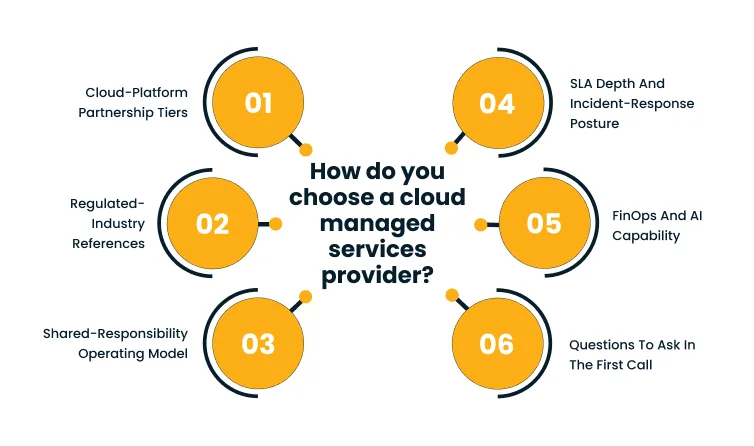
1. Cloud-platform partnership tiers
Cloud-platform partnership tiers show verified experience on AWS, Azure, or Google Cloud. Look for credentials such as AWS Advanced Tier, AWS Premier Tier, Azure Expert MSP, Google MSP, or AWS Managed Service Provider competencies. Ask for audit dates, renewal history, and relevant workload examples. The credential should match your primary cloud environment.
2. Regulated-industry references
Regulated-industry references matter when your business operates under PCI, HIPAA, GDPR, RBI, ISO 27001, GST, or data residency rules. Ask for client references from a similar industry, scale, and compliance regime. Prioritize examples from the last twenty-four months. This helps you judge current audit, evidence, and control experiences.
3. Shared-responsibility operating model
The shared-responsibility operating model should define ownership across monitoring, security, change management, FinOps, and incident response. Ask the provider to explain the boundary during the first call. The answer should cover alerts, approvals, escalations, reporting, and stakeholder communication. Clear ownership keeps both teams aligned during incidents and major changes.
4. SLA depth and incident-response posture
SLA depth should be checked through the actual SLA document. Review incident classes, response targets, resolution targets, escalation matrix, service credits, and change-management cadence. Match P1 and P2 definitions to your business impact. Ask how service performance is reported, reviewed, and improved.
5. FinOps and AI capability
FinOps and AI capability should be proven through artifacts. Ask for a sample monthly cost review, optimization report, and AI-workload operating model. The provider should explain rightsizing, reserved capacity, GPU planning, inference costs, and workload-level visibility. The answer should connect finance, engineering, and cloud operations.
6. Questions to ask in the first call
The first call should show how the provider manages real engagements. Ask who the delivery lead is, what month one includes, how exit handover works, and what engagement size they accept. Also, ask what a recent enterprise client would have scoped differently. Look for answers based on delivery experience, documented artifacts, ownership, and transition planning.
How does Cygnet deliver cloud-managed services?
At Cygnet.One, we deliver cloud-managed services through our Managed IT Services practice, supported by cloud engineering, 24/7 monitoring, infrastructure operations, cybersecurity, and GRC. Our focus is to keep cloud environments reliable, secure, compliant, and cost-aware while giving internal teams a clear operating model. As an AWS Advanced Tier Partner, we bring audited cloud expertise into day-to-day operations.
1. Cygnet’s Managed IT Services scope
Our Managed IT Services scope covers IT strategy, application managed services, infrastructure managed services, cybersecurity, and governance, risk, and compliance. We define the exact sub-services in scope for each engagement, so the runbook reflects the buyer’s operating needs, ownership split, and escalation paths.
2. Cloud Engineering interlock for the operation phase
Our cloud engineering practice supports cloud operations and optimization during the operation phase. We address cost, performance, monitoring, security, and governance together across AWS, Azure, GCP, Kubernetes, Terraform, and Datadog. This gives multi-cloud and hybrid environments a cleaner operating rhythm.
3. AWS Advanced Tier partnership
Cygnet.One is an AWS Advanced Tier Partner, bringing AWS-aligned delivery practices into cloud operations. Our teams work with current AWS service patterns, Well-Architected practices, and platform guidance to support better decisions across performance, cost, reliability, security, and governance.
4. Cybersecurity and GRC operations
Our Cybersecurity and GRC operations cover identity-first security, threat monitoring, vulnerability management, compliance evidence, and continuous control validation. We keep control mappings aligned with frameworks such as ISO, SOC, and NIST, so audit readiness becomes part of daily operations.
5. Regulated-industry footprint
We work with regulated sectors such as tax, finance, and BFSI, where compliance, residency, and audit posture need careful operating discipline. Our teams bring experience from environments with similar control expectations, helping buyers build a cloud model that supports continuity and regulatory confidence.
6. 24/7 monitoring and infrastructure managed services
Cygnet.One’s 24/7 monitoring and infrastructure managed services cover the platform layer with documented SLAs, tiered incident response, and clear escalation paths. We align architecture standards with daily operations, helping cloud environments stay stable, observable, and easier to manage as the engagement matures.
Conclusion
The threshold for hiring a cloud managed services provider sits at one of five concrete signals: runaway spend, on-call fatigue, audit pressure, multi-cloud sprawl, or AI workloads breaking the operating model. The operational gap that has already cost engineering capacity or audit confidence is the real test, well ahead of any cloud-maturity score.
Buyers who get the engagement right scope by deliverable (discovery report, runbook, SLA framework, FinOps cadence, quarterly review rhythm) and pressure-test the SLA, shared-responsibility split, and FinOps reporting in the first conversation rather than the renewal. Providers that resist those interrogations rarely improve once the ink dries.
The decision that follows is which provider can describe the first 90 days in operational specifics, with named artifacts and a named delivery lead, and back the description with regulated-industry references that survive a reference call.
Comparing cloud-managed services providers gets easier when the engagement is anchored in operational deliverables instead of slide decks. Cygnet structures cloud operations around an audited AWS Well-Architected practice, named SLA frameworks. FinOps cadences and regulated-industry GRC. To see how the first 90 days would land in your environment, book a demo with the Managed IT team.
FAQs
A cloud managed services provider runs the cloud environment on an ongoing basis under an SLA. It covers monitoring, incident response, security, FinOps, compliance support, and operational reporting. A cloud consulting firm usually supports strategy, architecture, migration, or modernization as a defined project.
Enterprise cloud MSP engagements often range from 8% to 20% of cloud spend. The final cost depends on scope, 24/7 coverage, compliance needs, security operations, FinOps depth, and the number of clouds managed. Buyers should compare the services included, because a lower rate may exclude critical operating support.
Standard onboarding usually takes 60 to 90 days for a single-cloud environment. Multi-cloud or regulated workloads may take up to 120 days because discovery, runbook creation, SLA finalization, and operational handover take longer. A clear onboarding plan should define milestones, owners, access requirements, and handover dates.
AWS Managed Services supports AWS workloads through AWS-defined operating procedures. A third-party cloud MSP can operate across AWS, Azure, GCP, and on-premises environments. It can also tailor the runbook, FinOps cadence, compliance support, and operating model to the enterprise’s cloud setup.
Success is usually measured through SLA attainment, cost efficiency, compliance posture, and engineering capacity returned to the internal team. Useful metrics include response times, resolution rates, cloud cost trends, closed audit findings, control validation results, and the number of recurring issues removed from operations.
Enterprises often switch providers because of vague SLAs, weak incident communication, limited FinOps action, poor reporting, or frequent delivery team changes. Service quality, accountability, and operational consistency usually drive the decision. A provider that cannot show clear ownership and steady improvement becomes difficult to justify over time.
Author


Abhishek Nandan
AVP, Marketing
Abhishek Nandan is the AVP of Services Marketing at Cygnet.One, where he drives global marketing strategy and execution. With nearly a decade of experience across growth hacking, digital, and performance marketing, he has built high-impact teams, delivered measurable pipeline growth, and strengthened partner ecosystems. Abhishek is known for his data-driven approach, deep expertise in marketing automation, and passion for mentoring the next generation of marketers.