


































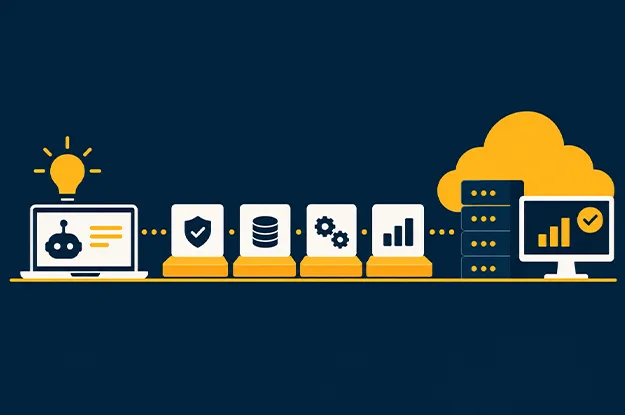
A prototype can look convincing while most enterprise risk remains hidden. The moment real users arrive, the system begins touching identity, private data, business policy, service limits, budgets, and decisions. A polished demo has now become an operational service with consequences.
McKinsey’s 2025 survey of 1,993 respondents illustrates the gap. Only 7% described their organizations’ AI use as fully deployed and integrated across the organization. The harder work starts after the first use case proves that the model can produce a useful answer.
GenAI production readiness is the work of proving that the complete application can operate safely, predictably, economically, and under accountable ownership, where Enterprise AI solutions help enterprises move from prototype to governed production. which connects closely with enterprise AI implementation at scale. The model is only one dependency. Identity, retrieval, prompts, data pipelines, guardrails, observability, user workflow, model-provider behavior, and incident response all affect the result.
A GenAI service needs an explicit production contract: who can ask, what data can be used, acceptable answer quality, response time, request cost, and failure ownership. That contract is the foundation of production-ready generative AI.
What Is GenAI Production Readiness After a Prototype Works?
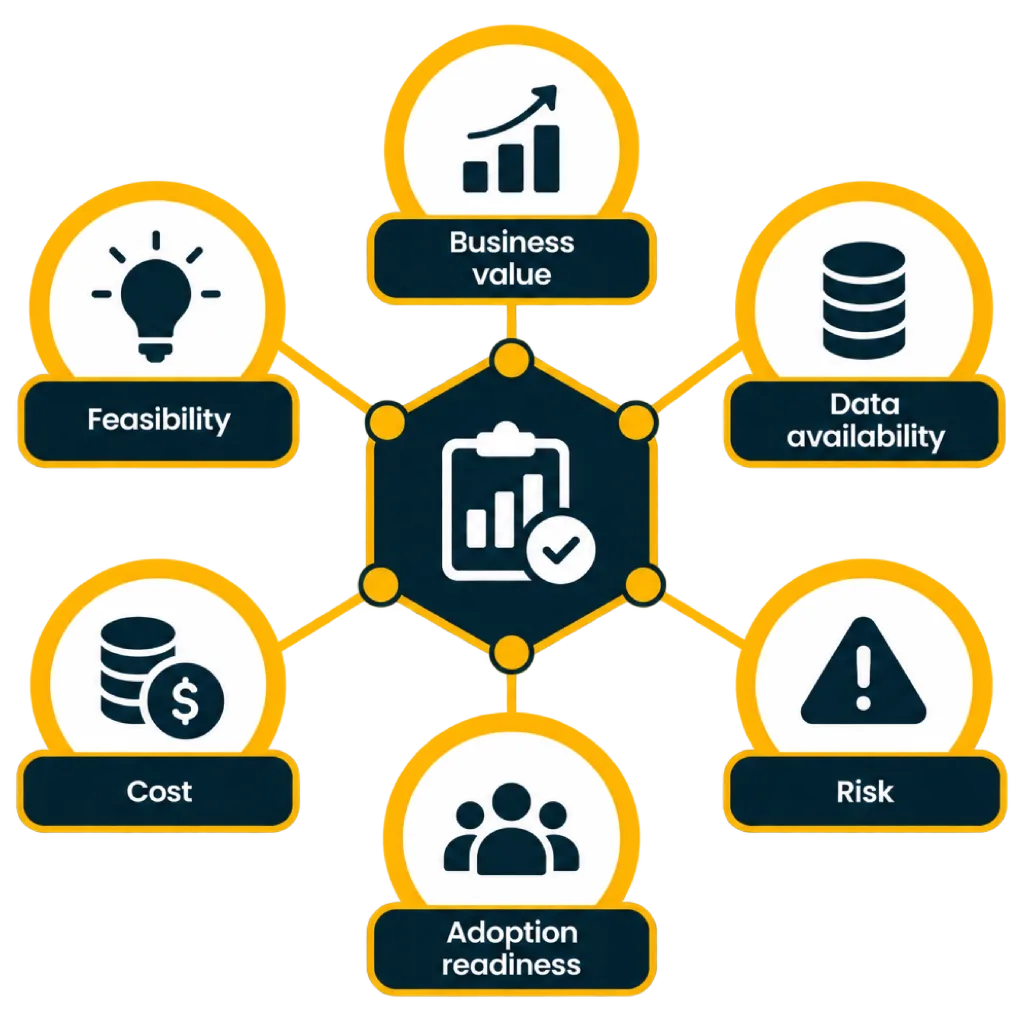
Prototype testing usually proves a narrow question: can this idea work with a controlled prompt, selected data, and a small user group? GenAI production readiness asks a harder question: can the service keep meeting its business and risk requirements when inputs become messy, permissions differ by user, source documents change, traffic becomes uneven, and the underlying model changes?
NIST makes a similar distinction in its Generative AI Profile. It warns that laboratory tests and benchmark datasets may fail to reflect real deployment conditions, and recommends documented testing, evaluation, validation, and verification before release. NIST also treats post-deployment monitoring, incident response, user feedback, and decommissioning as part of the operating lifecycle.
The release conversation should focus on bounded failure. Can the system block unauthorized requests, flag weak evidence, route highrisk responses to a human, and trace the prompt, model, policy, and data behind a disputed answer?
Those questions belong to the first GenAI deployment checklist, not in a later hardening phase.
Why Do GenAI Prototypes Break Under Real Enterprise Conditions?
A pilot may use one model, one knowledge base, one permission level, and a friendly test set. Real users bring ambiguous language, confidential text, malformed documents, multilingual requests, prompt injection attempts, and questions outside the intended use case. Backend systems add retries, timeouts, stale indexes, missing metadata, rate limits, and partial outages.
Quality has to cover the whole request path:
User identity → policy check → prompt construction → retrieval → model call → tool call → output filtering → evidence → user action → audit record
One weak step can still produce a fluent answer.
That is why production-ready generative AI should be reviewed as a distributed application rather than as a model endpoint. AWS’s current Generative AI Lens follows this wider view by covering operational quality, security, reliability, performance, cost, traceability, and lifecycle management together.
How Should Enterprises Secure GenAI Permissions and Data Access?
The first security question is rarely “Is the model secure?” The more useful question is “What can this application cause a user to see or do?”
Access control must sit outside the model. A system prompt that says “do not reveal confidential data” is not an authorization layer. OWASP’s 2025 guidance identifies prompt injection, sensitive information disclosure, and excessive agency as distinct risks. It also warns that RAG does not remove prompt injection risk.
For AI security and governance, three permission boundaries deserve separate tests:
- Input permission: Is the user allowed to submit this data to the application and model provider?
- Retrieval permission: Can the retriever return only documents, rows, or fields that the requesting identity is allowed to access?
- Action permission: If the model can call tools, what operations are permitted, under which identity, and with what approval step?
Agent-style systems raise the consequence. A wrong tool call can alter a record, send a message, or initiate a business process. High-impact actions need deterministic policy checks, narrow tool permissions, audit trails, and human approval where warranted.
A production gate should fail when authorization depends on model judgment.
What Does Good LLM Evaluation Look Like Before Release?
A demo review usually rewards plausible answers. Production evaluation needs defined acceptance thresholds tied to the actual job.
For customer support, correctness and policy adherence may outweigh prose style. For legal research, citation fidelity matters heavily. For an internal knowledge assistant, abstention quality can matter as much as answer quality.
Effective LLM monitoring and evaluation starts with a representative evaluation set containing common requests, difficult edge cases, policy-sensitive prompts, adversarial inputs, and cases that require refusal or escalation. Microsoft’s current RAG guidance recommends testing individual components and the complete application because changes in data formatting or retrieval can alter downstream quality.
The release decision should include four views:
| Evaluation view | What to test | Release evidence |
| Task quality | Correctness, completeness, instruction following | Agreed threshold on representative cases |
| Grounding | Citation support, faithfulness to retrieved evidence | Failure cases reviewed by domain owners |
| Safety | Prompt injection, sensitive data exposure, harmful output | Adversarial test results and mitigation record |
| Operations | Latency, errors, token use, dependency failure | Service targets and alert thresholds |
This is where production-ready generative AI becomes measurable. A launch should depend on evidence, not a roomful of favorable demos.
How Do You Know a RAG System Is Ready for Production?
A RAG system can return a grounded answer and still be wrong for the business because the source was stale, unauthorized, poorly chunked, or incomplete.
RAG production readiness starts before retrieval. Source ownership, ingestion frequency, document status, metadata quality, access controls, deletion handling, and index freshness all need explicit rules, supported by data engineering services that build governed data pipelines and reliable retrieval foundations. Microsoft’s architecture guidance recommends security evaluation that includes adversarial testing, document sanitization, and monitoring for anomalous retrieval patterns.
A useful diagnostic separates three failure points:
- Retrieval: Did the system find the right evidence and enforce permissions?
- Generation: Did the model use that evidence accurately and cite it correctly?
- Source fitness: Was the evidence current, approved, and authoritative?
This separation matters because prompt changes cannot repair a stale index, and a better model cannot fix a permission filter that retrieves the wrong documents. Teams need to locate the failing layer instead of treating every bad answer as a model problem.
What Should GenAI Monitoring Cover After Launch?
Traditional application telemetry remains necessary. Request count, error rate, dependency health, latency, and availability still matter. GenAI adds another operating surface: semantic quality can degrade while the service remains technically healthy.
That is why LLM monitoring and evaluation needs two planes. The operational plane tracks latency, failures, token consumption, queueing, retrieval duration, and tool-call errors. The behavioral plane tracks groundedness, refusal quality, policy adherence, citation quality, unsafe output, user corrections, and recurring failure themes. Microsoft Foundry’s 2026 observability guidance similarly combines operational metrics such as token use, latency, and error rates with quality, RAG, safety, and agent-specific evaluators.
For enterprise GenAI operations, aggregate averages are too coarse. Segment results by use case, user group, model version, prompt version, retrieval source, language, and request type.
Operators also need a replay path. A flagged answer should be reconstructable across context, evidence, model and prompt version, tool activity, guardrail result, and final response without widening data access.
How Should Enterprises Control GenAI Latency and Cost?
Latency and cost shape user behavior. A response that arrives after the task is complete has little operational value. An application that meets its budget only under pilot traffic has not proven its economics. Google Cloud recommends response streaming to improve perceived responsiveness, while AWS covers inference, prompt, vector-store, and agent-workflow cost.
For production-ready generative AI, cost should be measured per completed business task, not only per token. A cheaper model can become more expensive if weak answers trigger retries, longer prompts, added retrieval calls, or human rework.
Track at least:
- End-to-end latency by request type;
- Input and output tokens per completed task;
- Retrieval and tool-call duration;
- Model retries and fallback frequency;
- Cost by workflow, user group, and model version;
- Abandonment or repeated queries after slow or weak responses.
The second GenAI deployment checklist test is economic: can the owner explain the cost of a successful task, a failed task, and a retried task?
How Do User Adoption and Workflow Design Affect Production Readiness?
A technically sound system can still produce poor business results if users do not know when to trust it, when to verify it, or what to do after it responds.
Test adoption as workflow behavior. Repeated prompt rewrites, ignored citations, bypassed AI steps, and unofficial workarounds expose missing product decisions.
GenAI production readiness should include clear user expectations: what the assistant is for, what it should avoid, which sources it uses, when verification is required, how to report a weak answer, and when a human remains accountable for the final decision.
For higher-risk workflows, the interface should make uncertainty visible. A confident sentence with weak evidence is a design failure even if the model followed its instructions.
What Governance Must Be in Place Before GenAI Goes Live?
Governance needs authority over release decisions.
A practical AI security and governance model assigns named owners for the use case, data, controls, evaluation criteria, operating service, and business outcome. It also defines which changes require re-evaluation. Model, prompt, data-source, tool-permission, and policy changes can alter behavior while the interface stays identical.
NIST recommends documented deployment approval, ongoing monitoring, incident procedures, and mechanisms to disengage or deactivate AI systems when outcomes fall outside intended use.
A mature change process answers four questions before release:
- What changed?
- Which evaluation set must be rerun?
- Who accepts the residual risk?
- What is the rollback path?
That discipline turns enterprise GenAI operations into an owned service rather than a sequence of experiments.
A Practical GenAI Production Readiness Checkpoint Table
A useful readiness review should require evidence. “Done” is too vague.
| Checkpoint | Evidence required | Release blocker |
| Use-case boundary | Approved users, tasks, exclusions, risk tier | No defined owner or intended use |
| Identity and access | Permission tests across user roles | Model or prompt makes authorization decisions |
| Evaluation | Representative test set and acceptance thresholds | No agreed quality threshold |
| Retrieval | Source ownership, freshness, access filtering | Unauthorized or stale evidence can be returned |
| Security | Prompt-injection tests, data handling rules, tool restrictions | High-impact action lacks deterministic control |
| Observability | Operational and behavioral telemetry, replay path | Failure cannot be reconstructed |
| Performance | Latency target and dependency behavior under load | User task misses its response window |
| Economics | Cost per completed task and fallback path | Unit cost is unknown |
| Change control | Versioning, re-test rules, rollback | Model or prompt changes bypass review |
| User workflow | Human accountability, feedback, escalation | Users cannot challenge or report output |
This table is deliberately stricter than a feature checklist. RAG production readiness may be green while tool permissions remain unsafe. Evaluation may pass while latency makes the workflow unusable. Cost may be acceptable while no one owns incident response. Production approval should follow the weakest release-critical checkpoint.
That is the core of production-ready generative AI: readiness is a system property.
When Is a GenAI Application Ready for Production?
The prototype proves possibility. Production proves control.
GenAI production readiness is reached when the enterprise can define acceptable behavior, measure it, trace failures, restrict access, contain actions, monitor live performance, control cost, and assign ownership for change and incidents. Production-ready generative AI also requires a credible answer to a less comfortable question: what happens when the model behaves correctly according to its configuration and the business outcome is still wrong?
The release decision should be evidence-led. Test realistic failure modes, set thresholds before launch, and make rollback part of the design.
One closing test catches more weakness than a long feature review: Can the team show what will happen when the answer is wrong, the source is stale, the user lacks permission, the provider is slow, or the tool call carries real consequence?
If those paths are defined, tested, monitored, and owned, the application is approaching production-ready generative AI. If they are still being discussed, production has arrived before readiness.
Author


Yogita Jain
Content Lead
Yogita Jain leads with storytelling and Insightful content that connects with the audiences. She’s the voice behind the brand’s digital presence, translating complex tech like cloud modernization and enterprise AI into narratives that spark interest and drive action. With a diverse of experience across IT and digital transformation, Yogita blends strategic thinking with editorial craft, shaping content that’s sharp, relevant, and grounded in real business outcomes. At Cygnet, she’s not just building content pipelines; she’s building conversations that matter to clients, partners, and decision-makers alike.