
































• Cygnet IRP
  • Glib.ai
  • IFSCA
Cygnet.One
  • About
  • Products
  • Solutions
  • Services
  • Partners
  • Partner
  • Resources
Generic selectors
Exact matches only
Search in title
Search in content
Post Type Selectors
Get Started
About
  • Overview

    A promise of limitless possibilities

  • We are Cygnet

    Together, we cultivate an environment of collaboration

  • Careers

    Join Our Dynamic Team: Careers at Cygnet

  • CSR

    Impacting Communities, Enriching Lives

  • In the News

    Catch up on the latest news and updates from Cygnet

  • Contact Us

    Connect with our teams across the globe

What’s new

chatgpt

Our Journey to CMMI Level 5 Appraisal for Development and Service Model

Full Story

chatgpt

ChatGPT: Raising the Standards of Conversational AI in Finance and Healthcare Space

Full Story

Products
  • Cygnet Tax
    • Cygnet Tax
    • e-Invoicing / Real time reportingIRP-integrated e-Invoicing with real-time validation
    • e-Way Bills / Road permitsGST-compliant centralized e-Way Bill platform for scalable operations
    • Direct Tax ComplianceAccurate direct tax compliance, filings, litigation, and assessments
    • Indirect Tax ComplianceEnterprise-grade platform for indirect tax compliance
      • Indirect Tax Compliance
      • GST Compliance India
      • VAT Compliance EU
      • VAT Compliance ME
    • Managed ServicesEnd-to-end indirect tax compliance support by experts
  • Global e-Invoicing
    • Global e-Invoicing
    • APAC
      • India
      • Malaysia
      • Singapore
      • Japan
    • Africa
      • Egypt
      • Kenya
      • Zambia
      • Nigeria
    • Europe
      • Spain
      • France
      • Germany
      • Poland
      • Belgium
    • Oceania
      • Australia
      • New Zealand
    • Middle East
      • UAE
      • Oman
      • Saudi Arabia
      • Bahrain
      • Qatar
      • Jordan
  • Cygnet Vendor Postbox
    • Cygnet Vendor PostboxDigitize purchase invoice validation & posting to ERPs & maximize ITC
  • Finance Transformation
    • Finance Transformation
    • Cygnet FinalyzeUnlock working capital with data-driven invoice-based credit decisions
    • Bank Statement AnalysisEvaluate company health by analyzing performance and financial risk
    • Financial Statement AnalysisAssess company performance and risk with financial statement analysis
    • GST Business Intelligence Report360-degree financial health insights using GST data analytics
    • GST Return Compliance ScoreGST-based compliance score to assess business risk and credibility
    • ITR AnalysisAssess creditworthiness and lending risk using ITR filing analysis
    • Invoice Verification for Trade FinanceVerify invoices to reduce fraud and improve credit decisions
    • Account Aggregator – Technology Service Provider (AA-TSP)Onboard to the Account Aggregator ecosystem with FIP & FIU modules
  • Cygnet BridgeFlow
    • Cygnet BridgeFlowAutomated digital onboarding with real-time validations and compliance
  • Cygnet Bills
    • Cygnet BillsGST-compliant centralized e-Way Bill platform for scalable operations
  • Cygnet IRP
    • Cygnet IRPIRP-integrated e-Invoicing with real-time validation
  • Cygnature
    • CygnatureSecure, compliant digital signing with audit-ready traceability

What’s new

e-Invoicing compliance Timeline

Know More →

UAE e-Invoicing: The Complete Guide to Compliance and Future Readiness

Read More →

Types of Vendor Verification and When to Use Them

Read More →

Safeguard Your Business with Vendor Validation before Onboarding

Read More →

Modernizing Dealer/Distributor & Customer Onboarding with BridgeFlow

Read More →

Accelerate Vendor Onboarding with BridgeFlow

Read More →

GST Filing 360°: GST, E-Invoicing, E-Way Bills & Annual Returns Made Simple

Read More →

Why Manual Tax Determination Fails for High-Volume, Multi-Country Transactions

Read More →

GST Filing 360°: GST, E-Invoicing, E-Way Bills & Annual Returns Made Simple

Read More →

Key Features of an Invoice Management System Every Business Should Know

Read More →

Automating the Shipping Bill & Bill of Entry Invoice Operations for a Leading Construction Company

Read More →

From Manual to Massive: How Enterprises Are Automating Invoice Signing at Scale

Know More →

Solutions
  • HireAI
  • Agent as a Service
  • AI-powered Voice Assistant
  • Generative AI Workshop
  • TestingWhiz
  • VIPRE

What’s new

AI powered Interviewer

AI-Powered Interviewing Helped an Education Group Reduce Hiring Time Significantly

Know More

Generative AI ebook

Navigating the Generative AI Landscape

Download eBook

Services
  • Data Analytics & AI
    • Data Analytics & AI
    • Data Engineering and ManagementData engineering and management for smart, scalable systems
    • Data Migration and ModernizationData migration and modernization for future-ready platforms
    • Insights Driven Business TransformationInsight-driven business transformation for faster decisions
    • Business Analytics and Embedded AIBusiness analytics and embedded AI for data-led growth
  • Digital Engineering
    • Digital Engineering
    • Technical Due DiligenceEnabling smarter decisions through future-ready digital ecosystems
    • Product EngineeringEngineering impactful digital products that elevate business growth
    • HyperautomationSmarter hyperautomation using low-code for agile business processes
    • Enterprise IntegrationIntegrating enterprise systems for seamless operations and growth
    • Application ModernizationModernizing IT ecosystems with scalable, AI-driven innovation
  • Quality Engineering
    • Quality Engineering
    • Test Consulting & Maturity AssessmentTest consulting and maturity assessments for reliable software QA
    • Business Assurance TestingBusiness assurance testing aligned with real business outcomes
    • Enterprise Application & Software TestingEnterprise application testing for continuity and scale
    • Data Transformation TestingData transformation testing for scalable, trusted data quality
  • Cloud Engineering
    • Cloud Engineering
    • Cloud Strategy and DesignCloud strategy and design services for secure, scalable growth
    • Cloud Migration & ModernizationORBIT: a proven framework for measurable cloud transformation
    • Cloud Native DevelopmentCloud-native development for resilient, scalable innovation
    • Cloud Operations and OptimizationCloud optimization and operations for enterprise resilience
    • Cloud for AI FirstAI-first cloud transformation for smarter, scalable enterprises
  • Managed IT Services
    • Managed IT Services
    • IT Strategy and ConsultingStrategic IT consulting to align technology with business goals
    • Application Managed Services24/7 managed application services for performance and security
    • Infrastructure Managed ServicesEnd-to-end infrastructure management for resilient IT operations
    • CybersecurityComprehensive cybersecurity solutions to protect business assets
    • Governance, Risk Management & ComplianceGRC solutions to manage risk, compliance, and governance
  • Cygnet TaxAssurance
    • Cygnet TaxAssurance
    • Tax DatalakeUnified tax data lake for intelligent, compliant decision-making
    • Tax InfraDigital tax infrastructure for efficient, compliant transformation
  • Amazon Web Services
    • Amazon Web Services
    • Migration and ModernizationMake Your Move to the Cloud With AWS Smarter & Faster
    • Generative AIRun your Gen AI workloads on AWS with full control

What’s new

AI-Powered Voice Assistant for Smarter Search Experiences

Explore More →

Cygnet.One’s GenAI Ideation Workshop

Know More →

Our Journey to CMMI Level 5 Appraisal for Development and Service Model

Read More →

Extend your team with vetted talent for cloud, data, and product work

Explore More →

Enterprise Application Testing Services: What to Expect

Read More →

Future-Proof Your Enterprise with AI-First Quality Engineering

Read More →

Cloud Modernization Enabled HDFC to Cut Storage Costs & Recovery Time

Know More →

Cloud-Native Scalability & Release Agility for a Leading AMC

Know More →

AWS workload optimization & cost management for sustainable growth

Know More →

Cloud Cost Optimization Strategies for 2026: Best Practices to Follow

Read More →

Cygnet.One’s GenAI Ideation Workshop

Explore More →

Practical Approaches to Migration with AWS: A Cygnet.One Guide

Know More →

Tax Governance Frameworks for Enterprises

Read More →

Cygnet Launches TaxAssurance: A Step Towards Certainty in Tax Management

Read More →

Partners
  • Products Partner Program
Resources
  • Blogs
  • Case Studies
  • eBooks
  • Events
  • Webinars

Blogs

A Step-by-Step Guide to E-Invoicing Implementation in the UAE

A Step-by-Step Guide to E-Invoicing Implementation in the UAE

View All

Case Studies

Cloud-Based CRM Modernization Helped a UK Based Organization Scale Faster and Reduce Deployment Complexity

Cloud-Based CRM Modernization Helped a UK Based Organization Scale Faster and Reduce Deployment Complexity

View All

eBooks

Build Smart Workflow with Intelligent Automation and Analytics

Build Smart Workflow with Intelligent Automation and Analytics

View All

Events

11th CIO Conclave & Awards

11th CIO Conclave & Awards

View All

Webinars

Beyond Chat: How Voice-Assisted AI is Redefining Digital Engagement

Beyond Chat: How Voice-Assisted AI is Redefining Digital Engagement

View All
Cygnet IRP
Glib.ai
IFSCA

Upcoming e-Invoicing Mandates Globally: Country-wise Timelines & Readiness Guide

  • January 9, 2026
  • 6 minutes read
Share
Subscribe

For years, e-Invoicing sat in an uncomfortable middle ground. It was encouraged, sometimes incentivised, but rarely unavoidable. Most organisations treated it as a digitisation upgrade—helpful, but not urgent. 

That changed decisively over the last few years. 

By the end of 2025, tax authorities across regions had demonstrated that invoice-level data gives them something returns never could: immediate visibility into transactions as they happen. Once that became clear, the direction was inevitable. From 2026 onward, e-Invoicing is no longer an efficiency choice. It is becoming the default compliance mechanism. 

This shift matters because it changes how enterprises operate, not just how they invoice. What follows is a grounded look at where mandates are headed, which countries matter most in 2026, and what “being ready” actually looks like in practice. 

1. How e-Invoicing changed by 2025—and why 2026 is different 

Not long ago, an “electronic invoice” usually meant a PDF attached to an email. That definition no longer holds. 

Governments have drawn a clear line between electronic documents and true e-Invoices. True e-Invoices are structured data files, exchanged through regulated systems, validated automatically, and often reported to authorities in real time or near real time. 

By 2025, three things had quietly settled across many jurisdictions. First, clearance and real-time reporting models proved workable at scale. Second, common standards such as PEPPOL formats and country-specific XML schemas became enforceable, not optional. Third, invoice data began feeding directly into VAT and GST controls, audit selection, and fraud analytics. 

Once these elements were in place, voluntary adoption stopped making sense. From 2026 onward, enforcement—not experimentation—becomes the defining theme. 

2. Countries to watch as new mandates arrive in 2026 

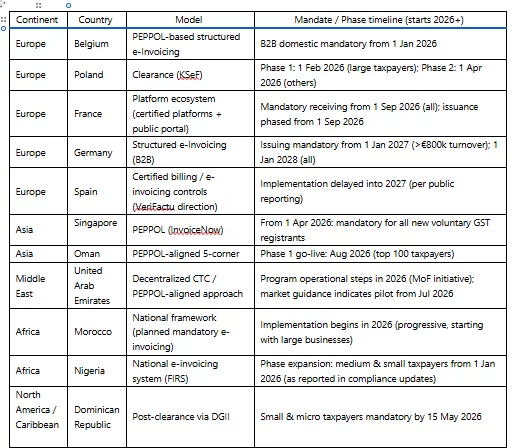
In Europe, Belgium will require structured B2B e-Invoicing for domestic transactions from 1 January 2026. PEPPOL will act as the default exchange framework, leaving little room for informal or document-based invoicing. 

For enterprises operating across these jurisdictions, adopting a PEPPOL Accredited E-invoicing solution can simplify onboarding and help standardise compliant exchange.

France follows later in the year. From 1 September 2026, B2B e-Invoicing obligations begin rolling out in phases, starting with larger enterprises. France’s approach combines a central public portal with certified private platforms, adding an extra layer of operational complexity for businesses that assumed a single integration would be enough. 

Across Asia, timelines differ but the direction is the same. Singapore’s InvoiceNow network moves closer to being a requirement rather than an option. From 1 April 2026, all new voluntary GST registrants must transmit invoice data electronically to the tax authority, with broader coverage expected over time. 

Malaysia continues its MyInvois rollout based on turnover thresholds. As the mandate reaches medium and smaller businesses through 2026, readiness becomes less about awareness and more about execution. Oman, meanwhile, has announced a PEPPOL-aligned five-corner model, with Phase 1 expected around August 2026, initially targeting large taxpayers. The Philippines has extended its structured e-Invoicing deadlines, with 31 December 2026 emerging as a key compliance milestone. 

In Africa, Zambia and Kenya provide early signals of what broader enforcement can look like. Zambia’s Smart Invoice regime is already mandatory and increasingly strict. Kenya’s eTIMS framework goes a step further by linking invoice validity directly to expense deductibility, making e-Invoicing part of everyday financial decision-making. 
3. Understanding phased rollouts beyond the headline dates 

One of the most common planning mistakes is treating e-Invoicing mandates as single dates on a calendar. In reality, most programmes unfold in stages. 

Receiving capability often becomes mandatory before issuance. Large taxpayers are typically onboarded first, followed by smaller entities. Certification, sandbox testing, and registration requirements can appear months before legal enforcement begins. 

For multinational groups, the challenge is rarely one deadline. It is the accumulation of many—each with different technical rules, networks, and documentation expectations. This is why readiness needs to be continuous, not reactive. 

4. What actually breaks inside ERP and finance teams 

When e-Invoicing projects struggle, it is rarely because the ERP cannot create an invoice. The problems surface after that point. 

Master data issues are usually the first to appear. Buyer details, tax registrations, addresses, and classifications that once passed internal checks suddenly fail external validations. In a structured regime, these are not warnings. They are hard stops. 

Invoice lifecycles also change in ways many teams underestimate. An invoice is no longer simply issued or paid. It is validated, accepted, rejected, corrected, resubmitted, and sometimes versioned. Each step affects accounting entries, tax reporting, and cash flow. 

On the technical side, document exchange gives way to API-driven integration with portals or certified platforms. That introduces monitoring, retries, and failure handling—areas that typically fall outside traditional finance operations. 

The cumulative effect shows up during close cycles. Rejected invoices delay recognition, trigger disputes, and create reconciliation gaps. At that point, e-Invoicing is no longer a compliance topic. It becomes a financial operations issue. 

5. What real readiness looks like in practice 

Being ready for e-Invoicing is less about passing a go-live test and more about surviving the first few months of production without chaos. 

It starts with clarity around scope. Enterprises need a precise view of which entities, transaction types, and counterparties fall under which mandate. This is especially important where shared services or intercompany billing is involved. 

Data standardisation follows. Organisations that establish a consistent internal invoice data structure find it far easier to adapt to local rules without repeatedly modifying ERP logic. 

Master data governance then becomes unavoidable. Tax identifiers, legal names, addresses, and classifications stop being “admin data” and start functioning as compliance controls. 

Equally important is exception handling. Rejections and corrections are not rare events during early adoption. Teams need ownership models, SLAs, and escalation paths before—not after—issues arise. 

Finally, visibility matters. Dashboards, alerts, and reconciliation views are what allow teams to manage compliance rather than constantly chase it. 

6. Where implementations commonly go wrong 

Most failures are predictable. 

Some organisations treat e-Invoicing as a file-format conversion exercise. Others underestimate how long onboarding, certification, and approvals will take. Many wait until rejections appear in production before defining correction workflows. 

Another recurring issue is building one-off solutions for each country. These may work in isolation, but they accumulate technical debt and make the next mandate harder, not easier. 

The underlying problem is perspective. When e-Invoicing is treated as a series of local projects, complexity compounds. When it is treated as a global capability, it becomes manageable. 

7. Preparing for 2026 and beyond without repeated disruption 

Enterprises that handle upcoming mandates well tend to share a few traits. 

They track regulatory change centrally rather than relying on fragmented updates. They separate internal invoice data from country-specific compliance logic. They invest in integration layers that are monitored like any other critical system. 

Just as importantly, they document operational playbooks for corrections, disputes, and audits, so compliance does not depend on individual knowledge. And they keep tax, finance, and IT aligned—not through one-off workshops, but through ongoing ownership. 

With this approach, new mandates stop feeling like surprises. They become another configuration step in an already stable compliance environment. 

Strategic takeaway for enterprises 

By 2026 onward: 

  • More than 80 countries will either mandate or tightly regulate e-Invoicing 
  • Enterprises will operate multiple models simultaneously 
  • ERP-only approaches will not scale 
  • A global compliance layer becomes essential.

Closing thought 

From 2026 onward, e-Invoicing is less about following rules and more about how enterprises structure trust in a digital economy. The organisations that adjust early will experience fewer shocks. The rest will learn the hard way—one rejected invoice at a time.

FAQs 

1. What qualifies as a true e-Invoice under global mandates? 

A true e-Invoice is a structured, machine-readable invoice exchanged electronically through a regulated network or certified platform. PDFs and scanned invoices generally do not qualify. 

2. Are e-Invoicing mandates limited to B2B transactions? 

Most initial mandates focus on B2B and B2G transactions, but several countries are gradually expanding scope to include B2C reporting. 

3. Which region is moving fastest—Europe or Asia? 

Europe is accelerating domestic B2B mandates, while Asia is integrating e-Invoicing directly with GST/VAT administration through phased onboarding and real-time reporting. 

4. How early should enterprises start preparing? 

Preparation should begin 12–18 months before the legal mandate, particularly where certification, sandbox testing, or PEPPOL onboarding is required. 

Related Blog Posts

Oman E-Invoicing Explained: Fawtara Framework, Timeline, and Business Impact

CalendarFebruary 09, 2026

UAE e-Invoicing for Trading & Wholesale: Dual-Sided Risk, DRC Exposure and Back-to-Back Sales Compliance

CalendarMarch 02, 2026

The Crucial Role of Invoice Verification in Facilitating Invoice Financing

CalendarJune 20, 2024

Sign up to our Newsletter

    Latest Blog Posts

    Why Is Data Product Thinking Transforming Enterprise Analytics Teams? 
    Why Is Data Product Thinking Transforming Enterprise Analytics Teams? 

    CalendarApril 14, 2026

    Co-Managed IT vs Fully Managed IT: Choosing the Right Operating Model 
    Co-Managed IT vs Fully Managed IT: Choosing the Right Operating Model 

    CalendarApril 06, 2026

    The Role of Metadata Management in Scaling Enterprise Data Platforms 
    The Role of Metadata Management in Scaling Enterprise Data Platforms 

    CalendarApril 03, 2026

    Let’s level up your Business Together!

    The more you engage, the better you will realize our role in the digital transformation journey of your business


      I agree to the Terms & Conditions and Privacy Policy and allow Cygnet.One (and its group entities) to contact me via Promotional SMS / Email / WhatsApp / Phone Call.*

      I agree to receive occasional product updates and promotional messages from Cygnet.One (and its group entities) on Promotional SMS / Email / WhatsApp / Phone Call.

      I agree to receive informational SMS (e.g., service updates, account notifications) from Cygnet.One (and its group entities). Message frequency varies. Message & data rates may apply. Reply HELP for help or STOP to opt out.

      I agree to receive promotional SMS (e.g., offers, product updates, marketing messages) from Cygnet.One (and its group entities). Up to 4 messages per month. Message & data rates may apply. Reply HELP for help or STOP to opt out. Consent is not a condition of purchase.

      Cygnet.One Locations

      India India

      Cygnet Infotech Pvt. Ltd.
      2nd Floor, The Textile Association of India,
      Dinesh Hall, Ashram Rd,
      Navrangpura, Ahmedabad, Gujarat 380009

      Cygnet Infotech Pvt. Ltd.
      6th floor, A-wing Ackruti Trade Center,
      Road number 7, MIDC, Marol,
      Andheri East, Mumbai-400093, Maharashtra

      Cygnet Infotech Pvt. Ltd.
      WESTPORT, Urbanworks,
      5th floor, Pan Card Club rd.,
      Baner, Pune, Maharashtra 411045

      Cygnet Infotech Pvt. Ltd.
      10th floor, 73 East Avenue,
      Sarabhai campus, Vadodara, 391101

      Global

      CYGNET INFOTECH LLC
      125 Village Blvd, 3rd Floor,
      Suite 315, Princeton Forrestal Village,
      Princeton, New Jersey- 08540

      CYGNET DIGITAL IT SOLUTION LLC
      Office 707, Magnum Opus Tower,
      Al Thanyah First, Dubai, U.A.E,
      P.O. Box 125608

      CYGNET INFOTECH PRIVATE LIMITED
      Level 35 Tower One,
      Barangaroo, Sydney, NSW 2000

      CYGNET ONE SDN.BHD.
      Unit F31, Block F, Third Floor Cbd Perdana 3,
      Jalan Perdana, Cyber 12 63000 Cyberjaya Selangor, Malaysia

      CYGNET INFOTECH LIMITED
      C/O Sawhney Consulting, Harrow Business Centre,
      429-433 Pinner Road, Harrow, England, HA1 4HN

      CYGNET INFOTECH PTY LTD
      152, Willowbridge Centre,
      39 Cronje Drive, Tyger Valley,
      Cape Town 7530

      CYGNET INFOTECH BV
      Peutiesesteenweg 74, Machelen (Brab.), Belgium

      Cygnet One Pte. Ltd.
      160 Robinson Road,
      #26-03, SBF Centre,
      Singapore – 068914

      • Explore more about us

      • Download Corporate Deck
      • Terms of Use
      • Privacy Policy
      • Contact Us
      © Copyright – 2026 Cygnet.One
      We use cookies to ensure that we give you the best experience on our website. If you continue to use this site we will assume that you are happy with it.

      Cygnet.One AI Assistant

      ✕
      AI Assistant at your help. Cygnet AI Assistant