































Managed IT services for enterprises do one thing that in-house teams structurally cannot: maintain continuous ownership of your IT environment. This includes monitoring, securing, and optimising it around the clock, not just when something breaks.
According to Deloitte’s 2024 Global Outsourcing Survey, 80% of executives plan to maintain or increase investment in IT outsourcing, reflecting that managed IT is now a core operating model.
Enterprise IT environments spanning multi-cloud platforms, acquisition integrations, and expanding compliance obligations have become too complex to manage reactively. When infrastructure lags behind operational demand, the consequences compound as missed SLAs, regulatory exposure, and revenue losses that cannot be recovered.
This blog examines how managed IT services work across four enterprise industries, what the service lifecycle involves, and how to identify the providers who can deliver.
What are Managed IT Services for Enterprises?
Managed IT services for enterprises involve outsourcing IT operations, infrastructure management, cybersecurity, and technical support to a specialized provider that monitors and maintains enterprise systems on an ongoing basis.
The provider operates as a continuously active management layer, maintaining ongoing ownership of the IT environment rather than responding to incidents on demand.
This model covers:
- Infrastructure and cloud management
- Cybersecurity and compliance monitoring
- 24/7 operational support
- Data backup and disaster recovery
These capabilities are delivered through structured service agreements with defined performance commitments and response protocols.
For enterprises managing complex, multi-system environments, managed IT services replace reactive IT cycles with a proactive management framework, keeping infrastructure stable, secure, and aligned with operational and compliance requirements.
Industry-Specific Managed IT Services for Enterprises
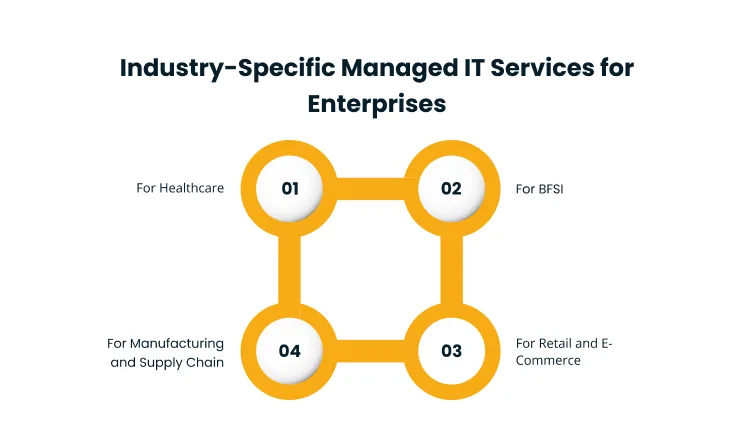
No two industries carry the same IT risk profile. A hospital running critical care workflows operates in a fundamentally different environment from a manufacturing firm managing IoT-connected equipment across production floors.
Enterprise managed IT services, at their most effective, are shaped around these differences rather than applied as a uniform overlay. The following examines how the model addresses the distinct demands of four enterprise-critical industries.
Managed IT Services for Healthcare
Healthcare enterprises operate under one of the most demanding IT environments of any sector, where system failures carry consequences far beyond financial cost.
Managing electronic health records, diagnostic imaging platforms, and clinical data exchange networks requires infrastructure that is always available and fully HIPAA-compliant. Managed IT providers deliver this through:
- EHR system management with uptime guarantees and access control enforcement
- Secure data exchange between clinical systems, labs, and third-party networks
- High-availability infrastructure built for zero-tolerance downtime requirements
The compliance stakes are acute. Patient data must be protected at rest and in transit, audit logs must be maintained with precision, and breach detection must be active at all times. According to the 2024 IBM Cost of a Data Breach Report, healthcare recorded the costliest breaches of any industry for the 14th consecutive year, averaging $9.77 million per incident.
For hospitals managing critical care workflows, managed IT providers who understand this environment build response protocols that treat infrastructure with the same urgency as clinical teams bring to patient care.
Managed IT Services for BFSI
Financial services enterprises navigate a compliance landscape spanning PCI-DSS, RBI guidelines, SOX, and a growing framework of global regulatory standards, where the integrity of IT systems is the integrity of the business.
Transaction failures, data exposures, and audit gaps carry direct regulatory and reputational consequences that compound quickly. Managed IT capabilities in the BFSI context focus on:
- Fraud detection and real-time risk monitoring integrated with core banking systems
- Secure transaction infrastructure with end-to-end encryption and access governance
- Data governance frameworks and audit-ready compliance reporting
The threat environment makes this non-negotiable. According to the 2025 Verizon Data Breach Investigations Report, the financial and insurance sector recorded 3,336 security incidents, among the highest of any industry, with system intrusion and social engineering as the dominant attack patterns.
Managed IT providers serving BFSI must embed compliance controls into every operational layer to maintain the real-time reliability regulators now expect as a baseline.
Managed IT Services for Manufacturing and Supply Chain
Manufacturing enterprises depend on operational continuity across a highly connected environment where ERP platforms, connected production equipment, and supply chain visibility systems must function in tandem without interruption.
An IT failure that disrupts production scheduling or logistics coordination translates directly into lost output and potential contract penalties.
Managed IT capabilities relevant to manufacturing include:
- ERP system management and integration monitoring across production and procurement workflows
- Connected device monitoring for IoT-enabled equipment across factory floors
- Supply chain visibility systems with end-to-end data integrity controls
The shift toward Industry 4.0 has extended IT risk into operational technology environments, where connected equipment and automation platforms sit alongside traditional business applications. Managed IT providers must monitor and protect both OT and business layers cohesively, because a failure in one will expose vulnerabilities in the other.
Managed IT Services for Retail and E-Commerce
Retail enterprises with significant e-commerce operations face IT demands that fluctuate sharply. Seasonal campaigns and peak-demand periods create infrastructure stress that fixed internal capacity cannot absorb reliably, and a system failure during a high-traffic event carries an immediate, measurable revenue impact.
Managed IT capabilities in retail environments include:
- High-traffic infrastructure handling with auto-scaling and load balancing for peak demand cycles
- Payment system uptime with continuous security monitoring and PCI-DSS alignment
- Omnichannel integration management across physical stores, e-commerce platforms, and mobile applications
Beyond peak-demand handling, retail enterprises face growing pressure on customer data protection and payment security. These are two areas where the cost of getting it wrong far outweighs the cost of getting it right.
Enterprises across all four industries increasingly rely on providers that combine domain expertise with enterprise-scale IT operations. What makes that possible comes down to how managed IT services are actually structured and delivered.
Key Benefits of Managed IT Services for Enterprises
Enterprises adopt managed IT services to drive measurable business outcomes that span cost, performance, security, and strategic agility.
- Cost Optimization and Predictability: Enterprises shift from unpredictable CapEx to structured, OpEx-based IT spending, eliminating cost volatility from unplanned hardware failures and reactive incidents.
- Improved Uptime and Business Continuity: Continuous monitoring detects and resolves issues before they escalate, reducing unplanned downtime and its financial impact across regions and business units.
- Faster Scalability and Digital Transformation: Providers scale capacity in line with business requirements, enabling enterprises to expand infrastructure, adopt cloud workloads, and onboard new units without parallel hiring.
- Stronger Security and Compliance Posture: Built-in compliance frameworks covering HIPAA, PCI-DSS, and ISO 27001 maintain continuous security, shifting enterprises from reactive incident response to proactive threat management.
- Access to Specialized Expertise: Enterprises gain multi-domain expertise across cloud, cybersecurity, and application management without the hiring cycle and retention risk of building those teams internally.
According to MarketsandMarkets, the global managed services market is projected to grow from USD 365.3 billion in 2024 to USD 511.0 billion by 2029, a trajectory driven by enterprise demand for scalable, compliance-ready IT infrastructure.
The real value lies in transforming IT from a reactive cost centre into a proactive, always-on capability aligned with business goals.
How Do Managed IT Services Work in Enterprise Environments?
Understanding how managed IT services are structured gives enterprises a framework for evaluating providers accurately and setting realistic expectations from the outset. The model follows a clear lifecycle, beginning with an assessment of the existing environment and developing into a continuous operational and optimization partnership.
1. Assessment and IT Environment Audit
The engagement begins with a systematic evaluation of the enterprise’s current infrastructure, applications, security posture, and operational workflows. A well-structured audit maps:
- Active systems, their interdependencies, and documented ownership gaps
- Infrastructure performance baselines and recurring failure points
- Compliance status across applicable regulatory frameworks
- Security posture across endpoints, network architecture, and data handling practices
The depth of this audit determines everything downstream. SLA commitments are only as credible as the baseline they are built on, and how thoroughly a provider maps an unfamiliar environment reflects the operational discipline they will bring to the engagement going forward.
2. Transition and Onboarding Process
Transitioning IT operations to an external provider is a high-risk phase when managed poorly. A staged handover can produce service gaps, knowledge loss, and operational disruption that take months to stabilize. Effective onboarding requires:
- Structured knowledge transfer from internal IT teams, including undocumented processes and system-specific workarounds
- Detailed documentation of workflows, escalation paths, and system ownership boundaries
- A phased migration plan that allows issues to surface and be resolved before full operational handover
Staged transitions allow the provider to validate monitoring coverage, test incident response protocols, and build operational familiarity before assuming full accountability. Risk-controlled onboarding treats the transition itself as a deliverable with defined milestones, not a precondition that happens in the background.
3. Continuous Monitoring and Proactive Support
Once the environment is under management, the provider maintains 24/7 visibility through automated monitoring, predictive analytics, and dedicated support personnel. The objective is to detect anomalies before they become incidents, tracking system health, security events, application performance, and infrastructure capacity simultaneously.
Real-time incident response protocols ensure that when issues arise, they are addressed within SLA-defined timeframes.
Cygnet.One differentiates at this stage by combining monitoring with intelligent optimization, ensuring IT environments evolve continuously rather than remain static, spanning infrastructure management, cloud oversight across AWS and Azure, and ITSM frameworks built for enterprise-level accountability.
4. Reporting, Optimization, and SLA Management
The ongoing engagement is governed by clear performance metrics and regular reporting cadences. Providers deliver dashboards covering uptime, incident resolution times, security event logs, and infrastructure utilization.
SLA tracking is continuous rather than retrospective, and issues that put commitments at risk are surfaced before they become violations. Optimization recommendations emerge from usage pattern analysis, allowing enterprises to reduce waste, right-size resources, and improve system performance on a rolling basis.
How consistently a provider delivers across all four phases is a direct reflection of their operational maturity, and identifying that maturity is work that happens before the engagement starts.
How to Choose the Right Managed IT Services Provider for Enterprises
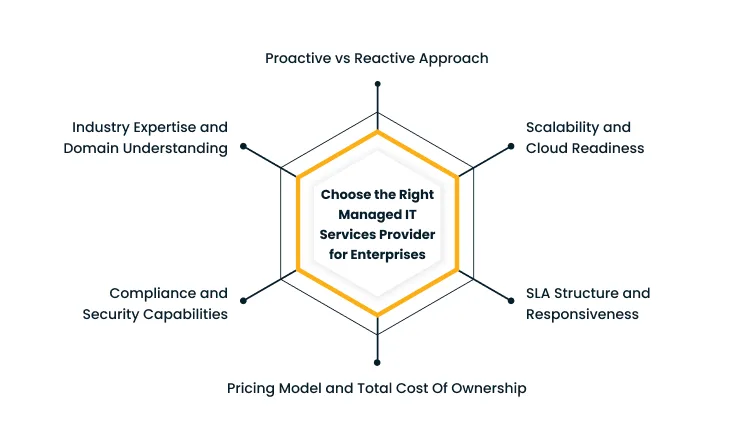
Choosing the right provider directly impacts scalability, compliance, and long-term ROI. The evaluation should go beyond service catalogue breadth and focus on the factors that determine real-world delivery capability and strategic alignment.
- Industry Expertise and Domain Understanding: Look for sector-specific experience in healthcare, BFSI, or manufacturing. Reference cases should reflect the compliance and operational requirements relevant to your industry. Check for:
Verified case studies from your specific industry vertical, not generic references
Demonstrated familiarity with your sector’s regulatory and operational requirements
Provider personnel with domain-relevant certifications or audit experience
- Compliance and Security Capabilities: Verify documented certifications, audit history, and active monitoring controls across frameworks such as ISO 27001, SOC 2, and the regulatory standards applicable to your sector. Ensure:
Active certifications such as ISO 27001 and SOC 2 Type II, not expired or pending
Third-party audit history available for review
Real-time compliance monitoring is built into the standard service model
- Scalability and Cloud Readiness: Ensure the provider supports hybrid and multi-cloud architectures and can scale coverage as the enterprise grows or adopts new platforms. This includes:
Documented support for multi-cloud environments across AWS, Azure, and GCP
Demonstrated capacity to scale during M&A activity or geographic expansion
Defined process for onboarding new platforms or workloads mid-engagement
- SLA Structure and Responsiveness: Evaluate SLA terms and how the provider tracks and reports against them. Providers who surface performance data proactively tend to operate more transparently and accountably. Ensure:
SLA terms are defined at the service level, not just at headline uptime metrics
Live performance dashboards accessible to the enterprise at any time
Documented escalation protocols and resolution timeframe tiers
- Pricing Model and Total Cost of Ownership: Look beyond the headline monthly fee. Understand how pricing scales with scope expansion, what base tiers include, and where costs can escalate under real operational conditions. This includes:
Transparent pricing for scope changes and add-on services
Clear breakdown of what is and is not included at each service tier
Historical cost data from comparable engagements is available on request
- Proactive vs. Reactive Approach: Ask specifically how predictive monitoring is incorporated into daily operations. The answer distinguishes providers who actively manage IT from those who simply react to incidents. Look for:
Evidence of predictive monitoring in practice, not just in the sales pitch
Documented incident prevention rate versus incident response rate
Defined protocol for proactive escalation before an SLA breach occurs
Getting this selection right determines whether managed IT becomes an operational asset or another vendor layer to coordinate.
Providers like Cygnet.One stand out by offering industry-aligned managed IT services, combining compliance readiness through a dedicatedGovernance, Risk Management, and Compliance practice with scalable infrastructure and operational efficiency across enterprise environments.
Conclusion
Selecting the right managed IT provider starts with a clear-eyed assessment of where your IT environment stands today.
Map your current infrastructure gaps and identify which compliance frameworks apply to your industry. From there, build a shortlist of providers with documented experience in your sector, and when evaluating proposals, push beyond service tier descriptions.
Ask for reference cases, SLA reporting samples, and a walkthrough of the onboarding process. The answers will tell you everything about whether a provider can actually deliver, or just sell well.
If your enterprise operates across regulated industries and needs managed IT built around compliance, uptime, and scalability, Cygnet.One brings end-to-end infrastructure management, 24/7 monitoring, and industry-specific expertise across healthcare, BFSI, manufacturing, and retail environments.
Book a demo today and see how Cygnet.One can align with your operational requirements.
Managed IT services for enterprises involve outsourcing IT operations, including infrastructure management, cybersecurity, cloud services, and technical support to specialized providers. These services ensure continuous monitoring, improved uptime, and scalable IT operations. Enterprises maintain strategic control of IT direction while the provider handles day-to-day operations, issue resolution, and compliance management under defined service-level agreements.
Managed IT services replace unpredictable capital expenditure with predictable operational spending. Enterprises eliminate the costs of maintaining large in-house teams, reduce downtime-related revenue losses, and optimize infrastructure usage through proactive monitoring and automation. The shift from reactive to proactive IT management also reduces the frequency and severity of costly incidents that would otherwise require emergency response.
Industries with high compliance, security, and uptime requirements see the strongest returns, including healthcare, BFSI, manufacturing, and retail. Healthcare enterprises need HIPAA-aligned infrastructure management; BFSI firms require real-time compliance and fraud monitoring; manufacturers depend on operational continuity across connected environments; and retailers need scalable infrastructure for peak-demand periods and payment security compliance.
Managed IT providers implement continuous monitoring, threat detection, and compliance frameworks aligned with regulations, including HIPAA, PCI-DSS, and GDPR. Security controls are active at all times rather than applied periodically, and audit logs are maintained with the precision regulators require. This approach reduces both the risk of data breaches and the cost of non-compliance.
Enterprises should evaluate providers based on industry expertise, compliance capabilities, scalability, SLA structure, and approach to proactive management. A provider with domain experience in your sector will understand the regulatory and operational requirements relevant to your environment. Equally important is transparency in SLA reporting and a service model built around prevention, not just incident response.
Managed IT services provide access to broader multi-domain expertise, 24/7 monitoring coverage, and scalable resources that most in-house teams cannot match in cost or scope. Internal teams often focus on strategic priorities while the managed provider handles operational continuity and compliance monitoring. The two models work best when complementary rather than competing.
Author


Abhishek Nandan
AVP, Marketing
Abhishek Nandan is the AVP of Services Marketing at Cygnet.One, where he drives global marketing strategy and execution. With nearly a decade of experience across growth hacking, digital, and performance marketing, he has built high-impact teams, delivered measurable pipeline growth, and strengthened partner ecosystems. Abhishek is known for his data-driven approach, deep expertise in marketing automation, and passion for mentoring the next generation of marketers.