







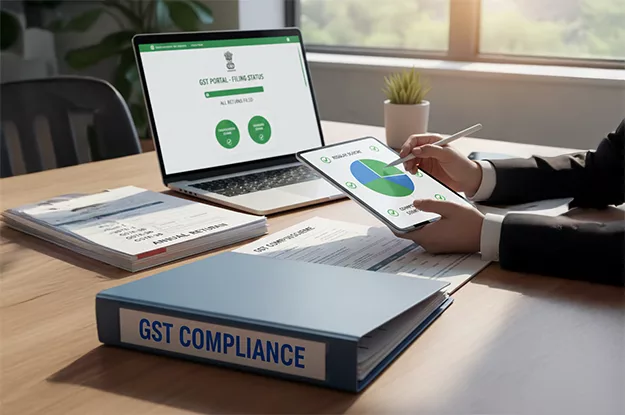




























Goods and Services Tax (GST) is India’s nationwide indirect tax system, introduced in 2017. Every registered business must file returns, reconcile invoices, and claim Input Tax Credit (ITC) on time. This is difficult to do manually, especially when transaction volumes are large. AI in tax uses machine learning (ML) and automation to handle these tasks. It helps Indian enterprises file returns faster, catch errors early, and always stay ready for audits.
Why Is It So Hard for Indian Businesses to Comply With GST?
India’s GST system has several layers that make compliance hard to manage manually.
- The four main tax slabs are 0%, 5%, 12%, 18%, and 28%. Rates change frequently.
- Businesses need to make multiple returns every month and quarter. Some of these consist of GSTR-1, GSTR-3B and GSTR-9.
- Firms who generate more than a certain turnover also need to create e-Invoices via the Invoice Registration Portal (IRP).
- A GSTN auto-generated GSTR-2B report needs to match between a company’s purchase records and claims from ITC.
- Businesses operating throughout multiple states must maintain a separate GSTIN system for each state.
- GSTN uses data analytics to spot mismatches and issue notifications to companies. Important
Key Stats: One of the major reasons Indian enterprises are given GST notices is the ITC mismatch between buyer files and supplier sent invoices. For large companies, even a 1% error can mean crores of rupees in disputed tax credits.
Old, Rule-Based Tax Systems Limitations: What Are Their Limits?
Most traditional tools for tax deal with fixed rules. They operate via if-then instructions that developers write and then update manually. These systems have considerable limitations.
- They cannot update automatically as GST rules change. IT teams must update the logic every time.
- They can’t parse unstructured data such as scanned invoices or PDFs.
- They give lots of false alerts, and it wastes the tax team time.
- They require human help in matching entries across different time periods.
- If the number of invoices grows, they slow down or break.
Manual and rule-based tools aren’t enough when businesses process over 50,000 invoices monthly. This is where AI in tax comes in.
What Is AI in Tax? A Simple Definition
AI in tax means using machine learning (ML), natural language processing (NLP), and intelligent automation to process tax data and manage compliance. It also includes important aspects as:
AI-powered GST compliance software can use machine learning, automation, reconciliation, validation, and analytics to help enterprises manage tax data and compliance at scale.
- ML models to classify transactions, estimate potential tax values and flag suspicious transactions.
- NLP tools that do the job of reading and pulling data from invoices, emails, and contracts.
- AI for the automatic matching of purchase data between GSTR-2B, GSTR-1, and ERP records.
- Predictive tools to score audit risk against past filing patterns.
AI in tax doesn’t replace tax professionals. It processes the mundane data so that the finance teams can concentrate on important things such as tax planning and dispute resolution.
Where Does AI Make the Biggest Difference in GST Compliance?
Although in its nascent stage, AI has become the front-runner in disrupting compliance in GST. It has helped in a lot of aspect, some of which we have listed below:
How Does AI Help with Invoice Reconciliation?
Every Indian enterprise must match purchase invoices with the GSTR-2B report generated by the GSTN. This manually takes lots of time and causes errors. Here, AI comes to the rescue and simplifies the reconciliation process through:
- Automatically matches invoices, regardless of small differences in supplier names, invoice numbers, or amounts.
- Indicates why each unmatched invoice was logged so that an error occurs with respect to a supplier’s filing delay, the cancelled invoice, or the rate mismatch.
- Returns high-value mismatches to the tax team for review.
- Learns from errors over time to reduce future mismatches.
Business Result: Businesses utilizing AI reconciliation tools usually reduce manual effort by 60-80% and receive near real-time visibility about the available ITC.
How Does AI Improve Input Tax Credit (ITC) Matching?
ITC is a key cash flow tool for businesses. Claiming too little means lost money. Claiming too much creates legal risk.
An AI-led ITC eligibility approach can help improve these ITC decisions by:
- Automatically checking whether each credit is eligible under GST rules, including Section 17(5) blocked credits
- Tracking ITC across time periods so no eligible credit is missed within the allowed window
- Scoring vendor reliability based on their GSTR-1 filing history
How Does AI Detect Anomalies and Reduce Audit Risk?
India’s GSTN and Central Board of Indirect Taxes and Customs (CBIC) use analytics to detect suspicious filing patterns. AI gives businesses the same ability internally.
AI anomaly detection tools:
- Find statistical outliers in invoice data, such as duplicate invoices or round-number GST amounts
- Identify possible fake invoice fraud using ML classification models
- Monitor filing patterns across all GST returns and flag inconsistencies before they attract departmental scrutiny
- Produce pre-audit risk reports so teams can fix problems before receiving a notice
Example: An AI system trained on a company’s invoice history can spot a vendor whose GST amounts are always round numbers. Human reviewers often miss this pattern. It is a common sign of fake invoicing.
How Does AI in GST Work with India’s GSTN Ecosystem?
India’s GST technology infrastructure runs on the GSTN, which processes over 100 crore invoices every year. The GSTN ecosystem includes:
- The Invoice Registration Portal (IRP) for mandatory e-Invoicing
- The E-Way Bill system for tracking goods in transit
- GSTR auto-population based on what suppliers file
- The Annual Information Statement (AIS) and notice management portals
AI tax platforms that connect with GSTN APIs can pull real-time data from GSTR-2B, the IRP, and E-Way Bill systems. This supports a continuous compliance model instead of a last-minute month-end rush.
Key features to look for when evaluating AI tax platforms:
- For e-Invoicing in India, direct API connectivity for e-Invoice generation and IRN fetching
- Real-time GSTR-2B sync to track ITC availability live
- Automated GSTR-1 and GSTR-3B preparation from ERP data with AI-assisted validation before submission
What Business Benefits Does AI-Driven GST Compliance Deliver?
The table below shows how AI improves key compliance areas compared to traditional approaches.
| Compliance Area | Traditional Approach | With AI in Tax | Typical Improvement |
|---|---|---|---|
| ITC Reconciliation | Manual, done monthly | Automated, near real-time | 60 to 80% time reduction |
| Anomaly Detection | Rule-based, reactive | ML-driven, proactive | 3 to 5 times more issues caught |
| Return Filing | Manual data entry | AI-assisted, auto-validated | 40 to 50% faster filing |
| Audit Readiness | Reactive, post-notice | Continuous monitoring | Significant risk reduction |
| Cost of Compliance | High FTE dependency | Lean, scalable team | 20 to 35% cost reduction |
What Challenges Do Companies Face When Adopting AI for GST?
There is no doubt that including AI in the GST system will propel the business by making the teams focus on more important task. Although, as it happens with every new technology, there are some issues that the teams face, they are:
Is the Data Good Enough for AI to Work?
Is the Data Good Enough for AI Functioning? AI models need to work properly provided they are trained on clean and consistent input. Fragmented ERP systems, inconsistent vendor GSTINs across various Indian businesses and incomplete historical records to mention a few. The data needs to be cleaned and standardized before a release of AI tax tools.
How Difficult Is Integration with Existing ERP Systems?
Bringing the AI tools to legacy ERPs like SAP, Oracle, Tally or other systems you build for yourself requires structured APIs and careful mapping of your data. Companies may want to adopt a phased integration approach without the use of modern ERP configuration.
How Should Teams Be Prepared for the Change?
If the finance and tax teams are trained in traditional manual processes they must invest time in training, otherwise they will find it difficult working effectively with AI tools. It’s not only a technology project. It requires sound change management, defined roles and support.
Can AI Replace Human Tax Judgment?
It is a model that can automate rule-based decisions. However, GST fights primarily concern interpretation of exemption notifications, advance rulings and sector-specific provisions. You cannot replace human judgment for judgment-heavy decision making because of AI alone.
What About Data Security?
Tax data is sensitive. When selecting an AI tax platform, organisations should consider data residency policies, encryption standards, SOC 2 compliance and clear contractual data protection agreements (the latter of which places a heavy load on cloud solutions).
What Does the Future of Autonomous Tax Compliance Look Like?
AI in GST is heading towards a future where compliance processes race, at almost instantaneous cycle speed-up with almost no human interaction. We know that key short-term features that will help us in the next few months will be on a high level:
- Continuous transaction monitoring: After an event, it goes in the ERP system automatically, every transaction is classified and tax-coded at once.
- Predictive liability management: AI will predict monthly GST payments from order streams so enterprises have early cash flow planning.
- Automated notice responses: AI drafting replies to GST department notices in line with the departmental records.
- Blockchain-linked audit trails: Permanent records linking e-Invoices, E-Way Bills, and payments to minimize the amount of time taken to settle audits.
- AI-driven advance ruling applications: Systems that identify ambiguous transactions and flag them for possible ruling requests prior to audit exposure.
Important context: The CBIC roadmap for GST 2.0 will include provision for robust e-Invoicing, real-time information sharing with local state tax administrations, and AI-powered scrutiny tools. Businesses that don’t invest in tax automation at this stage will face a tougher tax compliance obstacle when those changes launch in the market.
Key Takeaways
AI in tax is a practical tool that Indian enterprises can use today to manage GST compliance more efficiently.
- GST compliance in India requires ongoing, multi-step obligations that cannot be handled by manual tools very effectively, at scale.
- AI brings greatest value in invoice reconciliation, ITC matching, anomaly detection, and audit readiness.
- Continuous compliance solution through integration with GSTN APIs, IRP, E-Way Bill systems.
- AI deployment needs clean data, change management and well-defined human-AI task limits.
Businesses investing in AI tax automation in the near-term are preparing for GST 2.0 and enhanced regulatory scrutiny”
Frequently Asked Questions
What is AI in tax and how does it apply to GST in India?
In the context of GST, it enables invoice reconciliation, ITC matching, anomaly detection and return preparation automation. This minimizes manual work and increases efficiency among Indian companies of different sizes.
How does AI improve ITC matching for Indian businesses?
Through fuzzy matching, AI ITC matching engines compare purchase records with GSTR-2B data. They identify a mismatch with reasons and flag it, score vendor filing reliability, and chart ITC in various periods. This allows businesses to claim the maximum possible credit when they are qualified to the maximum eligible credit and prevents over-claiming.
Is AI in GST compliance suitable for mid-size Indian companies?
Yes. AI enabled GST tools can be found on SaaS platforms, ERP plugins as well as enterprise solutions. Even companies dealing with 5,000 to 10,000 invoices a month realize significant time and cost savings. It is highly necessary to produce master data that is reasonably clean, GSTINs and HSN codes must be correct, etc.
What happens if a company uses AI for tax without clean data?
In the absence of clean input data, AI instruments obtain inaccurate outputs. This may result in inaccurate ITC estimation, an anomaly in the data that is overlooked, or a transaction classified incorrectly. Data governance – such as clean vendor masters and validated GSTIN – has to be established when deploying AI for tax compliance.
How does AI tax software connect with the GSTN?
Solid AI tax systems can link up to the GSTN through official APIs. This entails real-time GSTR-2B data grabbing, creating e-Invoices via the IRP and e-Way Bill sync. These integrations can take responsibility of eliminating manual data downloading and lowering the likelihood of filing errors.
FAQ's
In the context of GST, it enables invoice reconciliation, ITC matching, anomaly detection and return preparation automation. This minimizes manual work and increases efficiency among Indian companies of different sizes.
Through fuzzy matching, AI ITC matching engines compare purchase records with GSTR-2B data. They identify a mismatch with reasons and flag it, score vendor filing reliability, and chart ITC in various periods. This allows businesses to claim the maximum possible credit when they are qualified to the maximum eligible credit and prevents over-claiming.
Yes. AI enabled GST tools can be found on SaaS platforms, ERP plugins as well as enterprise solutions. Even companies dealing with 5,000 to 10,000 invoices a month realize significant time and cost savings. It is highly necessary to produce master data that is reasonably clean, GSTINs and HSN codes must be correct, etc.
In the absence of clean input data, AI instruments obtain inaccurate outputs. This may result in inaccurate ITC estimation, an anomaly in the data that is overlooked, or a transaction classified incorrectly. Data governance – such as clean vendor masters and validated GSTIN – has to be established when deploying AI for tax compliance.
Solid AI tax systems can link up to the GSTN through official APIs. This entails real-time GSTR-2B data grabbing, creating e-Invoices via the IRP and e-Way Bill sync. These integrations can take responsibility of eliminating manual data downloading and lowering the likelihood of filing errors.
Author


Kesha Shah
General Manager - Products Marketing
Kesha Kumar leads the global products marketing team at Cygnet.One, where she turns the complexity of tax and finance transformation into stories that resonate with the people who matter most. She’s the strategic force behind the brand’s presence across India, the GCC, Southeast Asia, and Europe, translating dense subjects like e-Invoicing mandates, digital engineering, and enterprise AI into narratives that inform and drive action. With expertise spanning tax and finance transformation, quality, enterprise applications, and data and AI, Kesha blends sharp strategic thinking with a marketer’s instinct for what truly connects. At Cygnet.One, she does more than build campaigns and content; she shapes the conversations that help enterprises navigate compliance with clarity and confidence, propelling the brand to the forefront of the industry along the way.