



































Artificial Intelligence is poised to be the next wave of digital transformation. The time to explore AI implementation has come for every business leader. At this point, developing an AI roadmap should be a top priority for most enterprises. B2B organizations are no exception to this trend. AI is penetrating the B2B market as well.
As AI moves deeper into mainstream enterprise, it is important to understand its significant and imminent impact on everything from business strategy, business operations to customer delivery.
Why artificial intelligence matters to B2B organizations
The customer buying cycle for B2B is significantly longer and more complex than B2C. To address each requirement of clients, B2B companies must put concentrated efforts to understand the buyer persona.
Be it end users or corporate clients, each individual leaves behind a plethora of information through their online activities. Whether they search online, visit websites, or purchase online, a large volume of data showing such as these needs to be analyzed to understand the user mindset, demographics and their behavior.
When investing manual efforts in understanding the buyer, businesses often miss crucial insight as data collected can be inaccurate, mismanaged or found redundant – resulting in loss of sales and customer experience.
Hence, B2B marketers need an accurate method to do a precise interpretation of data. AI is one such tactical approach that every B2B marketer should adopt. It helps in evaluating valuable data insights, quickly responding to decision-makers, resulting in enhanced user experience.
Importance of AI in B2B organizations
Artificial intelligence (AI) technology promises to solve complex problems of B2B organizations that no humans could legitimately solve earlier. AI can help businesses increase sales, accelerate lead conversion, optimize content delivery, and improve customer experience.
AI can help B2B companies gain a steady advantage and encourage exponential growth. While many companies are still exploring AI solutions, several top organizations are already thriving with AI.
For instance, AI controls everything at LinkedIn, from the right job recommendation, providing relevant content to their members, helping salespersons predict the responsiveness of the lead, to helping a recruiter find new talent pools.
“Artificial Intelligence will transform every industry across both B2B and B2C sectors, including retail, healthcare, legal, manufacturing, and automotive. It is not a matter of if AI will transform your industry — it is only a matter of when”. — Ronald van Loon
Here are some of the major ways Artificial Intelligence is facilitating operations for B2B companies.
Lead generation
B2B lead generation is a laborious manual process. It can take hundreds of hours of manpower to search for potential clients, categorize them based on requirements and find contact information.
In this aspect, Machine Learning can help collect large volumes of data while organizing unstructured data to determine a good prospect. This information is vital for effective marketing campaigns. Gartner reports that Generative AI reduces prospecting and meeting prep time by over 50% for B2B sales organizations within two years, with conversational AI interfaces driving up to 60% of B2B sales interactions by 2028.
Real-Life Example:
EY helped an Irish telecom streamlining their B2B sales pipeline using AI-powered lead generation, resulting in a 50% increase in lead conversion rates and healthier sales pipeline
Predictive analysis efforts
We already see this in the B2C landscape. Customized ads and suggestions are visible in search results and social media feeds. B2B companies are also leveraging predictive analysis to offer a customized range of services or products based on their user purchase history. Gartner predicts 90% of B2B buying will be mediated by AI agents by 2028, representing over USD 15 trillion in spend, pushing procurement platforms and buyers targeting new levels.
There is much more opportunity for upselling as well as sustaining collaboration with the rise of AI solutions in B2B companies.
Customer Engagement
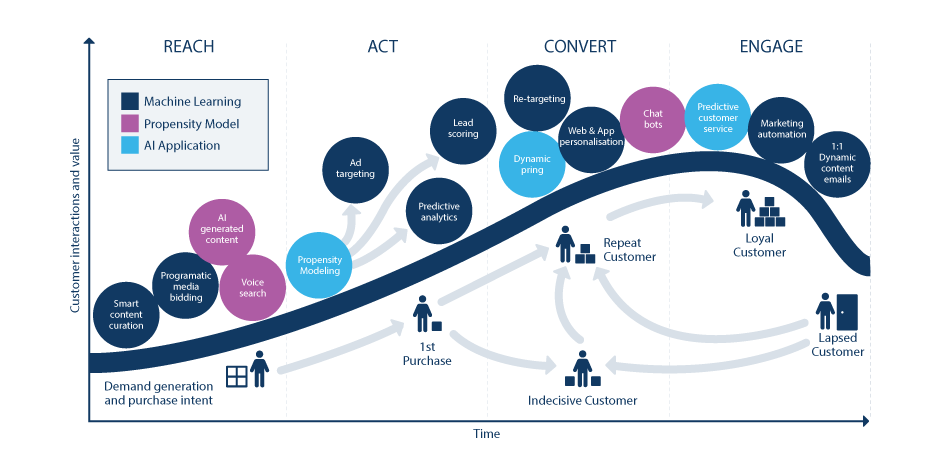
Artificial Intelligence helps B2B organizations to enhance customer experience during each stage of the customer lifecycle. Predictive analysis, Ad targeting, and Re-targeting can convert an indecisive consumer or customer who does not prefer to purchase the second time into a repeat buyer.
Chatbots improve the customer’s buying process. To give you a real-life example, Salesforce and HubSpot use AI for personalized marketing campaigns, leading to significant increases in engagement rates and conversions. AI-powered chatbots now handle over two-thirds of initial prospect interactions, qualifying leads and scheduling meetings automatically.
Customers can easily get answers to their questions when browsing online. Marketing automation can target lapsed customers to turn them into loyal customers and keep them from buying from a single brand.
Search and tracking
AI-driven technology like text-to-speech and image recognition helps consumers find what they are seeking more quickly. It remembers each user’s search preference upon each succeeding visit.
Additionally, B2B industries can also use AI to track vehicle movement and physical inventory with automated stock monitoring. It informs automatically when inventory is too low, or if the product is not shipped. In fact, according to one report by Gartner, digital twins and connected products will reshape B2B commerce, yielding drastic improvements in inventory tracking and customer value by 2026–2030.
It’s high time for B2B companies to adopt AI to capitalize on the lifetime value of their customer relationships.
Author


Cygnet.One
Living the trust
Cygnet.One is a technology consulting and development company, that co-creates business growth strategies and delivers partnership value through the Power of Digital. We specialize in leading technologies such as Cloud Computing, AI/ML, and Blockchain with a focus on innovation and agility.