






























Introduction
As a transformative shift, authorities worldwide are understanding the impact of e-invoicing on the functioning of tax administration, including Malaysia’s IRBM. As the benefits of e-invoicing are not a secret anymore, neither for authorities nor for business organizations, it is equally crucial to understand and work on key prerequisites and assess an organization’s readiness for implementing e-invoicing in the business process.
This pre-requisite and readiness assessment involves legal and regulatory compliance, technical infrastructure, and comprehensive training. By addressing these pre-requisites, businesses can have a seamless transition to e-invoicing, adding operational efficiency and accuracy and fostering sustainable business workflow.
This article will take to the prerequisites for the implementation of e-invoicing.
Prerequisites
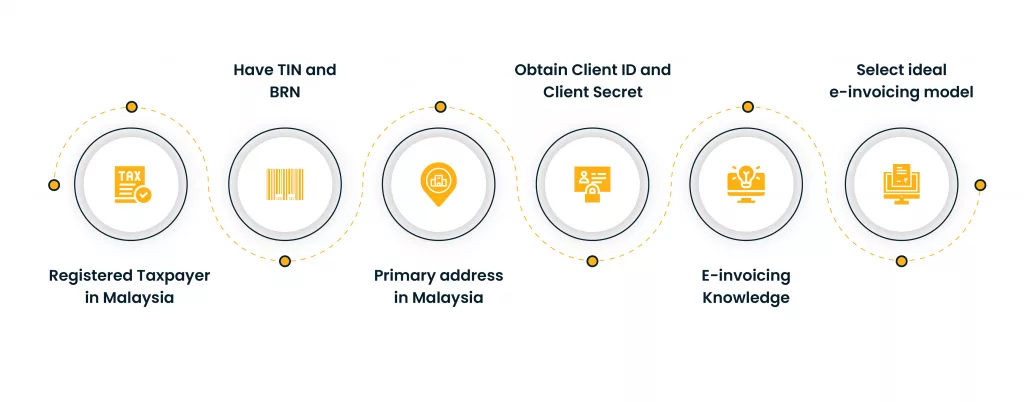
- The company must be a registered taxpayer of Malaysia and have a TIN (Tax Identification Number) and BRN (Business Registration Number).
- The Primary address of the entity must be in Malaysia.
- Obtain a digital signature certificate from one of the Malaysian certificate authorities to digitally sign electronic invoices.
- Obtain Client ID and Client secret values to establish a secure integration with IRBM Portal.
- Have a comprehensive understanding of e-invoicing rules and regulations. To learn more about Malaysia’s e-invoicing in simplified form, visit our e-book “E-invoicing in Malaysia: A Complete Guide.”
- Decide about the approach to be considered for E-Invoice project implementation.
How do you get a Client ID and Client Secret?
- Registered taxpayers with TIN in Malaysia can obtain client IDs and Client Secrets.
- To obtain a Client ID and Client Secret, the business has to submit a request via email to sdkmyinvois@hasil.gov.my, with below information:
- Tax Identification Number (TIN) – excluding Employer’s (E) No.
- New Business Registration Number
- Company Name
- Company Email Address
- Name of ERP System
How do you acquire a Digital Signature?
- The digital signature has to be obtained by registered taxpayers from Certified and Recognized authorities only.
- The user can apply to purchase a digital signature for an e-invoice with any of the above-listed agencies.
- Up on issuance, the Cygnet’s system must provide the same.
- Cygnet’s system will generate the signature value for every document generation.
The Approach of e-Invoicing Project
There are the following approaches:
- LHDNM Approach
- Integration through APIs
- Direct integration of ERP with LHDNM
- Integration through technology/e-invoice solution provider
- MDEC Approach (Peppol route)
Readiness Assessment for implementation of e-invoicing project
It is vital for businesses to be ready when the implementation deadlines hit to ensure a hassle-free start of the e-invoicing process. To ensure that, here are a few points to be considered:
- Evaluate the current process and IT capabilities for issuing documents like invoices, credit notes, debit notes, bills, etc.
- Determine the availability of IT infrastructure, data source, and structure to evaluate system readiness.
- Evaluate the best-fit e-invoicing model based on your business requirements.
- Select the ideal technology/e-invoice solution provider or PEPPOL-accredited service provider to ensure optimum compliance with minimum effort.
- Allocate and equip the organization’s personnel with proper e-invoicing facilities and required infrastructure to adopt and supervise e-invoicing implementation.
Technical Checklist for e-Invoicing Implementation
To ensure smooth deployment and ongoing compliance, organizations should verify the following technical aspects before going live:
- ERP/System Compatibility: Confirm that your ERP or accounting system supports structured e-invoice formats (such as XML/JSON) required by IRBM.
- API Readiness: Ensure secure API connectivity with IRBM portal, including sandbox testing and production environment setup.
- Digital Signature Integration: Validate that the system can generate, apply, and verify digital signatures automatically for each invoice.
- Data Mapping & Validation: Map invoice data fields accurately as per IRBM schema and implement validation checks to avoid rejection.
- Security & Encryption: Implement secure authentication protocols, data encryption, and role-based access controls.
- Archival & Storage: Establish compliant document retention and secure storage mechanisms for audit and regulatory requirements.
- Error Handling Mechanism: Configure automated alerts and error logs for rejected invoices and failed submissions.
- System Testing: Conduct end-to-end testing, including invoice generation, submission, validation, clearance, and reporting.
- Business Continuity Plan: Prepare fallback mechanisms in case of system downtime or API unavailability.
- Reporting & Reconciliation: Ensure real-time tracking, reconciliation, and reporting capabilities for submitted e-invoices.
Looking Forward
While there is always room for discrepancy when the systems and solutions are in practical use, that does not mean an organization should not work on pre-requirements and ensure optimum readiness for the e-invoicing process. The rest of the minor issues and discrepancies can be tackled easily if organizations have in-house experts or suitable service providers. To be compliant ready, approach Cygnet’s e-invoicing for your businesses’ effortless and automated e-invoice workflow.
Author


Komal Vithalani
Content Writer
Komal Vithalani, a Chartered Accountant and Commerce graduate, is a dedicated professional committed to delivering value with years of expertise in navigating the complexities of indirect tax laws. Her practical excellence includes managing perplexed litigations, dispensing tactical tax advice, conducting thorough compliance checks, supervising audits, and crafting articulate and insightful content. At Cygnet, Komal seamlessly blends her profound understanding of tax regulations with cutting-edge tax technology. Leveraging her competence, she adeptly transforms complex tax tech jargon into concise, impactful, and engaging content. This not only aids readers in comprehending tax-related topics with enlightening clarity but also ensures the delivery of narratives that resonate broadly.