




























• Cygnet IRP
  • Glib.ai
  • IFSCA
Cygnet.One
  • About
  • Products
  • Solutions
  • Services
  • Partners
  • Resources
Generic selectors
Exact matches only
Search in title
Search in content
Post Type Selectors
Get Started
About
  • Overview

    A promise of limitless possibilities

  • We are Cygnet

    Together, we cultivate an environment of collaboration

  • Careers

    Join Our Dynamic Team: Careers at Cygnet

  • CSR

    Impacting Communities, Enriching Lives

  • In the News

    Catch up on the latest news and updates from Cygnet

  • Contact Us

    Connect with our teams across the globe

What’s new

chatgpt

Our Journey to CMMI Level 5 Appraisal for Development and Service Model

Full Story

chatgpt

ChatGPT: Raising the Standards of Conversational AI in Finance and Healthcare Space

Full Story

Products
  • Cygnet Tax
    • Cygnet Tax
    • e-Invoicing / Real time reportingIRP-integrated e-Invoicing with real-time validation
    • e-Way Bills / Road permitsGST-compliant centralized e-Way Bill platform for scalable operations
    • Direct Tax ComplianceAccurate direct tax compliance, filings, litigation, and assessments
    • Indirect Tax ComplianceEnterprise-grade platform for indirect tax compliance
      • Indirect Tax Compliance
      • GST Compliance India
      • VAT Compliance EU
      • VAT Compliance ME
    • Managed ServicesEnd-to-end indirect tax compliance support by experts
  • Global e-Invoicing
    • Global e-Invoicing
    • APAC
      • India
      • Malaysia
      • Singapore
      • Japan
    • Africa
      • Egypt
      • Kenya
      • Zambia
      • Nigeria
    • Europe
      • Spain
      • France
      • Germany
      • Poland
      • Belgium
    • Oceania
      • Australia
      • New Zealand
    • Middle East
      • UAE
      • Oman
      • Saudi Arabia
      • Bahrain
      • Qatar
      • Jordan
  • Cygnet Vendor Postbox
    • Cygnet Vendor PostboxDigitize purchase invoice validation & posting to ERPs & maximize ITC
  • Finance Transformation
    • Finance Transformation
    • Cygnet FinalyzeUnlock working capital with data-driven invoice-based credit decisions
    • Bank Statement AnalysisEvaluate company health by analyzing performance and financial risk
    • Financial Statement AnalysisAssess company performance and risk with financial statement analysis
    • GST Business Intelligence Report360-degree financial health insights using GST data analytics
    • GST Return Compliance ScoreGST-based compliance score to assess business risk and credibility
    • ITR AnalysisAssess creditworthiness and lending risk using ITR filing analysis
    • Invoice Verification for Trade FinanceVerify invoices to reduce fraud and improve credit decisions
    • Account Aggregator – Technology Service Provider (AA-TSP)Onboard to the Account Aggregator ecosystem with FIP & FIU modules
  • Cygnet BridgeFlow
    • Cygnet BridgeFlowAutomated digital onboarding with real-time validations and compliance
  • Cygnet Bills
    • Cygnet BillsGST-compliant centralized e-Way Bill platform for scalable operations
  • Cygnet IRP
    • Cygnet IRPIRP-integrated e-Invoicing with real-time validation
  • Cygnature
    • CygnatureSecure, compliant digital signing with audit-ready traceability

What’s new

e-Invoicing compliance Timeline

Know More →

UAE e-Invoicing: The Complete Guide to Compliance and Future Readiness

Read More →

Types of Vendor Verification and When to Use Them

Read More →

Safeguard Your Business with Vendor Validation before Onboarding

Read More →

Modernizing Dealer/Distributor & Customer Onboarding with BridgeFlow

Read More →

Accelerate Vendor Onboarding with BridgeFlow

Read More →

GST Filing 360°: GST, E-Invoicing, E-Way Bills & Annual Returns Made Simple

Read More →

Why Manual Tax Determination Fails for High-Volume, Multi-Country Transactions

Read More →

GST Filing 360°: GST, E-Invoicing, E-Way Bills & Annual Returns Made Simple

Read More →

Key Features of an Invoice Management System Every Business Should Know

Read More →

Automating the Shipping Bill & Bill of Entry Invoice Operations for a Leading Construction Company

Read More →

From Manual to Massive: How Enterprises Are Automating Invoice Signing at Scale

Know More →

Solutions
  • HireAI
  • Agent as a Service
  • AI-powered Voice Assistant
  • Generative AI Workshop
  • TestingWhiz
  • VIPRE

What’s new

AI powered Interviewer

AI-Powered Interviewing Helped an Education Group Reduce Hiring Time Significantly

Know More

Generative AI ebook

Navigating the Generative AI Landscape

Download eBook

Services
  • Data Analytics & AI
    • Data Analytics & AI
    • Data Engineering and ManagementData engineering and management for smart, scalable systems
    • Data Migration and ModernizationData migration and modernization for future-ready platforms
    • Insights Driven Business TransformationInsight-driven business transformation for faster decisions
    • Business Analytics and Embedded AIBusiness analytics and embedded AI for data-led growth
  • Digital Engineering
    • Digital Engineering
    • Technical Due DiligenceEnabling smarter decisions through future-ready digital ecosystems
    • Product EngineeringEngineering impactful digital products that elevate business growth
    • HyperautomationSmarter hyperautomation using low-code for agile business processes
    • Enterprise IntegrationIntegrating enterprise systems for seamless operations and growth
    • Application ModernizationModernizing IT ecosystems with scalable, AI-driven innovation
  • Quality Engineering
    • Quality Engineering
    • Test Consulting & Maturity AssessmentTest consulting and maturity assessments for reliable software QA
    • Business Assurance TestingBusiness assurance testing aligned with real business outcomes
    • Enterprise Application & Software TestingEnterprise application testing for continuity and scale
    • Data Transformation TestingData transformation testing for scalable, trusted data quality
  • Cloud Engineering
    • Cloud Engineering
    • Cloud Strategy and DesignCloud strategy and design services for secure, scalable growth
    • Cloud Migration & ModernizationORBIT: a proven framework for measurable cloud transformation
    • Cloud Native DevelopmentCloud-native development for resilient, scalable innovation
    • Cloud Operations and OptimizationCloud optimization and operations for enterprise resilience
    • Cloud for AI FirstAI-first cloud transformation for smarter, scalable enterprises
  • Managed IT Services
    • Managed IT Services
    • IT Strategy and ConsultingStrategic IT consulting to align technology with business goals
    • Application Managed Services24/7 managed application services for performance and security
    • Infrastructure Managed ServicesEnd-to-end infrastructure management for resilient IT operations
    • CybersecurityComprehensive cybersecurity solutions to protect business assets
    • Governance, Risk Management & ComplianceGRC solutions to manage risk, compliance, and governance
  • Cygnet TaxAssurance
    • Cygnet TaxAssurance
    • Tax DatalakeUnified tax data lake for intelligent, compliant decision-making
    • Tax InfraDigital tax infrastructure for efficient, compliant transformation
  • Amazon Web Services
    • Amazon Web Services
    • Migration and ModernizationMake Your Move to the Cloud With AWS Smarter & Faster
    • Generative AIRun your Gen AI workloads on AWS with full control

What’s new

AI-Powered Voice Assistant for Smarter Search Experiences

Explore More →

Cygnet.One’s GenAI Ideation Workshop

Know More →

Our Journey to CMMI Level 5 Appraisal for Development and Service Model

Read More →

Extend your team with vetted talent for cloud, data, and product work

Explore More →

Enterprise Application Testing Services: What to Expect

Read More →

Future-Proof Your Enterprise with AI-First Quality Engineering

Read More →

Cloud Modernization Enabled HDFC to Cut Storage Costs & Recovery Time

Know More →

Cloud-Native Scalability & Release Agility for a Leading AMC

Know More →

AWS workload optimization & cost management for sustainable growth

Know More →

Cloud Cost Optimization Strategies for 2026: Best Practices to Follow

Read More →

Cygnet.One’s GenAI Ideation Workshop

Explore More →

Practical Approaches to Migration with AWS: A Cygnet.One Guide

Know More →

Tax Governance Frameworks for Enterprises

Read More →

Cygnet Launches TaxAssurance: A Step Towards Certainty in Tax Management

Read More →

Partners
  • Products Partner Program
Resources
  • Blogs
  • Case Studies
  • eBooks
  • Events
  • Webinars

Blogs

A Step-by-Step Guide to E-Invoicing Implementation in the UAE

A Step-by-Step Guide to E-Invoicing Implementation in the UAE

View All

Case Studies

Cloud-Based CRM Modernization Helped a UK Based Organization Scale Faster and Reduce Deployment Complexity

Cloud-Based CRM Modernization Helped a UK Based Organization Scale Faster and Reduce Deployment Complexity

View All

eBooks

Build Smart Workflow with Intelligent Automation and Analytics

Build Smart Workflow with Intelligent Automation and Analytics

View All

Events

11th CIO Conclave & Awards

11th CIO Conclave & Awards

View All

Webinars

Beyond Chat: How Voice-Assisted AI is Redefining Digital Engagement

Beyond Chat: How Voice-Assisted AI is Redefining Digital Engagement

View All
Cygnet IRP
Glib.ai
IFSCA

How Enterprises Can Reduce Dashboard Sprawl in Business Intelligence Platforms? 

  • By Yogita Jain
  • April 3, 2026
  • 7 minutes read
Share
Subscribe

Data dashboard growth has accelerated across enterprise analytics environments. The challenge is that management practices have not kept pace. As more teams adopt business intelligence tools, dashboards multiply across departments and platforms. And while access increases, clarity tends to decline. 

This is already evident across enterprises, with studies showing that 40% of data managers struggle daily with too many tools and data sources. Fragmented reporting environments are a direct consequence of weak data governance. At the same time, organizations still continue to invest in dashboards as a primary decision-making layer. 

A 2025 survey of SaaS leaders found that while 78% of companies actively use dashboards, user satisfaction remains low at just 3.6 out of 5. 

A significant portion of users, as a result, abandon dashboards entirely and revert to spreadsheets. That shift is where dashboard sprawl begins to affect decision-making at the organizational level. 

What is data dashboard sprawl? 

Dashboard sprawl refers to the uncontrolled growth of dashboards and analytics views across an organization using data analytics services. It takes hold when dashboards are created continuously, while older ones remain active, unreviewed, and without clear ownership. 

The accumulation is gradual. Teams respond to business requests, analysts build what is asked of them, and the reporting environment quietly becomes harder to navigate. By the time the problem is recognized, duplication is already embedded in how the organization works. 

Several patterns tend to emerge at this stage: 

  • Multiple dashboards serve similar purposes 
  • Users struggle to identify the most reliable report 
  • Metrics are calculated differently across dashboards 
  • Many dashboards receive little to no usage 

These are not isolated symptoms. Taken together, they indicate a structural gap in how dashboards are governed and maintained across teams — which raises the more important question of why this happens in the first place. 

Why dashboard sprawl happens in enterprises 

The root cause is usually a lack of accountability without accessibility. Business intelligence tools have made dashboard creation fast and self-service, which is valuable — until there is no corresponding process for review, consolidation, or retirement. 

Lack of ownership across dashboards 

Dashboards are frequently created by individuals who move on to other priorities shortly after. Without a handoff or a designated owner, no one is responsible for ensuring that a dashboard remains accurate and relevant. Over time, reports accumulate across the environment with no active steward behind them. 

Ad hoc dashboard creation culture 

In many organizations, a new data request defaults to a new dashboard. Searching for an existing report that might already address the need rarely happens under time pressure. This pattern, repeated across teams, is one of the primary drivers of duplication at scale. 

Fragmented BI environments 

Enterprises frequently operate multiple BI platforms across business units — finance on one tool and marketing on another. Without centralized visibility across these platforms, overlapping reports are difficult to identify and even harder to consolidate. 

Absence of BI governance frameworks 

Without BI governance, there are no defined standards for creating or reviewing dashboards. Hence, dashboard creation becomes a default response to any analytical request. Ultimately, the environment grows without any structural limits. 

As each of these factors compounds, the organizational cost of dashboard sprawl becomes increasingly difficult to ignore. 

What is the cost of a dashboard sprawl? 

The impact of dashboard sprawl shows in day-to-day operations well before it appears on any cost report. 

Reduced productivity across analytics teams 

A disproportionate share of analytics capacity gets absorbed by maintenance — reconciling numbers across reports, updating dashboards after metric changes, and responding to questions about why two reports show different values for the same KPI. The time cost is real, and it compounds as the dashboard count grows. 

Loss of trust in business reporting 

When different dashboards present conflicting values for the same metric, confidence in the data erodes. And once it does, it is difficult to rebuild. As a result, decision-makers start second-guessing reports, and analytical work that should inform strategy gets caught up in debates about data accuracy. 

“20 people could run a report 20 different ways and come up with 20 different numbers.” 

This is a governance failure, which manifests as a data quality problem in practice. 

Higher infrastructure and licensing costs 

Every dashboard consumes resources regardless of whether it is actively used. Storage, compute, and licensing costs scale with the number of assets under management. Across a large enterprise, the overhead associated with dormant dashboards represents significant spend with no corresponding return. 

Impact of dashboard sprawl across business functions 

Area Impact 
BI Teams Increased time spent on maintenance 
Business Users Difficulty finding accurate insights 
Leadership Slower and less confident decisions 
IT Costs Higher infrastructure and licensing expenses 

These consequences span the organization. That breadth is precisely why addressing dashboard sprawl requires a structured, cross-functional response rather than a localized fix. 

How to reduce dashboard sprawl in business intelligence platforms 
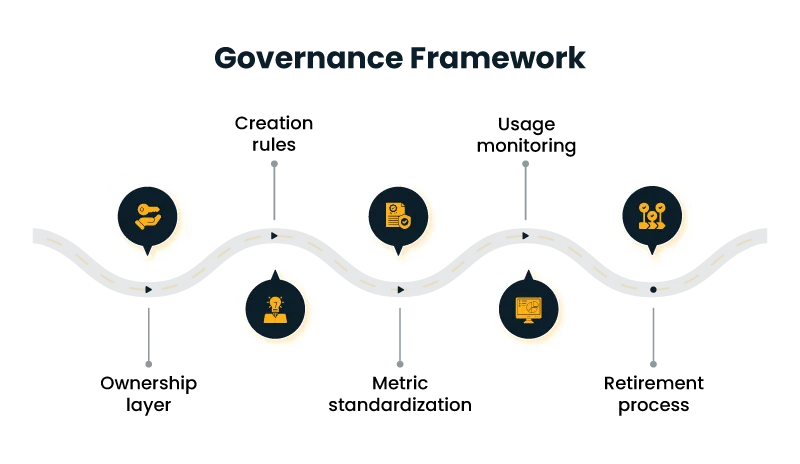
Governance Framework

1. Establish clear ownership and accountability 

Assigning a named owner to every dashboard is the foundational step. Ownership creates accountability for accuracy, relevance, and timely updates. Without it, governance policies and retirement processes remain theoretical, and there is no mechanism to enforce them at the asset level. 

When ownership is embedded into how dashboards are managed, reports are treated as active, maintained assets rather than static outputs that persist indefinitely. 

2. Implement structured BI governance policies 

BI governance establishes the operational rules that keep dashboard environments manageable over time. This includes defining who is authorized to create dashboards, what approval process applies, and at what intervals reviews should occur. 

In fact, studies show that organizations with strong data governance frameworks outperform their peers financially by an average of 20%. This shows the direct impact of structured BI governance on business outcomes. 

3. Build a centralized dashboard discovery layer 

A significant share of duplicate dashboards exists because analysts had no easy way to find out whether a comparable report already existed. A centralized discovery layer — a searchable, curated catalog of all dashboards across the BI environment — removes that gap. When existing assets are visible and accessible, teams are far more likely to reuse them than to build from scratch. 

4. Standardize metric definitions across dashboards 

Inconsistent metric definitions are one of the most persistent sources of confusion in analytics environments. Business intelligence governance addresses this by establishing a single, authoritative definition for each metric — one that is documented, maintained, and referenced across all dashboards. 

Standardization removes interpretive ambiguity that leads to conflicting reports and provides cross-functional teams with a shared analytical foundation. 

How standardization improves clarity  

Without Standardization With Standardization 
Metrics vary across dashboards Metrics remain consistent 
Reports show conflicting values Reports align across teams 
Rework is frequent Reuse becomes possible 

5. Introduce a formal dashboard request workflow 

A structured intake process for new dashboard requests serves as a practical filter against duplication. Before a new dashboard is built, the workflow prompts a review of existing assets to determine whether the need is already addressed. Even a lightweight process at this stage prevents a meaningful volume of redundant development. 

6. Monitor dashboard usage continuously 

Usage analytics provide an objective basis for managing the dashboard portfolio within modern data analytics environments. Reports that see consistent traffic are clearly serving a purpose; those that go weeks or months without a view warrant closer scrutiny. Decisions about consolidation and retirement become data-driven rather than subjective when usage is tracked consistently. 

7. Create a structured dashboard retirement process 

Dashboard creation tends to receive far more process attention than dashboard retirement — which is precisely where sprawl accumulates. A formal retirement workflow closes that gap: identify low-usage dashboards, review them with relevant stakeholders, archive before deletion, and maintain a record of what was removed and why. Managing dashboards through their full lifecycle, not just at creation, is what keeps the environment sustainable. 

Before vs After dashboard management strategy 

Without Strategy With Strategy 
Duplicate dashboards Consolidated reporting 
No ownership Clear accountability 
Conflicting metrics Standard definitions 
Increasing costs Controlled usage 

When these practices operate together, the dashboard environment becomes significantly more manageable. Analytics teams recover capacity previously spent on maintenance, and the reporting layer regains its core function — supporting informed, confident decision-making. 

FAQs 

What is a dashboard sprawl in simple terms? 

Dashboard sprawl describes a state in which an organization has accumulated more dashboards than it can effectively manage. Reports proliferate across teams and platforms; ownership becomes unclear, and users lose confidence in which report reflects the accurate picture. The dashboards exist — but they no longer serve as reliable decision-making tools. 

Why does dashboard sprawl keep increasing over time? 

Dashboard creation is fast and low friction; dashboard management is not. Teams respond to analytical requests by building new reports, while older dashboards remain active by default. Without BI governance providing clear rules around creation, review, and retirement, the volume compounds with no natural constraint. 

How does BI governance help reduce dashboard sprawl? 

BI governance introduces accountability and process at every stage of the dashboard lifecycle. It defines who owns each dashboard, what criteria a new dashboard must meet before it is built, and when existing dashboards should be reviewed or retired. Combined with business intelligence governance, it creates a consistent operational standard that limits duplication and restores trust in the reporting environment. 

How long does it take to reduce dashboard sprawl? 

The timeline depends on the scale of the environment and the depth of existing duplication. Organizations that implement a dashboard management strategy alongside a BI governance framework typically begin to see measurable improvement within a few months. More importantly, the governance structure that produces those early gains also prevents dashboard sprawl from re-emerging as the organization continues to grow. 

Author

Yogita Jain Linkedin
Yogita Jain
Content Lead

Yogita Jain leads with storytelling and Insightful content that connects with the audiences. She’s the voice behind the brand’s digital presence, translating complex tech like cloud modernization and enterprise AI into narratives that spark interest and drive action. With a diverse of experience across IT and digital transformation, Yogita blends strategic thinking with editorial craft, shaping content that’s sharp, relevant, and grounded in real business outcomes. At Cygnet, she’s not just building content pipelines; she’s building conversations that matter to clients, partners, and decision-makers alike.

Related Blog Posts

4 Reasons Artificial Intelligence is Crucial for B2B Organizations

CalendarAugust 10, 2023

How Cloud Data Platforms Are Transforming Analytics Solutions

CalendarJanuary 07, 2025

AI/ML Integration in Cloud Native Development: Leveraging Data for Innovation

CalendarDecember 18, 2025

Sign up to our Newsletter

    Latest Blog Posts

    The Role of Metadata Management in Scaling Enterprise Data Platforms 
    The Role of Metadata Management in Scaling Enterprise Data Platforms 

    CalendarApril 03, 2026

    Designing Enterprise Data Contracts to Improve Data Reliability Across Teams 
    Designing Enterprise Data Contracts to Improve Data Reliability Across Teams 

    CalendarMarch 31, 2026

    Why Traditional Monitoring Fails in Distributed AWS Architectures 
    Why Traditional Monitoring Fails in Distributed AWS Architectures 

    CalendarMarch 31, 2026

    Let’s level up your Business Together!

    The more you engage, the better you will realize our role in the digital transformation journey of your business


      I agree to the Terms & Conditions and Privacy Policy and allow Cygnet.One (and its group entities) to contact me via Promotional SMS / Email / WhatsApp / Phone Call.*

      I agree to receive occasional product updates and promotional messages from Cygnet.One (and its group entities) on Promotional SMS / Email / WhatsApp / Phone Call.

      I agree to receive promotional SMS messages from Cygnet.One (and its group entities). Up to 4 messages per month. Message & data rates may apply. Reply STOP to opt out. Consent is not a condition of purchase.

      Cygnet.One Locations

      India India

      Cygnet Infotech Pvt. Ltd.
      2nd Floor, The Textile Association of India,
      Dinesh Hall, Ashram Rd,
      Navrangpura, Ahmedabad, Gujarat 380009

      Cygnet Infotech Pvt. Ltd.
      6th floor, A-wing Ackruti Trade Center,
      Road number 7, MIDC, Marol,
      Andheri East, Mumbai-400093, Maharashtra

      Cygnet Infotech Pvt. Ltd.
      WESTPORT, Urbanworks,
      5th floor, Pan Card Club rd.,
      Baner, Pune, Maharashtra 411045

      Cygnet Infotech Pvt. Ltd.
      10th floor, 73 East Avenue,
      Sarabhai campus, Vadodara, 391101

      Global

      CYGNET INFOTECH LLC
      125 Village Blvd, 3rd Floor,
      Suite 315, Princeton Forrestal Village,
      Princeton, New Jersey- 08540

      CYGNET DIGITAL IT SOLUTION LLC
      Office 707, Magnum Opus Tower,
      Al Thanyah First, Dubai, U.A.E,
      P.O. Box 125608

      CYGNET INFOTECH PRIVATE LIMITED
      Level 35 Tower One,
      Barangaroo, Sydney, NSW 2000

      CYGNET ONE SDN.BHD.
      Unit F31, Block F, Third Floor Cbd Perdana 3,
      Jalan Perdana, Cyber 12 63000 Cyberjaya Selangor, Malaysia

      CYGNET INFOTECH LIMITED
      C/O Sawhney Consulting, Harrow Business Centre,
      429-433 Pinner Road, Harrow, England, HA1 4HN

      CYGNET INFOTECH PTY LTD
      152, Willowbridge Centre,
      39 Cronje Drive, Tyger Valley,
      Cape Town 7530

      CYGNET INFOTECH BV
      Peutiesesteenweg 74, Machelen (Brab.), Belgium

      Cygnet One Pte. Ltd.
      160 Robinson Road,
      #26-03, SBF Centre,
      Singapore – 068914

      • Explore more about us

      • Download Corporate Deck
      • Terms of Use
      • Privacy Policy
      • Contact Us
      © Copyright – 2026 Cygnet.One
      We use cookies to ensure that we give you the best experience on our website. If you continue to use this site we will assume that you are happy with it.

      Cygnet.One AI Assistant

      ✕
      AI Assistant at your help. Cygnet AI Assistant