

































Why GST Refund Slow Down Enterprises

Data scattered across GSTR-1, GSTR-3B, GSTR-2B, purchase registers, e-invoices, and ICEGATE
Manual preparation of Annexure-B; creates risk at the invoice level
Strict GSTN utility validations triggering errors for minor mismatches
High rejection or deficiency memo risk due to data gaps
Delays in filing leading to blocked working capital
Increasing scrutiny during departmental review and audit
Shipping bill & ICEGATE mismatches delay export refund validation
With Cygnet.One, Bring Control and Structure to GST Refunds
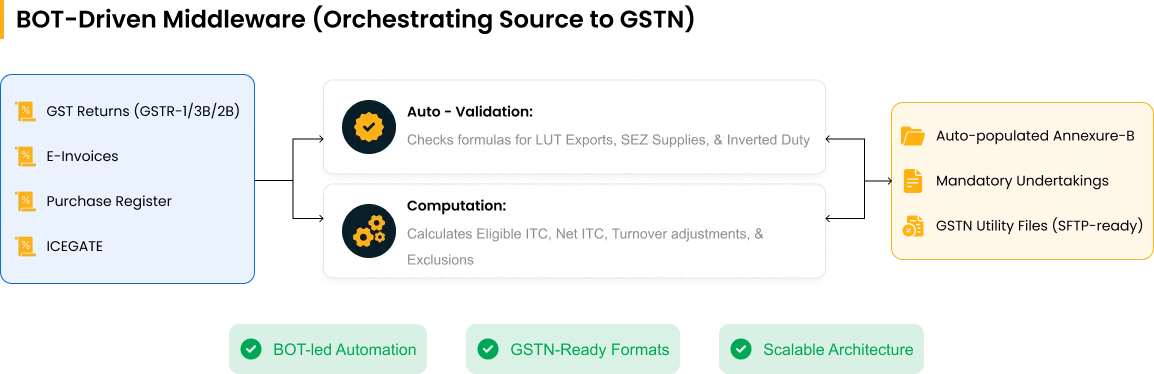
Cygnet.One replaces manual refund preparation with a BOT-driven middleware layer that orchestrates data from source systems to GSTN-ready outputs.
Multi-Source Data Orchestration
Automatically pulls data from GSTR-1, GSTR-3B, GSTR-2B, purchase registers, e-invoices, and ICEGATE shipping bills/EGM.
Automated Annexure-B Preparation
Prepares invoice-level Annexure-B with validated ITC linkage, reducing manual working and review effort.
GSTN Utility-Ready Outputs
Generates JSON files strictly in GSTN-prescribed format to minimize technical validation errors.
Intelligent Refund Computation
Applies GSTN-defined formulas to calculate eligible ITC, net ITC, adjusted turnover, and refund amount accurately
Mandatory Declarations & Undertakings
Auto-generates required declarations and structured documentation for upload
Built for Enterprise Scale
Handles high transaction volumes and multiple GSTINs without increasing headcount
How Invoice-Level GST Classification Works
What This Enables for High-Volume GST Environments
-
Faster realization of export, SEZ, and inverted duty refunds
-
Lower rejection and deficiency memo exposure
-
Better alignment between GST returns, books, and shipping data
-
Reduced manual reconciliation across GSTINs
-
Greater predictability in refund timelines and cash flow
-
Structured, audit-ready documentation by design