






























Introduction: GST Litigation Is No Longer an Exception
GST litigation is no longer occasional or manual. With automated GSTN notices, tighter timelines, and growing digital scrutiny, disputes have become continuous and system driven. What was earlier handled case by case now demands ongoing coordination, visibility, and control across tax, finance, and compliance teams.
Yet many enterprises still rely on emails and spreadsheets to manage notices and responses. The risk isn’t a lack of expertise; it’s the absence of structure. Without a centralized GST litigation management software, notices can be missed; ownership becomes unclear, deadlines slip, and audit readiness weakens.
A modern GST notice management system brings governance to this complexity. By enabling structured GST compliance case management, automated workflows, real-time visibility, and risk-based prioritization, today’s GST litigation tracking software, increasingly powered by AI, helps enterprises move from reactive handling to disciplined, audit-ready dispute management at scale.
Why Dedicated Litigation Software Is Needed
GST litigation has become continuous, and system driven. Automated GSTN notices, tighter response timelines, and growing digital scrutiny mean disputes now demand timely, coordinated, and well-documented action.
However, many enterprises still manage GST litigation through emails, spreadsheets, and shared folders—one of the most common GST litigation mistakes businesses make. This creates risk not because teams lack expertise, but because litigation is handled without structure, visibility, or control.
A dedicated GST litigation management software helps enterprises move from reactive handling to governed, audit-ready GST compliance case management. This shift highlights the growing role of AI in GST litigation, where automation, analytics, and intelligent workflows are becoming essential to managing disputes at scale.
For teams evaluating what is Litigation management system, the real answer is a platform that centralizes notices, workflows, evidence, and reporting to keep every case governed and audit-ready.
Key Features of GST Litigation Management Software:
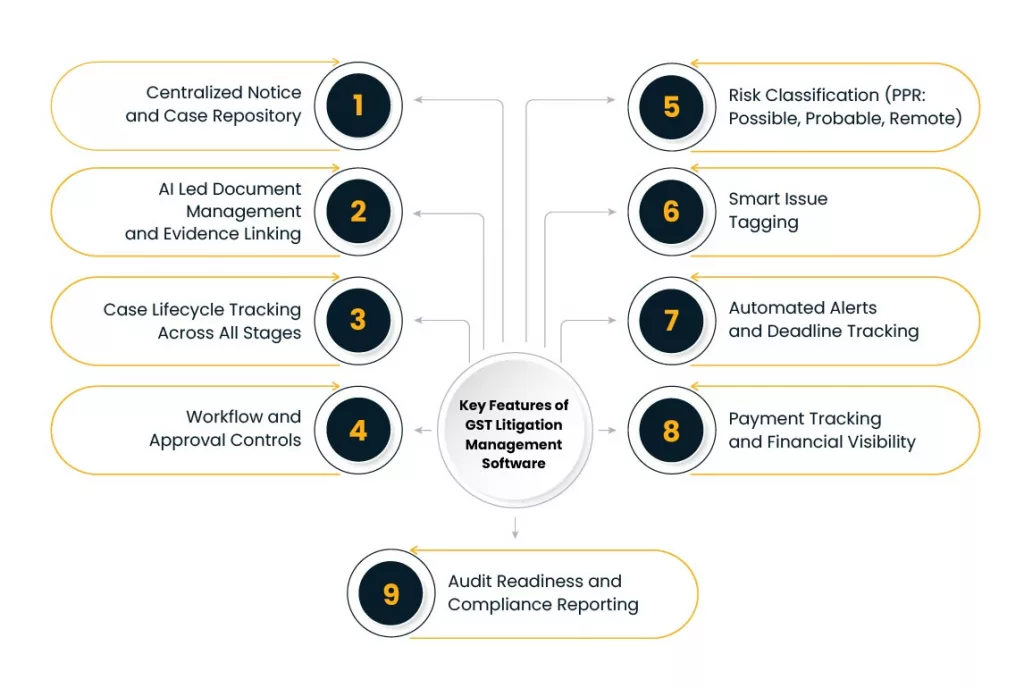
1. Centralized Notice and Case Repository:
Manual tracking of GST notices across inboxes and spreadsheets often leads to delayed visibility, missed notices, increasing penalty and escalation risk. A centralized notice and case repository automatically captures GST notices and organizes them by GSTIN, state, financial year, and case status.
This ensures every notice is logged, tracked, and assigned ownership from day one, forming the backbone of an effective GST notice management system. For enterprises handling high notice volumes, this single source of truth eliminates dependency on individuals and prevents cases from slipping through the cracks.
2. AI Led Document Management and Evidence Linking:
GST litigation involves large volumes of documents-returns, invoices, reconciliations, workings, and correspondence. Manually reviewing notices and matching them with supporting evidence slows down case assessment and heavily depends on senior resources.
With AI-based GST notice analysis, powered by machine learning in tax compliance, the system automatically extracts key information such as sections, periods, amounts, and deadlines. Documents and evidence are intelligently linked to each case, making response preparation faster, cleaner, and audit ready.
3. Case Lifecycle Tracking Across All Stages
Litigation does not end with a single response. A modern platform tracks the entire lifecycle of a case from notice of issuance by the assessing officer through replies, hearings, appeals, and higher judicial forums.
Each case is tracked using a unique case ID, providing complete traceability and continuity even as matters move across authorities and years. This level of structure is essential for enterprise-grade GST litigation tracking software.
4. Workflow and Approval Controls:
GST litigation; responses typically involve multiple stakeholders, including preparers, reviewers, approvers, and external consultants. Without structured workflows, responses become inconsistent and difficult to govern.
Workflow and approval controls introduce maker-checker processes, clear task ownership, and approval hierarchies. This enables automation in GST litigation management, ensuring responses follow a repeatable, review-ready path through automated GST litigation workflows, rather than ad-hoc execution.
5. Risk Classification (PPR: Possible, Probable, Remote):
Treating all GST cases equally makes it difficult to prioritize attention and provisioning. Risk classification using PPR (Possible, Probable, Remote) brings structure to litigation assessment.
By categorizing cases based on likelihood and exposure, enterprises can focus resources on material risks, align provisioning decisions, and give leadership a clearer view of where attention is truly required.
6. Smart Issue Tagging
As litigation volumes increase, organizing cases becomes critical. Smart issue tagging lets enterprises classify disputes by department, statute, business unit, or issue type, making cases easy to filter and retrieve.
More importantly, tagging enables pattern analysis, helping teams identify recurring issues, high-risk areas, and systemic compliance gaps. This turns litigation data into actionable insight and strengthens governance within GST litigation management software.
7. Automated Alerts and Deadline Tracking :
Real-time GST litigation is highly deadline-driven, with strict timelines for responses, hearings, and follow-ups. Manual calendar tracking often results in missed milestones and last-minute firefighting.
Automated alerts and SLA tracking ensure every deadline is monitored; reminders are sent proactively, and escalations occur when required; helping enterprises avoid penalties, adverse orders, and compliance lapses.
8. Payment Tracking and Financial Visibility
Penalties, pre-deposits, and litigation-related payments are logged against individual cases, improving financial reconciliation and visibility. This ensures litigation costs are tracked alongside outcomes, not managed in isolation.
9. Audit Readiness and Compliance Reporting:
Statutory Audits often test how well litigation is documented and governed. When case histories and evidence are scattered, audit preparation becomes time-consuming and stressful.
Audit-ready reports provide complete, end-to-end visibility into notices, responses, approvals, and outcomes. This strengthens GST compliance with case management and supports confident engagement with auditors and regulators, backed by defensible documentation.
Evaluation Checklist for Software Selection
Before choosing a solution, enterprises should go beyond feature list and ask right operational questions:
- Does it automatically capture and track GST notices?
- Can it scale across multiple GSTINs and entities?
- Are workflows and approvals configurable to internal processes?
- Does it provide real-time dashboards for leadership visibility?
- Are reports audit-ready and defensible?
- Is risk classification supported for prioritization and provisioning?
- Are documents and evidence directly linked to cases?
The right platform acts as a governance layer; not just another GST dispute management tool. A solution that checks these boxes delivers more than efficiency; it provides governance, confidence, and long-term control through modern GST dispute management tools and GST litigation tracking software.
Conclusion
GST litigation is no longer occasional; it’s continuous, automated, and increasingly shaped by AI in GST litigation, where intelligent systems drive speed, accuracy, and control. Enterprises that rely on spreadsheets remain exposed to avoidable risk. Those that adopt modern GST dispute management tools gain visibility, control, and confidence in how disputes are handled.
A modern GST litigation management software brings structure where it’s needed most. By acting as a centralized GST notice management system, it gives enterprises clear visibility, built-in controls, and predictable execution across cases. Move from reactive firefighting to disciplined GST compliance case management using AI-driven GST litigation tracking software with real-time dashboards, approvals, and audit-ready reporting
The outcome is simple: fewer surprises, stronger governance, and greater confidence when dealing with GST authorities. As enterprises adopt AI-driven tax dispute resolution, litigation shifts from reactive firefighting to disciplined, insight-led GST compliance with case management.
