




























Decisions lose power the moment data arrives late. By the time leadership reviews a report, the market has already moved, customer behavior has shifted, and operational risks have changed shape. What looks like insight on a dashboard often reflects the past, not the present.
This gap is where many growths strategies stall.
Enterprises generate more data than ever, yet strategic decisions still rely on scheduled reports and delayed signals instead of leveraging business analytics and embedded AI. Teams react instead of anticipating. Opportunities surface after the window closes. Risks escalate before anyone sees them coming.
Real-time business insights change this dynamic, especially when supported by data analytics services that deliver continuous intelligence. They give organizations the ability to see what is happening now, understand its impact immediately, and act with confidence while outcomes are still in motion. When insight flows at the speed of the business, strategy stops being a quarterly exercise and becomes a continuous capability.
This blog explores how real-time business insights drive strategic growth. It breaks down the shift from traditional reporting, the principles behind insights-driven organizations, the role of automation, and a practical roadmap enterprise can follow to move from delayed visibility to real-time decision-making at scale.
Traditional Reporting vs Real-Time Business Insights
Traditional reporting was designed for consistency and control. Data is collected in batches, processed on fixed schedules, and delivered as periodic reports. This approach supports historical analysis and compliance needs, but it introduces delays. By the time insights reach decision-makers, the underlying business conditions have already shifted.
Real-time business insights follow a continuous model enabled by modern data engineering and management practices. Data flows as events occur, updates dashboards instantly, and surfaces signals while outcomes are still unfolding. This changes how organizations respond to opportunities and risks. Insight moves closer to action, and decisions rely on current context instead of past performance.
The differences become clear when viewed across key dimensions.
Traditional reporting typically involves
- Batch-based data processing with daily, weekly, or monthly refresh cycles
- Manual intervention for report preparation and validation
- Limited visibility into live operations and emerging issues
- Decision-making that reacts to what already happened
Real-time business insights enable
- Continuous data ingestion from operational systems
- Automated processing and near-instant visibility
- Early detection of trends, anomalies, and performance gaps
- Faster decisions that influence outcomes while they are still in motion
As growth strategies demand speed and precision, this shift becomes unavoidable. Organizations that rely on delayed reporting struggle to keep pace. Those that invest in real-time insights build the ability to act decisively, adjust strategy continuously, and drive sustained growth.
Core Principles of Real-Time, Insights-Driven Organizations
Tools on their own do not produce real-time insights. They are based on a collection of operating principles that determine how data is gathered, processed, and utilized throughout the enterprise. Successful organizations that use real time insights consider data as a dynamic asset and decision making as an ongoing process.
These principles are centered on speed, trust, and alignment between data and business action.
Data flows continuously, not periodically
Insights-based organizations create pipelines that transport data as they happen. Changes are captured by the systems in real time and are propagated downstream without the need to wait until a batch window. This keeps the decision-makers in touch with what is occurring now.
Automation replaces manual handoffs
Manual steps slow insight delivery and introduces inconsistency. Automation handles ingestion, validation, transformation, and delivery. This ensures insights remain timely and repeatable at scale.
Data quality is enforced at the point of movement
Real-time insights depend on trust. Quality checks, validations, and reconciliation rules run as data flows through pipelines. Issues surface immediately instead of weeks later in reports.
Insights are embedded into workflows
Dashboards alone do not drive action. Leading organizations surface insights directly inside operational tools and business processes. Teams act on data without switching context or waiting for reports.
Decision ownership is clearly defined
Real-time visibility only matters when someone is accountable for acting on it. Insights-driven organizations assign ownership to metrics and decisions. This creates faster responses and consistent outcomes.
Together, these principles create a system where insight keeps pace with execution. Strategy evolves continuously, supported by data that reflects the business in real time.
Automation as the Backbone of Real-Time Business Insights
Automation sits at the center of every real-time insight strategy. The moment manual steps enter the data flow, speed drops, and trust erodes.
Real-time insights require systems that ingest, process, and deliver data continuously through scalable cloud engineering foundations, without human intervention slowing things down. Automation ensures that insight keeps pace with business activity, even as data volumes, sources, and use cases expand.
How does automation enable real-time business insights?
- Runs continuous data ingestion across applications, platforms, and external sources
- Processes and transforms data in near real time with predictable performance
- Applies validation rules and anomaly checks as data moves through pipelines
- Enforces consistent data quality, security, and governance standards
- Eliminates manual handoffs, spreadsheet fixes, and ad hoc reporting efforts
What does this unlock for the business?
- Faster access to reliable insights across teams
- Higher confidence in decision-making due to consistent data quality
- Reduced operational effort for analysts and data teams
- More time spent on action and strategy instead of data preparation
Automation does more than accelerate pipelines. It creates the conditions required for real-time insights to scale, remain trustworthy, and support strategic growth across the enterprise.
Business Benefits of Real-Time Business Insights
Real-time business insights transform the way organizations develop. Whenever leaders observe what is transpiring to them as it occurs, decisions will be more precise, and results will be enhanced. Growth ceases to be a matter of lagging indicators and begins to be a matter of live indicators of customers, operations, and the market. The benefits extend across strategy, execution, and operational efficiency.
Faster and more confident decision-making
Leaders do not wait to get reports before acting. This reduces the time taken to make decisions and minimizes speculation, particularly in high-impact situations.
Improved operational agility
Teams identify problems in performance, demand, and process bottlenecks early. They adapt fast and avoid minor problems in the form of major disruptions.
Stronger customer responsiveness
Customer behavior transformation is noted and communicated in real time. The response of organizations includes timely offers, individual experience, and quicker resolution of issues.
Better risk visibility and control
Immediately, anomalies and exceptions begin to emerge. This enhances the risk management in finance, compliance, and operations whereby delays in signals are very expensive.
Sustainable, scalable growth
Growth decisions become in line with reality as the insight of delivery is continuous. Placing investments, expansions, and optimization is based on live performance signals and not the past averages.
Real-time insights are not merely effective at increasing the speed of reporting. They establish a cycle of feedback with strategy and implementation being closely intertwined to allow steady and informed development.
A Practical Roadmap to Become an Insights-Driven Enterprise
Turning an organization into an insight-driven organization does not mean a total overhaul in a single night. It demands a definite progression of actions that will reinforce the flow of data, the speed of the decision, and trust in the long run. The capability of building roadmap below is based on the aspect of layering without interfering with the day-to-day operations.
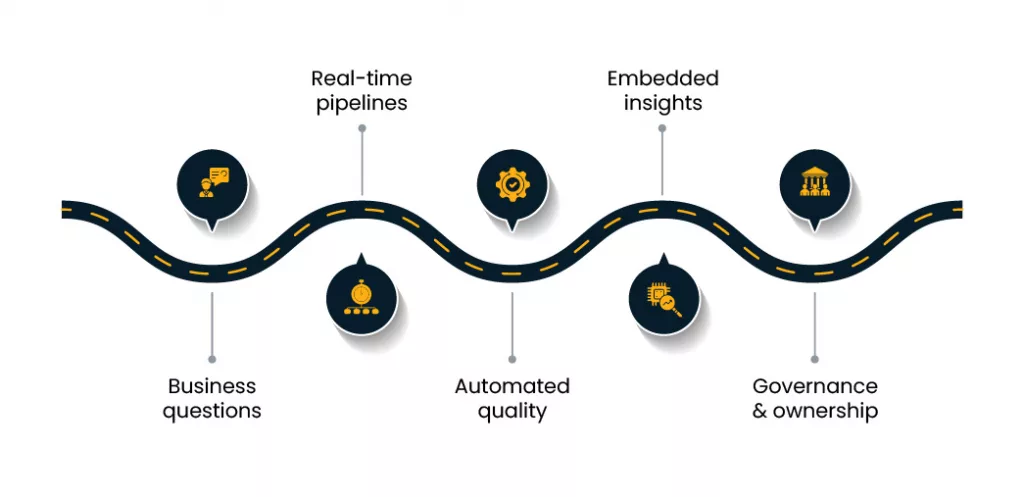
Start with high-impact business questions
Identify decisions that suffer most from delayed data. Focus on use cases tied to revenue, cost control, risk, or customer experience. This keeps the effort grounded in business value from day one.
Modernize data pipelines for real-time flow
Enable continuous ingestion from core systems and external sources. Reduce batch dependencies and remove manual handoffs. Design pipelines that support low latency and consistent performance.
Standardize data quality and validation rules
Define quality checks, thresholds, and reconciliation logic early. Apply them automatically as data moves. This builds confidence and prevents bad data from reaching decision-makers.
Embed insights into operational workflows
Surface insights where work happens. Integrate dashboards, alerts, and signals into existing tools used by business teams. This shortens the distance between insight and action.
Establish ownership and governance
Assign clear owners to metrics, data domains, and decisions. Define access controls and audit trails. Governance should enable speed, not slow it down.
Measure impact and iterate
Track how real-time insights affect decision speed, outcomes, and operational efficiency. Use these learnings to refine pipelines, expand use cases, and scale across functions.
An insight-driven enterprise is built through execution discipline. With the right roadmap, organizations move from delayed visibility to continuous intelligence that supports strategic growth at scale.
Conclusion
Timing is as important to strategic growth as intent is. Late arrival of an insight decays the decision, and execution becomes out of step with reality. Real-time business insights bridge this gap by ensuring that leaders are in touch with the current events and not with what has already occurred.
Companies investing in real-time visibility, automation and disciplined data practices are not only gaining speed but also gaining more. They develop trust in their judgments, cohesiveness on teams, and adaptability to change in conditions. Strategy is made into an on-going process. Execution becomes informed. The growth becomes repeatable and quantifiable.
The change is not achieved by means of tools alone. It occurs with definite tenets, systematic bases, and a plan that brings understanding to action. Organizations that make this commitment place themselves ahead of others in terms of speed, smartness, and clarity in an ever-changing business world.
Author


Yogita Jain
Content Lead
Yogita Jain leads with storytelling and Insightful content that connects with the audiences. She’s the voice behind the brand’s digital presence, translating complex tech like cloud modernization and enterprise AI into narratives that spark interest and drive action. With a diverse of experience across IT and digital transformation, Yogita blends strategic thinking with editorial craft, shaping content that’s sharp, relevant, and grounded in real business outcomes. At Cygnet, she’s not just building content pipelines; she’s building conversations that matter to clients, partners, and decision-makers alike.