































Cloud migrations shift active systems from one environment to another. As that happens, data moves, rules change, and access points adjust in real time. Nothing about the process stays still. The activity runs in parallel with daily operations, while people sign in and update records.
Security questions begin to surface as the transfer unfolds.
- Who has access to specific folders during movement?
- Which endpoints are interacting with the data?
- Are these events being recorded right now, or left unchecked?
These questions belong in the migration plan from the beginning.
When they are missing, visibility breaks down, and data becomes exposed as part of the process. That exposure is not delayed. It starts with the first transfer.
This blog shares ten precise steps that support secure cloud data migration and address real cloud migration security concerns. Each one is designed for teams that want control and clarity while systems are actively shifting.
How to Protect Your Data During Cloud Migration
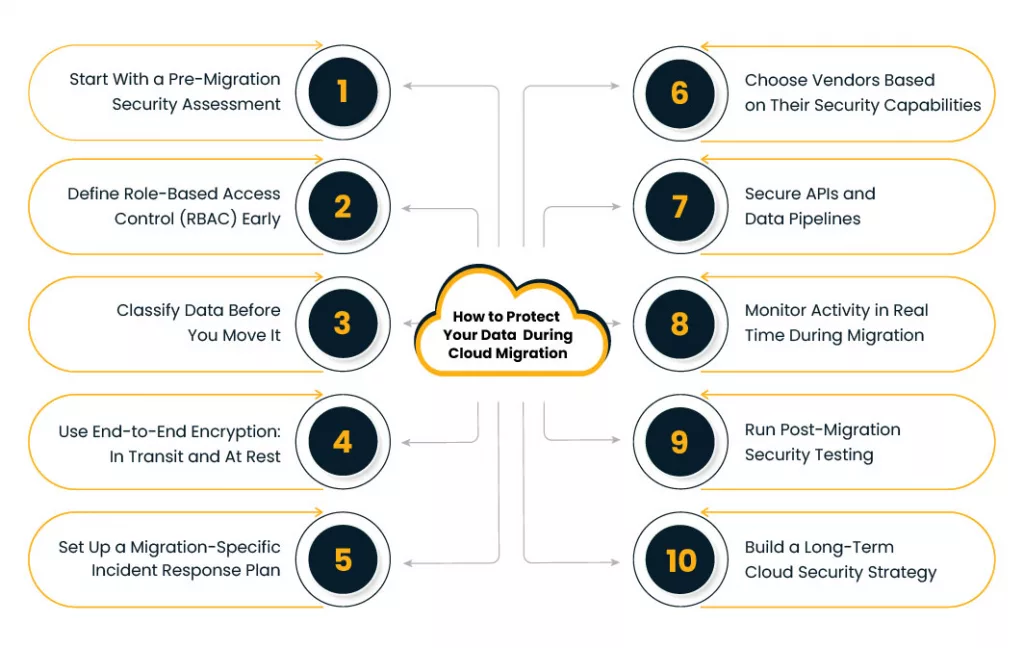
1. Start With a Pre-Migration Security Assessment
Before moving any data, run a full audit of your current systems. List every server, database, and data source. For each one, document:
- What kind of data it stores (personal, internal, regulated)
- Who has access and what level of access they have
- Any known vulnerabilities or outdated components
This creates a baseline that lets you track changes and catch security gaps before they cause issues. It also helps prioritize what needs protection first. These early steps are critical to cloud migration security, helping you anticipate and prevent risks before data transfer begins.
2. Define Role-Based Access Control (RBAC) Early
Access should follow the “least privilege” rule. Set up roles before the migration starts, such as:
- Migration engineer (access to migration tools only)
- Data analyst (can view but not edit sensitive data)
- Cloud admin (manages cloud settings, but with limits)
Remove unnecessary admin rights. Over-permissioned users are a known threat vector. Good access control prevents accidental damage and stops misuse.
3. Classify Data Before You Move It
Label your data based on sensitivity:
- Public (non-sensitive)
- Confidential (business-sensitive but not regulated)
- Regulated (personal, health, or financial data)
This helps assign protection levels. Use stronger encryption, stricter access control, and detailed monitoring for regulated data. This step gives clarity and direction for all other security actions during cloud data migration.
4. Use End-to-End Encryption: In Transit and At Rest
Encryption must be applied at all stages. Use:
- TLS 1.2 or TLS 1.3 for data while it is moving
- AES-256 for storage encryption
- A dedicated key management service (avoid storing keys in the same cloud)
Do not assume your cloud provider’s defaults are strong enough. Confirm their encryption policies and adjust if needed. Encryption is a core part of any reliable cloud security strategy. Without it, basic cloud migration security measures fall apart under active workloads.
5. Set Up a Migration-Specific Incident Response Plan
A regular incident response plan might not be enough during migration. Create one focused on:
- What to do if data leaks during transfer
- Who gets alerted and when
- Steps to pause, recover, or roll back a migration
- Which logs are needed to investigate
Build and test this plan before the migration starts. Your team should know exactly what to do if something goes wrong while the systems are live. It is one of the most overlooked elements of cloud migration security planning.
6. Choose Vendors Based on Their Security Capabilities
When evaluating vendors, ask for:
- Certifications like ISO 27001, SOC 2 Type II, or HIPAA compliance
- Data residency options if you have legal or regional restrictions
- Details on how tenant isolation is handled
- How they define shared responsibility (what they secure vs. what you do)
When a vendor meets these conditions, you get a clearer picture of how their systems align with your cloud migration services and long-term modernization goals. The right vendor setup supports your internal policies and helps reduce hidden cloud migration risks caused by unclear responsibilities or poor visibility.
7. Secure APIs and Data Pipelines
APIs used in cloud data migration are often overlooked. To protect them:
- Require authentication tokens (JWT, OAuth, etc.)
- Use rate limits to stop abuse
- Validate inputs and block large, malformed payloads
- Shut down any old or unused API endpoints
A large number of data leaks start from unsecured endpoints. Fixing this before the migration makes the entire cloud data migration process more secure and resilient. It is one of the clearest ways to avoid cloud migration risks during active data transfer.
8. Monitor Activity in Real Time During Migration
Do not wait for post-migration checks to find problems. Use real-time monitoring tools like:
- AWS CloudTrail
- Azure Sentinel
- A third-party SIEM platform
Watch closely for:
- Failed login attempts
- Data moving outside expected boundaries
- New user accounts or access keys created suddenly
- Configuration changes made outside your change window
These are the kinds of early warning signs that often go unnoticed during active migrations. According to Spacelift, fewer than 10% of companies encrypt more than 80% of their sensitive cloud data. Weak monitoring and missed encryption are two of the biggest reasons behind breaches.
Real-time tracking helps fix both. These controls serve as a backbone for proactive cloud migration security.
9. Run Post-Migration Security Testing
Once the migration is done, test everything. Run:
- Penetration tests
- Vulnerability scans
- Checks on open ports, permissions, and storage policies
- Validation of backup access and encryption settings
Remove unused accounts, leftover credentials, and unneeded permissions. This is cleanup work that keeps your cloud environment lean and secure. Leaving gaps here is one of the more common causes of issues post-migration.
10. Build a Long-Term Cloud Security Strategy
Security does not stop once your data is in the cloud. You need an ongoing cloud security strategy that includes:
- Regular audits (quarterly or bi-annually)
- Cloud training sessions for internal teams
- Patch schedules for every service in use
- Clear documentation of who owns which systems
- Routine backup drills and restore tests
This ongoing discipline is what keeps you secure year-round. Threats evolve, so your defense plan should evolve too. Long-term cloud migration security depends on consistent follow-through, not one-time setup.
Secure Migration from Day One!
Each step of a cloud migration carries operational weight, and every unchecked process increases exposure. But with the right framework in place, securing data in motion becomes a structured, manageable part of the transition.
At Cygnet.One, we help businesses re-architect their systems for long-term success. We begin with a clear assessment and security-first planning. From there, we support full modernization of your systems. Our team focuses on optimizing performance and aligning every step with your compliance needs. These services are customized to fulfil the demands of real enterprise environments.
We support enterprises through:
- Cloud migration assessments and readiness planning
- Application modernization using the 6R framework
- Hybrid and multi-cloud strategy development
- Ongoing security and compliance implementation
- Cost and performance optimization at scale
If you are planning a migration or already in the middle of one, now is the time to ensure security is embedded in every step — not added at the end.
Talk to our cloud experts today and get a tailored migration plan that is aligned with your goals, timelines, and risk profile.
Author


Yogita Jain
Content Lead
Yogita Jain leads with storytelling and Insightful content that connects with the audiences. She’s the voice behind the brand’s digital presence, translating complex tech like cloud modernization and enterprise AI into narratives that spark interest and drive action. With a diverse of experience across IT and digital transformation, Yogita blends strategic thinking with editorial craft, shaping content that’s sharp, relevant, and grounded in real business outcomes. At Cygnet, she’s not just building content pipelines; she’s building conversations that matter to clients, partners, and decision-makers alike.