




































Provisioning cloud resources without a structured forecast creates two equally expensive problems. Systems buckle under peak load, or infrastructure runs at 20% utilization while billing at full capacity every month.
Cloud capacity planning is the process of predicting how much compute, storage, memory, and network capacity a workload will need over a defined future period. Then, it entails provisioning that capacity before demand outpaces supply.
This blog covers the forecasting techniques and optimization strategies that keep scaled cloud environments performing reliably without chronic overspend.
What Is Cloud Capacity Planning and Why Do Enterprises Get It Wrong?
What It Actually Means
Cloud capacity planning is a continuous forecasting discipline, not a one-time pre-deployment activity. Workload usage patterns change as products grow, user bases expand, and business cycles produce demand spikes that static forecasts cannot anticipate.
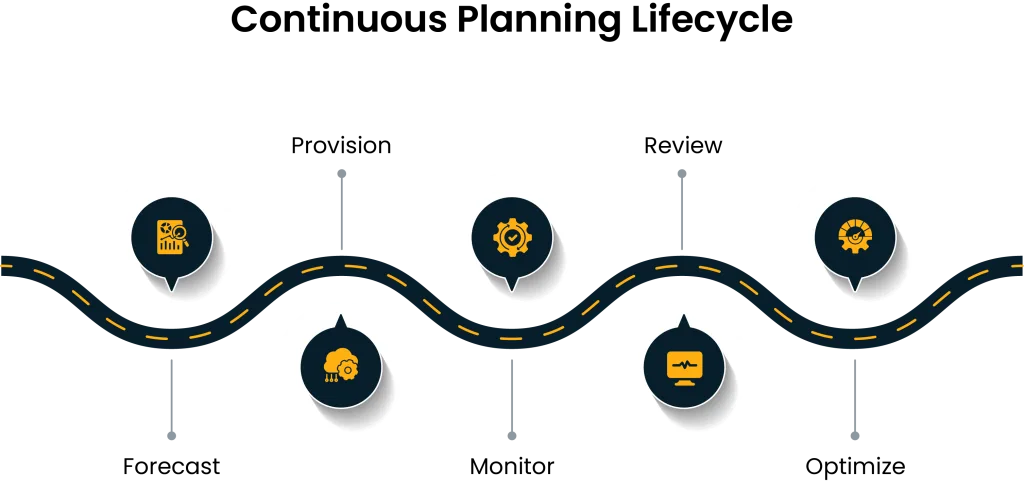
The goal is simple:
- Provision exactly what is needed, when it is needed
- Avoid over-provisioning that wastes budget every month
- Avoid under-provisioning that causes failures at peak load
Why Enterprises Get It Wrong
Most enterprises carry on-premise planning habits into cloud environments without adapting their cloud strategy. On-premise planning assumed fixed infrastructure and annual procurement cycles. Cloud infrastructure scales in minutes and bills by the second.
A planning framework built for static annual procurement produces forecasts that are either dangerously conservative or wildly overcautious. The two outcomes are predictable — under-provisioned systems degrade under load, and over-provisioned systems waste budget silently until someone runs a cost audit.
What Happens When Cloud Capacity Planning Fails in Production?
Performance failures in scaled cloud environments rarely happen without warning. They follow a pattern that structured capacity planning is designed to interrupt.
Performance Bottlenecks at Peak Load
Under-provisioned resources create bottlenecks precisely when demand is highest. Application response times degrade, transaction queues build up, and user-facing systems slow down before the operations team has time to respond.
Avoiding performance bottlenecks cloud environments requires anticipating peak demand before it arrives through cloud performance optimization — not responding after users report slowdowns.
Unpredictable Scaling Events
Without structured forecasting, scaling events happen reactively. They trigger after performance has already degraded. The gap between a demand spike and resource availability is exactly where user-facing failures occur in production environments.
These consequences trace back to specific gaps in forecasting methodology. Structured techniques are designed to close those gaps before they become incidents.
What Cloud Resource Forecasting Techniques Actually Work?
Historical Utilization Analysis
The most reliable starting point for any forecast is historical utilization data collected over a minimum 90-day period. A 30-day window captures one monthly cycle. It misses seasonal variation, product launch spikes, and end-of-quarter demand patterns that appear consistently in longer observation windows.
What 90-day data reveals:
- Seasonal demand patterns across business cycles
- Weekly and daily peak utilization windows
- Sustained baseline consumption per workload type
Workload Capacity Forecasting Through Trend Modeling
Workload capacity forecasting applies trend modeling to historical utilization data to project future resource requirements. Two model types cover most enterprise workload patterns:
| Model Type | Best For | Risk If Misapplied |
| Linear trend | Steady, predictable growth | Underestimates rapid growth |
| Exponential trend | Fast-growing or new workloads | Overestimates stable workloads |
The model type must match the growth pattern. Applying a linear model to exponential growth produces forecasts that underestimate capacity requirements — and the gap widens with every planning cycle.
Load Testing and Simulation
Load testing runs the workload against simulated traffic volumes in modern cloud engineering practices. It reveals exactly where bottlenecks appear before those load levels occur in production.
If the simulation breaks at 80% of projected peak demand, the forecast is updated before deployment, not after an incident.
Cost-Based Capacity Modeling
Cost-based modeling sets a defined budget ceiling and works backward to determine the capacity that the budget supports. It forces prioritization decisions about which workloads get dedicated capacity. This technique is most useful during annual planning cycles when budget constraints are fixed before technical requirements are fully defined.
These cloud resource forecasting techniques produce the data that capacity plans are built from. The planning framework that turns that data into actionable decisions determines whether the forecast translates into reliable performance.
How Should Enterprises Build a Cloud Capacity Planning Framework?
Understanding how to plan cloud capacity enterprise environments need is one thing. Building a repeatable framework is another. Five components make the difference between a capacity plan that holds and one that drifts within a quarter.
1. Define Capacity Tiers Per Workload
Three tiers cover most enterprise workload populations:
- Mission-critical: Reserved capacity with defined SLA protection
- Standard: On-demand instances with autoscaling configured
- Background: Spot or preemptible instances with interruption handling built in
Tier assignment determines cost structure and performance guarantee per workload — it is the first decision the framework makes.
2. Set Utilization Thresholds That Trigger Action
| Resource | Warning Threshold | Action Threshold |
| CPU utilization | 70% over 15 minutes | 85% over 5 minutes |
| Memory utilization | 75% over 15 minutes | 90% over 5 minutes |
| Network throughput | 60% of provisioned bandwidth | 80% of provisioned bandwidth |
| Storage IOPS | 70% of provisioned IOPS | 85% of provisioned IOPS |
Thresholds are set before a performance event occurs. They define the response before the pressure arrives.
3. Implement Autoscaling With Defined Boundaries
Autoscaling adjusts resource allocation automatically in response to utilization metrics. Three parameters must be defined before it is enabled:
- Minimum instance count: The floor below which scaling never drops
- Maximum instance count: The ceiling above which scaling never grows
- Scaling policy: The metric and threshold that triggers scale-out and scale-in events
Scaling cloud workloads efficiently requires autoscaling boundaries set from capacity forecast data.
4. Run Quarterly Capacity Reviews
A quarterly review compares actual utilization against the previous quarter’s forecast. It answers three specific questions:
- Did actual utilization match the forecast within an acceptable variance?
- Which workloads exceeded their forecast and why?
- Which workloads ran below forecast and can be right-sized?
Review output feeds directly into the next cloud capacity planning cycle. Reviews run on a calendar.
5. Maintain a Capacity Buffer for Unplanned Demand
A 20% buffer above peak forecast is a standard starting point for most enterprise workloads. Mission-critical workloads carry a larger buffer. Background workloads carry none. The buffer absorbs unplanned demand spikes without requiring a reactive scaling response during a live performance event.
What Optimization Techniques Keep Cloud Environments Running Efficiently?
Planning sets the capacity envelope, and optimization is driven by cloud engineering services.
Right-Sizing on a Defined Schedule
Right-sizing compares actual utilization against provisioned capacity and adjusts instance types where utilization consistently falls below threshold.
- Monthly for high-cost workloads
- Quarterly for standard workloads
An oversized instance running at 15% CPU is not just wasting budget. It is running on infrastructure that is not matched to its actual workload characteristics. Cloud performance optimization through right-sizing addresses both problems in a single operation.
Caching and Content Delivery Optimization
Application-layer caching reduces the compute load on backend infrastructure by serving repeated requests from cache rather than reprocessing them. Content delivery networks reduce latency by serving static assets from edge locations.
Both techniques reduce backend compute requirements. This means the workload capacity forecasting model must account for cache hit rates when projecting backend capacity needs accurately.
Database Query and Index Optimization
A single unoptimized query on a high-traffic table can consume enough resources to degrade performance across the entire database tier. Query optimization and index tuning reduce resource consumption without requiring additional provisioned capacity.
Lower resource consumption per query means the same provisioned capacity supports higher transaction volumes. That is a direct cloud performance optimization gain with no increase in infrastructure spend.
Autoscaling Policy Tuning
Autoscaling policies drift from optimal settings as workload patterns evolve. A policy configured for last year’s traffic pattern may over-scale or under-scale for this year’s demand profile.
Reviewing and tuning autoscaling policies quarterly — as part of the capacity review cycle — keeps scaling cloud workloads efficiently achievable as workload behavior changes over time.
Start Planning Before the Next Bottleneck Finds You
Cloud resource forecasting techniques produce accurate results when applied consistently.
Three practices sustain capacity planning over time:
- Utilization data collection runs continuously across every production workload
- Forecast accuracy is reviewed quarterly against actual utilization
- Capacity tier assignments are reassessed whenever a workload’s usage pattern changes significantly
Cloud capacity planning at enterprise scale is an ongoing operational discipline. Organizations that need help building or reviewing their capacity planning framework can connect with Cygnet.One for cloud modernization services for a structured assessment.
FAQs
What is cloud capacity planning?
It is the process of predicting how much compute, storage, memory, and network capacity a cloud workload will require over a defined future period, and provisioning that capacity before demand exceeds what is available.
What are the 4 types of capacity planning?
The four types are workload-based planning, trend-based planning, baseline modeling, and simulation-based planning. Each uses a different input method to project future resource requirements.
What is the performance bottleneck of cloud services?
A performance bottleneck occurs when one resource — CPU, memory, network, or storage — becomes the constraint that limits overall system throughput while other resources remain underutilized.
How to fix performance bottlenecks?
Identify the constrained resource through utilization monitoring. Right-size the instance type to provide more of that resource. Apply caching or query optimization to reduce demand on the constrained layer. Set autoscaling policies that trigger before the constraint affects user-facing performance.
Author


Yogita Jain
Content Lead
Yogita Jain leads with storytelling and Insightful content that connects with the audiences. She’s the voice behind the brand’s digital presence, translating complex tech like cloud modernization and enterprise AI into narratives that spark interest and drive action. With a diverse of experience across IT and digital transformation, Yogita blends strategic thinking with editorial craft, shaping content that’s sharp, relevant, and grounded in real business outcomes. At Cygnet, she’s not just building content pipelines; she’s building conversations that matter to clients, partners, and decision-makers alike.